What Defines Old World and New World Wine?
The terms Old World and New World are among the most useful shorthand in wine, yet they are also among the most frequently misunderstood. At their simplest, Old World refers to the wine-producing countries of Europe and the Near East — France, Italy, Spain, Germany, Portugal, Austria, Greece, and beyond — where viticulture has been practiced for thousands of years. New World encompasses everywhere else: the United States, Australia, New Zealand, Argentina, Chile, South Africa, and Canada, among others.
But geography is only the starting point. The more meaningful distinction is philosophical and historical. Old World viticulture evolved over centuries, shaped by monastic tradition, aristocratic estate culture, and bureaucratic codification into tightly regulated appellation systems. Every rule — from permitted grape varieties to minimum aging requirements — was accumulated through generations of trial and error, failure and discovery. New World viticulture, by contrast, emerged from scientific viticulture, commercial ambition, and the freedom to experiment without centuries of inherited regulation.
The terms were never meant to imply superiority in either direction. They describe two fundamentally different relationships between winemaker, vine, soil, and consumer. Understanding that distinction — and knowing when each philosophy produces its most compelling results — is one of the most valuable frameworks a wine lover can develop.
Winemaking Philosophy: Terroir-Driven vs Fruit-Driven
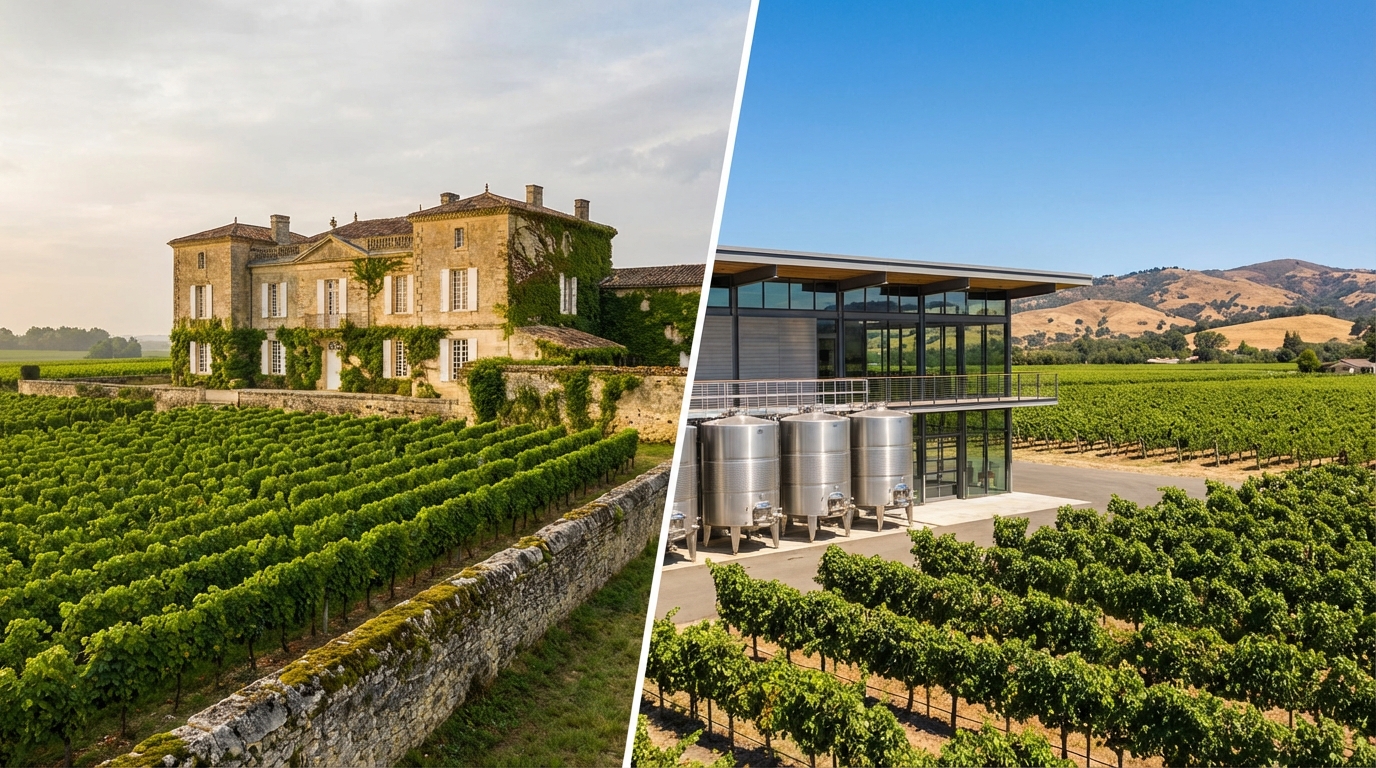
The central philosophical divide between Old and New World winemaking is often summarized as terroir-driven versus fruit-driven — a simplification, but one that captures something essential.
Terroir is the French concept that a wine's greatest expression comes from the specificity of its place: the combination of soil composition, topography, microclimate, and vine age that cannot be replicated elsewhere. For an Old World winemaker in Burgundy or Priorat, the winemaker's role is essentially editorial — to intervene as little as possible so that the vineyard speaks clearly. Chaptalisation (adding sugar to boost alcohol) is permitted in cool climates but considered a corrective tool, not a stylistic choice. Sulfur dioxide is used sparingly. Fermentation relies on indigenous yeasts. The resulting wines may not be immediately approachable, but they carry the unmistakable imprint of their origin.
New World winemaking philosophy emerged through a different lens. The University of California, Davis, established in the mid-20th century as the world's leading center of enological research, trained generations of winemakers in a data-driven, science-first approach. Commercial yeast strains, temperature-controlled fermentation, micro-oxygenation, reverse osmosis — these tools were developed to produce consistent, technically clean, fruit-forward wines that would succeed in competitive international markets. Australian wine producers like Penfolds and Yalumba helped pioneer large-scale, brand-driven quality winemaking in the 1970s and 1980s. California's Robert Mondavi was instrumental in proving that New World wines could compete with European classics on flavor and aging potential.
The practical consequence of these philosophies is evident in the cellar. Old World wines are typically lower in alcohol (11.5–13.5% ABV), higher in acidity, more structured with tannins or minerality, and more austere in youth. New World wines often land at 13.5–15% ABV, with riper fruit, rounder tannins, and more immediate accessibility. Neither profile is fixed — there are lean, elegant wines from the Barossa, and rich, hedonistic wines from Burgundy — but the tendencies are real.
Labeling and Classification Systems
Nothing illustrates the philosophical gap more clearly than how each tradition labels its bottles.
Old World labeling is place-centric. A bottle of Chablis tells you it contains Chardonnay only if you already know that Chablis is a Chardonnay appellation in northern Burgundy. A Barolo label reveals the grape (Nebbiolo) only by implication. The premise is that place is the primary quality signal: the wine of a given appellation should taste like that appellation, year after year, because the terroir is constant.
These systems are enforced by law. France's AOC (Appellation d'Origine Contrôlée) system, established in the 1930s, now covers over 360 appellations. Italy's DOC/DOCG framework spans 77 DOCG and 334 DOC designations. Spain's DO/DOCa system includes 2 DOCa regions (Rioja and Priorat) and over 70 DOs. Each comes with regulations specifying permitted grapes, maximum yields, minimum aging, alcohol levels, and tasting panel approval.
New World labeling is grape-centric. A bottle from California will typically tell you: the grape variety (Cabernet Sauvignon), the region (Napa Valley), and the producer (Opus One). This approach is immediately transparent to the consumer but carries no implied quality standard. The American AVA (American Viticultural Area) system defines geographic boundaries but specifies nothing about permitted grapes, yields, or winemaking techniques — it simply requires that 85% of the grapes come from the named region.
Australia's GI (Geographical Indication) system is similarly boundary-only. Argentina, Chile, and South Africa have developed their own geographic classification frameworks, all of them more permissive than their European counterparts.
Climate, Soil, and Flavor Profiles
Climate is perhaps the single most powerful determinant of wine style, and it maps closely onto the Old World/New World divide.
Most Old World wine regions sit between 45° and 51° North latitude — the climatic sweet spot where grapes ripen reliably but retain high natural acidity. Burgundy, Bordeaux, Champagne, Mosel, and Barolo all occupy this zone. The result is wines where acidity is a structural pillar rather than a background note: think the razor-sharp Riesling of the Mosel, the saline, bone-dry Chablis Grand Crus, or the electric freshness of a Chianti Classico Riserva.
New World regions are more climatically diverse, but many of the most celebrated zones are considerably warmer. Napa Valley averages daytime summer temperatures exceeding 35°C; the Barossa Valley can reach 40°C during harvest. At these temperatures, sugars accumulate rapidly and grapes achieve phenolic ripeness that translates to bold, plush, fruit-forward wines. Cool-climate New World regions — Central Otago, Tasmania, Sonoma Coast, Adelaide Hills — deliberately seek out latitude, altitude, and maritime influence to replicate the freshness of European conditions.
Soils tell a complementary story. Burgundy's Côte d'Or is limestone and clay; Barolo's Langhe hills are a complex mosaic of Tortonian and Helvetian sediment. The Douro Valley is ancient schist. The Mosel is blue Devonian slate. These cool, poor soils force vines to struggle, limiting yields and concentrating flavor while preserving acidity and mineral tension. New World soils tend to be more fertile and less geologically ancient, though there are spectacular exceptions: Margaret River's lateritic gravels, Marlborough's Wairau alluvials, and Mendoza's high-altitude Andean piedmont soils.
| Dimension | Old World | New World |
|---|---|---|
| Key countries | France, Italy, Spain, Germany, Portugal | USA, Australia, Argentina, Chile, New Zealand |
| Labeling | Place/appellation on label; grape implied | Grape variety prominent; region secondary |
| Classification | Strict AOC/DOC/DO rules (yields, varieties, aging) | Geographic boundaries only (AVA, GI); few restrictions |
| Typical alcohol | 11.5–13.5% ABV | 13.5–15% ABV |
| Flavor profile | Earthy, mineral, restrained fruit, high acidity | Ripe fruit-forward, plush, lower acidity |
| Winemaking philosophy | Minimal intervention; terroir expression | Technological precision; fruit optimization |
| Aging potential | Generally higher (structured tannin/acid) | Variable; many designed for early drinking |
| Price entry point | Broad range; classified wines command premium | Broad range; prestige tier growing rapidly |
Key Comparisons by Grape
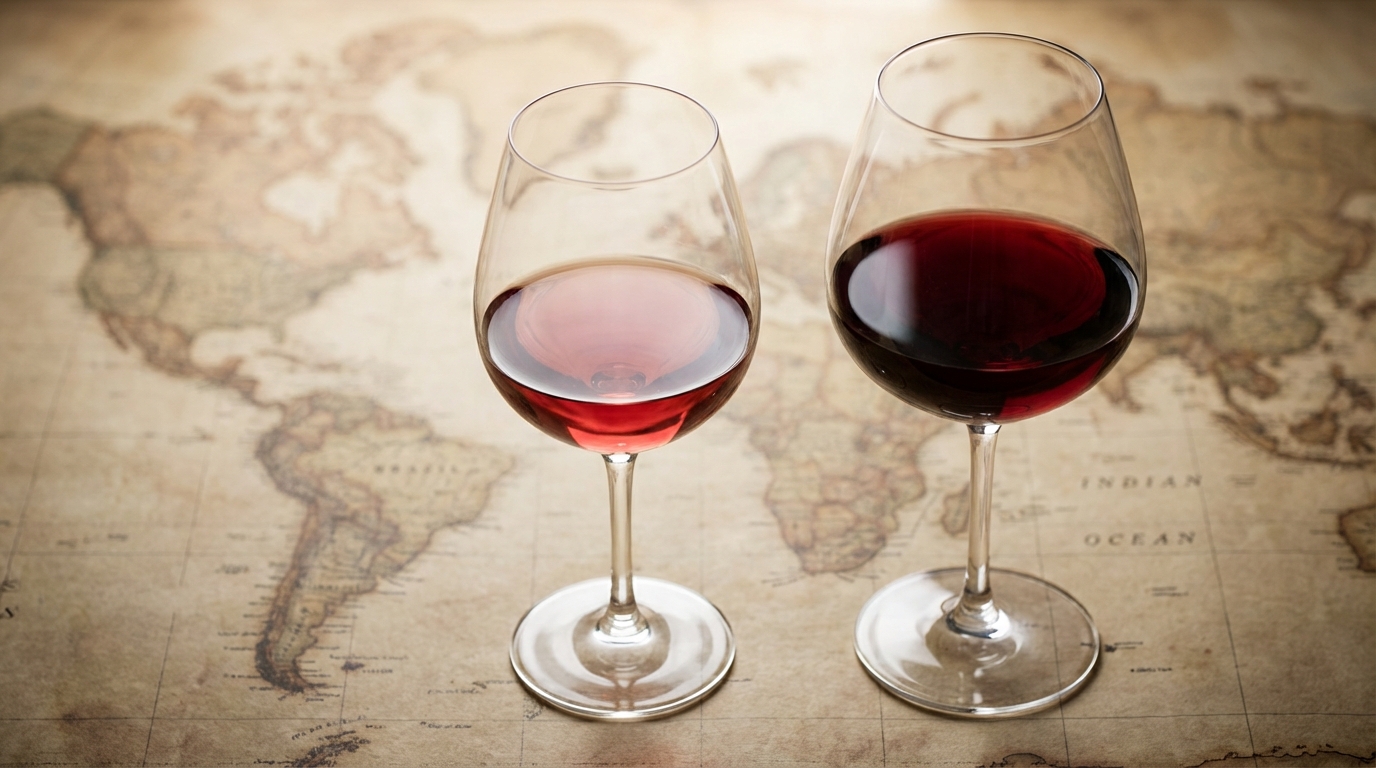
The philosophical divide becomes concrete when examining the same grape across both hemispheres.
Pinot Noir is the starkest example. Burgundy Pinot Noir — from the limestone villages of Gevrey-Chambertin, Chambolle-Musigny, and Vosne-Romanée — is defined by translucency, floral lift (violet, rose petal), forest floor complexity, and silky, fine-grained tannins that seem to float on the palate. Production at top estates like Domaine de la Romanée-Conti, Méo-Camuzet, and Joseph Drouhin is tiny. California Pinot from Russian River Valley (Williams Selyem, Kosta Browne) and Oregon Pinot from Willamette Valley (Domaine Drouhin Oregon, Eyrie Vineyards) offer riper berry character, deeper color, more evident new oak, and broader, fleshier texture. Both can be magnificent — but they are expressing different ideas about what Pinot Noir should be.
Chardonnay from Burgundy's Côte de Beaune — Meursault, Puligny-Montrachet, Chablis — combines creamy, nutty richness from careful barrel aging with crystalline acidity and chalky minerality. The finest examples (Ramonet, Leflaive, Coche-Dury) are among the world's most complex white wines. Napa Valley Chardonnay, exemplified by Kistler, Paul Hobbs, or Marcassin, leans into tropical fruit, vanilla, butter, and full body. Australian Chardonnay from Margaret River (Leeuwin Estate Art Series) has moved closer to the Burgundian model in recent decades, with restrained fruit and more acidic precision.
Cabernet Sauvignon from Bordeaux's Médoc and Graves — estates like Château Latour, Léoville-Barton, Pichon Baron — is austere and tannic in youth, built on cassis, pencil shaving, tobacco, and cedar. Time is mandatory. Napa Valley Cabernet (Screaming Eagle, Opus One, Stag's Leap Wine Cellars) delivers a lush, velvety expression of the same grape — black cherry, mocha, and cocoa with softer tannins and more immediate appeal. Both have proven they can age for 20–40 years; the journey to that destination is simply different.
Syrah and Shiraz offer perhaps the widest stylistic gulf of any grape. Northern Rhône Syrah from Hermitage (Chave, Jaboulet's La Chapelle) and Côte-Rôtie (E. Guigal's single-vineyard La Mouline, La Landonne, La Turque) is cool, savory, and mineral — violet, smoked meat, black olive, iron, and white pepper. Barossa Valley Shiraz from Penfolds Grange, Henschke Hill of Grace, or Torbreck is a different beast entirely: inky, voluptuous, saturated with dark fruit, chocolate, and licorice, built on old bush vines in broiling heat. Both are Syrah/Shiraz; the same DNA produces utterly different expressions under different suns.
The Great Convergence
The strict binary of Old World versus New World has been blurring for at least two decades, and the lines will only continue to blur.
A generation of New World winemakers deliberately studied in European cellars and returned with a reverence for restraint. California's Rhys Vineyards and Brewer-Clifton make Pinot Noir of Burgundian precision. Hanzell Vineyards in Sonoma has always believed in place over variety. Australia's Jasper Hill, Lethbridge, and Bindi make structured, site-specific wines that would sit comfortably alongside Old World benchmarks. Argentine Zuccardi Valle de Uco and Achaval Ferrer have elevated terroir-driven single-vineyard Malbec to international acclaim.
Simultaneously, some European producers have adopted New World techniques: using cultured yeasts for consistency, purchasing micro-oxygenation equipment, and adjusting oak regimes to appeal to international palates. Antinori's Super Tuscan project (Tignanello) was itself a New World-influenced disruption of Italian tradition when it launched in 1971.
Climate change is another force of convergence. As temperatures rise across Europe, Old World regions are harvesting riper, higher-alcohol grapes that share more characteristics with New World styles. Conversely, climate-change-driven establishment of vineyards at higher altitudes and more northerly latitudes in the New World is producing wines of increasing restraint and acidity.
The result is a spectrum, not a binary — which makes the wine world richer, if more difficult to generalize about.
Which to Choose and When
Practical guidance for navigating both worlds comes down to occasion, food, and personal preference.
Choose Old World when:
- You want wines that pair intuitively with food — the classic European table is built around wine and food as a unit, and high-acid, earthy Old World wines cleave to cuisine naturally.
- You are cellaring for the long term — structured tannins and acidity are the architecture of age-worthy wine.
- You want to taste place specificity — no other wine tradition offers the granular geographic differentiation of Burgundy or Barolo.
- You are working with a moderate budget in a restaurant — French Cru Bourgeois, southern Italian DOC wines, and Spanish Rioja Reserva offer extraordinary value.
Choose New World when:
- You want immediate drinkability and approachable fruit — most New World wines are designed to deliver pleasure on release.
- You are entertaining guests who are newer to wine — clear, fruit-forward flavors are more immediately accessible than complex, earthy Old World wines.
- You want variety-led discovery — Marlborough Sauvignon Blanc, Napa Cabernet, and Barossa Shiraz are all superb introductions to what those grapes can achieve.
- You are pairing with non-European cuisines — the richness and fruit in New World styles often pair better with Asian, Middle Eastern, or barbecue flavors than leaner Old World profiles.
The most rewarding approach, of course, is to use the Old World / New World framework as a map rather than a verdict. Set a red Burgundy next to an Oregon Pinot, pour a white Hermitage beside a Margaret River Chardonnay, taste a Côte-Rôtie against a Barossa Shiraz. The comparison does not declare a winner — it illuminates what each tradition values and what the vine is capable of in the hands of different people, in different soils, under different skies.


