Why Wine Labels Matter More Than You Think
A wine label is a contract between the producer and the drinker. Every element — from the appellation to the alcohol percentage — is regulated by law and tells you something specific about what's in the bottle. The problem is that no two countries use the same system, and the terminology can feel like a foreign language (because it literally is).
The good news: once you crack the code, reading a wine label becomes second nature. You'll be able to assess quality, origin, style, and value in seconds — skills that will save you money and improve every bottle you open. This guide covers the major label systems you'll encounter, from classic European designations to straightforward New World labels.
Understanding labels is not about snobbery. It's about making informed choices. A bottle labeled Bourgogne and one labeled Gevrey-Chambertin Premier Cru may sit on the same shelf, but they represent vastly different levels of specificity, quality expectations, and price. The label tells you why.
The Anatomy of a European Wine Label
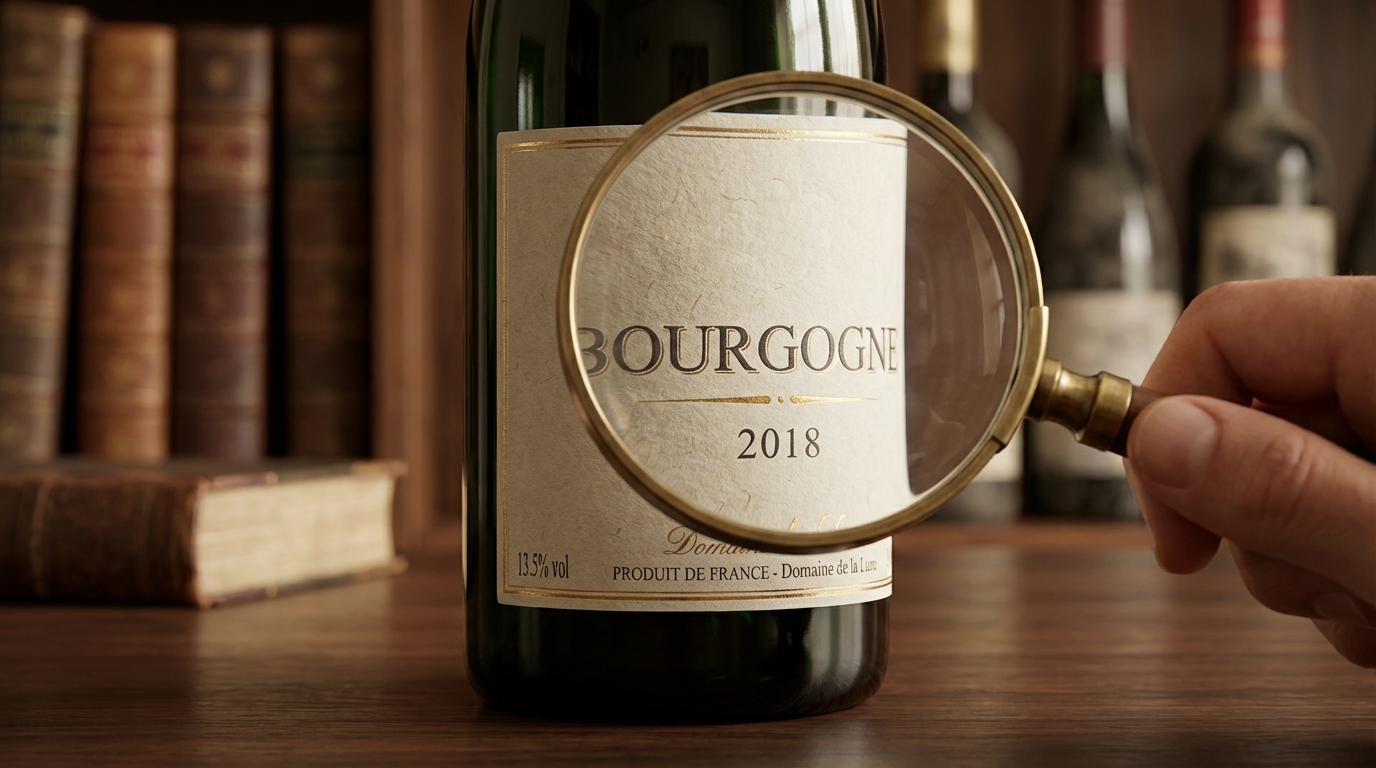
European wine labels are place-driven. The most important information is not the grape variety — it's the geographic origin. This reflects the Old World philosophy that terroir (the combination of soil, climate, and tradition) matters more than the grape itself.
French labels are organized around the AOC/AOP (Appellation d'Origine Contrôlée/Protégée) system. The hierarchy runs from broad to specific: Vin de France (table wine, any region) → IGP (Indication Géographique Protégée, regional wine) → AOC/AOP (the most regulated tier, specifying exact geographic origin, permitted grape varieties, yields, and winemaking methods). Within AOC, some regions have further internal hierarchies — Burgundy's Village → Premier Cru → Grand Cru being the most famous.
Italian labels follow a similar pyramid: Vino → IGT (Indicazione Geografica Tipica) → DOC (Denominazione di Origine Controllata) → DOCG (the "G" stands for Garantita — Guaranteed). A Barolo DOCG guarantees that the wine is 100% Nebbiolo from a specific zone in Piedmont, aged for a minimum of 38 months (62 for Riserva). The designation does the heavy lifting.
Spanish labels use DO (Denominación de Origen) and DOCa/DOQ (the higher tier, currently only Rioja and Priorat qualify). But Spain adds another layer: aging classifications. Joven (young), Crianza (aged minimum 2 years, 1 in oak), Reserva (3 years, 1 in oak), and Gran Reserva (5 years, minimum 18 months in oak) tell you exactly how the wine was treated.
Decoding German Wine Labels
German labels are notoriously complex but actually follow a remarkably logical system once you understand the Prädikat hierarchy. German quality wine is classified by the ripeness of the grapes at harvest — not by geography or aging time.
The Prädikat levels, from lightest to richest: Kabinett (lightest, most delicate) → Spätlese (late harvest, riper) → Auslese (select harvest, richer) → Beerenauslese (BA, individual berry selection, very sweet) → Trockenbeerenauslese (TBA, dried berry selection, the sweetest and rarest) → Eiswein (ice wine, harvested frozen). The confusing part: Kabinett and Spätlese can be made either sweet or dry (trocken). Look for "trocken" on the label if you want dry Riesling.
The VDP (Verband Deutscher Prädikatsweingüter) classification adds a Burgundy-style vineyard hierarchy on top: Gutswein (estate wine) → Ortswein (village wine) → Erste Lage (Premier Cru equivalent) → Grosse Lage (Grand Cru equivalent). VDP producers mark their best dry wines as Grosses Gewächs (GG), which has become the gold standard for German dry Riesling.
| Element | France | Italy | Spain | Germany | New World |
|---|---|---|---|---|---|
| Quality tier | AOC/AOP, IGP | DOCG, DOC, IGT | DOCa, DO | Prädikat, VDP | Rarely regulated |
| Grape on label? | Often omitted | Sometimes | Sometimes | Usually | Almost always |
| Key info | Appellation name | Appellation + aging | DO + aging class | Prädikat + trocken | Grape + region |
| Aging terms | Variable | Riserva, Superiore | Crianza, Reserva | Spätlese, GG | Reserve (unregulated) |
| Vineyard naming | Lieu-dit, Cru | Vigna, Cru | Viña, Pago | Lage, Einzellage | Vineyard designate |
New World Labels: What You See Is What You Get
New World labels (USA, Australia, New Zealand, Chile, Argentina, South Africa) take a fundamentally different approach. The grape variety is front and center, followed by the region. This makes them more immediately accessible for consumers but provides less information about terroir and tradition.
In the United States, the AVA (American Viticultural Area) system defines geographic regions but imposes almost no rules about grape varieties, yields, or winemaking methods. If a label says "Napa Valley Cabernet Sauvignon," at least 85% of the grapes must come from Napa Valley and at least 75% must be Cabernet Sauvignon. That's it. Contrast this with Bordeaux, where the AOC dictates everything from permitted varieties to pruning methods.
Australia's Geographic Indication (GI) system is similarly permissive. The famous Barossa Valley GI tells you where the grapes come from, but nothing about how the wine must be made. This freedom has allowed Australian winemakers to be remarkably innovative, but it also means labels require more producer-specific knowledge to interpret.
The Back Label: Hidden Information Gold
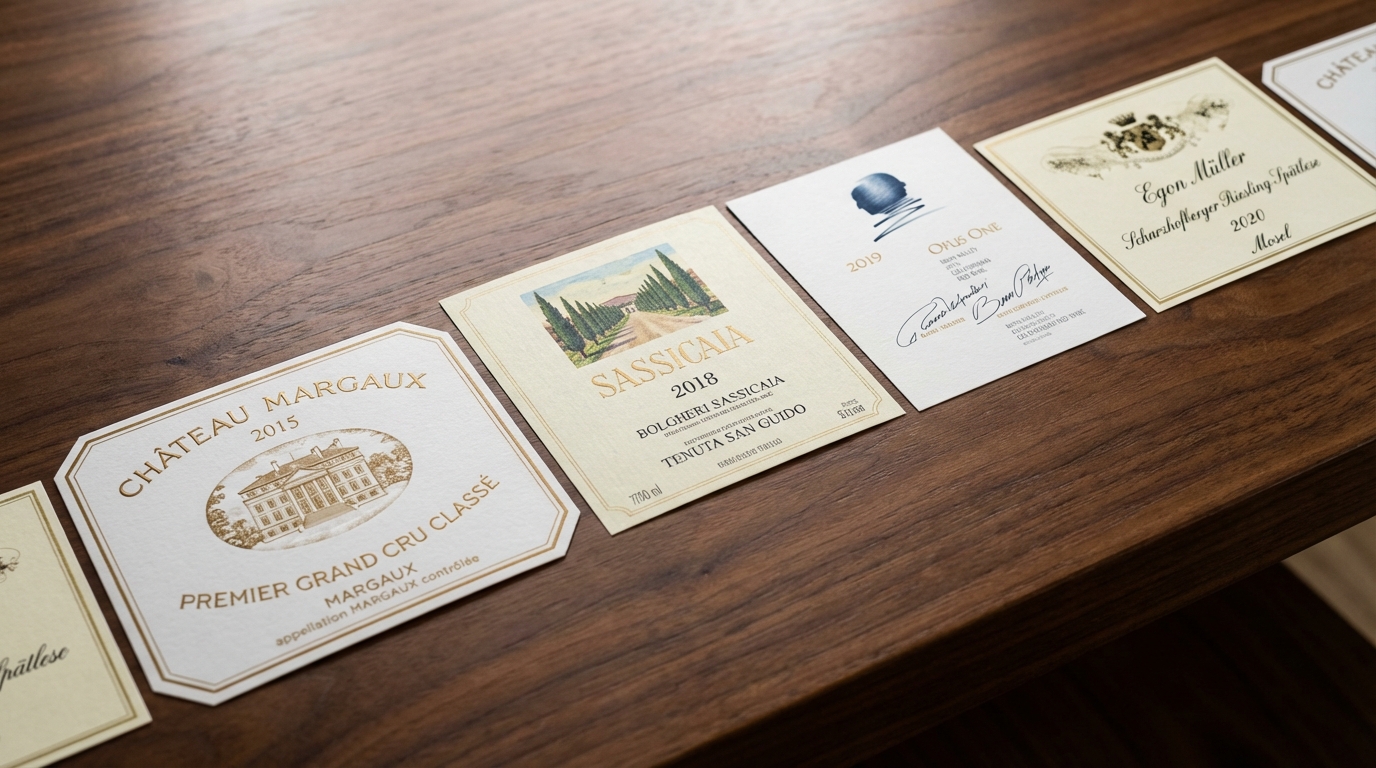
Most consumers ignore the back label, but it often contains the most useful practical information. Look for:
Alcohol by volume (ABV) — This tells you about the wine's body and style. Wines below 12% tend to be lighter (think Mosel Riesling at 8-10%). Wines at 13-14% are medium to full-bodied. Above 14.5% suggests a rich, warm-climate wine. EU law requires ABV on the label; actual alcohol may vary by up to 0.5% from the stated figure.
Sulfite declaration — "Contains sulfites" is required in most countries. Nearly all wines contain sulfites (a natural byproduct of fermentation), but wines with over 10 mg/L must declare them. This is not an indicator of quality or natural winemaking — it's a legal requirement. Wines labeled "no added sulfites" may still contain naturally occurring sulfites.
Bottling information — In France, "Mis en bouteille au château/domaine" means estate-bottled — the same entity grew the grapes and made the wine. "Mis en bouteille dans la région de production" or "par [négociant name]" indicates the wine was made by a merchant who purchased grapes or bulk wine. Estate bottling generally (but not always) signals higher quality and traceability.
Organic and biodynamic certifications — Look for the EU organic leaf logo (mandatory since 2012 for EU organic wines), Demeter certification (biodynamic), or the USDA organic seal. "Made with organic grapes" (US) is different from "Organic wine" — the latter has stricter sulfite limits.
Common Label Terms That Trip People Up
Grand Cru means different things in different regions. In Burgundy, it designates the absolute top tier of vineyards (only 33 exist). In Alsace, it refers to 51 designated vineyard sites. In Bordeaux, the 1855 Classification's "Grand Cru Classé" is a property ranking that hasn't been updated in over 170 years (with one exception: Mouton Rothschild's promotion in 1973). In Saint-Émilion, the classification is updated roughly every decade.
Cuvée simply means "blend" or "batch" in French. "Cuvée Prestige" or "Cuvée Spéciale" sounds impressive but has no legal definition. It may indicate a producer's top selection, or it may be pure marketing.
Vieilles Vignes (old vines) has no legal minimum age in France. A producer can slap it on a label with 25-year-old vines. In practice, most serious producers use the term for vines over 40-60 years old, but buyer beware.
Supérieur in French appellations (e.g., Bordeaux Supérieur) typically means slightly higher minimum alcohol and lower maximum yields than the basic appellation — a modest step up, not a dramatic quality leap.
Classico in Italian wines (e.g., Chianti Classico, Soave Classico) denotes the historical heartland of the appellation — generally the best terroir and the area where the wine tradition originated. This is a meaningful quality indicator.
Practical Tips for Label Navigation
When you're standing in a wine shop, apply this quick mental checklist:
First, identify the country and region. This immediately narrows the style expectations. A Côtes du Rhône will be warm-climate, Grenache-based. A Mosel will be cool-climate Riesling.
Second, check the quality designation. AOC beats IGP in the regulatory hierarchy. DOCG beats DOC. But don't be a snob — some of the world's greatest wines deliberately operate outside the classification system (Super Tuscans like Sassicaia were originally labeled as humble Vino da Tavola).
Third, look at the vintage year. This tells you the wine's age and, if you know the region, the quality of the growing season. Not all vintages are equal — 2015 and 2019 were exceptional across much of Europe, while 2017 was uneven.
Fourth, note the producer name. In most regions, the producer matters more than any classification or designation. A great winemaker in a modest appellation will outperform a lazy one in Grand Cru.
Finally, read the ABV and back label for style clues. A 12.5% white Burgundy will be leaner and more mineral than a 14.5% Napa Chardonnay, even though both are 100% Chardonnay. The number doesn't lie.
Wine labels are not designed to confuse you — they're designed to inform within a regulatory framework that varies by country. Once you learn to read them, every bottle on the shelf becomes an open book. And that knowledge, more than any app or score, is what transforms wine shopping from anxiety into adventure.


