You Already Know More Than You Think
Here is a secret that the wine industry does not always want you to know: you do not need a sommelier certification, a cellar full of First Growths, or a vocabulary of 500 tasting terms to appreciate wine. You already possess the only equipment that matters — a nose, a palate, and the willingness to pay attention.
Wine tasting is not a talent reserved for gifted elites. It is a skill, and like any skill, it improves with practice and a basic understanding of technique. The professional taster who swirls a glass and declares "graphite, cassis, and pencil shavings with a hint of violet" is not performing magic. They are applying a systematic method to organize sensory information — the same information that is available to every person holding that same glass. The difference is simply vocabulary and experience.
This guide will give you the method. The experience — the joyful, lifelong process of tasting, comparing, remembering, and discovering — is up to you.
The Five S's: A Systematic Approach
Professional wine tasters around the world use variations of the same core framework. The version below, organized around five steps that conveniently all begin with S, provides a logical structure for evaluating any wine.
1. See
Before the wine touches your lips, it tells a story through your eyes. Pour roughly 60 mL (two ounces) into a clean, clear glass — ideally a standard ISO tasting glass or a good-quality wine glass with a tulip-shaped bowl. Tilt the glass at a 45-degree angle against a white background (a sheet of paper works perfectly).
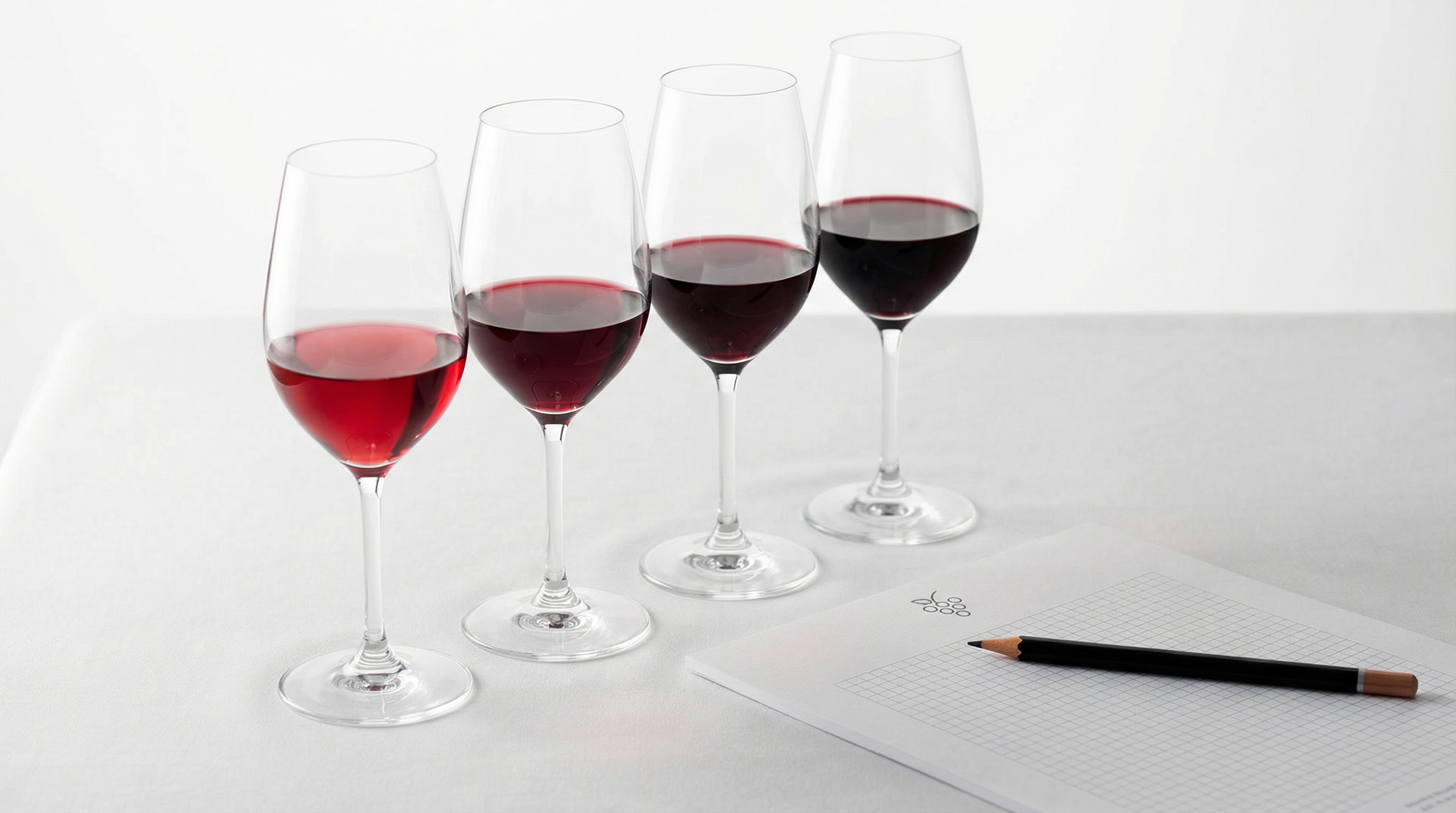
Color reveals grape variety, age, and winemaking style:
| Wine Type | Young | Mature | Old |
|---|---|---|---|
| White | Pale straw, green-gold | Gold, amber tinges | Deep gold to amber |
| Rosé | Pale salmon, pink | Copper, onion-skin | Fading copper |
| Red | Purple, ruby | Garnet, brick-red edges | Tawny, brown edges |
A deep purple-black color in a red wine suggests a thick-skinned grape variety (Cabernet Sauvignon, Syrah, Malbec) and/or a warm climate. A lighter ruby or garnet might indicate Pinot Noir, Nebbiolo, or an aged wine. White wines darken with age; red wines lighten. These are not rules to memorize but patterns that, over time, you will begin to recognize instinctively.
Clarity is worth noting. Most modern wines are crystal clear thanks to fining and filtration. A slight haze in an unfiltered or natural wine is not a fault — it simply means the winemaker chose not to remove suspended particles. Genuine cloudiness combined with off-aromas, however, may indicate a problem.
Viscosity — the "legs" or "tears" that form on the inside of the glass after swirling — relates primarily to alcohol and sugar content. Thick, slow-moving legs suggest higher alcohol or residual sugar. This observation is mildly useful but far less important than the wine industry's fascination with it would suggest.
2. Swirl
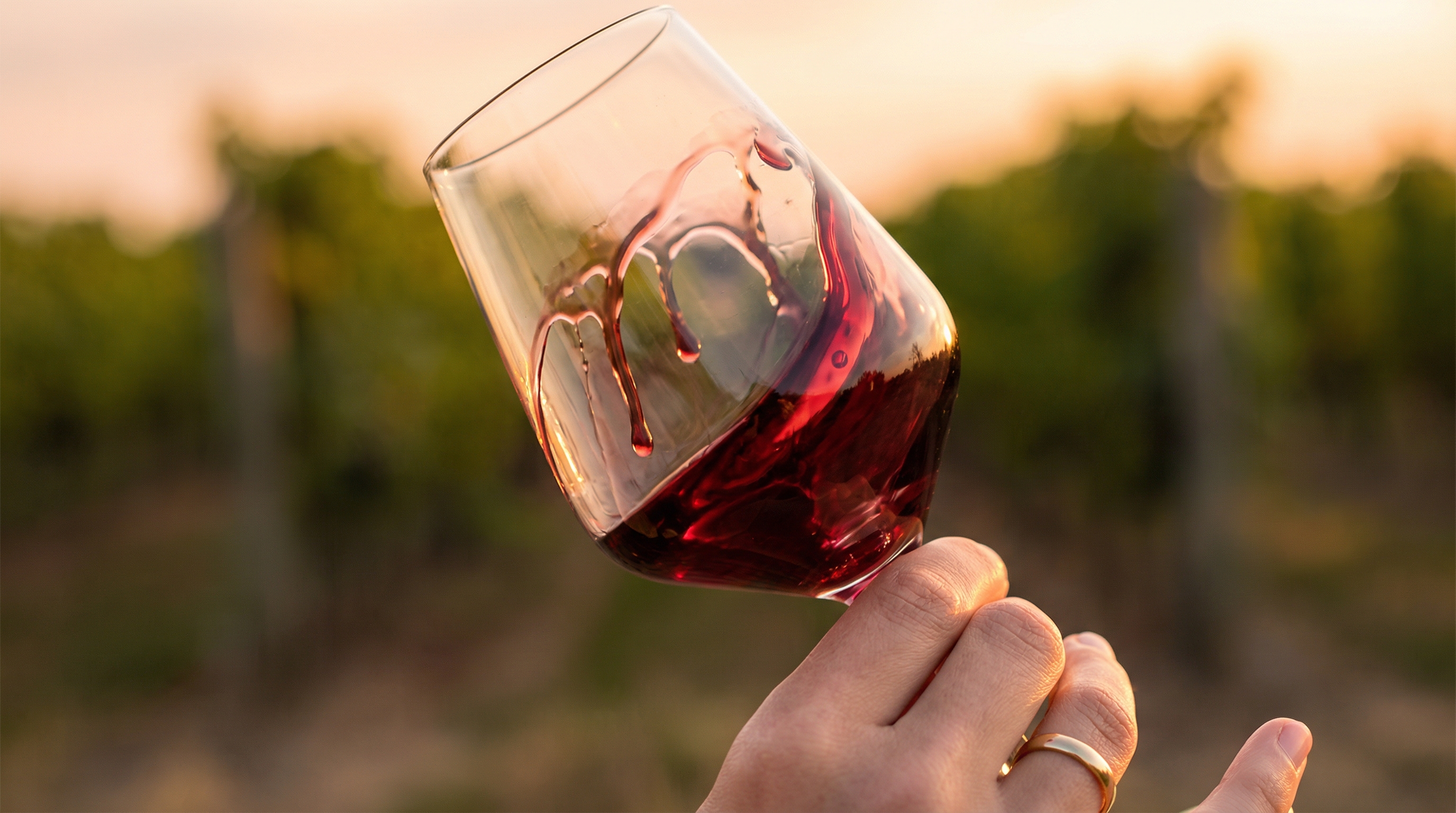
Swirling the wine in the glass aerates it, releasing volatile aromatic compounds from the liquid's surface. Hold the glass by its stem (or base) and rotate it gently on a flat surface — this is easier and less risky than the aerial swirl favored by showoffs. Five or six rotations are sufficient. The wine should coat the sides of the glass and then settle, releasing its aromas into the bowl.
3. Smell
This is the most important step, and the one that beginners most often rush through. Your sense of smell is vastly more discriminating than your sense of taste — humans can detect thousands of distinct odors but only five basic tastes (sweet, sour, salty, bitter, umami). The majority of what we perceive as "flavor" in wine is actually aroma, detected by olfactory receptors either through the nose (orthonasal) or through the back of the mouth during tasting (retronasal).
Bring the glass to your nose — right to the rim, almost inside the bowl — and inhale gently. Do not sniff aggressively; a series of short, gentle inhalations is more effective than one deep breath, which can overwhelm the olfactory receptors.
First nose (before swirling): Note your immediate impressions. Is the wine fruity? Floral? Earthy? Spicy? Does it smell clean and inviting, or is there something off-putting?
Second nose (after swirling): The aeration will have released more complex aromas. Try to identify specific scents. Wine aromas are conventionally grouped into three categories:
- Primary aromas — from the grape itself: fruit (citrus, stone fruit, tropical fruit, red berries, black berries), floral (rose, violet, elderflower), and herbal (green bell pepper, mint, eucalyptus) notes
- Secondary aromas — from fermentation and winemaking: yeast (bread dough, brioche), dairy (butter, cream from malolactic fermentation), and nutty or honey-like notes
- Tertiary aromas — from aging, whether in barrel or bottle: vanilla, toast, smoke, and coconut (from oak); leather, tobacco, dried fruit, mushroom, forest floor, and truffle (from bottle age)
“The language of wine is the language of memory. Every aroma you identify is one you have encountered before — in a garden, a kitchen, a forest, a spice market. The more attention you pay to the scents of daily life, the richer your wine vocabulary becomes.”
— Jancis Robinson
Do not worry about identifying every aroma in the glass. Start broad — is it more fruity or more earthy? More floral or more spicy? — and gradually work toward specificity. With practice, "red fruit" becomes "cherry," which becomes "sour cherry versus ripe cherry," which eventually becomes "morello cherry with a hint of kirsch." This progression takes time, and there are no shortcuts. But it is deeply satisfying.
4. Sip
Now, finally, the wine enters your mouth. Take a moderate sip — enough to coat your tongue and palate, but not so much that you cannot move it around. Some professionals draw a small amount of air through the wine (a slurping sound) to further volatilize aromas; this is effective but socially optional outside of professional settings.
Your palate evaluates several key dimensions:
Sweetness is perceived on the tip of the tongue. Most table wines are technically dry (less than 4 g/L residual sugar), but ripe fruit flavors, high alcohol, and oak sweetness can create the impression of sweetness even in a bone-dry wine. Off-dry wines (like many Rieslings) will have a perceptible but gentle sweetness; dessert wines will be overtly sweet.
Acidity is the backbone of white wine and a crucial structural element in reds. It creates freshness, makes your mouth water, and gives wine its sense of vitality. Wines from cooler climates (Chablis, Mosel, Willamette Valley) tend to have higher, more vibrant acidity; warmer-climate wines (Napa, Barossa, Châteauneuf-du-Pape) are often softer and rounder.
Tannin (in red wines) creates a drying, gripping sensation on the gums and inner cheeks — similar to the astringency of strong black tea. Tannin comes from grape skins, seeds, and stems, as well as from oak barrels. Young, tannic wines can feel harsh and astringent; with age, tannins polymerize and soften, creating a smoother, more integrated texture.
Body refers to the overall weight and texture of the wine in your mouth — think of the difference between skim milk (light-bodied), whole milk (medium-bodied), and cream (full-bodied). Body is influenced by alcohol, extract, and residual sugar.
Alcohol manifests as warmth or heat in the back of the throat. Well-integrated alcohol is imperceptible; excessive alcohol creates a burning sensation that overwhelms other flavors.
Flavor intensity and complexity — how vivid are the flavors? Do they change and evolve as the wine moves across your palate, or is it a one-dimensional experience?
5. Savor (or Spit)
The finish — how long the flavors persist after you swallow (or spit) — is one of the most revealing indicators of quality. Great wines have long, complex finishes that evolve over 30, 60, even 90 seconds, offering new flavors and sensations as they fade. Simple wines have short, straightforward finishes.
At a professional tasting, spitting is essential — you may need to evaluate 50 or more wines in a session, and swallowing them all would impair your judgment long before the end. At a social tasting, the choice is yours. There is no shame in spitting, and it is the mark of a serious taster.
Common Mistakes and How to Avoid Them
Tasting too many wines at once. Professional stamina aside, most people's palates begin to fatigue after eight to twelve wines. If you are at a tasting event with dozens of options, be selective. Taste what interests you, skip what does not, and take breaks with water and plain bread or crackers.
Ignoring the nose. Many beginners take a cursory sniff and immediately sip. Resist this impulse. Spend at least 15 to 20 seconds smelling the wine before tasting it. The nose reveals complexity that the palate alone cannot fully capture.
Overthinking. If you are staring at a glass trying to identify whether the aroma is boysenberry or blackberry, you have gone too far. Tasting should be pleasurable, not stressful. Broad categories are perfectly valid — "dark berry fruit" is a useful descriptor. Precision comes with time.
Dismissing wines you do not like. A wine that you personally dislike may still be well-made. Learning to evaluate quality separately from personal preference is one of the most valuable skills in wine tasting. You might not enjoy dry Riesling, but acknowledging its balance, purity, and precision builds your palate and your understanding.
Neglecting food. Wine evolved to be consumed with food, and many wines that seem angular, austere, or overly tannic in isolation transform at the dinner table. If a wine disappoints you on its own, try it with a meal before passing final judgment.
Building Your Palate: A Practical Program
The fastest way to develop your tasting abilities is through comparative tasting — evaluating two or more wines side by side to identify differences and similarities. Here is a structured program that will take you from beginner to confident taster in approximately three months:
Weeks 1–4: Grape Variety Exploration
Taste the six major international grape varieties side by side — one white flight and one red flight per week:
- Week 1 (White): Sauvignon Blanc from three origins — Sancerre (France), Marlborough (New Zealand), Napa Valley (California). Note how climate affects acidity, body, and fruit character.
- Week 2 (Red): Cabernet Sauvignon from three origins — Bordeaux (France), Napa Valley (California), Coonawarra (Australia). Same grape, radically different expressions.
- Week 3 (White): Chardonnay — Chablis (unoaked), Burgundy Meursault (barrel-fermented), and California (your choice). This flight illustrates the impact of oak on a single variety.
- Week 4 (Red): Pinot Noir — red Burgundy (Bourgogne-level), Oregon Willamette Valley, Central Otago (New Zealand). Pinot is the most transparent variety — terroir differences are vivid.
Weeks 5–8: Structure and Style
- Week 5: Tannin comparison — a young, tannic Barolo versus a soft, fruity Beaujolais. Learn to distinguish tannin quality and intensity.
- Week 6: Acidity comparison — a high-acid Riesling (Mosel Kabinett) versus a low-acid Viognier (Condrieu or California). Acidity is the single most important structural element in wine, and this flight will train your palate to detect it.
- Week 7: Sweetness spectrum — a dry Riesling, an off-dry Riesling (Spätlese), and a sweet Riesling (Auslese or Beerenauslese). Using the same grape variety isolates the sweetness variable.
- Week 8: Oak versus no oak — a stainless-steel-fermented Chardonnay (Chablis or Mâcon) versus a heavily oaked California Chardonnay. Identify vanilla, toast, butterscotch, and coconut as oak-derived aromas.
Weeks 9–12: Integration and Complexity
- Week 9: Old World versus New World — compare a Bordeaux with a Napa Cabernet, a Burgundy with a Sonoma Coast Pinot Noir. Look for differences in alcohol, fruit profile, and oak integration.
- Week 10: Aged wine — if possible, obtain a wine with 10+ years of bottle age and taste it alongside the same producer's current release. This flight reveals tertiary aromas and the transformative effect of time.
- Week 11: Blind tasting — have a friend pour two or three wines without revealing the labels. Apply your framework and make notes before the reveal. This is humbling, educational, and enormous fun.
- Week 12: Your personal tasting — select three wines that you love and try to articulate why. This final exercise is about finding your palate identity: the styles, regions, and flavors that resonate most deeply with you.
Essential Tasting Vocabulary
You do not need to memorize a wine dictionary, but a core vocabulary helps you communicate about wine and, more importantly, helps you organize your own sensory impressions. Here is a functional starter set:
Fruit descriptors:
- White wine: citrus (lemon, grapefruit, lime), stone fruit (peach, apricot, nectarine), tropical fruit (pineapple, mango, passion fruit), orchard fruit (apple, pear)
- Red wine: red fruit (cherry, strawberry, raspberry, cranberry), black fruit (blackcurrant, blackberry, plum, blueberry), dried fruit (fig, date, prune, raisin)
Non-fruit descriptors:
- Floral: rose, violet, elderflower, jasmine, orange blossom
- Herbal: mint, eucalyptus, thyme, sage, green bell pepper, cut grass
- Earthy: mushroom, forest floor, truffle, wet stone, chalk, clay
- Spice: black pepper, white pepper, cinnamon, clove, nutmeg, vanilla
- Oak-derived: vanilla, toast, smoke, coconut, cedar, coffee, chocolate
Structural terms:
- Crisp / tart / racy (high acidity)
- Soft / round / smooth (low acidity or resolved tannin)
- Grippy / firm / chewy (high tannin)
- Silky / velvety / supple (fine, resolved tannin)
- Lean / angular / austere (high acid, low fruit)
- Rich / lush / opulent (full body, ripe fruit)
For deeper study, the Wine & Spirit Education Trust (WSET) offers structured tasting courses worldwide, from beginner (Level 1) to expert (Diploma). The Court of Master Sommeliers provides a more service-oriented educational track. And Jancis Robinson's website remains the gold standard for independent, intelligent wine writing.
“The aim of wine tasting is not to pronounce a score or a verdict. It is to understand. And understanding begins with attention — the simple, patient act of noticing what is in the glass.”
— Jancis Robinson
Your Palate, Your Journey
The most important thing I can tell you about wine tasting is this: there are no wrong answers. If a wine smells like wet dog to you and like roses to the person next to you, you are both right. Aroma perception is profoundly individual, shaped by genetics, experience, memory, and even the foods you ate as a child. The goal is not to arrive at an objective truth about a wine — no such thing exists — but to develop your own sensory awareness and your own capacity for pleasure.
Start tonight. Open a bottle — any bottle. Pour a glass. Look at it. Swirl it. Smell it. Taste it. Think about what you are experiencing. Write it down if you are so inclined. Then do it again tomorrow with a different wine. And again the day after that. Within a few weeks, you will notice that you are picking up aromas and textures that previously escaped you. Within a few months, you will have the vocabulary and confidence to navigate a wine list, hold your own in a tasting group, and — most importantly — know what you like and why you like it.
That is all wine tasting is: the cultivated habit of paying attention. And there is no more delicious habit to cultivate.


