Bordeaux: Where Wine Became Legend
There is a stretch of land in southwestern France where history, climate, and human ambition conspired to create something extraordinary. The vineyards of Bordeaux do not merely produce wine — they produce culture. For more than two thousand years, since Roman legions first planted vines along the Garonne's gravelly banks, this region has defined what fine wine means to the rest of the world. Today, Bordeaux encompasses roughly 111,000 hectares of vineyards, over 60 appellations, and approximately 6,000 wine-producing châteaux. It is a place where a single bottle can sell for thousands of euros and where a modest farmer's cooperative can yield a Tuesday-night dinner wine of remarkable quality. The span between those two extremes is what makes Bordeaux endlessly fascinating.
The geography tells the first part of the story. Two rivers — the Garonne flowing from the south and the Dordogne from the east — merge north of the city of Bordeaux to form the broad Gironde estuary, which empties into the Atlantic. This convergence of waterways creates a natural division of the wine-producing land into what locals call the Left Bank (west of the Garonne and Gironde), the Right Bank (east of the Dordogne), and Entre-Deux-Mers (the rolling countryside between the two rivers). Each zone possesses distinct soils, microclimates, and grape-growing philosophies. To understand Bordeaux, you must understand this tripartite geography and the wines it shapes.
The maritime climate is moderated by the Gulf Stream and shielded from Atlantic gales by the vast Landes pine forest to the west. Summers are warm but rarely scorching, autumns are long and mild, and rainfall is generous — sometimes too generous. This climatic variability is precisely why vintage variation matters so profoundly here. A brilliant Bordeaux vintage requires a dry, warm September and October; a wet harvest can dilute even the best-tended fruit. It is this tension between potential greatness and meteorological risk that gives Bordeaux its dramatic arc, vintage after vintage.
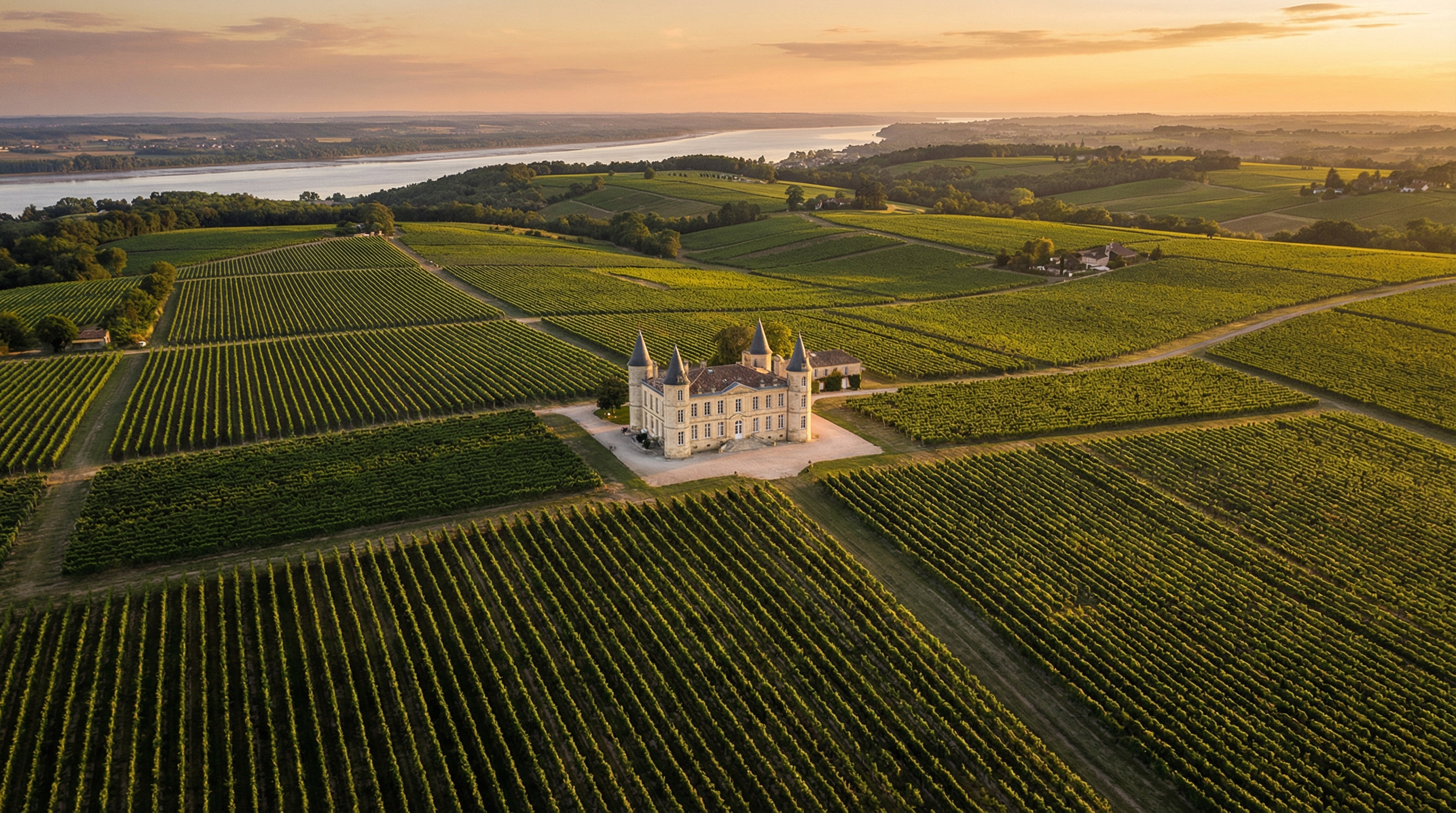
Left Bank: The Kingdom of Cabernet Sauvignon
The Left Bank is the Bordeaux of postcards and auction records. Deep beds of Quaternary gravel, deposited by glacial rivers millions of years ago, provide superb drainage and force vine roots to plunge meters underground in search of water and nutrients. This stressed but healthy vine produces small, thick-skinned berries of extraordinary concentration. Cabernet Sauvignon thrives in these conditions, typically making up 60 to 85 percent of Left Bank blends, supported by Merlot, Cabernet Franc, and small quantities of Petit Verdot.
The Haut-Médoc stretches north from the city of Bordeaux along the western shore of the Gironde estuary, and within it lie the four legendary communal appellations:
Pauillac is the undisputed crown jewel. Home to three of the five First Growths — Château Lafite Rothschild, Château Latour, and Château Mouton Rothschild — Pauillac produces deeply colored, powerfully structured wines defined by blackcurrant, cedar, graphite, and cigar-box complexity. In great vintages, these wines can evolve gracefully for half a century or more. But Pauillac is not only about its famous names: properties like Pichon Baron, Pichon Comtesse de Lalande, and Lynch-Bages offer world-class wine at comparatively accessible prices.
Margaux is the largest of the communal appellations and arguably the most diverse. At its finest — embodied by Château Margaux itself, as well as Palmer, Rauzan-Ségla, and Brane-Cantenac — Margaux produces wines of ethereal perfume, silky texture, and haunting violet-and-rose-petal aromatics. The terroir here includes some lighter gravel mounds that can yield less consistent results at the lower end, but top Margaux is among the most seductive wine in the world.
Saint-Julien lacks a First Growth but consistently delivers the most reliable quality in the Médoc. Léoville-Las Cases, Léoville-Barton, and Ducru-Beaucaillou regularly produce wines of First Growth caliber. The appellation's relatively compact size and uniform gravel terroir contribute to a house style of classical balance — structured enough to age, polished enough to enjoy relatively young.
Saint-Estèphe sits at the northern end of the Haut-Médoc, where clay increasingly mingles with the gravel. The resulting wines are firmer, more austere in youth, and often the longest-lived of all Médoc wines. Cos d'Estournel, with its pagoda-like façade, and Montrose are the flagships, but Calon-Ségur and Phélan Ségur offer exceptional value.
“Bordeaux is not a place you understand in a single visit or a single bottle. It is a lifetime's conversation — one that rewards patience, curiosity, and an open palate.”
— Jean-Michel Cazes
Beyond the Haut-Médoc, the Left Bank also includes the Pessac-Léognan appellation, located south of the city of Bordeaux and home to Château Haut-Brion — the only First Growth located outside the Médoc. Pessac-Léognan is notable for producing both outstanding reds and some of Bordeaux's finest dry whites, with Domaine de Chevalier and Smith Haut Lafitte leading the way.
Right Bank: Merlot's Heartland
Cross the Dordogne and the landscape changes. Gone are the flat gravel plains; in their place rise gentle hills of clay and limestone, sometimes mixed with sand and iron-rich subsoils. Merlot dominates here, often comprising 80 to 100 percent of the blend, with Cabernet Franc as the principal supporting variety. The resulting wines are rounder, fleshier, and more immediately approachable than their Left Bank counterparts, though the finest examples possess extraordinary depth and complexity.
Saint-Émilion is both a wine appellation and a UNESCO World Heritage medieval village, its honey-stone buildings perched above a labyrinth of underground limestone quarries that now serve as wine cellars. The appellation is large and geologically diverse, which means quality varies more than in the compact Médoc communes. The limestone plateau and clay-limestone slopes yield the most concentrated wines: Château Ausone, Château Cheval Blanc (technically on gravel), Château Angélus, and Château Pavie are among the elite. But Saint-Émilion's classification, unlike the static 1855 system, is revised roughly every decade — a process that generates fierce controversy and occasional lawsuits, but also ensures a dynamic hierarchy that rewards improving estates.
Pomerol is tiny — barely 800 hectares — and fiercely exclusive. There is no official classification, no grand stone châteaux, and some of the most expensive wine on Earth. Château Pétrus, planted almost entirely to Merlot on a unique buttonhole of blue clay, produces wines of legendary richness and longevity. Le Pin, from a modest garage-like facility, pioneered the "garagiste" movement. Lafleur, L'Évangile, Vieux Château Certan, and Trotanoy complete a roster of properties that punch astronomically above their diminutive size.
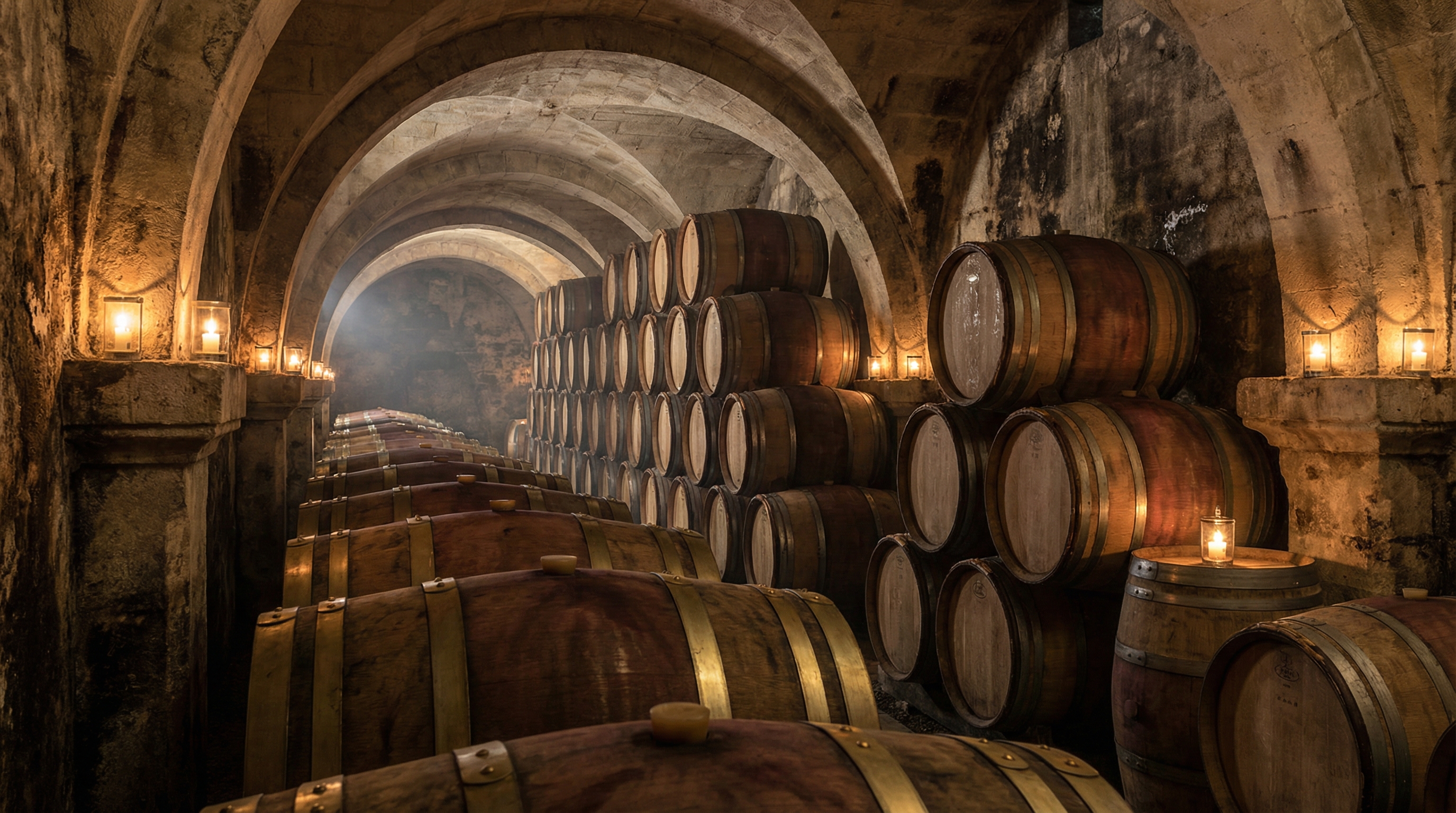
The 1855 Classification: Glory and Controversy
The story of the 1855 Classification begins with Napoleon III, who commissioned a ranking of Bordeaux's finest wines for the Paris Universal Exhibition. The Bordeaux wine brokers, or courtiers, organized the top estates into five tiers — Premiers Crus (First Growths) through Cinquièmes Crus (Fifth Growths) — based on the market prices each château commanded at the time. Sixty-one estates in the Médoc plus Château Haut-Brion from Graves made the cut.
The remarkable fact about this hierarchy is its durability. More than 170 years later, it has been officially amended only once, in 1973, when Baron Philippe de Rothschild successfully lobbied to have Mouton Rothschild elevated from Second to First Growth. His famous revised motto — "Premier je suis, second je fus, Mouton ne change" ("First I am, second I was, Mouton does not change") — captures the fierce pride these rankings inspire.
Critics rightly point out that the 1855 list is a snapshot of mid-nineteenth-century market conditions and fails to account for the dramatic quality improvements (and occasional declines) of the subsequent century and a half. Estates like Léoville-Las Cases, Pichon Comtesse, and Palmer consistently perform at First Growth level, while some classified châteaux have rested on their laurels. Nevertheless, the classification remains the most referenced hierarchy in wine and provides a useful, if imperfect, roadmap to the region.
For a comprehensive overview of the classification and its historical context, the Conseil Interprofessionnel du Vin de Bordeaux (CIVB) maintains an authoritative resource on its official website.
Outstanding Bordeaux Vintages: A Reference Table
| Vintage | Character | Left Bank | Right Bank | Drinking Window |
|---|---|---|---|---|
| 2022 | Concentrated, powerful, shaped by extreme heat | Excellent | Excellent | 2028–2060 |
| 2020 | Elegant with notable freshness, superb structure | Outstanding | Outstanding | 2027–2055 |
| 2019 | Balanced and immediately appealing, great freshness | Excellent | Excellent | 2025–2050 |
| 2018 | Rich, opulent, generous fruit, warm vintage | Very Good | Excellent | 2025–2048 |
| 2016 | Classical, structured, age-worthy — vintage of the decade | Outstanding | Outstanding | 2026–2060+ |
| 2015 | Opulent, ripe, drinking beautifully now | Excellent | Excellent | 2024–2045 |
| 2010 | Monumental concentration, still needs time | Outstanding | Outstanding | 2028–2065+ |
| 2009 | Hedonistic richness with remarkable balance | Excellent | Outstanding | 2024–2055 |
| 2005 | Mature, complex, entering its prime | Excellent | Very Good | Now–2040 |
| 2000 | Generous, ripe, a millennial landmark | Excellent | Outstanding | Now–2040 |
“The great vintages of Bordeaux are not merely good wines from a good year. They capture a specific moment in time — a particular summer's warmth, a particular autumn's mercy — and preserve it in the bottle for decades. That is the miracle of this place.”
— Robert Parker
How to Buy Bordeaux Wisely
Bordeaux's marketplace operates unlike any other in wine. The en primeur system — where wines are offered for sale as futures in the spring following the harvest, roughly 18 months before bottling — is the traditional entry point for acquiring top châteaux. Buyers commit funds early in exchange for (theoretically) lower prices, with delivery typically two years later.
However, the en primeur system does not always favor the consumer. In strong vintages with high demand, release prices can exceed what the same wines eventually trade for on the secondary market. A more reliable strategy for most collectors is to:
- Monitor the secondary market via merchants like Berry Bros. & Rudd, Millesima, or Wine-Searcher for back-vintage deals.
- Explore lesser-known appellations — Côtes de Bourg, Blaye Côtes de Bordeaux, Castillon Côtes de Bordeaux, and Francs Côtes de Bordeaux deliver outstanding quality in the EUR 8–20 range.
- Buy half-bottles and magnums — half-bottles mature faster (ideal for impatient drinkers), while magnums age more slowly and are the preferred format for long cellaring.
- Follow the second wines — nearly every top château produces a second label (e.g., Les Forts de Latour, Pavillon Rouge du Château Margaux, Le Petit Mouton) at a fraction of the grand vin price but with genuine estate character.
- Consult vintage charts — but treat them as guidelines, not gospel. Many "lesser" vintages produce wines that drink beautifully young and offer terrific value precisely because demand is lower.
For current pricing and availability, Wine-Searcher provides the most comprehensive global database. For critical assessments, Decanter and JancisRobinson.com offer reliable, independently produced reviews.
Visiting Bordeaux: A Traveler's Companion
Bordeaux has transformed itself over the past two decades from a somewhat staid, gray provincial capital into one of France's most dynamic and beautiful cities. The riverside promenade, the restored eighteenth-century architecture, and the extraordinary Cité du Vin museum — a swooping, deconstructivist building that houses interactive exhibitions on global wine culture — make the city itself worth the trip.
For vineyard visits, advance planning is essential. Most classified châteaux require appointments, often booked weeks or months ahead. Some suggestions for organizing your itinerary:
- Start in the city. Spend a day at the Cité du Vin and exploring Bordeaux's wine bars and bistros. The Saint-Pierre district is particularly atmospheric.
- Drive the Médoc. The D2 road running north from Bordeaux through Margaux, Saint-Julien, Pauillac, and Saint-Estèphe is one of the world's great wine routes. Plan two to three winery visits per day to avoid palate fatigue.
- Cross to the Right Bank. Saint-Émilion's medieval village is breathtaking. Visit the underground monolithic church, walk the ramparts, and book tastings at estates like Troplong Mondot or Canon, which offer beautiful visitor experiences.
- Explore Entre-Deux-Mers. This often-overlooked zone between the rivers produces charming dry whites and easy-drinking reds at gentle prices. The rolling countryside dotted with Romanesque churches is gorgeous.
The Sweet Side: Sauternes and Barsac
No guide to Bordeaux is complete without acknowledging its extraordinary dessert wines. The appellations of Sauternes and Barsac, located south of the city where the cold Ciron river meets the warmer Garonne, experience morning fogs that encourage the growth of Botrytis cinerea — the so-called "noble rot." This fungus desiccates Sémillon, Sauvignon Blanc, and Muscadelle grapes on the vine, concentrating sugars, acids, and flavors to an extraordinary degree.
Château d'Yquem, classified as a Premier Cru Supérieur in its own 1855 ranking of sweet wines, stands alone at the summit. A single vine at Yquem yields, on average, just one glass of wine — an extravagant commitment to quality that explains both the wine's transcendent richness and its formidable price. But Sauternes as a category remains one of fine wine's greatest bargains: estates like Suduiraut, Climens, Coutet, and Rieussec produce nectar-like wines that can age for decades, often available for a fraction of what comparable-quality reds would command.
Pair these golden elixirs with foie gras, Roquefort cheese, or a simple slice of tarte Tatin, and you will understand why Sauternes, despite its commercial struggles, remains one of the wine world's most precious treasures.
The Future of Bordeaux
Bordeaux faces profound challenges in the decades ahead. Climate change is reshaping growing seasons — harvest dates have advanced by roughly two weeks since the 1980s, and extreme heat events are becoming more frequent. Some producers are experimenting with varieties historically foreign to the region, including Touriga Nacional and Marselan, recently approved for Bordeaux AOC blends. Others are investing in organic and biodynamic viticulture, recognizing that soil health is the foundation of resilience.
The commercial landscape is also shifting. Younger consumers, particularly in key export markets, are gravitating toward lighter, more immediate wine styles — a trend that challenges Bordeaux's traditional emphasis on structure and aging potential. In response, many châteaux are producing earlier-drinking cuvées and communicating the diversity of their offerings more effectively.
Yet the fundamentals that made Bordeaux great remain intact: deep, complex soils; a maritime climate still capable of producing ethereal growing seasons; a winemaking culture that values precision and long-term thinking; and a classification system that, for all its imperfections, continues to inspire aspiration and debate. The conversation between Bordeaux and the wine world is far from over. In many ways, it is just entering its most interesting chapter.
“What makes Bordeaux unique is not simply the quality of its best wines — many regions can make great wine. It is the depth of quality across all levels, the length of its history, and the seriousness with which even modest estates approach their craft.”
— Jean-Michel Cazes


