The World's Most Celebrated Sparkling Wine
There is no wine on earth that carries the same weight of myth, prestige, and sheer celebratory power as Champagne. From royal coronations at Reims Cathedral to New Year's toasts in living rooms across the globe, the pop of a Champagne cork signals something momentous. Yet behind the glamour lies one of the most demanding, technically precise, and terroir-driven wine regions in existence.
Champagne is not merely a style of sparkling wine — it is a place, a set of traditions stretching back centuries, and an ever-evolving community of farmers, blenders, and visionaries. This guide takes you from the limestone caves of Épernay to the radical grower movement reshaping how we think about bubbles.
“Champagne is the only wine that leaves a woman beautiful after drinking it.”
— Madame de Pompadour
The Dom Pérignon Myth and the True Origins of Champagne
The popular legend credits the Benedictine monk Dom Pierre Pérignon (1638–1715) with "inventing" Champagne, supposedly exclaiming to his fellow monks, "Come quickly, I am drinking the stars!" The truth, as always, is more nuanced and far more interesting.
Dom Pérignon was cellar master at the Abbey of Hautvillers, and his contributions were substantial — but they had nothing to do with creating bubbles. In fact, he spent much of his career trying to prevent secondary fermentation, which was considered a flaw. His real innovations included pioneering blending techniques across different vineyards and villages, improving pressing methods to extract clearer juice from red Pinot Noir grapes, and advancing the use of stronger English-made glass bottles and cork closures that could withstand internal pressure.
The effervescence that would eventually define Champagne was likely discovered by accident and refined over generations. English scientist Christopher Merret documented the deliberate addition of sugar to create bubbles in wine as early as 1662 — six years before Dom Pérignon arrived at Hautvillers.
What Dom Pérignon truly pioneered was the concept of assemblage — the art of blending parcels from different vineyards and grape varieties to create a wine greater than the sum of its parts. This philosophy remains the beating heart of Champagne production today.
“Dom Pérignon's true legacy is not the bubble but the blend. He understood that Champagne's diversity of terroirs was its greatest asset.”
— Richard Juhlin, A Scent of Champagne
The Méthode Traditionnelle: How Champagne Is Made
The méthode traditionnelle (also called méthode champenoise, though this term is now reserved exclusively for wines from Champagne) is what distinguishes true Champagne from other sparkling wines. It involves a secondary fermentation that takes place inside the bottle itself, creating the fine, persistent bubbles and complex flavors that define the style.
Step 1: Base Wine Production (September–November)
Grapes are harvested — still largely by hand in Champagne — and pressed gently using whole-cluster pressing. The juice is fermented into a still base wine, typically in stainless steel tanks, though some producers use oak barrels. These base wines are tart, lean, and unremarkable on their own.
Step 2: Assemblage (January–March)
This is where the magic happens. The chef de cave (cellar master) tastes hundreds of individual parcels from different vineyards, villages, and vintages. Through blending, they create a cuvée that reflects the house style. For non-vintage Champagne, reserve wines from previous years are added for consistency and complexity.
Step 3: Tirage and Secondary Fermentation (Spring)
A mixture of sugar and yeast (the liqueur de tirage) is added to the blended wine, which is then sealed in bottles with a crown cap. Over the following weeks, the yeast consumes the sugar, producing alcohol and carbon dioxide. Because the bottle is sealed, the CO₂ dissolves into the wine, creating approximately 6 atmospheres of pressure — roughly three times the pressure in a car tire.
Step 4: Aging on Lees (15 months to 10+ years)
After fermentation, the dead yeast cells (lees) remain in contact with the wine, a process called autolysis. This is where Champagne develops its characteristic brioche, toast, and biscuit notes. Non-vintage Champagne must age on lees for a minimum of 15 months; vintage Champagne requires at least 36 months. Many prestige cuvées spend 5–10 years or more on lees.
Step 5: Riddling (Remuage)
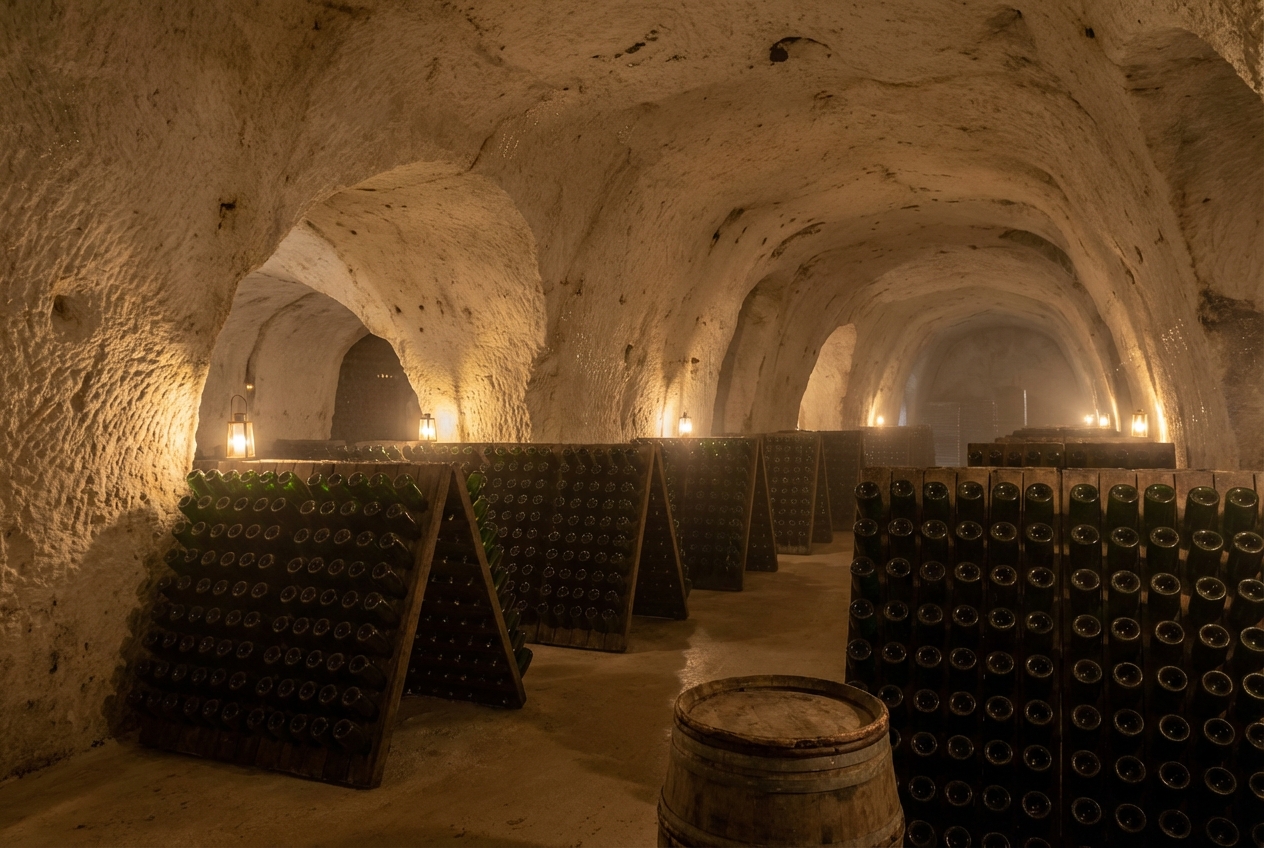
Bottles are gradually rotated and tilted neck-down to collect the lees sediment in the neck. Traditionally done by hand over six to eight weeks on wooden pupitres, today most producers use automated gyropalettes that accomplish the task in about a week.
Step 6: Disgorgement and Dosage
The bottle neck is frozen, the crown cap is removed, and the plug of frozen lees is ejected by the internal pressure. A small amount of liqueur d'expédition — a mixture of wine and sugar — is added to adjust the sweetness level. The dosage determines the final style:
| Sweetness Level | Sugar Content (g/L) | Character |
|---|---|---|
| Brut Nature / Zero Dosage | 0–3 | Bone-dry, austere, terroir-focused |
| Extra Brut | 0–6 | Very dry, precise, increasingly popular |
| Brut | 0–12 | The standard; balanced, versatile |
| Extra Dry / Extra Sec | 12–17 | Off-dry; slightly softer |
| Sec | 17–32 | Noticeably sweet |
| Demi-Sec | 32–50 | Sweet; ideal with desserts |
| Doux | 50+ | Very sweet; rarely produced today |
The Three Grapes of Champagne
Champagne is built on three grape varieties, each contributing distinct qualities to the blend:
Pinot Noir (38% of plantings) — The backbone. Provides structure, power, red fruit character, and aging potential. Dominant in the Montagne de Reims and the Aube.
Chardonnay (28% of plantings) — The finesse. Brings elegance, citrus and mineral notes, and linear acidity. Dominant on the Côte des Blancs, especially in the Grand Cru villages of Cramant, Avize, Oger, and Le Mesnil-sur-Oger.
Pinot Meunier (33% of plantings) — The unsung hero. Contributes roundness, fruitiness, and accessibility. Thrives in cooler, frost-prone areas like the Vallée de la Marne. Once considered a lesser variety, Meunier is increasingly celebrated by grower producers like Jérôme Prévost and Laherte Frères.
Styles of Champagne
Non-Vintage (NV) — The bread and butter of every Champagne house, representing roughly 80% of all production. Blended from multiple vintages to maintain a consistent house style. The best NV Champagnes, such as Krug Grande Cuvée and Billecart-Salmon Brut Réserve, are extraordinary wines in their own right.
Vintage — Produced only in exceptional years, vintage Champagne showcases the character of a single harvest. It must age on lees for a minimum of 36 months, but the best spend far longer. The vintage declaration is a statement of confidence from the producer.
Prestige Cuvée — The flagship wine of a Champagne house, made from the finest parcels and aged for extended periods. These are among the most complex and long-lived wines in existence:
- Dom Pérignon (Moët & Chandon) — Vintage-only; released after roughly 8 years on lees. Known for evolving through multiple "plénitudes" over decades
- Cristal (Louis Roederer) — Created in 1876 for Tsar Alexander II. Luminous, precise, increasingly biodynamic
- La Grande Dame (Veuve Clicquot) — Pinot Noir-dominant; bold yet refined
- Comtes de Champagne (Taittinger) — Pure Blanc de Blancs from Grand Cru Chardonnay; ethereal elegance
- Krug Grande Cuvée — Technically a non-vintage (multi-vintage blend), but constructed with the ambition and complexity of a prestige cuvée. Uses over 120 wines from 10+ vintages
Rosé — Made either by blending a small amount of still red Pinot Noir into white Champagne (rosé d'assemblage) or by brief skin contact with dark-skinned grapes (rosé de saignée). Champagne is the only French AOC where blending red and white wine to make rosé is permitted. Great rosé Champagne, such as Billecart-Salmon Rosé or Krug Rosé, ranks among the world's most gastronomic wines.
The Grower Revolution
For most of the 20th century, Champagne was dominated by the grandes maisons — the large Champagne houses like Moët & Chandon, Veuve Clicquot, and Pol Roger. These houses purchased grapes from thousands of small farmers (the region has roughly 16,000 growers), blending them into consistent, reliable, and widely distributed cuvées.
Starting in the 1970s and accelerating dramatically in the 2000s, a new movement emerged: the grower-producer (or récoltant-manipulant, abbreviated RM on the label). These are farmers who grow their own grapes and make their own wine, often from specific villages or even single vineyards. They prioritize terroir expression over house style, individuality over consistency.
“The grower movement is to Champagne what the natural wine movement is to still wine — a return to the land, to specificity, to the idea that a wine should taste of where it comes from.”
— Richard Juhlin
Key grower producers to seek out include:
- Jacques Selosse — The godfather of the grower movement. Anselme Selosse's radical approach — including barrel fermentation, extended lees aging, and biodynamic farming — was initially controversial but has proven deeply influential
- Egly-Ouriet — Francis Egly's muscular, Pinot Noir-driven Champagnes from Ambonnay set a benchmark for vinous intensity
- Pierre Gimonnet — Elegant Blanc de Blancs from the Côte des Blancs; among the best values in all of Champagne
- Laherte Frères — Aurélien Laherte champions Meunier and single-parcel wines with precision and verve
- Cédric Bouchard — Extreme minimalism: single-vineyard, single-variety, single-vintage, zero-dosage wines that challenge every convention
- Jérôme Prévost — "La Closerie" from a single plot of old-vine Meunier is one of Champagne's most thrilling wines
Understanding Champagne's Terroir
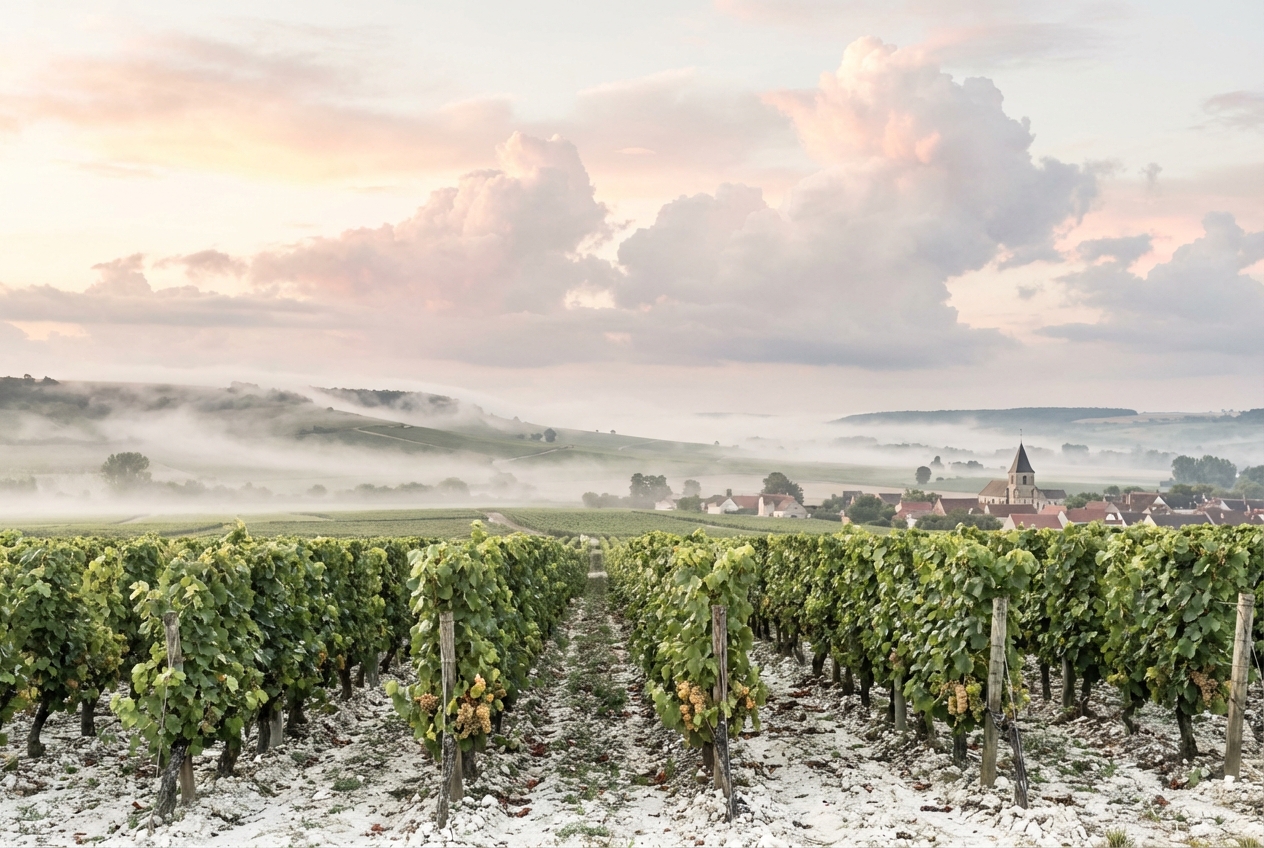
Champagne lies at the northern limit of viticulture at approximately 49°N latitude. The cool climate, with average growing season temperatures barely sufficient for ripening, produces high-acid, low-sugar base wines — ideal for sparkling wine production. But the region's true secret weapon is its soil.
Beneath the gentle, chalky slopes lies a thick bed of Cretaceous chalk — the same geological formation that created the White Cliffs of Dover across the English Channel. This chalk serves multiple functions: it provides excellent drainage while retaining enough moisture to sustain the vines during dry periods, regulates soil temperature, and contributes the signature mineral backbone that distinguishes great Champagne.
The major sub-regions include:
Montagne de Reims — A crescent of south- and east-facing slopes south of Reims. Grand Cru villages include Verzenay, Verzy, Ambonnay, and Bouzy. Pinot Noir dominates here, producing wines of power and structure.
Vallée de la Marne — Following the Marne River westward from Épernay. Pinot Meunier thrives on the cooler, north-facing slopes. Grand Cru: Aÿ (predominantly Pinot Noir and one of the region's most prized villages).
Côte des Blancs — The holy land of Chardonnay. A south-facing escarpment running from Chouilly to Vertus. Grand Cru villages — Cramant, Avize, Oger, Le Mesnil-sur-Oger — produce Champagne of dazzling purity and mineral tension. Salon's legendary single-vineyard, single-vintage Blanc de Blancs comes from Le Mesnil-sur-Oger.
Côte de Sézanne — South of the Côte des Blancs, warmer and less prestigious but producing excellent-value Chardonnay-based Champagnes. Worth watching.
The Aube (Côte des Bar) — Located 100 km south of the main Champagne region, closer to Burgundy. Pinot Noir dominates on Kimmeridgian clay soils similar to Chablis. Long considered second-tier, the Aube is now home to some of Champagne's most exciting grower producers.
For more on the terroir and geology of Champagne, visit The Comité Champagne's official resource.
Vintage Guide
Not every year is declared a vintage in Champagne, making vintage wines particularly special. Here are the standout recent vintages:
| Vintage | Character | Drinking Window |
|---|---|---|
| 2018 | Ripe, generous, immediately appealing; warm year | 2026–2038 |
| 2015 | Rich yet balanced; classic structure | 2025–2040 |
| 2014 | Elegant, precise Chardonnay year; a sleeper | 2025–2040 |
| 2013 | Lean and challenging; limited production | 2024–2032 |
| 2012 | Outstanding; tension, power, and depth | 2025–2045 |
| 2008 | Exceptional; monumental acidity and aging potential | 2026–2060+ |
| 2006 | Underrated; drinking beautifully now | 2024–2034 |
| 2004 | Elegant and mature; nearing its peak for many cuvées | Now–2030 |
| 2002 | Grand year; powerful and complete | Now–2045 |
| 1996 | Legendary; still incredibly youthful | Now–2050+ |
The 2008 vintage deserves special attention. After a cool, challenging growing season, the wines possess extraordinary acidity, concentration, and complexity. Many critics consider it the vintage of the century, surpassing even the legendary 1996. Dom Pérignon 2008, Krug 2008, and Salon 2008 are among the most sought-after Champagnes currently available.
Serving and Storing Champagne
Temperature: Serve non-vintage Champagne at 8–10°C (46–50°F) and vintage or prestige cuvées slightly warmer at 10–12°C (50–54°F) to allow their complexity to emerge.
Glassware: Forget the coupe (fun for parties, terrible for aroma) and the narrow flute (better but still restrictive). A white wine glass or a tulip-shaped glass — slightly wider than a flute with a tapered rim — is ideal for appreciating both the bubbles and the complex aromas. Serious producers like Krug now recommend their wines be served in regular wine glasses.
Storage: Champagne is one of the most underrated wines for aging. While NV Champagne is released ready to drink, it can gain complexity with 1–3 years of additional cellaring. Vintage and prestige cuvées can age gracefully for decades when stored at 10–13°C (50–55°F) in a dark, vibration-free environment.
For authoritative reviews and vintage assessments, consult Richard Juhlin's Champagne database and Wine-Searcher's Champagne section.
The Future of Champagne
Climate change is fundamentally reshaping Champagne. Rising temperatures mean that grapes now ripen more consistently, and there are fewer catastrophically poor vintages. But there are challenges too — earlier harvests, higher alcohol levels, and the looming threat of drought in a region historically defined by marginal conditions.
Forward-thinking producers are adapting. Organic and biodynamic viticulture is expanding rapidly, with houses like Louis Roederer (which has converted its entire Cristal vineyard to biodynamic farming) leading the way. The proportion of wines bottled with zero or very low dosage continues to rise, reflecting the riper fruit of recent vintages.
The grower movement shows no signs of slowing. If anything, the pandemic accelerated direct-to-consumer sales and heightened interest in authentic, terroir-driven wines. A new generation of vignerons — many of them women, like Alice Paillard, Vitalie Taittinger, and Charline Drappier — is bringing fresh perspectives while honoring centuries of tradition.
“Champagne is simultaneously the most traditional and the most innovative wine region in France. That tension is what keeps it endlessly fascinating.”
— Richard Juhlin
Whether you are savoring a glass of grower Champagne from a single chalk-soil parcel in Le Mesnil or celebrating with a bottle of Dom Pérignon, you are participating in a tradition that stretches back centuries and continues to evolve with every vintage. That is the enduring magic of Champagne.
For further reading, explore the Champagne Bureau's education portal for detailed maps, producer directories, and tasting notes.


