The Science of Decanting: What Oxygen Actually Does to Wine
Pouring wine into a decanter is not a ritual gesture or a sommelier's affectation — it is applied chemistry. When wine meets air, two distinct processes begin simultaneously, and understanding both explains why some wines transform dramatically in a decanter while others simply lose their freshness.
The first process is oxidation. Ethanol reacts with oxygen to form acetaldehyde, and then slowly toward acetic acid. In small doses, controlled oxidation is positive: harsh tannin polymers in young red wines begin to soften, and volatile aromatic compounds are released from the liquid into the headspace above it. This is the mechanism behind that moment when a closed, sullen Barolo or Napa Cabernet suddenly "opens up" after thirty minutes in a decanter.
The second process is volatilization — the simple evaporation of lighter, more volatile compounds. Chief among these are sulfur dioxide (SO₂) and hydrogen sulfide (H₂S), two sulfurous compounds used routinely during winemaking as antioxidants and anti-microbials. Freshly opened wine sometimes carries a faint struck-match or rubber aroma from these compounds. Swirling in a wide-based decanter exposes maximum surface area to air, accelerating the blow-off of these gases within fifteen to thirty minutes. This is why a wine that smells odd straight from the bottle can be unrecognizable — in a good way — forty-five minutes later.
Temperature matters too. The rate of volatile compound evaporation roughly doubles for every 10°C increase. A wine served at 18°C will aerate and open noticeably faster than the same wine at 12°C. This is why cellar-cold bottles benefit from both decanting and a brief warm-up on the counter before service.
One important caveat: oxygen is simultaneously a transforming agent and a destructive one. Delicate older wines with limited tannin and residual antioxidant capacity can be overwhelmed by aggressive aeration. The same exposure that liberates a young Syrah can strip a 30-year-old Burgundy of its last remaining perfume. Decanting is not universally beneficial — it is a tool that must be matched to the wine.
Which Wines Benefit from Decanting
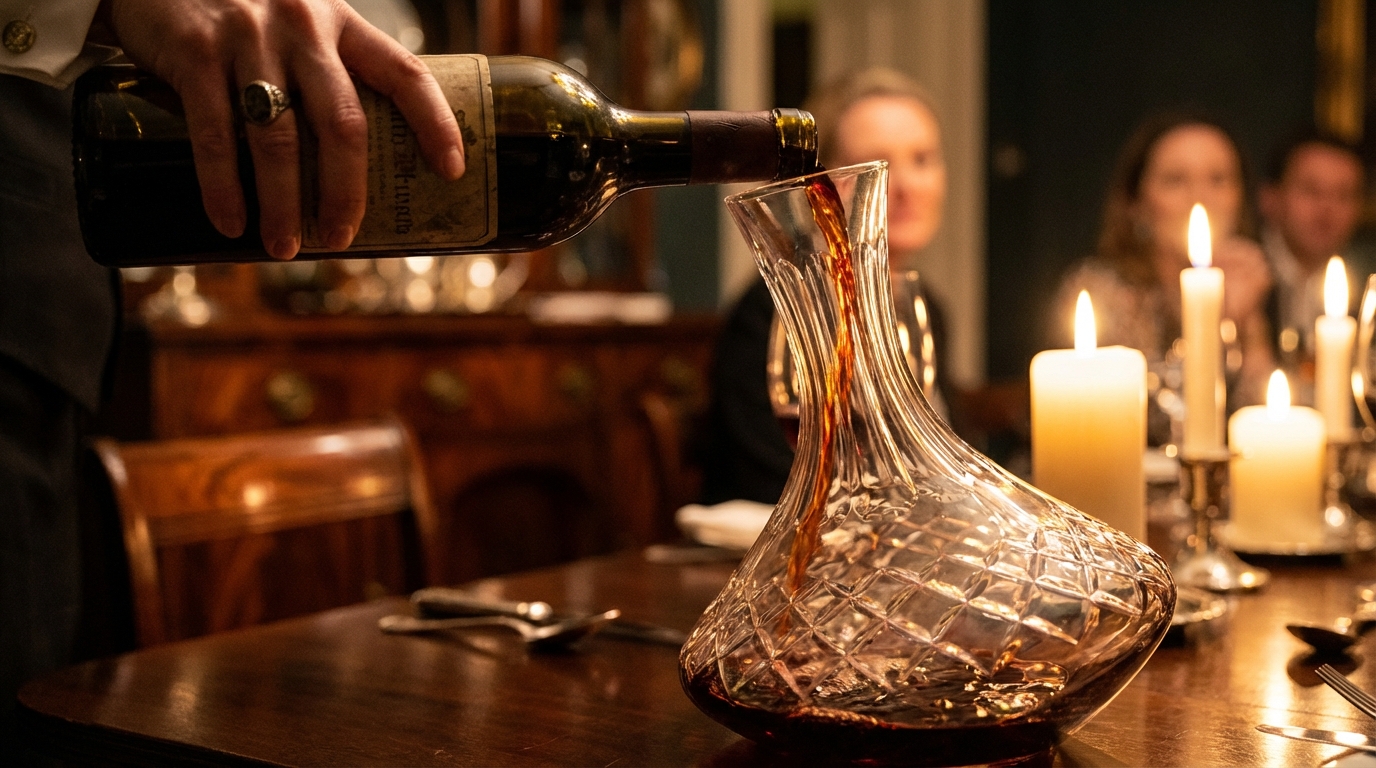
Not every wine needs a decanter. The candidates fall into two clear groups: wines that benefit from aeration and wines that benefit from sediment separation.
Tannic young reds are the most obvious beneficiaries of aeration. Wines with high tannin concentration — Cabernet Sauvignon, Nebbiolo, Syrah/Shiraz, Malbec, Tannat, Mourvèdre — benefit the most because tannins are the molecules most transformed by oxidation. The polymerization of tannin chains under oxygen exposure creates larger, rounder molecules that feel softer on the palate. A young Barolo from Giacomo Conterno or a recent-vintage Pauillac from Château Lynch-Bages will show dramatically better after ninety minutes in a decanter than it will straight from the bottle.
Full-bodied, reductive wines are another prime category. Some winemakers deliberately limit oxygen contact during winemaking — a style known as reductive winemaking — to preserve freshness and aromatic intensity. These wines often smell closed or slightly funky on opening. Examples include many natural wines, certain Grenache-based wines from the Southern Rhône, and minimal-intervention bottlings from producers like Thierry Allemand in Cornas.
Aged reds with sediment represent the other major use case. As red wine ages for a decade or more, unstable pigments and tannins polymerize and fall out of solution, forming a gritty, bitter deposit in the bottle. Pouring such a wine through sediment would ruin it. Here, decanting is not about aeration but about separation — a slow, steady pour against candlelight to catch the sediment before it clouds the decanter.
Wines that generally do not benefit from decanting include: light-bodied, low-tannin reds like Pinot Noir (unless very young and closed), most rosés, sparkling wines (which lose their bubbles), and delicate older wines with fragile structure. If in doubt, err toward a gentle swirl in the glass rather than a full decant.
How Long to Decant: A Guide by Wine Type
Decanting time is not one-size-fits-all. The right duration depends on the wine's age, structure, and tannin level. Under-decanting a structured young red leaves it closed and grippy; over-decanting a fragile older wine leaves it flat and lifeless.
| Wine Style | Decanting Time | Notes |
|---|---|---|
| Young Barolo / Barbaresco | 2–3 hours | Nebbiolo tannins need significant time |
| Young Napa Cabernet Sauvignon | 1–2 hours | More fruit-forward than Barolo but benefits from aeration |
| Young Bordeaux (Classified Growth) | 1.5–2.5 hours | Structure varies; older vintages need less time |
| Young Northern Rhône Syrah | 1–2 hours | Côte-Rôtie and Hermitage especially |
| Young Malbec (Mendoza) | 45–90 minutes | Smoother tannins than Bordeaux |
| Young Tannat (Madiran) | 2–3 hours | Among the most tannic wines in the world |
| Mature Red (10–20 years old) | 30–45 minutes | Separation only; gentle and brief |
| Very Old Red (20+ years) | 15–20 minutes max | Risk of rapid deterioration when exposed |
| Full-bodied White (oaked Chardonnay) | 15–20 minutes | Controversial but can help integrate oak |
| Light-bodied Red (Pinot Noir, Beaujolais) | 15–30 minutes max | Only if very young and closed |
For particularly tannic wines, some sommeliers practice double decanting (also called "splash decanting"): the wine is poured into the decanter, allowed to rest, then poured back into the rinsed original bottle. The process introduces more oxygen more quickly, compressing what might be a two-hour decant into thirty to forty-five minutes. It is aggressive but effective when time is short.
Decanting for Sediment vs. Decanting for Aeration
The technique differs depending on the goal. When separating sediment, precision is paramount.
Stand the bottle upright for at least 24 hours before serving — 48 is better — so that sediment sinks from the shoulder down to the base. Remove the foil and cork with minimal disturbance. Hold a light source (a candle, a torch, or a phone flashlight) beneath the neck of the bottle. Pour slowly and steadily in one continuous motion, watching through the glass as the wine travels through the neck. When the first wisp of sediment appears in the shoulder, stop. The inch or so of wine remaining in the bottle (mixed with sediment) is the sacrifice. Pouring it away preserves the clarity of everything else.
Older Bordeaux, aged Vintage Port, mature Rhône reds, and Italian agers like Brunello di Montalcino and Amarone della Valpolicella all commonly throw sediment after a decade or more. In such cases, the decanting vessel should be narrow-mouthed — minimal surface area — to limit oxygen exposure after separation.
When aerating a young wine, technique is the opposite. A bold, splashing pour from height introduces maximum oxygen. Swirling the decanter aggressively increases surface area further. Wide-base decanters with large surface areas are ideal. The aim is maximum air contact, not gentle handling.
Types of Decanters: Form Follows Function
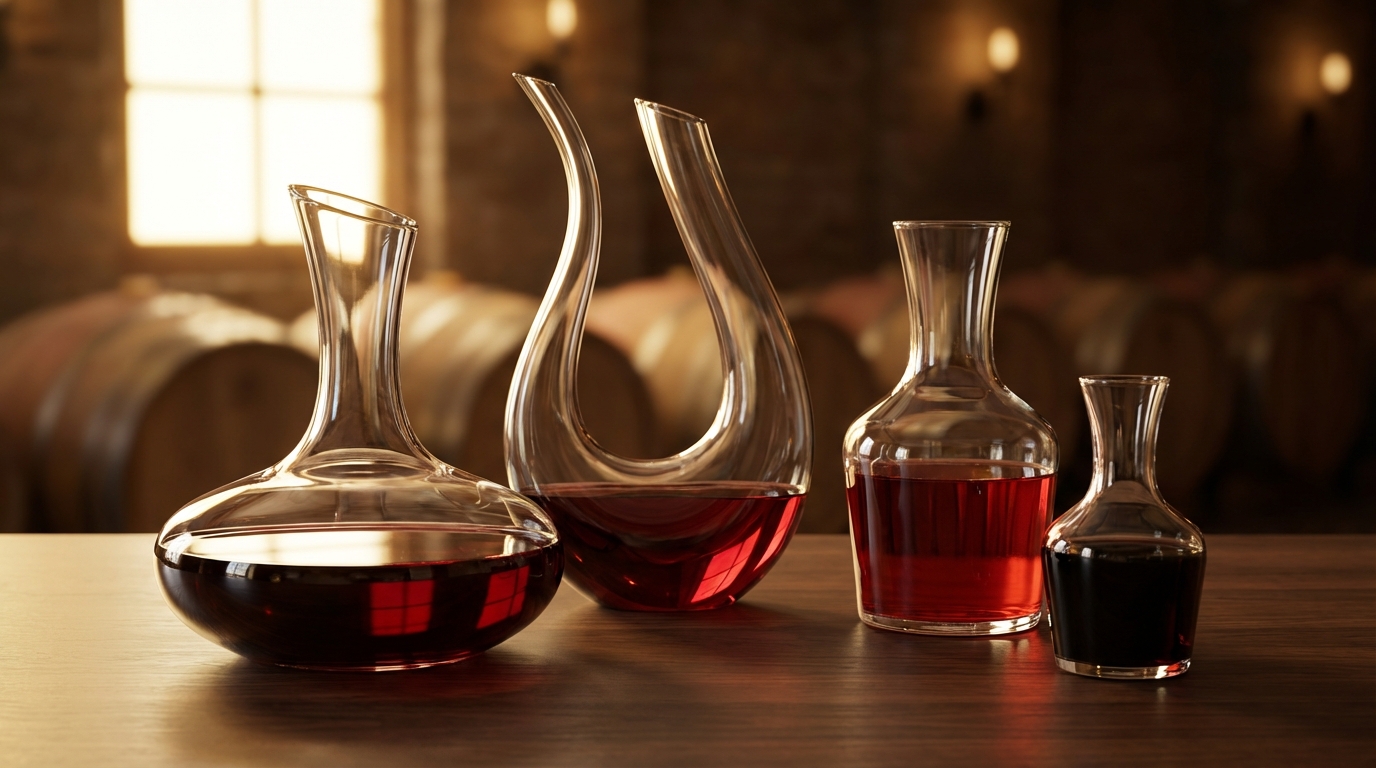
Decanter shape is not purely aesthetic. Different forms are engineered for different purposes.
Standard carafe decanters are the workhorses — a wide base tapering to a narrow neck. The wide base maximizes surface area for aeration while the narrow neck allows easy pouring. Most households need nothing more sophisticated. Well-made versions in clear crystal from producers like Riedel or Zalto allow you to see the wine's color clearly and catch sediment.
Wide-base or flat decanters take the surface-area principle to its extreme. Designs like the Riedel Amadeo or the Magnum style hold the wine in a very shallow, broad layer, accelerating aeration for particularly tannic wines. These are best for young, extracted reds that need aggressive opening.
Swan-neck decanters feature an elongated, curved neck that slows the pour and allows the wine to cascade gently along the interior wall, introducing air gradually. They are elegant but less practical for everyday use and harder to clean.
Burgundy decanters have a rounded, balloon-shaped body with a very wide opening — engineered for delicate Pinot Noir that needs only gentle, brief aeration. The shape echoes a large Burgundy glass blown wide.
Vintage decanters with stoppers are designed for wines that have already been aerated and are waiting to be served. Once a young Barolo has been decanted and opened for ninety minutes, pouring it back into a stoppered decanter keeps it from over-oxidizing at the table.
Regardless of type, decanters should be rinsed with a small pour of the wine itself (the "sacrifice pour") before the main decant — particularly if they have been washed with soap, which can leave a residue that mutes aromas.
White Wines and Decanting: The Underrated Practice
The idea of decanting white wine strikes most people as unusual, but for specific styles it is genuinely transformative.
Barrel-fermented, full-bodied Chardonnay — particularly white Burgundy from producers like Domaine Leflaive, Coche-Dury, or Ramonet — is one of the most reductive white wine styles in the world. These wines spend their lives in barrel and bottle with minimal oxygen, making them often closed, even mute, on opening. A fifteen-to-twenty-minute decant can unlock layers of hazelnut, butter, and stone fruit that would otherwise take two hours of glass-swirling to reveal.
Aged white Rhône wines — white Hermitage from Marsanne and Roussanne, or aged Châteauneuf-du-Pape Blanc — benefit from brief decanting for exactly the same reason: reductive aging and the need to blow off volatile compounds.
The risk with white wines is that they also lose temperature rapidly in a glass-walled decanter. A practical compromise: chill the decanter briefly in the refrigerator before use, then decant into it and return the decanter to the ice bucket for ten minutes before serving. This captures the aeration benefit without allowing the wine to warm uncomfortably.
What never benefits from decanting: aromatic whites like Riesling, Gewurztraminer, Sauvignon Blanc, and Viognier are built on volatile aromatic compounds that dissipate rapidly on exposure to air. Decanting these wines is actively harmful — it strips their most distinctive character within minutes.
Step-by-Step Decanting Technique
The mechanics are straightforward, but a few habits make a meaningful difference in the result.
1. Prepare the bottle. If the wine is known to have sediment, stand it upright for 24–48 hours before serving. Remove foil and cork carefully, minimizing disturbance.
2. Rinse the decanter. Pour a small amount of the wine into the decanter, swirl to coat the interior, and discard. This seasons the glass and removes any residual soap or dust.
3. Set up a light source. For older wines, position a torch or candle beneath the bottle neck. For young wines without sediment, this step is optional.
4. Pour in one continuous motion. For sediment separation, pour slowly and steadily, watching the shoulder through the light. Stop when sediment appears. For aeration, pour boldly from height, allowing the wine to splash and cascade.
5. Allow to rest. Give the wine its prescribed time based on style and age (see the table above). Swirl the decanter every fifteen minutes to expose fresh wine to the air.
Once poured and served, most decanters can be cleaned with warm water and a handful of uncooked rice (shake vigorously to abrade the interior), then rinsed thoroughly and air-dried inverted on a decanter stand or rolled towel. Avoid soap if possible — residue is nearly impossible to rinse fully from complex decanter shapes and will affect the taste of future wines.
Decanting is ultimately a conversation between wine and air — and like any good conversation, timing and attention to the other party makes all the difference.


