The Single Biggest Mistake Wine Drinkers Make
Here is a simple truth that will immediately improve every wine you drink: most people serve their white wines too cold and their red wines too warm. This is the most common and most easily correctable mistake in wine, and fixing it costs nothing.
Temperature has a profound effect on how wine tastes and smells. Serve a fine Burgundy at room temperature — which in a modern heated home is typically 21-23°C (70-73°F) — and the alcohol will dominate, the fruit will taste flabby and overblown, and the wine will feel heavy and graceless. Chill that same wine to 16°C (61°F) and it transforms: the tannins tighten, the acidity lifts, the aromatics become more precise, and the wine reveals its structure and elegance.
Conversely, serve a Chablis straight from the refrigerator at 3°C (37°F) and you will taste almost nothing — the cold mutes both aroma and flavor. Let it warm to 10-12°C (50-54°F) and the wine opens up gloriously, revealing its mineral precision, citrus notes, and chalky texture.
“Temperature is the most underrated variable in wine service. Get it right and even a modest wine sings. Get it wrong and even a great wine stumbles.”
— Rajat Parr, Sommelier and Author
The science is straightforward. Volatile aromatic compounds — the molecules responsible for a wine's scent — evaporate more readily at higher temperatures. Too cold, and these compounds are trapped in the liquid, rendering the wine mute and closed. Too warm, and they evaporate too quickly, with alcohol (the most volatile component) dominating the nose. The sweet spot is where the wine's aromatic complexity is fully expressed without being overwhelmed by alcohol.
The Complete Temperature Guide
Here is a comprehensive temperature guide for every major wine style. Print it, stick it on your refrigerator, and consult it until the ranges become second nature.
| Wine Style | Ideal Temperature | Practical Tip |
|---|---|---|
| Sparkling wine (Champagne, Cava, Prosecco) | 6-8°C (43-46°F) | 3-4 hours in the fridge, or 20-30 minutes in an ice bucket |
| Sweet white wine (Sauternes, Tokaji, Ice Wine) | 6-8°C (43-46°F) | Well chilled — cold enhances sweetness perception |
| Light, aromatic white (Riesling, Vinho Verde, Muscadet) | 8-10°C (46-50°F) | 2-3 hours in the fridge, then let warm slightly in the glass |
| Rosé | 8-10°C (46-50°F) | Chill thoroughly but not ice-cold |
| Full-bodied white (Burgundy, oaked Chardonnay, White Rhône) | 10-13°C (50-55°F) | 1-2 hours in the fridge — remove 20 minutes before serving |
| Orange wine / Skin-contact white | 12-14°C (54-57°F) | Light chill — treat more like a light red |
| Light red (Beaujolais, Pinot Noir, young Grenache) | 13-15°C (55-59°F) | 30-45 minutes in the fridge before serving |
| Medium red (Chianti, Rioja Crianza, Merlot) | 15-17°C (59-63°F) | 20-30 minutes in the fridge if your room is warm |
| Full-bodied red (Cabernet, Barolo, Syrah, Bordeaux) | 16-18°C (61-64°F) | 15-20 minutes in the fridge if stored at room temperature |
| Fortified wine — dry (Fino Sherry, Manzanilla) | 7-9°C (45-48°F) | Serve cold, like a white wine |
| Fortified wine — sweet (Port, Madeira, Pedro Ximénez) | 14-16°C (57-61°F) | Slightly below room temperature |
Why "Room Temperature" Is a Myth
The advice to serve red wine at "room temperature" — chambrée in French — dates to an era when European dining rooms were heated by fireplaces and typically sat at 15-17°C (59-63°F). That is, coincidentally, the perfect temperature range for most red wines. But modern centrally heated homes maintain temperatures of 21-23°C (70-73°F) or even higher, which is far too warm for any wine.
The phrase "room temperature" has caused more damage to wine enjoyment than perhaps any other piece of advice in the history of the beverage. If you take one lesson from this guide, let it be this: almost every red wine benefits from a brief chill before serving.
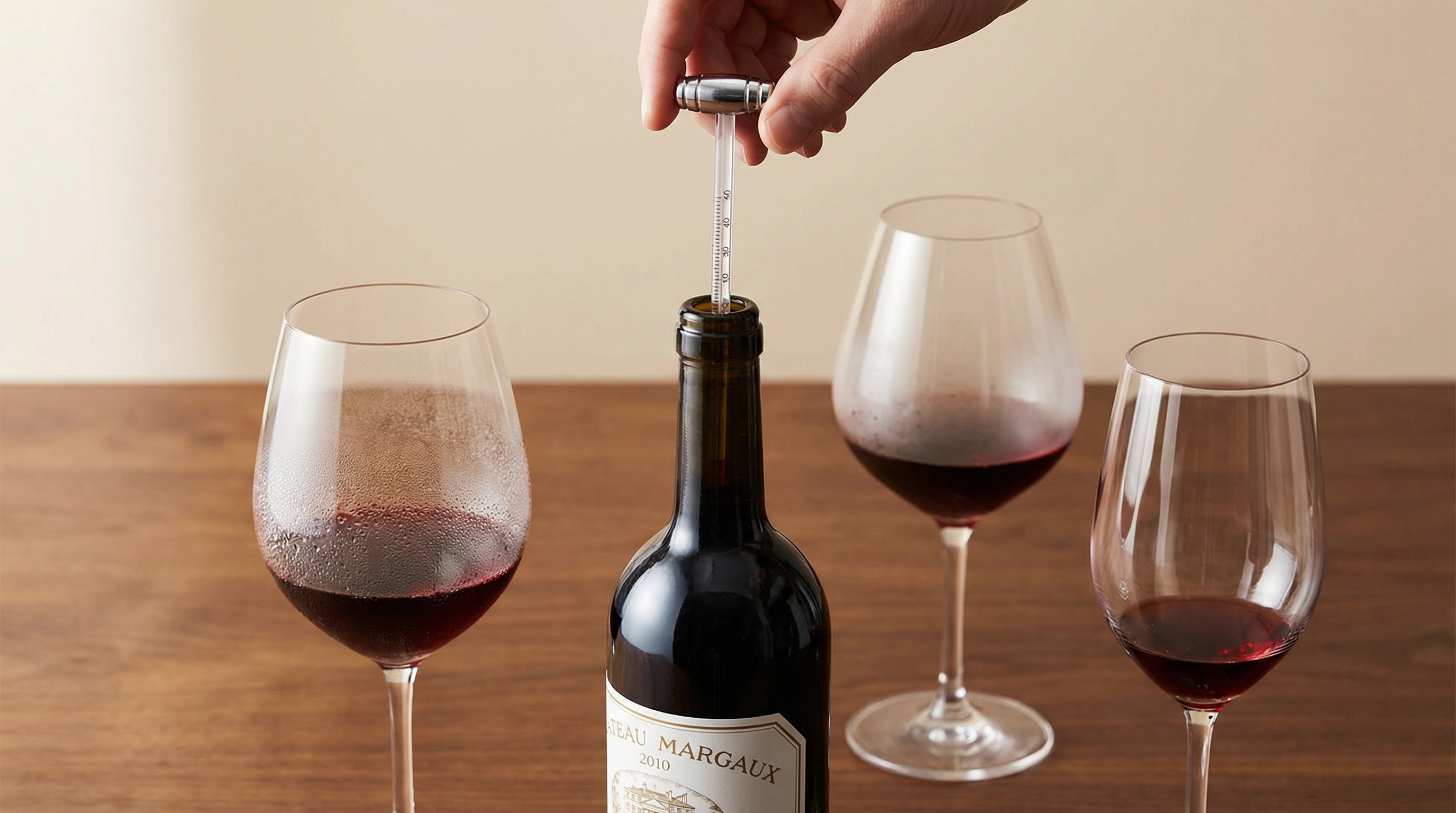
“The single best investment any wine lover can make is a simple wine thermometer. It costs ten dollars and will improve every bottle you open for the rest of your life.”
— Pascaline Lepeltier, Master Sommelier
The Science of Temperature and Taste
Temperature affects not just aroma but taste perception itself. Understanding these mechanisms will help you make informed decisions:
Sweetness perception decreases with cold. This is why ice cream tastes less sweet when frozen solid and why Coca-Cola tastes syrupy at room temperature. For sweet wines (Sauternes, Moscato d'Asti, late-harvest Riesling), serving cold prevents them from tasting cloying. For dry wines, excessive cold can make them seem tart and austere.
Acidity perception increases with cold. Chilling a wine makes it seem more acidic, which is why crisp, high-acid whites (Chablis, Sancerre, Albariño) taste refreshing when cold but can seem sharp when too cold. Warming a wine softens the perception of acidity, which is why low-acid wines served too warm taste flabby.
Tannin perception increases with cold. This is critical for red wines. Excessive cold makes tannins seem harsh, astringent, and drying. This is why most red wines are served warmer than whites — the higher temperature softens tannin perception and creates a smoother mouthfeel. But too warm, and the tannins can seem slack and the wine loses structure.
Alcohol perception increases with warmth. Alcohol is more volatile than water and evaporates more readily at higher temperatures. Warm wine smells and tastes more alcoholic. Since alcohol content in wine has crept upward over recent decades (many reds now exceed 14.5% ABV), serving slightly cooler than "traditional" room temperature helps keep alcohol in balance.
Aromatic complexity peaks in a narrow range. Each wine has an optimal aromatic window — typically a range of just 3-5°C — where its full complement of aromas is most expressive. Below this window, the wine is muted. Above it, alcohol dominates. Finding this window is the goal of proper temperature service.
Practical Methods for Achieving the Right Temperature
The refrigerator method:
A standard home refrigerator maintains a temperature of approximately 3-5°C (37-41°F). Use it as your starting point:
- For sparkling wine: 3-4 hours in the fridge
- For light whites and rosé: 2-3 hours in the fridge
- For full-bodied whites: 1-2 hours, remove 15-20 minutes before serving
- For light reds: 30-45 minutes in the fridge
- For full-bodied reds: 15-20 minutes in the fridge (if stored in a warm room)
The ice bucket method:
An ice bucket cools wine much faster than a refrigerator. A bottle in a properly prepared ice bucket (half ice, half water, with a handful of salt to lower the freezing point) will chill from room temperature to:
- 10°C in approximately 10 minutes
- 7°C in approximately 20 minutes
- 4°C in approximately 30 minutes
The wine fridge:
A dedicated wine storage unit is the ideal solution for anyone with more than a dozen bottles. Most wine fridges maintain a constant 12-14°C (54-57°F), which is perfect for long-term storage and close to serving temperature for many wines. Dual-zone models allow you to keep whites at a lower temperature and reds at a slightly higher one.
Digital wine thermometers:
An infrared or clip-on digital thermometer eliminates guesswork entirely. Models from brands like Vacu Vin, Le Creuset, or ThermoWorks cost $10-$25 and provide instant, accurate readings. This is the single most cost-effective wine accessory you can own.
Decanting: Temperature's Close Companion
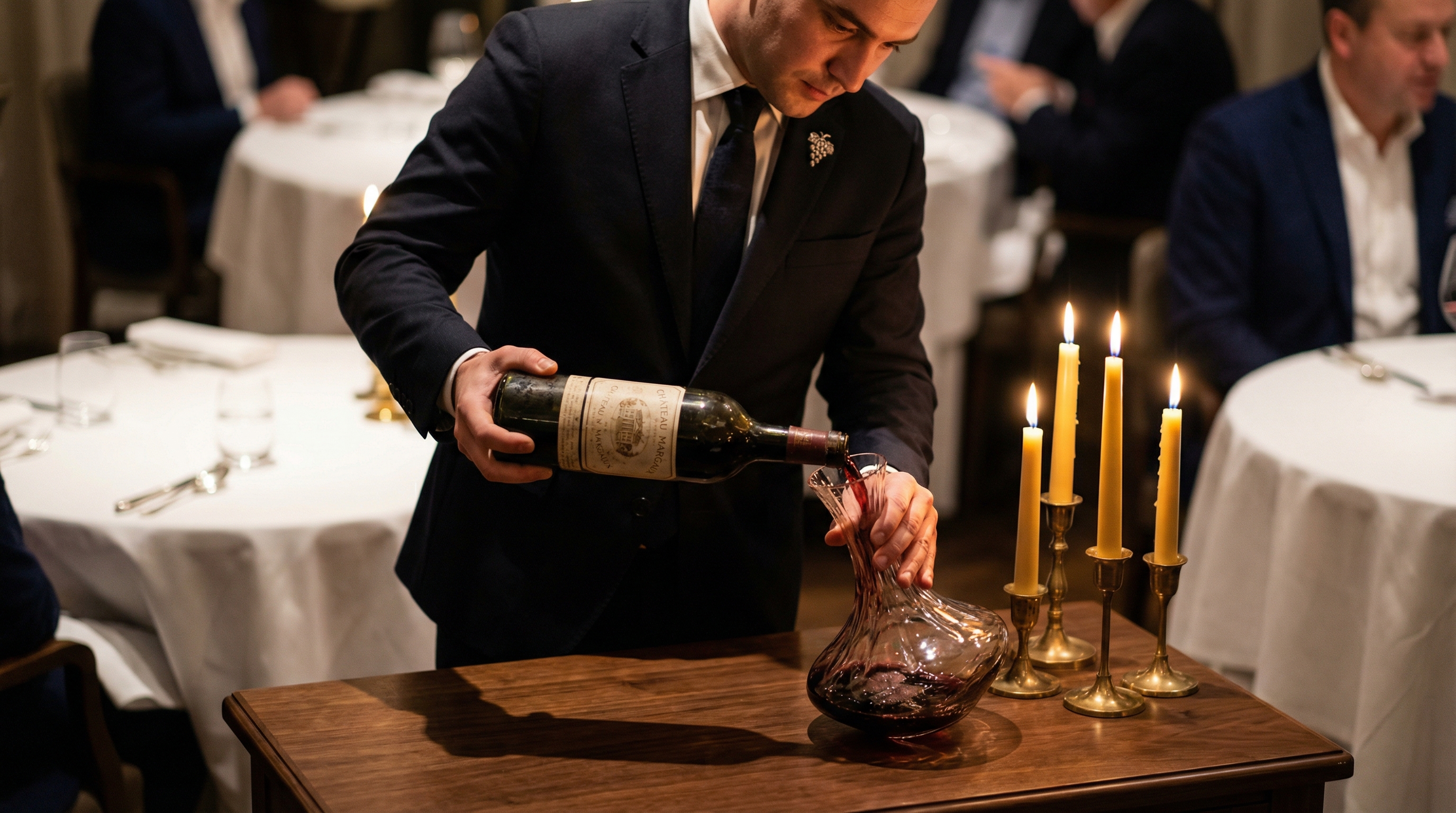
Decanting and temperature work together to optimize wine service. Decanting exposes wine to air, which accelerates the release of aromatic compounds and softens tannins. But decanting also warms the wine — pouring from bottle to decanter raises the temperature by approximately 1-2°C, and wine in an open decanter will warm faster than wine in a sealed bottle.
When to decant:
| Wine | Decant? | Duration | Notes |
|---|---|---|---|
| Young, tannic red (Cabernet, Barolo, Nebbiolo) | Yes | 1-2 hours | Opens aromas, softens tannins |
| Mature red (15+ years old) | Careful | 15-30 minutes | Decant for sediment removal; prolonged exposure can cause fragile old wines to fade |
| Full-bodied white (aged Burgundy, White Rhône) | Sometimes | 15-30 minutes | Can open up complex aromatics |
| Young, fresh white | No | — | Decanting warms the wine and offers no benefit |
| Sparkling wine | No | — | Destroys the bubbles |
| Natural/unfiltered wine | Optional | 15-30 minutes | Can help blow off initial reductive aromas |
Glassware: The Third Variable
Temperature, decanting, and glassware form a triad that determines how a wine presents itself. Glass shape affects both the rate of temperature change and the delivery of aromatics to your nose.
Key principles:
- Larger bowls allow more surface area exposure, accelerating warming and aeration. Use for full-bodied reds and complex whites.
- Smaller bowls retain temperature and concentrate aromatics. Use for light whites, sparkling wines, and delicate reds.
- Narrow openings channel aromatics toward the nose. Tulip-shaped glasses are ideal for most wines.
- Wide openings dissipate aromatics. Avoid very wide-brimmed glasses except for brandy service.
- Thin glass affects perception of quality — wine simply tastes better from thin-walled crystal than from thick glass. This is partly psychological and partly because thin glass transfers less heat from your hand to the wine.
Hold wine glasses by the stem or base, not the bowl. Your hand temperature (approximately 37°C / 98°F) will rapidly warm the wine through the glass. This is one of the practical reasons stemmed glasses exist. Stemless glasses may look modern, but they compromise temperature control.
A basic glass wardrobe for serious wine drinkers:
- One set of large Bordeaux-style glasses for full-bodied reds
- One set of Burgundy-style glasses (wider bowl) for Pinot Noir and Chardonnay
- One set of smaller, tulip-shaped glasses for white wines and lighter reds
- Champagne flutes or tulip glasses for sparkling wine
Quality matters more than variety. Two sets of excellent all-purpose glasses (such as the Riedel Veritas or Zalto Denk'Art Universal) will serve you better than six sets of cheap glasses.
Common Mistakes and How to Fix Them
Mistake 1: Storing wine on top of the refrigerator. The top of a refrigerator is one of the warmest spots in a kitchen, as the motor exhausts heat upward. Wine stored here is slowly cooking. Store wine in a cool, dark, vibration-free location.
Mistake 2: Chilling white wine in the freezer and forgetting it. A bottle left in the freezer for more than 45-60 minutes will begin to freeze, potentially pushing the cork out or cracking the bottle. Set a timer. If the wine has partially frozen, let it thaw slowly in the refrigerator — do not microwave it.
Mistake 3: Adding ice cubes to wine. Ice cubes dilute wine as they melt, destroying the balance the winemaker intended. If you need to chill wine quickly in the glass, use frozen grapes or stainless steel wine stones instead. Better yet, use the ice bucket method to chill the bottle properly before pouring.
Mistake 4: Serving Champagne ice-cold. Very cold temperatures (below 5°C) suppress Champagne's complex aromas — the toast, brioche, citrus, and mineral notes that distinguish great Champagne from ordinary sparkling wine. Serve at 7-8°C to enjoy both the effervescence and the aromatics.
Mistake 5: Warming red wine by the fire or in hot water. Sudden temperature changes shock wine. If your red wine is too cold, simply cup the bowl in your hands for a minute or pour it into a glass and wait. It will warm naturally. Never heat wine artificially.
Mistake 6: Ignoring the temperature of the glass. A warm glass from a dishwasher or a sunny shelf will immediately raise the wine's temperature by 1-2°C. For sparkling wine and delicate whites, pre-chill the glass in the refrigerator for 10 minutes, or rinse with cold water and dry.
Restaurant Service: What to Expect (and Demand)
In restaurants, temperature service varies wildly. Fine dining establishments with skilled sommeliers will generally serve wine at appropriate temperatures. More casual restaurants often serve white wines too cold (straight from a commercial cooler at 3°C) and red wines too warm (stored upright on a shelf behind the bar at ambient temperature).
You are well within your rights to:
- Ask for an ice bucket for whites and rosés to maintain temperature during the meal
- Request that a red wine be placed in an ice bucket for five minutes if it arrives too warm
- Ask the sommelier what temperature the wine cellar is set to
- Let a too-cold white wine sit in the glass for a few minutes before drinking — swirling gently accelerates warming
“A guest who asks about serving temperature is not being difficult — they are being knowledgeable. Any good sommelier respects that.”
— Aldo Sohm, Wine Director, Le Bernardin
Season and Context Matter
Temperature recommendations are not absolute. Consider the context:
- Hot summer day: Serve all wines 1-2°C cooler than standard recommendations. Even light reds can be delightful slightly chilled on a warm afternoon.
- Cold winter evening: Rich, full-bodied reds can be served at the upper end of their range (17-18°C) when you are eating hearty food by a fire.
- Outdoor dining: Wine will warm quickly in direct sunlight. Keep bottles in the shade or an ice bucket. Start cooler than you would indoors.
- Cheese course: Match the wine temperature to the cheese. Soft, cool cheeses pair well with cooler wines; aged, room-temperature cheeses pair with warmer reds.
Quick Reference: The Two Rules That Matter Most
If the comprehensive table is too much to remember, these two simple rules will get you 90% of the way:
- White wine should feel cool, not cold, against your cheek. If it numbs your skin, it is too cold.
- Red wine should feel slightly cool to the touch when you hold the bowl. If it feels warm, it is too warm.
Temperature is the simplest, cheapest, and most immediate way to improve your wine experience. It requires no expertise, no expensive equipment, and no special training. A $10 thermometer and 20 minutes of patience will transform every bottle you open. In the world of wine, there is no higher return on investment than getting the temperature right.


