Why Fine Wine Deserves a Place in Your Portfolio
Over the past twenty years, fine wine has quietly established itself as one of the most compelling alternative asset classes available to private investors. The Liv-ex Fine Wine 1000 index, which tracks the price movements of one thousand of the world's most sought-after wines, has delivered annualized returns of approximately 10% since its inception in 2003. That figure outpaces the S&P 500, gold, and most bond markets over the same period. Wine is tangible, pleasurable to own, and — unlike equities — it cannot be printed, diluted, or replicated.
But wine investment is not without complexity. It demands specialized knowledge, patience, proper storage, and a clear understanding of the risks involved. This guide walks you through everything you need to know to build and manage a fine wine portfolio wisely.
“Wine is one of the few investments where, if all else fails, you can simply drink your portfolio.”
— Andrew Caillard MW, Fine Wine Specialist
The Case for Wine as an Alternative Asset
Several structural factors make wine attractive as an investment:
- Finite supply — Once a vintage is consumed, it is gone forever. Supply only decreases over time, creating natural scarcity.
- Growing global demand — Rising wealth in Asia, particularly China, Hong Kong, and South Korea, has expanded the buyer pool dramatically since the mid-2000s.
- Low correlation — Fine wine prices show limited correlation with traditional equity and bond markets, providing genuine portfolio diversification.
- Tax advantages — In many jurisdictions, wine is classified as a "wasting asset" and may be exempt from capital gains tax. In the UK, for example, HMRC does not charge CGT on wine sales by private individuals.
- Inflation hedge — As a physical commodity with limited supply, wine has historically performed well during inflationary periods.
The Liv-ex exchange, founded in London in 1999, has been instrumental in professionalizing the wine market. It provides transparent pricing data, indices, and a regulated trading platform that has brought much-needed liquidity and trust to a market that was once notoriously opaque.
Understanding the Liv-ex Indices
Before investing, you should understand the key benchmarks:
| Index | Coverage | Focus |
|---|---|---|
| Liv-ex Fine Wine 50 | Top 10 Bordeaux châteaux, last 5 physical vintages | Blue-chip Bordeaux |
| Liv-ex Fine Wine 100 | Extended Bordeaux coverage across more producers and vintages | Broader Bordeaux benchmark |
| Liv-ex Fine Wine 1000 | 1,000 wines across Bordeaux, Burgundy, Champagne, Rhône, Italy, and the rest of the world | Most comprehensive index |
| Liv-ex Burgundy 150 | 150 wines from Burgundy's top domaines | Burgundy-specific tracking |
| Liv-ex Champagne 50 | 50 top Champagne cuvées | Prestige Champagne trends |
| Liv-ex Italy 100 | 100 leading Italian wines (Barolo, Barbaresco, Brunello, Super Tuscans) | Italian fine wine |
The Liv-ex 1000 is the broadest measure and is generally the most useful for understanding overall market health. Over the past decade, Burgundy and Italy sub-indices have significantly outperformed Bordeaux, reflecting shifting collector tastes.
En Primeur: Bordeaux Futures
En primeur is the practice of buying Bordeaux wines while they are still aging in barrel, approximately 18 months before they are bottled and delivered. It is the most traditional form of wine investment and functions similarly to a futures market.
How it works:
- Bordeaux châteaux release wines in "tranches" (batches) each spring, roughly six months after harvest.
- Négociants (merchants) in Bordeaux receive allocations and sell them to importers and retailers worldwide.
- Buyers pay upfront and receive their wine approximately two years later.
- Upon delivery, the wine can be stored, consumed, or resold on the secondary market.
Advantages of en primeur:
- Access to sought-after wines that may sell out quickly
- Historically lower entry prices compared to post-release market prices
- Ability to secure full cases in original wooden cases (OWC), which command a premium on the secondary market
Risks of en primeur:
- You are paying for wine you will not receive for up to two years
- The release price may be higher than the secondary market price upon delivery — this has happened repeatedly in recent years when châteaux have priced aggressively
- Merchant insolvency risk — always buy from established, bonded merchants
- Vintage quality risk — critic scores and market sentiment can shift between purchase and delivery
“The en primeur market has changed fundamentally. It is no longer an automatic bargain — you need to be disciplined and selective.”
— Will Hargrove, Head of Fine Wine at Corney & Barrow
What to Invest In: The Blue-Chip Wines
Not all wines are investment-grade. To qualify, a wine generally needs global recognition, critical acclaim, proven secondary market liquidity, and a track record of price appreciation. Here are the most established investment categories:
Bordeaux First Growths and Super Seconds
The bedrock of wine investment. These wines have centuries of trading history and remain the most liquid wines on the market. Key names include Lafite Rothschild, Latour, Margaux, Mouton Rothschild, and Haut-Brion among the First Growths, and Léoville-Las Cases, Pichon-Longueville Comtesse, Cos d'Estournel, and Palmer among the Super Seconds. Right Bank icons Pétrus, Le Pin, Lafleur, and Cheval Blanc also belong in this tier.
Burgundy Grand Cru
Burgundy has been the strongest-performing region for investment over the past fifteen years. Domaine de la Romanée-Conti (DRC) is the single most valuable wine brand in the world, with bottles of Romanée-Conti regularly fetching $15,000-$25,000 at auction. Other investment-grade producers include Leroy, Roumier, Coche-Dury, Rousseau, and Mugnier. The challenge with Burgundy is tiny production volumes — acquiring stock is often harder than paying for it.
Prestige cuvées from Dom Pérignon, Krug, Louis Roederer Cristal, Salon, and Taittinger Comtes de Champagne have shown strong appreciation in recent years. Champagne benefits from broad consumer demand beyond the collector market.
Italy
The top Barolos (Giacomo Conterno Monfortino, Bruno Giacosa, Bartolo Mascarello), Super Tuscans (Sassicaia, Ornellaia, Masseto), and Brunello di Montalcino (Biondi-Santi, Soldera) have established genuine investment credentials. Italy remains comparatively undervalued versus Bordeaux and Burgundy.
Domaine Jean-Louis Chave Hermitage and Château Rayas Châteauneuf-du-Pape are the benchmarks. E. Guigal's La La La trilogy (La Mouline, La Landonne, La Turque) from Côte-Rôtie also commands serious collector interest.
Top Investment Wines: Performance Overview
| Wine | Region | Avg. Annual Return (10yr) | Liquidity | Entry Price (per case) |
|---|---|---|---|---|
| DRC Romanée-Conti | Burgundy | 12-16% | Low (scarcity) | $150,000+ |
| Lafite Rothschild | Bordeaux | 6-9% | Very High | $3,500-$8,000 |
| Pétrus | Bordeaux (Pomerol) | 8-12% | Medium | $25,000-$45,000 |
| Sassicaia | Tuscany | 7-10% | High | $1,500-$3,000 |
| Dom Pérignon | Champagne | 6-9% | Very High | $1,800-$3,500 |
| Leroy Musigny | Burgundy | 14-18% | Very Low | $80,000+ |
| Giacomo Conterno Monfortino | Barolo | 8-12% | Medium | $3,000-$5,500 |
| Chave Hermitage | Rhône | 7-10% | Medium | $2,500-$4,500 |
| Krug Grande Cuvée | Champagne | 5-8% | High | $1,500-$2,800 |
| Latour | Bordeaux | 6-9% | Very High | $3,500-$7,000 |
Data approximate, based on Liv-ex trade data through 2025. Past performance does not guarantee future returns.
Storage: The Non-Negotiable Foundation
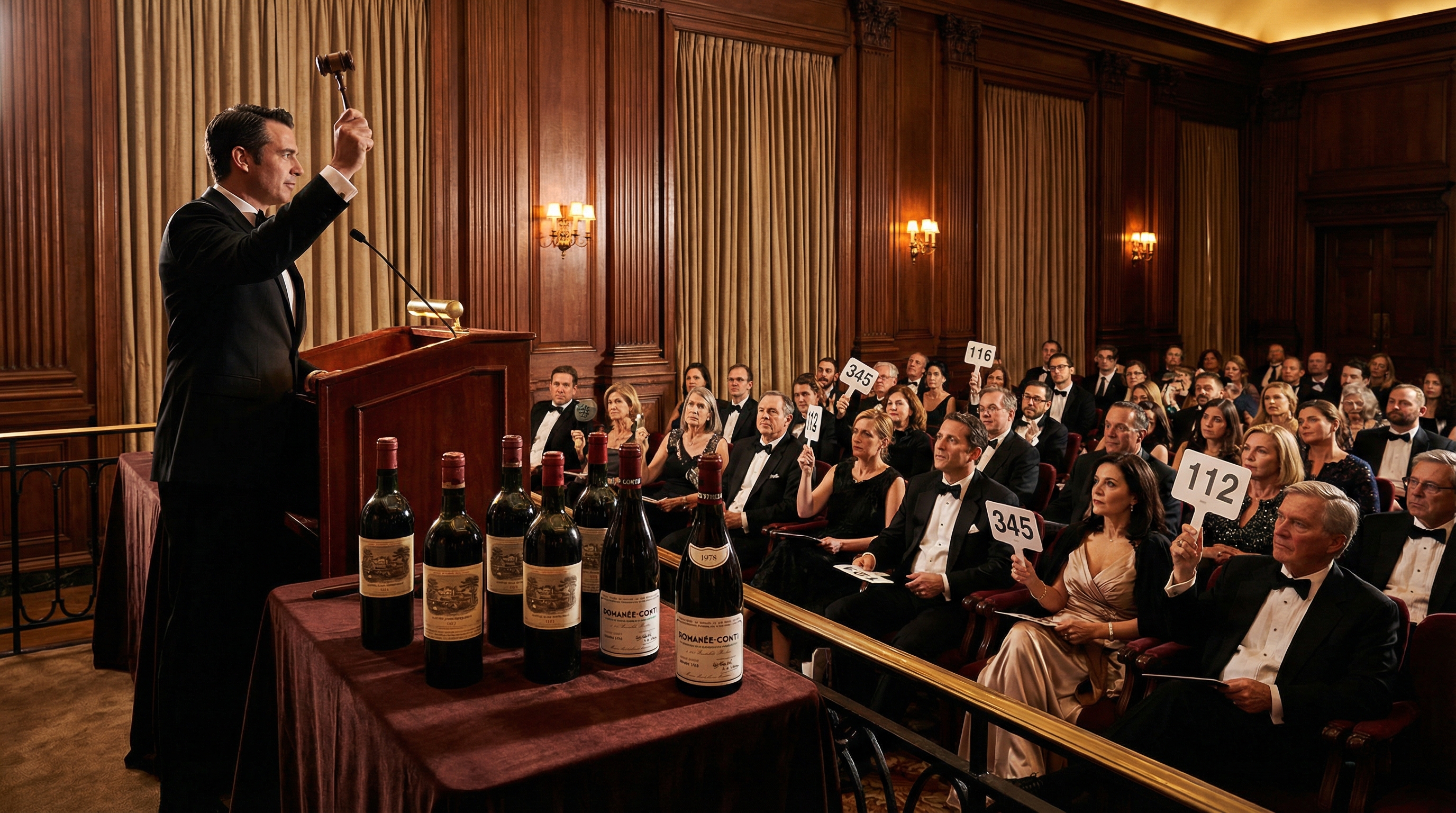
Wine is a living, perishable product. Improper storage can destroy thousands of dollars' worth of investment literally overnight. Professional storage is not optional — it is the single most important operational decision you will make.
Requirements for investment-grade storage:
- Temperature: Constant 12-14°C (54-57°F). Fluctuations are more damaging than a slightly elevated constant temperature.
- Humidity: 65-75% relative humidity to keep corks hydrated and prevent oxidation.
- Darkness: UV light degrades wine. Storage must be completely dark.
- Vibration-free: Vibration disturbs sediment and can accelerate chemical reactions.
- Security and insurance: Professional warehouses offer both, with full audit trails.
Bonded warehousing is the standard for investment wine. Storing wine "in bond" means it remains in a government-licensed warehouse, and you do not pay import duty or VAT until you remove it. This is a significant cost saving — in the UK, duty and VAT can add 40-50% to the cost of a case of fine wine.
Leading bonded warehouses include:
- London City Bond (LCB) — The largest in the UK, storing over 3 million cases
- Octavian Vaults — A former military bunker in Wiltshire, used by many of the top merchants
- Vinotheque — The leading US-based fine wine storage facility
Storage costs typically run $12-$18 per case per year in bonded warehousing, a negligible expense relative to the value of the wine.
How to Buy and Sell
Buying:
- Established merchants — Berry Bros. & Rudd, Justerini & Brooks, Corney & Barrow (UK); Hart Davis Hart, Acker Wines (US). These firms offer curated lists, professional storage, and resale services.
- Liv-ex — Direct access to the global trading platform is available to trade members. Private investors can access it through merchant partners.
- Auction houses — Christie's, Sotheby's, and specialist wine auctioneers like Acker Merrall & Condit offer access to rare and mature wines, though buyer's premiums of 20-25% apply.
- Wine investment platforms — Companies like Cult Wines and Vinovest offer managed portfolio services with lower barriers to entry. These platforms typically charge management fees of 2-3% annually.
Selling:
- Back through your merchant — Many merchants offer buyback services, though they will take a margin.
- Auction — Best for rare, mature wines. Seller's commission is typically 10-15%.
- Liv-ex — The most efficient platform for standard investment wines. Transaction costs are approximately 2% for sellers.
- Private sale — Possible but risky without a trusted intermediary.
Building Your Portfolio: A Practical Framework
A well-constructed wine portfolio should balance risk, liquidity, and return potential. Here is a suggested allocation framework:
Conservative allocation ($50,000-$100,000):
- 50% Bordeaux First Growths and Super Seconds (strong vintages: 2015, 2016, 2018, 2019, 2020)
- 20% Prestige Champagne (Dom Pérignon, Krug, Cristal)
- 15% Burgundy Premier/Grand Cru (Village-level from top domaines)
- 15% Italian (Sassicaia, Ornellaia, top Barolo)
Growth allocation ($100,000-$500,000):
- 35% Bordeaux (diversified across Left and Right Bank)
- 25% Burgundy Grand Cru (DRC, Leroy, Roumier if accessible)
- 15% Italy (Barolo, Super Tuscan, Brunello)
- 15% Champagne (prestige cuvées)
- 10% Emerging regions (Rhône, top Australian Shiraz, Spanish icons like Vega Sicilia)
Key principles:
- Buy in original wooden cases (OWC) — Wines in OWC command a 10-15% premium on the secondary market versus wines stored loose.
- Focus on strong vintages — Not every year is investment-worthy. Consult Wine-Searcher and critic scores to identify the top vintages.
- Diversify across regions and vintages — Do not put everything into a single château or vintage.
- Hold for a minimum of 5 years — Wine investment requires patience. Short-term trading is possible but margins are thin after transaction costs.
- Keep detailed records — Track purchase prices, storage costs, and market values. Review your portfolio annually.
Risks and Pitfalls
Wine investment carries specific risks that traditional assets do not:
- Counterfeiting — Fine wine fraud is a serious problem. The infamous Rudy Kurniawan case revealed millions of dollars' worth of fake wines entering the market. Buy only from reputable sources with documented provenance.
- Market concentration — The fine wine market is heavily concentrated in a small number of producers and regions. A shift in critical opinion or collector taste can significantly impact prices.
- Illiquidity — Wine is not a liquid asset like publicly traded stocks. Selling can take days, weeks, or even months depending on what you hold.
- Storage and insurance costs — These are ongoing carrying costs that reduce net returns.
- Regulatory risk — Changes in import duties, taxes, or alcohol regulations can affect prices and your ability to trade.
- Physical risk — Fire, flood, theft, or breakage can destroy inventory despite professional storage. Always insure fully.
- No income — Unlike dividend stocks or rental property, wine generates no income while you hold it. Your entire return comes from capital appreciation.
“The biggest mistake novice wine investors make is buying what they want to drink rather than what the market wants to buy. Discipline and data must override personal taste.”
— Philip Moulin, Director of Wine Investment, Bordeaux Index
The Role of Critics and Scores
Critical scores remain a significant price driver, particularly in Bordeaux. A 100-point score from Robert Parker (now retired, but his legacy scores still move markets), James Suckling, Neal Martin, or Jancis Robinson can cause an immediate price spike of 20-50%. The influence of critics is diminishing gradually as more data-driven analysis emerges, but for now, scores matter enormously for investment wines.
The most market-moving critics and publications:
- Robert Parker / Wine Advocate — The original 100-point scale influencer. His Bordeaux scores from the 1990s and 2000s still define the market for those vintages.
- Jancis Robinson / JancisRobinson.com — Uses a 20-point scale. Highly respected, particularly for Burgundy and European wines.
- James Suckling — Prolific reviewer with significant influence in Asian markets.
- Neal Martin / Vinous — The current leading Bordeaux critic. His en primeur reports move prices.
- Antonio Galloni / Vinous — Strong influence on Burgundy and Italian wine prices.
Emerging Trends in Wine Investment
Several trends are reshaping the investment landscape:
Burgundy dominance — Burgundy has overtaken Bordeaux as the most valuable fine wine region by price per bottle. Scarcity is the driving factor. While a Bordeaux First Growth may produce 15,000-20,000 cases annually, a top Burgundy Grand Cru might produce 300-500 cases.
Italian renaissance — Italian wines, particularly Barolo and Brunello, remain undervalued relative to their French counterparts and are attracting increasing investor attention.
American collectors returning — After a period of relative quiet, American collectors are re-entering the market aggressively, buoyed by strong dollar performance and growing domestic fine wine culture.
Fractional ownership — Platforms now allow investors to buy fractional shares in individual bottles or cases, lowering the barrier to entry to as little as $100. This democratization is bringing new participants into the market.
Climate change — Warmer vintages are producing consistently high-quality wines across regions, reducing the vintage variation that once created significant price differentials. Some analysts argue this could compress returns for recent vintages while increasing the premium for older, pre-climate-shift wines.
Getting Started: Your First Steps
- Educate yourself — Read the Liv-ex blog regularly. Subscribe to at least one major wine critic. Understand the basics of fine wine before committing capital.
- Set a budget — A meaningful wine portfolio starts at approximately $20,000-$30,000. Below this level, transaction and storage costs erode returns significantly.
- Choose a reputable merchant or platform — Prioritize firms with bonded storage, transparent pricing, and a proven track record.
- Start with blue-chip Bordeaux — The most liquid, best-documented, and easiest wines to buy and sell. Build confidence here before branching into less liquid regions.
- Store professionally from day one — In bonded storage, with full documentation.
- Be patient — Wine investment rewards long-term holders. Set a five-year minimum horizon and resist the urge to trade actively.
Conclusion
Fine wine investment offers a genuinely differentiated addition to a broader portfolio. It combines tangible pleasure with financial returns, low correlation with traditional markets, and the inherent scarcity that drives long-term appreciation. But it is not a get-rich-quick scheme. Success requires education, discipline, proper storage, and the patience to let compounding scarcity work in your favor over years and decades.
Approach wine investment as you would any serious financial commitment: do your homework, diversify, manage risk, and work with professionals. If you do, your portfolio should reward you handsomely — and if it does not, at least you can open the bottles and enjoy the consolation prize.


