A Desert in Canada That Makes World-Class Wine
The Okanagan Valley in British Columbia defies the assumptions that most wine drinkers bring to the words 'Canadian wine.' This is not a cool, grey, rain-soaked landscape producing thin, acidic wines by the grace of heated polytunnels. The Okanagan is a semi-arid desert -- North America's only true desert -- where summer temperatures regularly exceed 38 degrees Celsius, irrigation is mandatory, and the landscape looks more like the Columbia River Gorge than anything stereotypically Canadian.
Yet Canada produces roughly 75% of the world's icewine here, Pinot Noir of genuine elegance grows on the Naramata Bench, and Syrah from the Black Sage Bench has drawn comparisons to the northern Rhone. The Okanagan Valley is one of the wine world's great surprises -- a place where extreme geography creates extraordinary opportunity, and where a generation of committed winemakers has transformed a curiosity into a serious international destination.
Geography: The Okanagan System
The Okanagan Valley stretches roughly 200 kilometres from Vernon in the north to Osoyoos at the US border. Four significant lakes -- Okanagan, Skaha, Vaseux, and Osoyoos -- moderate the valley's temperature extremes, absorbing heat during the day and releasing it at night, extending the growing season and preventing the rapid temperature crashes that would otherwise prevent full ripening.
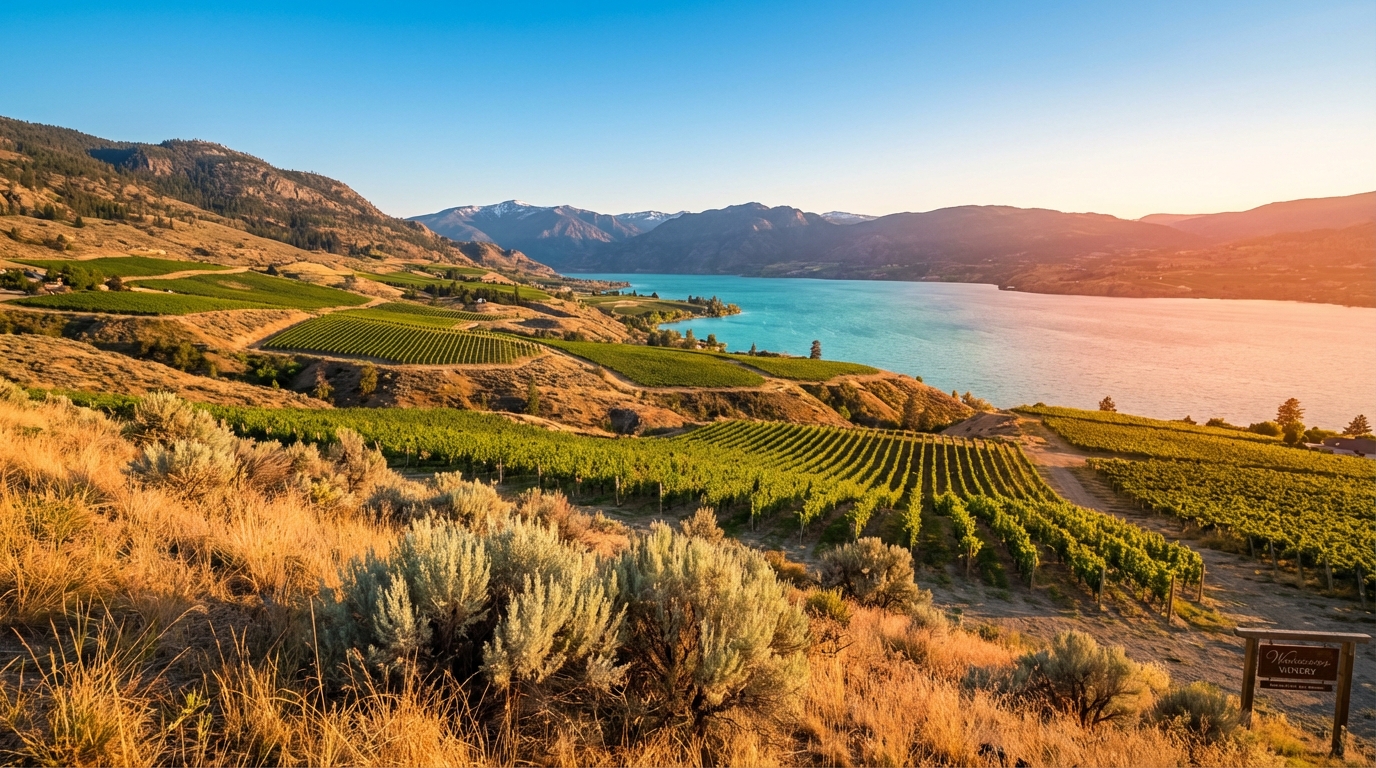
The valley runs roughly north-south, with the southern end (around Osoyoos and Oliver) being significantly warmer and drier than the north (around Vernon and Lake Country). This temperature gradient creates a natural zoning system that allows the valley to produce everything from delicate Riesling and Pinot Gris in the cooler north to powerful Cabernet Sauvignon and Syrah in the hot south.
Annual precipitation in the Okanagan can be as low as 250mm in the south -- genuinely desert conditions. All commercial viticulture depends on irrigation, drawn from the Okanagan lakes and their tributaries. The low humidity also minimises disease pressure, allowing organic and biodynamic farming to be more practical here than in many European regions.
The Icewine Capital of the World
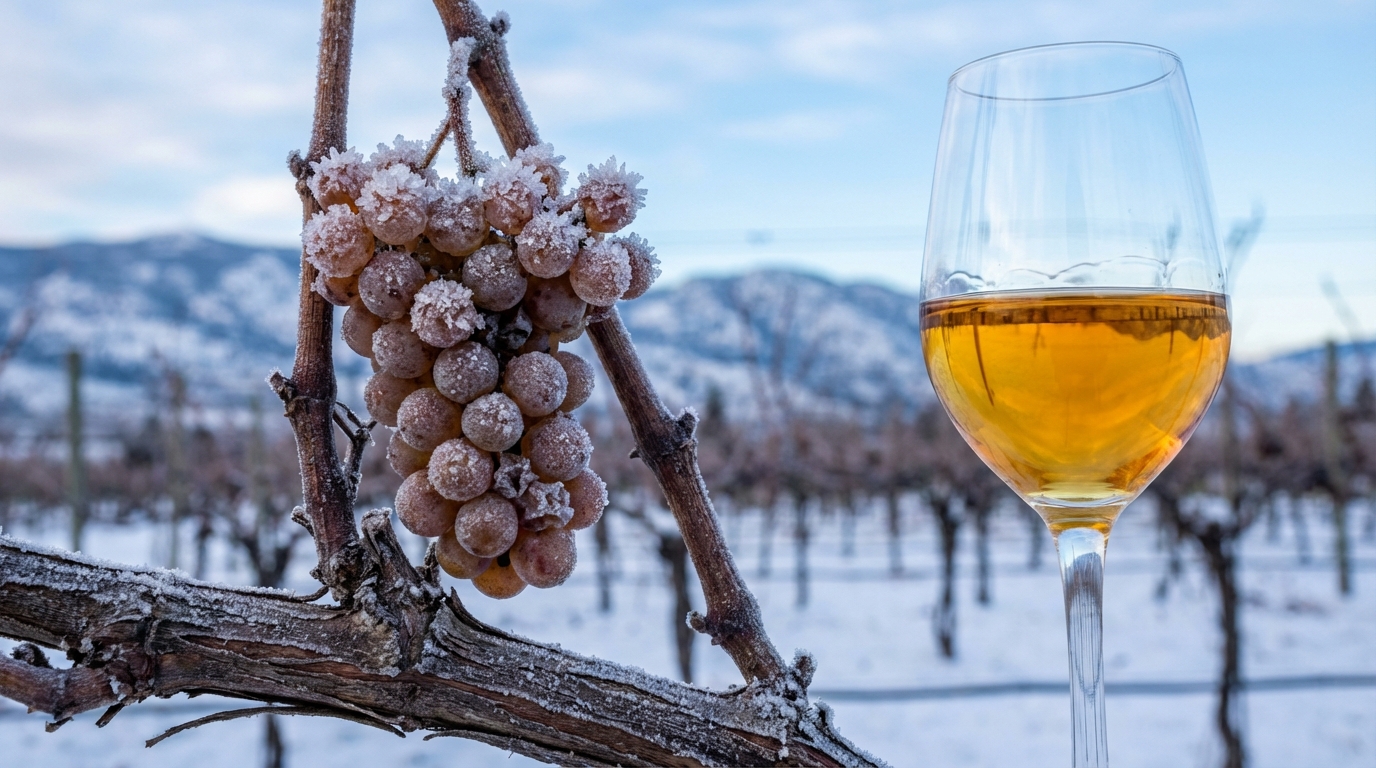
Canada produces approximately 75% of the world's icewine (the German Eiswein is the same style), and the Okanagan Valley is one of its primary production zones alongside Ontario's Niagara Peninsula. Icewine requires grapes to be left on the vine well into winter, until temperatures drop to at least -8 degrees Celsius, at which point the water in the grapes freezes while the sugars and acids remain liquid.
When these frozen grapes are pressed, a tiny quantity of intensely concentrated juice emerges -- often less than 10% of what a normal harvest would yield. The resulting wine is extraordinarily sweet, with sugar levels that can exceed 200 grams per litre, yet balanced by high natural acidity that prevents the sweetness from becoming cloying. Vidal Blanc and Riesling are the primary varieties used for Okanagan icewine, both chosen for their cold-hardiness and acid retention.
Sub-Regions: From Cool North to Hot South
The VQA (Vintners Quality Alliance) BC system recognises several distinct sub-geographic indications within the broader Okanagan Valley, each with meaningfully different growing conditions:
Lake Country and North Okanagan
The coolest part of the valley, Lake Country (near Kelowna) and the North Okanagan suit aromatic varieties: Riesling, Pinot Gris, Gewurztraminer, and Pinot Blanc. The growing season is shorter and the temperatures more moderate, producing wines with pronounced acidity and delicate aromatics. Lake Country is also Kelowna's wine tourism hub, with easy access from the city and a cluster of well-visited cellar doors.
Naramata Bench
Perhaps the Okanagan's most celebrated wine-tourism destination, the Naramata Bench runs along the east side of Okanagan Lake south of Penticton. The lake moderates temperatures significantly, and the benchland soils -- glacial gravels and silt over clay -- produce wines of genuine elegance. Pinot Noir from Naramata Bench has attracted the most attention internationally, with producers like Poplar Grove and Elephant Island demonstrating what is possible when the site is right.
Black Sage Bench and Golden Mile Bench
South of Oliver, the Black Sage Bench and Golden Mile Bench are the Okanagan's hottest and driest sub-zones -- officially sub-GIs recognised by the VQA. Black Sage Road in particular has established itself as the premier address for Bordeaux varieties and Syrah, with sandy loam soils over clay producing wines of remarkable concentration and structure. Burrowing Owl and Road 13 produce benchmark examples.
The Golden Mile Bench (also called the Okanagan Falls sub-GI) runs along the west side of the valley south of Oliver, with different soil profiles -- more rocky and mineral -- that produce wines of greater finesse than the power-driven Black Sage style.
Osoyoos Lake
At the very southern tip of the valley on the US border, Osoyoos Lake is the warmest sub-zone of all. The lake is the warmest in Canada, and its moderating influence extends the growing season significantly. This is where the Okanagan can produce Merlot and Cabernet Sauvignon of genuine depth and ripeness. NK'Mip Cellars -- Canada's first Indigenous-owned winery, operated by the Osoyoos Indian Band -- produces outstanding Merlot and Cabernet from vineyards here.
Similkameen Valley
West of the Okanagan proper, the Similkameen Valley is a narrow, rugged wine region with its own distinct character. The valley is known for organic and biodynamic farming -- the low rainfall, clean air, and relative isolation make conventional pesticide use almost unnecessary. Wines from the Similkameen tend to show more mineral austerity than the richer Okanagan styles, with a dedicated following among natural wine enthusiasts.
Key Grape Varieties by Zone
The Okanagan's vertical geography creates a natural variety selection guide:
| Sub-Zone | Best Varieties | Climate Character |
|---|---|---|
| Lake Country / North | Riesling, Pinot Gris, Gewurztraminer | Cool, short season |
| Naramata Bench | Pinot Noir, Chardonnay | Moderate, lake-moderated |
| Black Sage / Golden Mile | Syrah, Merlot, Cabernet Sauvignon | Hot, dry, desert |
| Osoyoos Lake | Merlot, Cabernet, Sangiovese | Warmest, lake-moderated |
| Similkameen | Mixed -- organic focus | Rugged, mineral |
Pinot Gris deserves special mention as the Okanagan's most consistently successful white variety across multiple sub-zones. At its best -- particularly from Naramata Bench and the cooler north -- it delivers stone fruit aromatics, crisp acidity, and textural richness that rivals good Alsace Pinot Gris. Merlot is the most widely planted red variety and the backbone of many estate blends, benefiting from the valley's warm days and cool nights.
The VQA System
British Columbia's Vintners Quality Alliance (VQA) system, established in 1990, is Canada's primary wine appellation framework. VQA wines must be made from 100% BC-grown grapes (with some specific GI rules requiring even higher percentages), must pass a tasting panel, and must meet minimum residual sugar/alcohol standards. The VQA logo on a label is a meaningful quality indicator -- it excludes blended wines made with imported grape concentrate, which were once common in the Canadian market.
Top Producers
Mission Hill Family Estate
The largest and most internationally prominent Okanagan winery, Mission Hill (Anthony von Mandl) operates from a striking architectural complex above West Kelowna with views over Okanagan Lake. The estate produces wines across a wide quality spectrum, from the accessible Terroir Collection to the highly regarded Perpetua Chardonnay and Oculus (a Merlot-dominant Bordeaux blend). Mission Hill was instrumental in establishing the Okanagan's international reputation in the 1990s and 2000s.
Quails' Gate Winery
Quails' Gate on the west shore of Okanagan Lake specialises in Chardonnay and Pinot Noir, producing wines of consistent elegance and restraint. Their Old Vines Foch (from the obscure Marechal Foch variety -- a cold-hardy red grape developed for Canadian conditions) has become a cult item, demonstrating that even lesser-known varieties can produce serious wine in the right hands. The lakeside restaurant is one of the Okanagan's finest dining destinations.
CheckMate Artisanal Winery
CheckMate is the Okanagan's most exciting premium producer -- a passion project of Mission Hill's Anthony von Mandl dedicated exclusively to Chardonnay and Merlot from single vineyard sites. The wines are named after chess pieces and are produced in tiny quantities at prices that compete with Grand Cru Burgundy. They represent the ceiling of what the Okanagan has achieved so far.
Burrowing Owl Estate Winery
Burrowing Owl on the Black Sage Bench is one of the Okanagan's most reliable producers of Bordeaux varieties. The estate's Meritage blend (the Canadian term for Bordeaux-variety blends) and straight Merlot consistently demonstrate what the warmer southern zones achieve with full phenolic ripeness and structured tannins. The estate also has an excellent restaurant and inn, making it a complete wine tourism destination.
Blue Mountain Vineyard
Blue Mountain in Okanagan Falls is the Okanagan's most dedicated Burgundy specialist, producing Pinot Noir, Chardonnay, and sparkling wines with genuine finesse. The winery sells exclusively through their mailing list and cellar door -- a testament to the demand their wines generate. The Pinot Noir in particular has drawn serious international attention from Burgundy collectors.
NK'Mip Cellars
NK'Mip Cellars (pronounced 'Inkameep') is operated by the Osoyoos Indian Band and holds the distinction of being Canada's first Indigenous-owned commercial winery, opened in 2002. Located on Osoyoos Lake at the hottest point of the valley, NK'Mip produces excellent Merlot, Cabernet Sauvignon, and Syrah from estate vineyards, as well as an outstanding Qwam Qwmt (Achieving Excellence) Syrah that is among the most serious red wines in Canada.
Okanagan vs. Washington State: Parallel Challenges
The Okanagan Valley shares significant similarities with Washington State's Columbia Valley directly to the south -- the same continental desert climate, irrigation dependence, and struggle with cold winter damage. The key difference is latitude: the Okanagan sits at 49-50 degrees North, giving it shorter days in winter (risking vine freeze) but longer days in summer (accelerating ripening during the growing season).
Washington's Columbia Valley is generally warmer and produces wines of greater weight and alcohol. The Okanagan tends toward more restrained alcohol and brighter acidity -- wines that pair more naturally with food and age with greater elegance. Washington's wine industry is also considerably larger, with more established export infrastructure. But the Okanagan's quality ceiling is rising steadily, and the gap narrows with each vintage.
Wine Tourism: Kelowna and Penticton
The Okanagan has become one of Canada's premier wine tourism destinations, drawing visitors who combine cellar door visits with access to the region's beaches, ski hills (Big White, Silver Star), and hiking. Kelowna is the commercial hub, with a growing restaurant scene and several cellar doors within the city limits. Penticton serves as the gateway to Naramata Bench -- a 16-kilometre stretch with over 30 wineries accessible by bicycle or the popular Naramata Bench wine tour operators.
Buying Guide and Practical Notes
Okanagan wines are not yet widely distributed internationally -- most production is consumed within Canada. The best strategy for international buyers is to visit the valley directly or order through the winery mailing lists, which are the primary sales channel for premium producers like Blue Mountain and CheckMate.
Within Canada, BC VQA wines are available through the provincial liquor boards (BC Liquor) and increasingly through direct-to-consumer channels. Key bottles to seek:
- Mission Hill Perpetua Chardonnay -- benchmark white wine from Okanagan Lake's west bank
- Quails' Gate Old Vines Foch -- uniquely Canadian, historically important
- CheckMate Chardonnay -- the Okanagan's most ambitious wine project
- NK'Mip Qwam Qwmt Syrah -- Indigenous pride and genuinely excellent
- Burrowing Owl Meritage -- reliable Bordeaux blend, consistent quality
The Okanagan Valley has transformed itself within a generation from a curiosity into a genuine wine destination. The icewine may be what put Canada on the wine map, but it is the Pinot Noir, Chardonnay, and Syrah from the valley's varied sub-zones that are keeping it there -- and pushing it further.


