Washington State: America’s Second Wine State
When wine enthusiasts think of American wine, California dominates the conversation. Yet quietly, relentlessly, and with increasing confidence, Washington State has established itself as America’s second wine state — not just by volume, but by quality. With over 60,000 acres of vineyards and more than 1,000 wineries, Washington produces wines of striking individuality, shaped by a high desert geography, dramatic diurnal temperature swings, and soils that owe their character to ancient lava flows and catastrophic Ice Age floods.
The key to understanding Washington wine is geography. The Cascade Mountains divide the state into two climatically opposite worlds. West of the Cascades, Seattle and the coast are cool, wet, and maritime. East of the Cascades — where virtually all of Washington’s wine grapes grow — is a high desert: sunny, arid, and subject to temperature extremes that would be impossible in any maritime wine region.
Columbia Valley: The Grand AVA
The Columbia Valley AVA is Washington’s largest appellation, encompassing over 11 million acres across eastern Washington and a sliver of northern Oregon. Within it sit all of Washington’s most celebrated sub-AVAs. The Columbia Valley’s wine identity is defined by several interlocking factors that make it unlike any other major wine region:
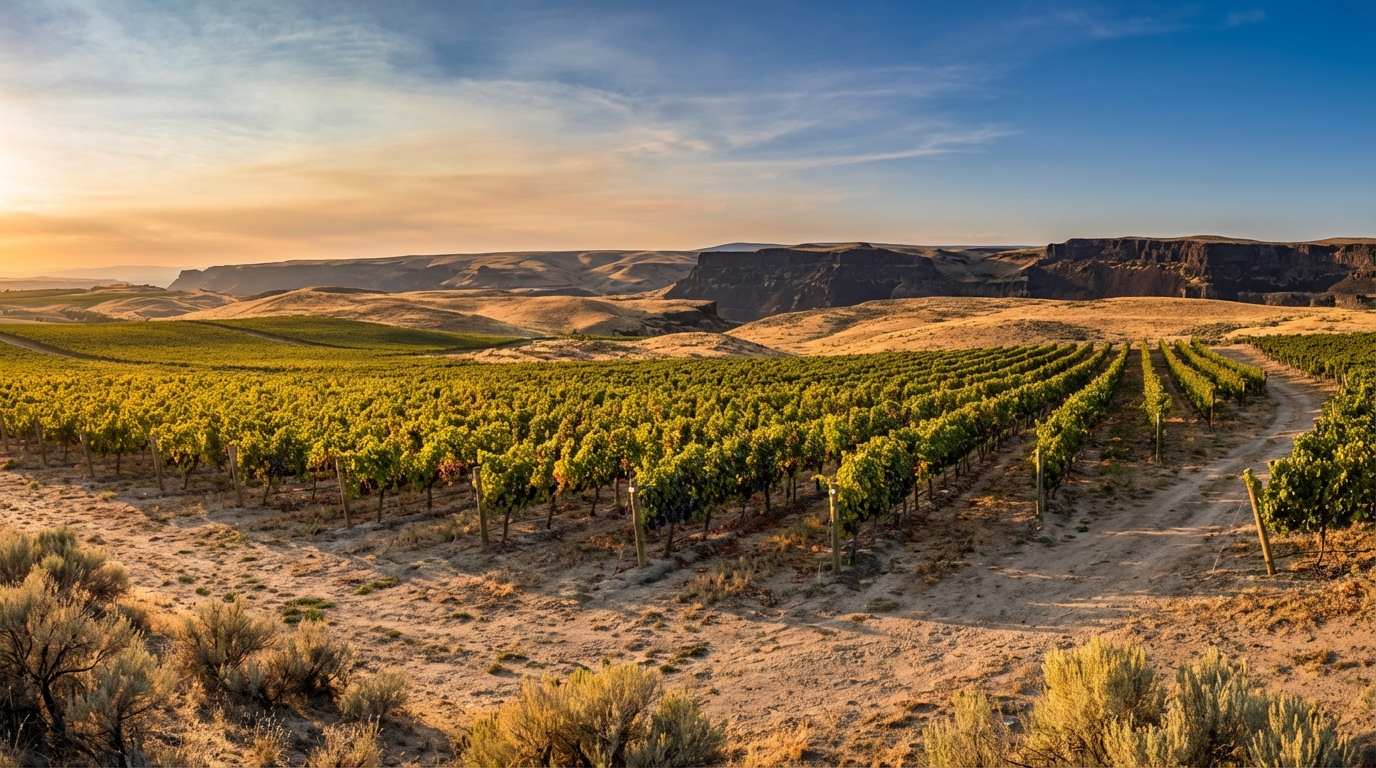
Basalt bedrock and sandy loam soils: The Columbia Basin was formed by catastrophic Ice Age floods (the Missoula Floods, 12,000–15,000 years ago) that scoured the landscape down to basalt bedrock and deposited sandy, well-drained soils. These soils are largely free of the phylloxera louse, meaning many Washington vines grow on their own ungrafted rootstocks.
Dramatic diurnal temperature variation: Summer days regularly reach 100°F (38°C), but nights drop to 55–60°F (13–16°C). This 40–45°F daily swing is among the most extreme of any major wine region, and it is the single most important factor in Washington’s wine style: grapes accumulate sugar during blazing days, then preserve acidity during cool nights, delivering wines of unusual concentration with natural freshness.
Long summer days: Washington’s northerly latitude (46°–48°N) means up to two hours more sunlight per day during summer than Napa Valley. More light means more photosynthesis, more flavor development, and the ability to ripen even thick-skinned Cabernet Sauvignon reliably despite the cool nights.
Low rainfall: Columbia Valley vineyards receive only 6–8 inches of rain annually — technically desert conditions. All commercial viticulture relies on drip irrigation drawn from the Columbia River and Snake River systems, giving growers precise control over vine water stress and canopy development.
Washington’s Sub-AVAs: A Wine Geography Guide
Red Mountain: The Most Concentrated of All
If Washington has a cult appellation, it is Red Mountain — a compact, west-facing slope of only 4,040 acres near Benton City, in the southern Columbia Valley. Red Mountain is Washington’s warmest sub-AVA, and its calcium-rich soils, dominated by caliche (calcium carbonate hardpan), produce Cabernet Sauvignon of extraordinary concentration, tannin structure, and aging potential.
Wines from Red Mountain are not subtle. They are big, dark, and built for extended cellaring — Washington’s answer to a Napa Valley Cabernet, but with more pronounced natural acidity and a mineral signature from the unique soils. Key producers: Quilceda Creek (two-time Wine Spectator Wine of the Year winner), Col Solare (Chateau Ste. Michelle / Antinori joint venture), and Hedges Family Estate.
Walla Walla Valley: Volcanic Cobblestones and Artisan Energy
In the southeastern corner of Washington, the Walla Walla Valley AVA straddles the Washington-Oregon border and produces some of the state’s most celebrated and expressive wines. Walla Walla is distinguished by its volcanic cobblestone soils — remnants of ancient basalt lava flows from the Blue Mountains — which provide excellent drainage and natural heat retention that moderates the sharp diurnal swings.
Walla Walla has developed a distinctly artisan, estate-driven culture. The region’s revival began with Leonetti Cellar, established by Gary Figgins in 1977 and widely considered Washington’s first cult winery. Leonetti Reserve Cabernet Sauvignon established a reference point for the state’s red wine ambition. Other landmark producers: L’Ecole No 41 (consistently reliable across its range), Pepper Bridge (biodynamic estate wines), Cayuse Vineyards (provocatively named cuvées from basalt soils, farmed biodynamically by Christophe Baron), Andrew Will (whose Champoux Vineyard wines are benchmarks for Washington Merlot and Cabernet Franc).
Yakima Valley: Washington’s Oldest AVA
The Yakima Valley, designated as Washington’s first AVA in 1983, runs northwest to southeast along the Yakima River through the heart of eastern Washington. It is the coolest of Washington’s major appellations, making it particularly well-suited to Riesling, Chardonnay, Pinot Gris, and Syrah with more restrained power than the warmer sub-appellations.
Within Yakima Valley, the Rattlesnake Hills and Snipes Mountain sub-AVAs offer the most concentrated red wine production. But the valley’s enduring fame rests on its Riesling. Chateau Ste. Michelle produces more Riesling here than any other US winery, and its collaboration with Ernst Loosen of Germany’s Mosel has produced the benchmark Eroica Riesling — a wine that demonstrates Washington’s untapped potential for serious white wine production.
Horse Heaven Hills: Wind-Swept Perfection
Perched on a dramatic ridge overlooking the Columbia River, the Horse Heaven Hills AVA is shaped by powerful winds off the river that reduce disease pressure, cool the canopy, and produce Cabernet Sauvignon and Merlot of particular finesse and aromatic precision. Chateau Ste. Michelle’s Cold Creek Vineyard — Washington’s most famous single vineyard, planted in 1973 — sits here. DeLille Cellars and Mercer Estates are among the sub-region’s finest producers.
Columbia Gorge: Where Climates Collide
The Columbia Gorge AVA straddles Washington and Oregon along the Columbia River, where the river carves through the Cascades. This unique geography creates a spectrum of microclimates — cool and maritime on the west end, warmer and more continental to the east — supporting an unusually wide range of varieties from Pinot Gris and Gewürztraminer to Syrah and Cabernet Sauvignon.
Key Varieties: What Washington Does Best
Cabernet Sauvignon: The King of Washington Reds
No variety defines Washington’s red wine identity more completely than Cabernet Sauvignon. At its best — from Red Mountain, Walla Walla, or Horse Heaven Hills — Washington Cabernet achieves a distinctive character that differentiates it clearly from both Napa Valley and Bordeaux: the combination of ripe dark fruit (blackcurrant, dark cherry, blueberry) with higher natural acidity, more defined tannin structure, and a freshness that comes from the dramatic diurnal variation. These are wines with both power and energy — a combination rare in the world’s great Cabernet regions.
Quilceda Creek has set the benchmark: winemaker Paul Golitzin produces Cabernet Sauvignon that has received perfect 100-point scores from multiple critics. Leonetti Cellar Reserve and Andrew Will Champoux Vineyard are the other pinnacles of the form.
Syrah: Washington’s Hidden Gem
While Cabernet Sauvignon gets the glory, Syrah may be Washington’s most exciting variety. Washington Syrah occupies a distinctive stylistic position between the peppery, meaty northern Rhône (Hermitage, Crozes-Hermitage) and the riper, more fruit-forward New World Shiraz. The combination of warm days and cool nights gives Washington Syrah an unusual combination of dark fruit richness with savory complexity and freshness.
The Walla Walla Valley and Yakima Valley produce the most compelling Syrah. Cayuse Vineyards (Cailloux Vineyard Syrah from volcanic cobblestones) and Mark Ryan Winery (“The Chief” Syrah) represent the variety’s potential. Long Shadows (a consortium of international winemakers including Michel Rolland and Randy Dunn using Washington fruit) also produces a benchmark Syrah.
Merlot: Misunderstood Potential
Washington Merlot suffered from the same reputation collapse as Merlot everywhere after Sideways (2004), but it was arguably unfair to Washington. The state has always produced genuine Merlot of character — fuller-bodied than Pomerol, but with real complexity and structure. Andrew Will’s Merlot from Champoux Vineyard and Pepper Bridge’s Merlot demonstrate what the variety can achieve in this climate.
Riesling: The Undersung White
Washington’s Riesling is perhaps the most underappreciated quality wine in America. The Yakima Valley’s cool nights and long days produce Riesling with the tension and precision associated with Germany’s Mosel or Alsace, but with distinctively Washington character. Chateau Ste. Michelle’s Eroica (with Ernst Loosen) and Poet’s Leap (from Long Shadows) are the reference bottlings.
Chateau Ste. Michelle: The Founding Father
No understanding of Washington wine is complete without Chateau Ste. Michelle, the state’s oldest winery (est. 1934, rebranded 1967). Ste. Michelle essentially created Washington’s modern wine industry: its Cold Creek and Indian Wells Vineyards were among the first planted in eastern Washington in the early 1970s, and its willingness to hire world-class winemakers (Bob Betz, Mike Januik, Doug Gore) and collaborate with European producers (Ernst Loosen for Eroica Riesling; Antinori for Col Solare) raised quality standards across the state. Today it remains the state’s largest and most important winery.
Washington vs. California: Understanding the Difference
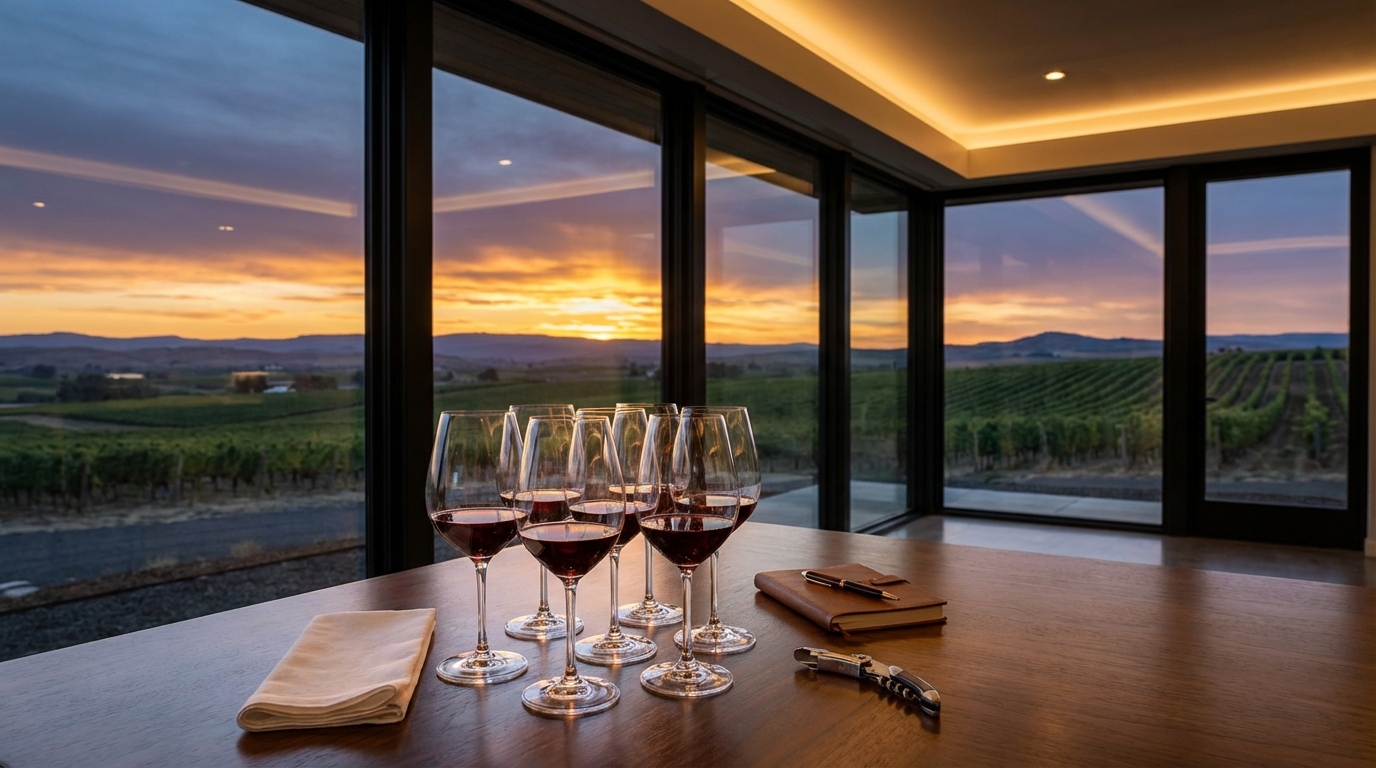
The most important distinction between Washington and California red wines is acidity. Washington’s dramatic diurnal swings preserve natural grape acids in a way that California’s warmer nights often cannot. The result is wines that taste fresher, age more gracefully, and pair more easily with food. Washington Cabernet Sauvignon typically has a pH of 3.3–3.5, compared to 3.6–3.8 or higher for many California Cabs.
Washington wines also tend to have lower alcohol at equivalent ripeness levels — typically 13.5%–14.5% compared to 14.5%–15.5% or more in premium Napa bottlings. This does not mean they are less serious; it means they are better balanced.
Top Producers Reference Guide
Quilceda Creek (Columbia Valley): The state’s most decorated winery, Cabernet-focused, multiple perfect scores.
Leonetti Cellar (Walla Walla): Pioneer estate; benchmark Cabernet Sauvignon and Merlot.
Andrew Will (Columbia Valley / Champoux): Outstanding single-vineyard Merlot, Cabernet Franc, and Cabernet Sauvignon.
DeLille Cellars (Woodinville): Bordeaux-style blends from top Columbia Valley vineyards; Chaleur Estate Blanc is one of the state’s finest whites.
Long Shadows (Columbia Valley): Joint venture with international winemakers including Michel Rolland; consistently high quality across all labels.
Mark Ryan Winery (Columbia Valley): Outstanding Syrah and Cabernet Sauvignon; “The Chief” and “Long Haul” are reliable benchmarks.
Cayuse Vineyards (Walla Walla): Biodynamic pioneer on volcanic basalt soils; Cailloux and En Chamberlin are cult wines with waiting lists.
Buying Guide: Washington Wine at Every Level
Washington wine offers outstanding value at every price point. At under 0, Chateau Ste. Michelle’s varietal range offers reliable, well-made wines. At 0–50, DeLille Cellars, L’Ecole No 41, and Mark Ryan deliver genuine complexity. Above 0, the cult wines of Quilceda Creek, Leonetti, Cayuse, and Andrew Will represent some of the best value in American fine wine — wines that would cost considerably more if they came from Napa Valley.


