History and Overview of Alsace Wine
Alsace occupies a narrow strip of vineyards along the eastern foothills of the Vosges Mountains in northeastern France, stretching roughly 170 kilometers from Thann in the south to Marlenheim in the north. Politically and culturally, the region has shifted between France and Germany four times since 1871, and that dual heritage is written into every aspect of its wine culture — from the tall, slender flute bottles borrowed from the Rhine tradition to the grape varieties that thrive here.
Winemaking in Alsace dates back at least to Roman times, with documented vineyard cultivation by the 2nd century AD. By the medieval period, Alsace was one of the most prolific wine-producing regions in Europe, exporting vast quantities down the Rhine to northern markets. The devastation of the Thirty Years' War (1618–1648) shattered the region's wine trade, and the subsequent centuries of border conflicts between France and Germany delayed recovery. Modern Alsace wine as we know it — focused on quality, varietal identity, and terroir expression — truly took shape in the decades following World War II.
Today, Alsace encompasses approximately 15,500 hectares of vineyard, producing around 1.1 million hectoliters annually. The region is unique in France for its emphasis on varietal labeling — almost all Alsace wines carry the name of a single grape variety on the label, a practice virtually unknown in Bordeaux, Burgundy, or the Rhône Valley. This transparency makes Alsace one of the most approachable French wine regions for newcomers, even as its finest Grand Cru bottlings rival the complexity and ageability of any wine in the world.
Terroir and Climate
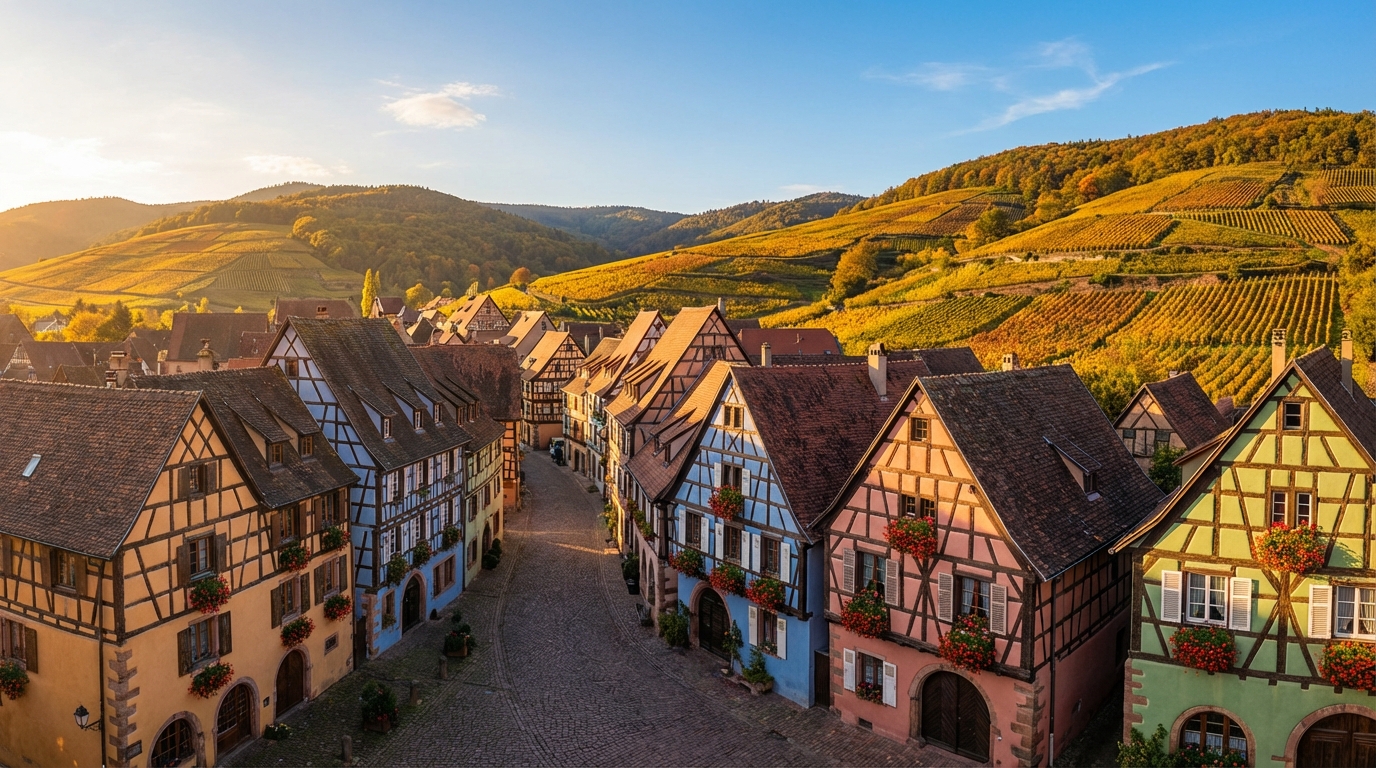
The genius of Alsace viticulture lies in the rain shadow created by the Vosges Mountains. Moisture-laden westerly weather systems from the Atlantic drop their precipitation on the western slopes, leaving Alsace as one of the driest regions in France — the city of Colmar receives only about 550 millimeters of annual rainfall, roughly half the French national average. This semi-continental climate produces warm, dry summers and long, gentle autumns that allow grapes to ripen slowly while retaining the acidity that gives Alsace wines their distinctive backbone.
The geological complexity of the region is extraordinary. A single vineyard slope may contain granite, gneiss, sandstone, limestone, marl, volcanic sediment, and loess — often in close proximity. This patchwork of soils, combined with variations in altitude (between 200 and 480 meters), aspect, and microclimate, means that the same grape variety can produce dramatically different wines from vineyards separated by only a few hundred meters. A Riesling from the granite soils of Brand tastes fundamentally different from one grown on the limestone-marl of Schlossberg just a few kilometers away.
The Vosges also create distinct mesoclimates along the length of the region. The southern vineyards around Guebwiller and Thann are warmer, producing richer, more powerful wines. The central stretch between Ribeauvillé and Colmar — the heart of the Grand Cru zone — benefits from an ideal balance of warmth and elevation. The northern vineyards tend to be cooler, yielding more restrained, mineral-driven expressions.
Key Grape Varieties
Alsace is defined by a small family of grape varieties, each producing a distinct style of wine. The region recognizes seven principal varieties for still wines, though four are considered truly noble.
Riesling is the undisputed king of Alsace, occupying roughly 22% of planted area — about 3,400 hectares. Alsace Riesling is fermented dry by default (unlike many German counterparts), producing wines of piercing acidity, citrus and stone-fruit aromatics, and a pronounced mineral signature that reflects the underlying geology. Grand Cru Riesling from top sites like Schlossberg, Rangen, or Sommerberg can age gracefully for 20 to 40 years, developing petrol notes, honey, and extraordinary complexity.
Gewurztraminer is the most immediately recognizable Alsace variety, responsible for about 20% of plantings. The name literally means "spice traminer," and the wine delivers on that promise: intensely aromatic with lychee, rose petal, ginger, and Turkish delight. Gewurztraminer is naturally low in acidity and high in alcohol, producing rich, full-bodied wines that range from dry to off-dry. Late-harvest versions — Vendange Tardive and Sélection de Grains Nobles — are among the greatest dessert wines produced anywhere.
Pinot Gris (historically called Tokay d'Alsace) accounts for roughly 15% of plantings and produces opulent, smoky wines with notes of baked apple, honey, and spice. It sits stylistically between the precision of Riesling and the exuberance of Gewurztraminer, offering richness without the overt aromatics. Pinot Gris from Grand Cru vineyards can be remarkably long-lived.
Muscat (both Muscat à Petits Grains and Muscat Ottonel) covers only about 2% of the vineyard area but produces some of the region's most charming wines. Unlike most Muscats worldwide, Alsace Muscat is vinified bone-dry, capturing the intense fresh-grape aroma of the variety without residual sweetness. It is an exceptional apéritif wine.
Pinot Noir is the only red variety permitted in Alsace, covering approximately 10% of plantings. Historically, Alsace Pinot Noir was thin and rosé-like, but a new generation of producers — notably Albert Mann, Marcel Deiss, and Domaine Bott-Geyl — are crafting structured, concentrated reds that invite serious comparison with Burgundy. Climate warming has accelerated this evolution.
Pinot Blanc and Sylvaner round out the varietal roster. Pinot Blanc (often blended with Auxerrois) produces approachable, medium-bodied whites that serve as everyday drinking wines. Sylvaner, long dismissed as a workhorse grape, is enjoying a modest revival at the hands of quality-focused producers.
The Grand Cru System
The Alsace Grand Cru classification, formally established between 1975 and 2007, designates 51 individual vineyard sites spanning approximately 850 hectares — just 5.4% of the total vineyard area. Each Grand Cru is defined by its specific geological, topographical, and climatic characteristics, and wines carrying a Grand Cru designation must meet strict production requirements: lower yields (typically 55 hectoliters per hectare maximum), minimum ripeness levels, and tasting-panel approval.
Only the four noble varieties — Riesling, Gewurztraminer, Pinot Gris, and Muscat — are permitted for Grand Cru designation, with one notable exception: Zotzenberg is the only Grand Cru that allows Sylvaner, reflecting that variety's historical importance on the site. The controversial producer Marcel Deiss has long advocated for field-blend Grand Cru wines (complanted vineyards where multiple varieties grow together), and recent regulatory changes have begun to accommodate this approach.
Among the most celebrated Grand Cru vineyards: Rangen de Thann — the southernmost and steepest, planted on volcanic soil at extreme gradient; Schlossberg — the first site to receive Grand Cru status in 1975, renowned for its granite-derived Riesling; Hengst — a south-facing limestone amphitheater producing monumental Gewurztraminer; Brand — granite terraces above Turckheim yielding intensely mineral wines; and Muenchberg — volcanic sandstone producing wines of extraordinary structure and longevity.
The Grand Cru system is not without controversy. Critics argue that some of the 51 sites were included for political rather than qualitative reasons, and that the generous boundaries of certain Crus encompass both excellent and mediocre terrain. Several of Alsace's most prestigious producers — including Trimbach — have historically declined to use Grand Cru designations on their labels, preferring proprietary names like Clos Sainte Hune (sourced entirely from the Rosacker Grand Cru) or Cuvée Frédéric Émile.
Appellations and Late Harvest Designations
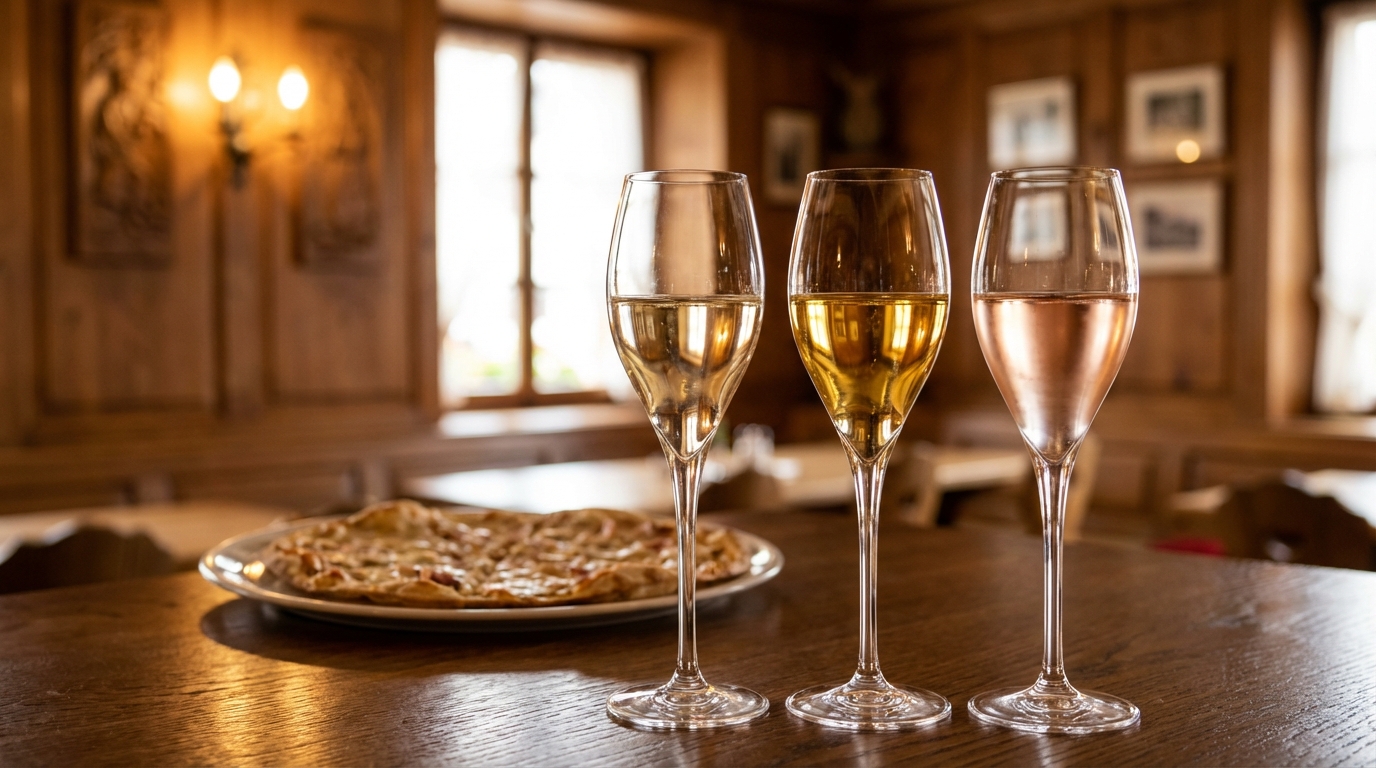
Alsace operates under three main appellations. Alsace AOC (established 1962) covers the vast majority of production — varietal wines from across the region that meet basic quality standards. Alsace Grand Cru AOC (established 1975, expanded through 2007) governs the 51 classified vineyard sites. Crémant d'Alsace AOC (established 1976) covers traditional-method sparkling wines, which now account for nearly 25% of Alsace production — making the region France's largest producer of Crémant. Most Crémant d'Alsace is based on Pinot Blanc, though Riesling, Pinot Gris, Pinot Noir (for rosé), and Chardonnay are also used.
Two additional designations set Alsace apart from every other French wine region: Vendange Tardive (VT) and Sélection de Grains Nobles (SGN). Vendange Tardive ("late harvest") wines are made from grapes left on the vine well past normal harvest, achieving exceptional sugar concentration. SGN wines take this further — produced from individually selected berries affected by Botrytis cinerea (noble rot), they reach extraordinary sweetness levels while maintaining Alsace's characteristic acidity.
Minimum must weights for VT and SGN are among the highest mandated anywhere: for Riesling VT, grapes must reach 244 g/L of natural sugar; for Gewurztraminer SGN, the requirement is 306 g/L. These are not wines made every year — only certain vintages produce the conditions necessary, and the hand-selection process for SGN berries is painstakingly slow, often requiring multiple passes through the vineyard over several weeks.
Notable Producers
Maison Trimbach (Ribeauvillé) — Perhaps the most internationally recognized Alsace house, family-owned for thirteen generations. Their Clos Sainte Hune Riesling is widely considered one of the finest white wines in the world: austere, mineral, and almost impossibly long-lived. The range from basic Riesling through Cuvée Frédéric Émile is a masterclass in consistency.
Domaine Zind-Humbrecht (Turckheim) — Olivier Humbrecht, France's first Master of Wine, farms 40 hectares biodynamically across some of Alsace's greatest terroirs. His wines from Rangen, Brand, Hengst, and Goldert are among the most concentrated and site-specific in the region. Zind-Humbrecht pioneered the use of a sweetness index on back labels to help consumers navigate residual sugar.
Famille Hugel (Riquewihr) — One of Alsace's most historic firms, dating to 1639. Hugel played a crucial role in establishing the VT and SGN designations and remains a benchmark for both categories. Their Hugel Jubilee range showcases excellent Grand Cru-level fruit.
Domaine Weinbach (Kaysersberg) — Originally a Capuchin monastery, now farmed biodynamically by the Faller family. Known for Rieslings and Gewurztraminers of extraordinary purity from the Schlossberg and Furstentum Grand Crus. The estate's walled Clos des Capucins vineyard is an iconic site.
Domaine Marcel Deiss (Bergheim) — The most intellectually provocative estate in Alsace. Jean-Michel Deiss championed the revival of traditional complantation — growing multiple varieties together in the same vineyard and vinifying them as a single field blend. His Grand Cru wines from Altenberg de Bergheim, Mambourg, and Schoenenbourg challenge the very concept of varietal wines.
Domaine Albert Mann (Wettolsheim) — Biodynamic farming across holdings in Hengst, Schlossberg, Furstentum, Steingrubler, and Pfersigberg. Known for both exceptional whites and increasingly serious Pinot Noir. The precision and energy of their Grand Cru Rieslings is remarkable.
Other producers of consistent excellence include Domaine Léon Beyer, Domaine Josmeyer, Domaine Paul Blanck, Domaine André Ostertag, Domaine Bott-Geyl, and Domaine Albert Boxler.
Food Pairing
Alsace wines are among the most food-versatile whites in the world, reflecting the region's own extraordinarily rich culinary tradition — a fusion of French technique and Germanic heartiness.
Riesling is the definitive match for the region's iconic choucroute garnie (sauerkraut with assorted pork and sausages), tarte flambée (Alsatian flatbread with crème fraîche, onions, and lardons), and fresh-water fish like trout or pike. Dry Grand Cru Riesling pairs beautifully with lobster, crab, sushi, and aged hard cheeses like Comté. The variety's high acidity and moderate alcohol make it an exceptional partner for cuisine across all levels of richness.
Gewurztraminer, with its low acidity and exotic aromatics, excels alongside Munster cheese (the pungent local washed-rind specialty), foie gras, Thai and Indian curries, Moroccan tagines, and Chinese dim sum. The variety's natural affinity for spice makes it one of the few white wines that can stand up to complex Asian flavors without being overwhelmed.
Pinot Gris bridges the gap between Riesling's precision and Gewurztraminer's richness. It pairs exceptionally with roast poultry, pork tenderloin, wild mushroom dishes, and baeckeoffe — the traditional Alsatian casserole of mixed meats slow-cooked in white wine with potatoes.
Crémant d'Alsace serves brilliantly as an apéritif and pairs well with lighter fare — smoked salmon, goat cheese, and fresh shellfish. For its quality-to-price ratio, Crémant d'Alsace remains one of the best-value sparkling wines in France.
Visiting Alsace: The Wine Route
The Route des Vins d'Alsace, established in 1953, is one of the oldest and most picturesque wine roads in France, winding 170 kilometers through flower-bedecked half-timbered villages, past vineyard slopes, and through medieval town centers. Key stops include Riquewihr, Kaysersberg, Eguisheim (regularly voted among France's most beautiful villages), Ribeauvillé, and Colmar — the unofficial wine capital of the region.
Most producers along the route welcome visitors for tastings, often without appointment. This accessibility, combined with the region's extraordinary gastronomic heritage — including Michelin-starred restaurants, traditional winstubs (wine taverns), and artisan food producers — makes Alsace arguably the most rewarding wine region in France for tourism. The annual harvest season in September and October brings festivals throughout the route, including the famous Foire aux Vins de Colmar each August.
The combination of world-class wine, storybook architecture, exceptional cuisine, and genuine warmth of welcome makes Alsace one of those rare wine regions where the experience of visiting is equal to the pleasure of drinking. For any wine lover who has not yet explored this corner of France, the journey is overdue.


