The Birthplace of Wine
Wine did not begin in France, or Rome, or even ancient Greece. The oldest confirmed evidence of wine production on Earth comes from the Caucasus -- specifically from the country of Georgia, where archaeologists excavating the site of Gadachrili Gora in 2017 uncovered ceramic shards coated with the chemical residue of fermented grapes dating to approximately 6,000 BC. Clay vessels called qvevri buried at the site contained tartaric acid, malic acid, and citric acid -- the unmistakable fingerprints of wine.
This makes Georgian winemaking at least 8,000 years old -- two millennia older than previously acknowledged wine production in the Near East, and thousands of years older than the Greek or Roman traditions that most Western wine drinkers trace as their heritage. Georgia's claim to be the birthplace of wine is not marketing hyperbole. It is supported by the best available archaeological science.
The Qvevri Method: Ancient Technology, Modern Relevance
The qvevri (sometimes spelled kvevri) is a large, egg-shaped clay amphora sealed with beeswax that is the defining vessel of Georgian winemaking. Unlike European oak barrels, which sit above ground, qvevri are buried underground -- submerged to their necks in the earth so that the surrounding soil maintains a constant temperature of approximately 14-15 degrees Celsius year-round. This natural refrigeration was the world's first temperature-controlled cellar.
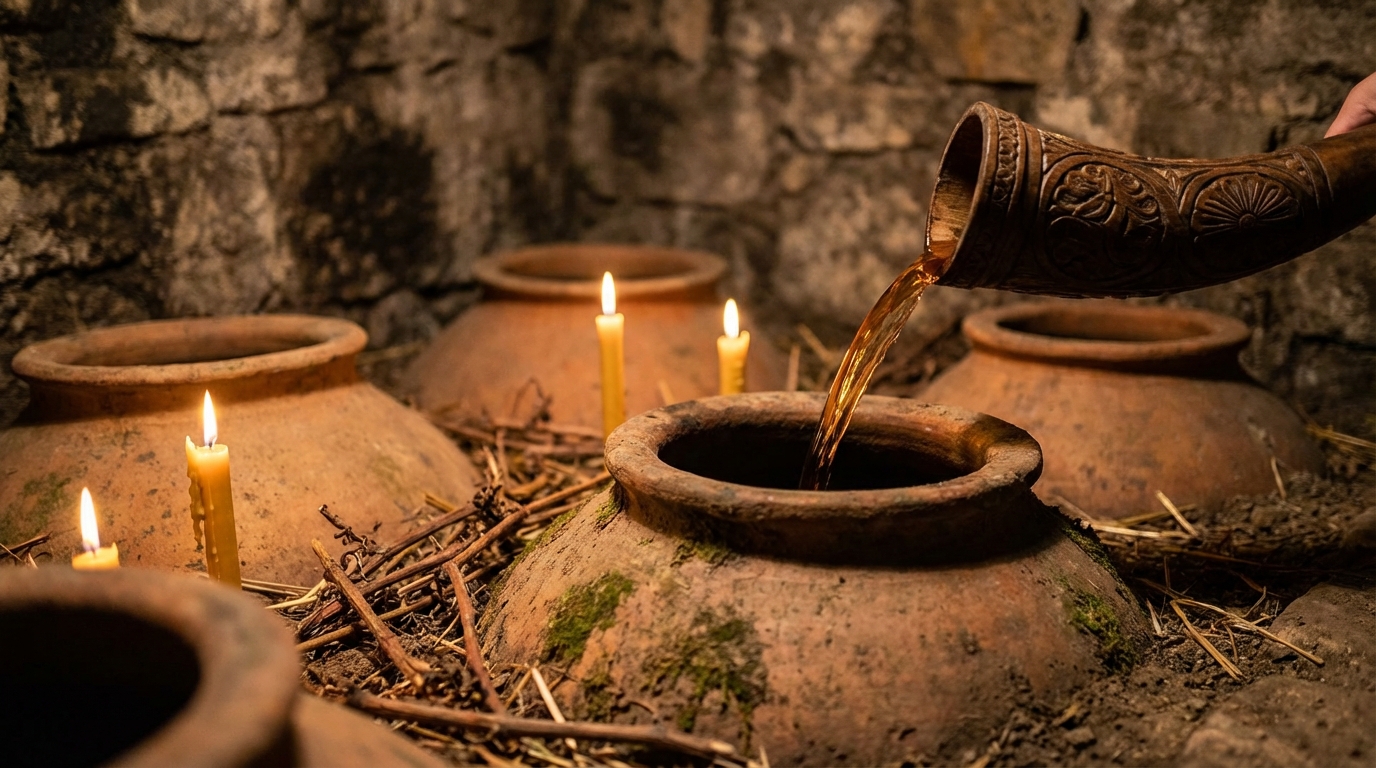
The winemaking process in a qvevri is radically different from what Western drinkers expect. White grapes are crushed and the juice, skins, seeds, and stems are placed together into the buried vessel. This is extended skin contact -- sometimes for six months or longer -- which extracts tannins, colour compounds, and phenolic complexity from the grape solids. The result is a white wine that is orange or amber in colour, with a tannic structure and textural depth completely unlike conventional white wine.
In 2013, UNESCO added the ancient Georgian tradition of qvevri winemaking to its Representative List of the Intangible Cultural Heritage of Humanity -- formal international recognition that this is not merely a winemaking technique but a living cultural practice inseparable from Georgian identity.
Rkatsiteli: The Great Georgian White
Rkatsiteli (pronounced r-kat-si-TEH-li) is the most widely planted white grape variety in Georgia and one of the oldest cultivated grape varieties in the world. The name translates roughly as "red stem" -- a reference to the distinctive red coloration of the vine's cane when ripe. Rkatsiteli produces naturally high acidity and relatively neutral flavour when vinified conventionally, but in a qvevri with extended skin contact, it transforms into something entirely different.
Qvevri-fermented Rkatsiteli offers:
- Amber/orange colour -- from the extended skin contact
- Dried citrus peel, quince, and apricot aromatics
- Walnut, beeswax, and chamomile secondary notes from oxidative ageing in clay
- Firm, grippy tannins -- unusual in a white wine, food-essential
- Very high natural acidity -- a characteristic of the variety that lends longevity
Conventionally vinified Rkatsiteli (without skin contact) is crisp, citrus-driven, and refreshing -- a good introduction to the grape before encountering the full qvevri expression.
Saperavi: Georgia's Great Red
Saperavi (meaning "dye" or "paint" in Georgian -- a reference to the grape's deeply pigmented flesh) is Georgia's most important red variety and one of the few teinturier grapes in the world -- a grape whose flesh, not just its skin, is red. Crushed Saperavi releases an intensely coloured juice before any skin contact occurs, producing wines of remarkable depth of colour and concentration.
Saperavi wines typically show:
- Very deep ruby to near-black colour
- Dark plum, blackberry, and dried cherry fruit
- Dark chocolate, leather, and tobacco complexity
- Firm, grippy tannins that soften beautifully with age
- High natural acidity that provides structure and longevity
Saperavi is an outstanding ageing grape. The best examples -- from Kakheti's finest vineyards -- develop extraordinary complexity over 10-20 years, rivalling Nebbiolo in their ability to evolve from austere youth to seamless, complex maturity. International wine critics have increasingly recognised Saperavi as one of the world's great under-appreciated varieties.
Georgia's Wine Regions
Kakheti: The Wine Heartland
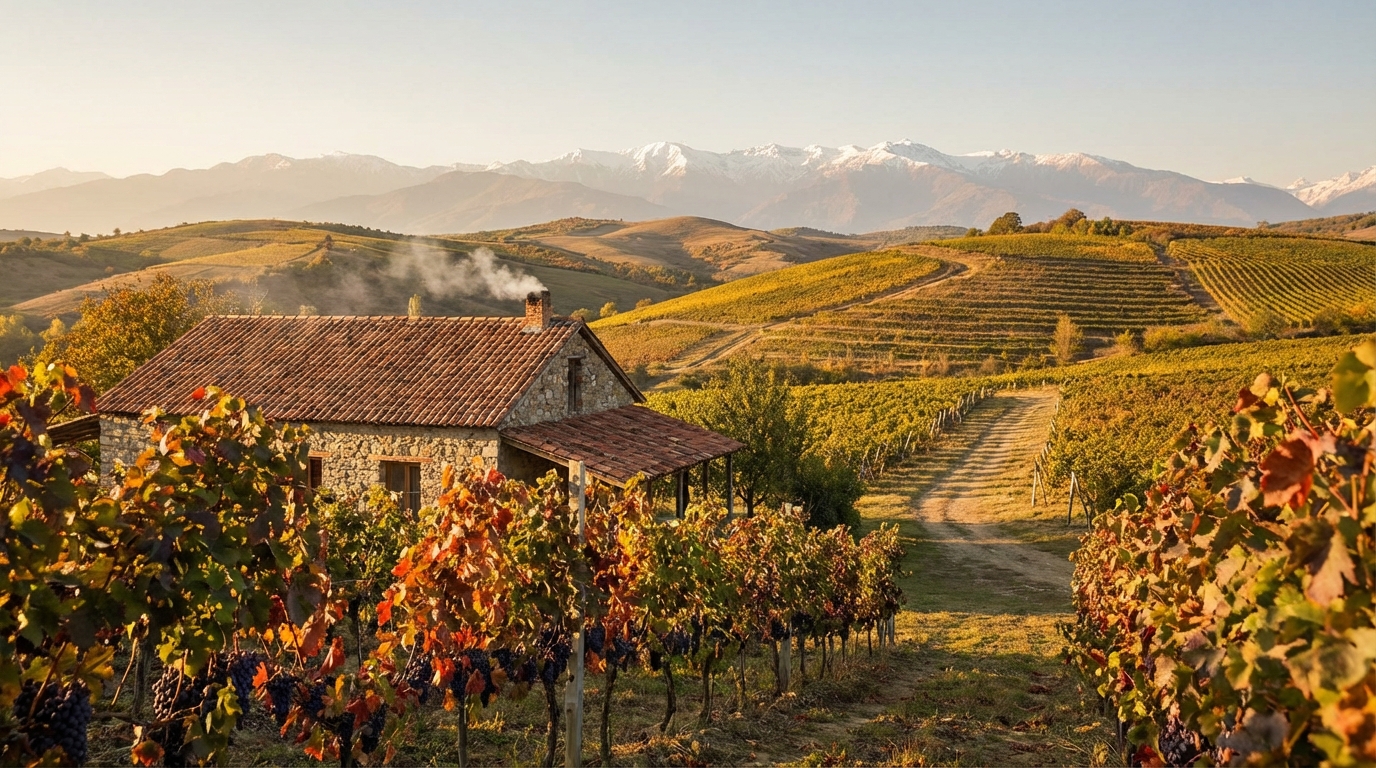
Kakheti in eastern Georgia produces approximately 70% of all Georgian wine and is home to the most celebrated vineyards and producers. The region lies in the broad Alazani River valley between the Greater Caucasus Mountains to the north and the Tsiv-Gombori Range to the south, protected from harsh northern winds and benefiting from a continental climate with warm summers and cold winters.
Kakheti contains several distinct micro-regions, each with local renown:
- Telavi: The commercial and cultural hub of Kakheti, home to large wineries and boutique producers alike
- Tsinandali: Famous for its estate wines since the 19th century; the Tsinandali Estate was the first Georgian winery to produce European-style wines
- Mukuzani: A protected designation for Saperavi aged in oak, producing wines of particular structure and longevity
- Kindzmarauli: A controlled designation for semi-sweet Saperavi -- Stalin's favourite wine, and still a significant export product
- Alaverdi: Home to the famous Alaverdi Monastery, where monks have produced wine in qvevri for over 1,500 years
Kartli
Kartli in central Georgia surrounds the capital Tbilisi and produces wines of both traditional and European styles. The climate is drier and hotter than Kakheti, with limestone-rich soils that produce wines of particular mineral character. The Goruli Mtsvane variety is prized in Kartli for making wines of delicate floral aromatics.
Imereti: Lighter Skin Contact
Imereti in western Georgia uses a distinct winemaking style: qvevri fermentation with skin contact, but typically only 10-30% of the grape solids (compared to 100% in Kakheti). The result is wines that are lighter in colour, less tannic, and more aromatic than full Kakhetian qvevri wines -- an intermediate style accessible to drinkers not yet accustomed to the full amber wine experience.
Adjara and Racha-Lechkhumi
Adjara on the Black Sea coast produces wines in a wetter, subtropical climate -- unusual in Georgia. Racha-Lechkhumi in the mountainous northwest is famous for naturally sweet wines, particularly Khvanchkara (a semi-sweet Alexandrouli and Mujuretuli blend that was, reportedly, another of Stalin's favourite wines), produced from naturally high-sugar grapes in cool mountain conditions.
The 525 Indigenous Varieties
Georgia is believed to have approximately 525 indigenous grape varieties -- an extraordinary repository of viticultural diversity. The world's most comprehensive DNA analysis of Georgian grapes, conducted by the Agricultural University of Georgia in partnership with international researchers, has catalogued this vast genetic treasury, which includes varieties unknown outside the Caucasus.
Most of these varieties survive only in small, isolated vineyards or genetic collections. The most commercially significant are Rkatsiteli and Mtsvane Kakhuri (whites) and Saperavi (red) in Kakheti; Tsitska and Tsolikouri in Imereti; Chinuri in Kartli; and the sweet-wine varieties of Racha-Lechkhumi. But there is growing interest from natural wine producers in reviving forgotten varieties, tasting through the genetic archive and finding commercially viable grapes that have simply been overlooked.
Soviet Disruption and Modern Revival
The Soviet era was catastrophic for Georgian wine. The USSR prioritised quantity over quality, flooding Soviet markets with cheap, industrial wine from Georgia's ancient vineyards. Traditional qvevri winemaking was suppressed as inefficient. Ancient varietals were torn out and replaced with high-yielding workhorse varieties. By the collapse of the Soviet Union in 1991, much of Georgia's winemaking tradition had been industrialised out of existence.
The modern revival has been led by two distinct groups: traditional family producers who maintained qvevri practices through the Soviet era despite pressure to modernise, and a new generation of young Georgian winemakers who returned to the qvevri tradition deliberately -- seeing in it not backwardness but a genuine point of differentiation in the global wine market.
The Natural Wine Connection
The international natural wine movement has been instrumental in bringing Georgian wine to a global audience. Natural wine producers in Europe and the US -- already experimenting with skin-contact whites and minimal intervention -- discovered Georgia in the 2000s as a living laboratory for the methods they were attempting to revive. The qvevri tradition, unbroken for 8,000 years, validated their approach with historical precedent.
Georgian techniques have directly influenced winemakers worldwide: Italian, Slovenian, Austrian, and French producers now make skin-contact whites in amphora or qvevri, explicitly referencing the Georgian tradition as their inspiration. The amber wine category that has emerged internationally is entirely the product of Georgia's ancient practice meeting the natural wine movement's appetite for authenticity.
Georgian Wine Culture: Supras and the Tamada
Wine in Georgia is not merely a beverage. It is the central element of the supra -- the traditional Georgian feast that is the country's primary form of hospitality and celebration. A supra can last for hours, structured around elaborate toasts delivered by the tamada (toastmaster) -- a respected figure who leads the gathering through a ritual sequence of tributes to God, peace, the hosts, the guests, the dead, children, and love.
These toasts are not perfunctory. A skilled tamada constructs each toast as a miniature speech, sometimes lasting several minutes, that sets the emotional and intellectual tone of the gathering. Each toast concludes with the entire table drinking -- not sipping, but drinking fully -- from their glass. A supra can involve 20 or more toasts across an evening, and the wines served must be capable of sustaining that scale of consumption while remaining pleasurable.
Top Producers
Pheasant's Tears
Pheasant's Tears (John Wurdeman, an American painter who fell in love with Georgia) is the producer most responsible for bringing Georgian natural wine to an international audience. Based in the village of Sighnaghi in Kakheti, Pheasant's Tears produces a range of qvevri wines from indigenous varieties that have been featured in restaurants worldwide. Their Rkatsiteli is the benchmark orange wine of Georgia for many international buyers.
Alaverdi Monastery
The Alaverdi Monastery in Kakheti has produced wine since the 6th century AD. The monastery's qvevri winery -- operating in a cellar beneath the monastery church -- is one of the oldest continuously operating wineries in the world. The wines are available in limited quantities and are made exclusively by monks using traditional techniques without any modern inputs.
Gotsa Wines
Gotsa Wines (Beka Gotsadze) is a newer producer gaining significant critical attention for qvevri wines of exceptional precision and cleanliness. The wines demonstrate that qvevri winemaking can produce wines of impeccable technical quality without sacrificing the character that makes Georgian wine distinctive. Gotsa's single-vineyard Chinuri from Kartli is among the most exciting whites in the country.
Orgo
Orgo wines, made by Giorgi Natenadze and his family in the Signaghi area of Kakheti, represent traditional Georgian winemaking at its most authentic. The family cultivates old-vine vineyards of Rkatsiteli and Kisi (a rare indigenous white variety) using only organic practices and vinifies entirely in qvevri. The wines are startling in their complexity and depth.
Lagvinari
Lagvinari (Eko Glonti) is one of the most intellectually rigorous of the new Georgian producers, producing tiny quantities of single-vineyard qvevri wines that explore the differences between specific villages and soil types. The work is analogous to Burgundy's terroir focus but applied to entirely different cultural and viticultural material.
Food Pairing: Georgia's Kitchen
Georgian cuisine is one of the world's great food cultures, and the wines are inseparable from it:
- Khinkali (spiced meat dumplings) -- pair with young Saperavi or conventionally made Rkatsiteli
- Khachapuri (cheese-stuffed bread, especially the egg-topped Adjarian version) -- pair with qvevri Rkatsiteli or Mtsvane
- Satsivi (walnut sauce over chicken) -- the walnut notes in qvevri whites are a perfect echo
- Mtsvadi (grilled pork skewers) -- aged Saperavi or Mukuzani-style wines
- Churchkhela (walnut-and-grape-juice candy, dried and shaped into sausages) -- enjoyed with semi-sweet wines or qvevri amber wines after the meal
Georgia's wine is not merely a drink but an act of identity -- an expression of 8,000 years of continuous culture, geological fortune, and the stubborn human impulse to turn fruit into something transcendent. The world is only now beginning to understand what Georgians have always known: that the oldest wine is also, sometimes, the most profound.


