The Wine That Refuses to Be Ignored
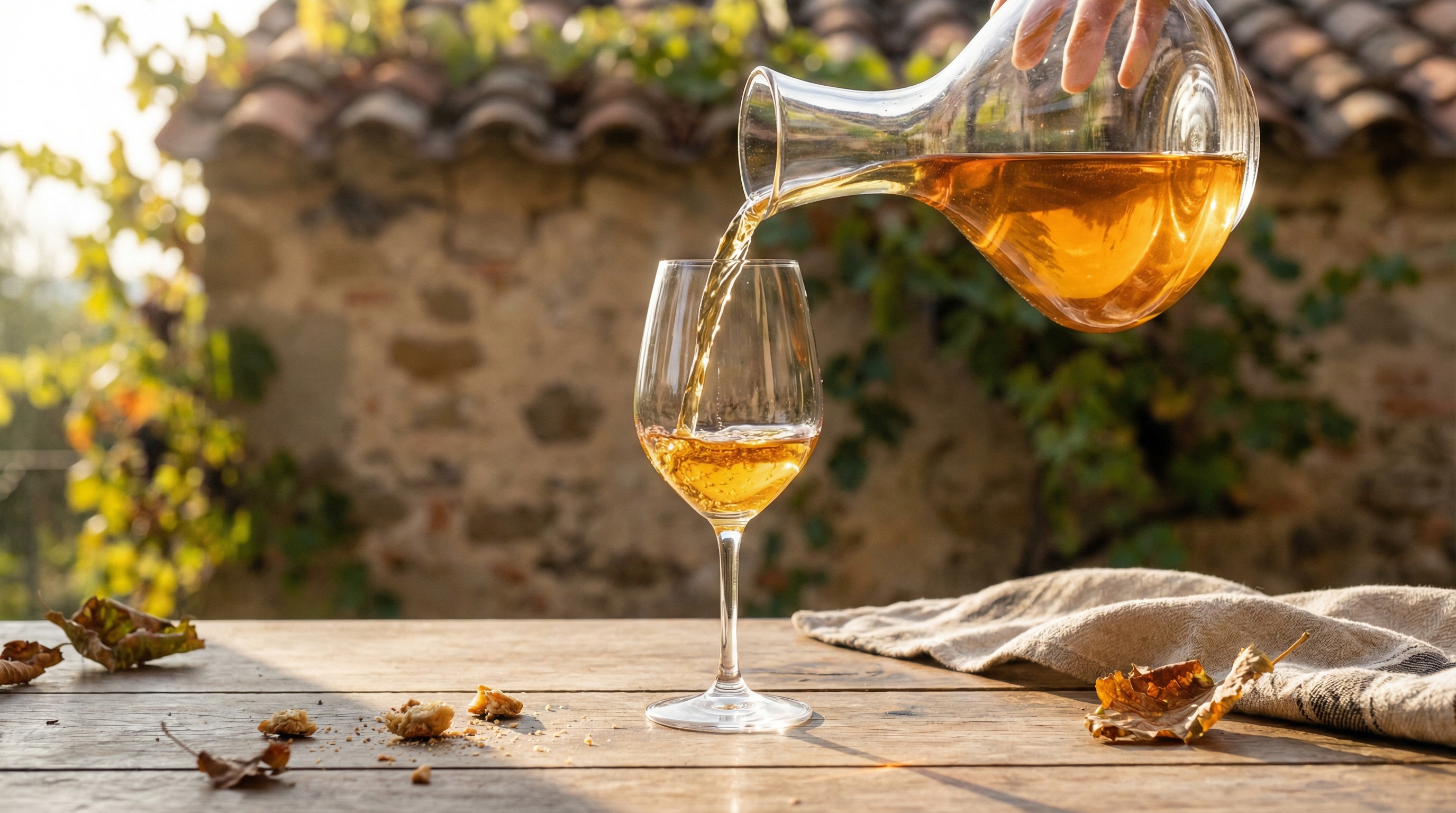
Pour a glass and watch the room divide. On one side, fascination: a golden-amber liquid, cloudy and alive, smelling of dried apricots, chamomile, and something wild — beeswax, perhaps, or bruised apple, or the faint mineral tang of wet clay. On the other side, suspicion: this is not what wine is supposed to look like. It is too dark for white wine, too light for red, and it has a tannic grip on the palate that defies every expectation about what white grapes should produce. Is this the future of wine, or has something gone terribly wrong?
Orange wine — white wine made with extended skin contact, the same technique used to make red wine — is the most polarizing category in the modern wine world. Its proponents call it the "fourth color," a category as legitimate and distinct as red, white, and rosé. Its detractors call it a fad, a hipster affectation, a category in which faults are celebrated as features. The argument has raged for over two decades now, and if anything, it is intensifying as orange wine moves from the radical fringe of natural wine bars into mainstream restaurants, retail shelves, and wine lists around the world.
But here is the thing that both sides often overlook: orange wine is not new. It is not a trend, an invention, or an experiment. It is, in fact, the oldest method of winemaking known to humanity — a technique that predates red and white wine as we know them by thousands of years. Before temperature-controlled fermentation, before stainless steel tanks, before the very concept of separating juice from skins, there was simply wine: grapes crushed, fermented on their skins in earthenware vessels, and drunk. That wine was, by definition, orange.
“People ask me why I make orange wine, as if it were something radical or strange. I tell them: I do not make orange wine. I make wine. Wine the way it has been made for eight thousand years, before someone decided that white grapes should be separated from their skins.”
— Joško Gravner
Eight Thousand Years in a Clay Vessel
The story of orange wine begins in the South Caucasus — the region now encompassing the modern nation of Georgia — where archaeological evidence confirms continuous winemaking stretching back approximately 8,000 years. In 2017, researchers from the University of Toronto and the Georgian National Museum analyzed residues from pottery fragments discovered at Gadachrili Gora and Shulaveris Gora, two Neolithic sites south of Tbilisi. The chemical signatures — tartaric acid, malic acid, succinic acid, and citric acid — provided the earliest known evidence of grape-based wine production, dating to approximately 6000 BCE.
The method used by these ancient winemakers was simple and elegant: harvest grapes (both white and red), crush them, place the entire mass — juice, skins, seeds, and sometimes stems — into large clay vessels called qvevri (also spelled kvevri), bury the vessels in the ground up to their necks, and allow fermentation to proceed naturally with indigenous yeasts. After fermentation, the qvevri were sealed with a stone lid and beeswax. The wine remained in contact with its skins for weeks or months — sometimes until the following spring — before being decanted off the solids.
This is not a quaint historical footnote. In Georgia, qvevri winemaking is a living, unbroken tradition. In 2013, UNESCO inscribed the Georgian qvevri winemaking method on its Intangible Cultural Heritage list. Today, hundreds of Georgian producers still make wine this way — and their skin-contact white wines, made primarily from the Rkatsiteli and Mtsvane grape varieties, are amber-gold, tannic, and hauntingly complex.
The Italian Connection
While Georgia preserved the tradition continuously, skin-contact white winemaking also has deep roots in northeastern Italy, along the Slovenian border in the region of Friuli Venezia Giulia. Here, in the hills of Collio and the Carso, winemakers historically vinified white grapes with extended skin contact as a matter of course. It was simply how wine was made.
The modernization of Italian winemaking in the mid-20th century pushed this tradition to the margins. Clean, crisp, technically precise white wines — fermented cool in stainless steel, bright and fruity — became the standard. The old method was viewed as primitive, a relic of peasant winemaking that produced cloudy, tannic wines that no modern consumer wanted.
But two men, working independently in the 1990s, chose to look backward rather than forward — and in doing so, launched the modern orange wine movement.
The Rebels of Friuli: Gravner and Radikon
Joško Gravner is the patriarch of modern orange wine. Born in 1952 in Oslavia, a tiny village in Collio just meters from the Slovenian border, Gravner spent the first decades of his career making conventional white wines — clean, modern, and critically acclaimed. By the 1990s, his wines were among Italy's most lauded whites, aged in French barriques and praised for their concentration and polish.
And then, to the bewilderment of the wine establishment, Gravner changed course entirely. Dissatisfied with what he saw as the homogenizing effect of modern winemaking — the way stainless steel and selected yeasts stripped wine of its individuality and terroir — he began experimenting with extended maceration of his white Ribolla Gialla grapes. In 1997, he traveled to Georgia and witnessed qvevri winemaking firsthand. The experience was transformative.
By 2001, Gravner had abandoned barriques entirely and imported Georgian qvevri to Oslavia. He now macerates his Ribolla Gialla on its skins for five to seven months in buried qvevri, then ages the wine in large Slavonian oak casks for an additional six years before release. The resulting wines are deep amber, intensely tannic, and staggeringly complex — unlike anything else in the wine world. They are also divisive: some critics consider them among Italy's greatest wines, while others dismiss them as oxidized curiosities.
Stanko Radikon, Gravner's neighbor and friend in Oslavia, undertook a parallel journey. Like Gravner, Radikon had been making polished modern whites before turning to extended maceration in the late 1990s. His approach differed in technique — Radikon used large wooden vats rather than qvevri, and his maceration periods were shorter (three to four months) — but the philosophy was identical: let the grapes speak, intervene as little as possible, and accept the wine that nature provides.
Radikon, who passed away in 2016, was a gentler evangelist than Gravner — warm, humorous, and endlessly patient with skeptics. His Ribolla Gialla, Jakot (Tocai Friulano), and Oslavje (a field blend) are among the most beloved orange wines in the world, prized for their balance of oxidative complexity and fruit purity.
Together, Gravner and Radikon proved that skin-contact white wine was not merely a historical curiosity but a viable, compelling, and intellectually rigorous approach to winemaking. Their example inspired a generation of producers across Italy, Slovenia, and eventually the entire world.
How Orange Wine Is Made
The production of orange wine is, at its core, straightforward: make white wine the way you would make red wine. But the details matter enormously, and the choices a winemaker makes during maceration determine whether the finished wine is elegant and complex or harsh and undrinkable.
The Process
- Harvest: White grapes are harvested, usually at full physiological maturity. Some producers prefer slightly underripe fruit for higher acidity; others pick late for more concentration.
- Crushing: Grapes are crushed (destemmed or with whole clusters, depending on the producer's style) and transferred to a fermentation vessel — qvevri, concrete eggs, stainless steel tanks, open wooden vats, or large glass demijohns.
- Maceration and Fermentation: The juice remains in contact with the skins (and sometimes stems) during fermentation. This is the critical step. Fermentation is almost always spontaneous, using indigenous yeasts. Maceration times vary dramatically:
| Maceration Duration | Style | Character |
|---|---|---|
| 3-7 days | Light skin contact | Pale gold, subtle tannin, slightly broader texture than conventional white |
| 1-4 weeks | Moderate maceration | Medium amber, noticeable tannin, dried fruit and herbal notes |
| 1-3 months | Extended maceration | Deep amber-gold, firm tannins, oxidative complexity, dried apricot, tea |
| 4-7 months | Long maceration (Gravner style) | Intense amber, powerful tannins, profound complexity, demands aging |
- Pressing: After maceration, the wine is pressed off the skins. The press wine (from the final, harder pressing) may be kept separate or blended back.
- Aging: Orange wines are typically aged in neutral vessels — large old oak, qvevri, concrete, or amphora — for months to years. New oak is almost never used, as its flavors would overwhelm the wine's character.
- Bottling: Most orange wines are bottled with minimal or no fining and filtration, and with low or zero added sulfites. This contributes to their often cloudy appearance and sometimes unpredictable evolution in bottle.
The Grape Factor
Not all white grape varieties are equally suited to skin contact. Varieties with thick, aromatic skins tend to produce the most compelling orange wines:
- Ribolla Gialla — The flagship grape of Friulian orange wine. Thick-skinned, high in acidity, and capable of producing profoundly complex wines with extended maceration.
- Rkatsiteli — Georgia's dominant white variety. Naturally high in tannin and acidity, perfectly adapted to qvevri winemaking.
- Mtsvane — Georgia's other great white grape. More aromatic than Rkatsiteli, with floral and herbal notes.
- Pinot Gris / Pinot Grigio — The copper-pink skin of Pinot Gris makes it a natural candidate for skin contact. Ramato ("copper-colored") Pinot Grigio from Friuli is a sub-category with deep historical roots.
- Gewürztraminer — Its intensely aromatic, thick skin responds beautifully to maceration, producing wines of extraordinary aromatic complexity.
- Sauvignon Blanc — Less common but increasingly used. Skin contact tames Sauvignon's aggressive aromatics and produces a more textured, savory style.
- Muscat — Various Muscat varieties produce floral, exotic orange wines. Popular in the Republic of Georgia (Muscat of Alexandria) and Austria.
The Modern Orange Wine Movement
The revolution that Gravner and Radikon began in Friuli has spread across the globe. Orange wine is now made in virtually every wine-producing country, and its influence extends far beyond the bottles labeled as "orange" or "skin-contact."
Slovenia
Just across the border from Friuli, Slovenian producers in the Goriška Brda (Collio's twin) and Vipava Valley have been essential to the movement. Movia, run by the charismatic Aleš Kristančič, makes skin-contact whites from Rebula (Ribolla) that combine Gravner's philosophy with a more accessible, fruit-driven style. Klinec and Kabaj produce outstanding amber wines that are increasingly available internationally.
Georgia
The Georgian orange wine scene has exploded since the country's independence and the end of Soviet-era industrial winemaking. Pheasant's Tears, founded by American-born painter John Wurdeman in partnership with winemaker Gela Patalishvili, has become the international face of Georgian wine. Their Rkatsiteli, fermented and aged in qvevri, is one of the most widely distributed and critically praised Georgian wines.
Iago Bitarishvili produces perhaps Georgia's most refined Chinuri — a single-varietal qvevri wine of startling purity and elegance from the Kartli region. Nikoladzeebis Marani and Archil Guniava represent the more radical end of the spectrum, producing unfiltered, zero-sulfite wines of wild, untamed character.
France
France's natural wine movement has embraced skin contact enthusiastically. In the Loire Valley, producers like Domaine de la Garrelière (Touraine) and Les Vignes de l'Ange Vin (Anjou) make skin-contact Chenin Blanc of remarkable depth. In Alsace, Patrick Meyer and Christian Binner produce amber Gewürztraminer and Pinot Gris that honor the region's heritage.
Austria
The Burgenland region, particularly around Neusiedlersee, has become a hotbed of orange wine production. Gut Oggau, Claus Preisinger, and Meinklang produce skin-contact wines that blend Austrian precision with the rustic energy of the natural wine movement.
The New World
South Africa's Testalonga (Craig Hawkins) makes extraordinary skin-contact Chenin Blanc from old Swartland vines. In Australia, Lucy Margaux and Momento Mori have been pioneers. The United States has seen a surge of orange wine production, particularly in New York's Finger Lakes (Bloomer Creek), Oregon (Bow & Arrow, Minimus), and California (Donkey & Goat, Scholium Project).
Tasting Orange Wine: What to Expect
If you approach orange wine expecting it to taste like white wine, you will be confused and possibly disappointed. Orange wine occupies its own sensory space — a space that borrows elements from white, red, and even sherry-like oxidative wines.
Appearance
Ranges from pale gold (short maceration) to deep amber or even brown-orange (long maceration). Many orange wines are hazy or cloudy — this is intentional and results from the absence of fining and filtration. Clarity is not a quality indicator in this category.
Aromatics
The aroma profile shifts dramatically from conventional white wine:
- Fruit: Dried rather than fresh — dried apricot, quince paste, orange marmalade, bruised apple, dried mango
- Floral/Herbal: Chamomile, saffron, dried flowers, sage, rosemary, hay
- Oxidative: Beeswax, honey, lanolin, roasted nuts, caramel
- Earthy/Mineral: Wet clay, slate, flint, forest floor
- Savory: Tea (particularly black or oolong), tobacco, umami
Palate
The defining textural characteristic is tannin. Unlike conventional white wine, orange wine has a grip and structure on the palate from the extended skin contact. This tannin can range from fine and silky (shorter maceration, gentle pressing) to firm and drying (long maceration, whole-cluster fermentation). Acidity is often prominent, providing the freshness that keeps the wine in balance despite its weight and tannin.
Body tends to be medium to full — these are not lightweight wines. Alcohol is typically moderate (12-14%), as most orange wine producers prioritize balance over power.
Food Pairing
Orange wine's unique combination of tannin, acidity, and aromatic complexity makes it extraordinarily food-friendly, particularly with cuisines that challenge conventional wine:
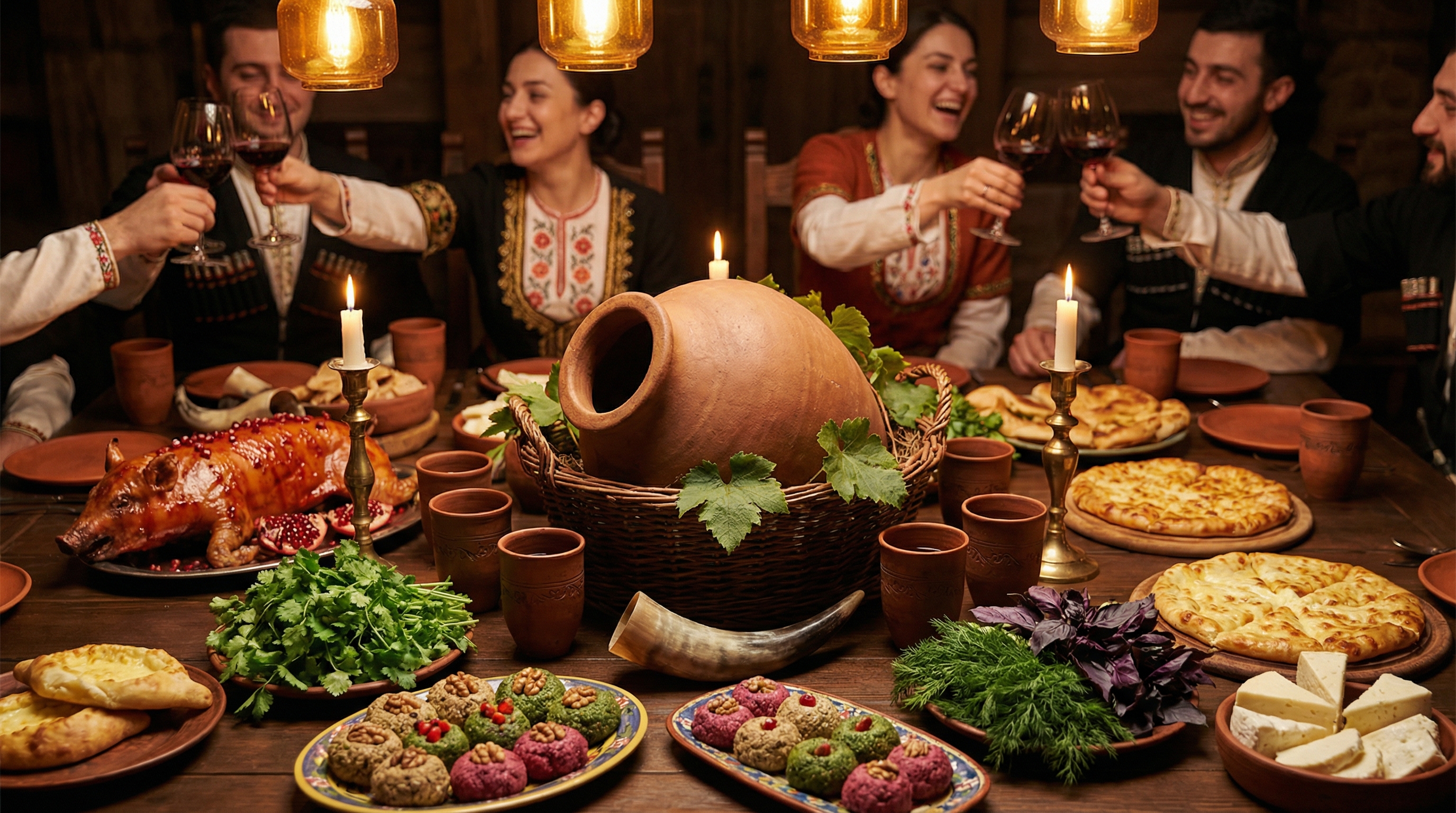
- Georgian cuisine: Khachapuri (cheese bread), khinkali (dumplings), walnut-stuffed vegetables — the wines evolved alongside these dishes
- Japanese cuisine: Ramen, yakitori, tempura, fermented vegetables — the umami character of orange wine resonates with Japanese flavors
- Indian and Middle Eastern: Curries, tagines, hummus, falafel — the tannin and spice of orange wine match complex spice profiles
- Aged cheese: Comté, Parmigiano-Reggiano, Manchego — the tannic structure and nutty flavors complement aged cheese brilliantly
- Mushroom dishes: Risotto ai funghi, mushroom ragù, truffle pasta — the earthy character of orange wine amplifies mushroom umami
- Charcuterie: Mortadella, coppa, bresaola — orange wine bridges the gap between white and red, making it ideal for cured meats
“Orange wine is the answer to a question that sommeliers have been asking for years: what do you pour with a diverse, spice-driven menu that defeats conventional white and red wine? The answer was always there, buried in the ground in a clay pot in Georgia.”
— Simon Woolf, author of Amber Revolution
The Debate: Fad or Future?
The argument over orange wine shows no signs of resolution, and perhaps that is the point. Like all genuinely important developments in wine, it challenges comfortable assumptions and forces drinkers to expand their frame of reference.
The critics' case is not without merit. Some orange wines are genuinely flawed — volatile, murky, and unpleasant in ways that have nothing to do with intentional style and everything to do with poor winemaking. The natural wine movement's occasional reluctance to acknowledge faults has not helped the category's credibility. And the trendiness of orange wine has attracted producers who macerate white grapes not because they believe in the technique but because amber-colored bottles sell well in certain markets.
But the case for orange wine is powerful and, ultimately, more persuasive. The technique is not a gimmick — it is the original method of winemaking, validated by 8,000 years of continuous practice. The best orange wines are not faulty; they are profoundly complex, age-worthy, and food-friendly in ways that conventional white wines cannot match. And the category's growth has driven a larger conversation about diversity and tradition in wine — pushing back against the homogenization that threatened to make every Chardonnay taste the same regardless of where it was grown.
Simon Woolf, whose 2018 book Amber Revolution remains the definitive English-language account of the orange wine movement, puts it succinctly:
"Orange wine is not a fad. Fads do not have 8,000 years of history behind them. What we are witnessing is not the birth of something new but the rediscovery of something ancient — a rediscovery that is enriching the wine world immeasurably."
A Practical Guide to Exploring Orange Wine
Where to Start
| Producer | Country | Wine | Style | Price |
|---|---|---|---|---|
| Pheasant's Tears | Georgia | Rkatsiteli | Medium maceration, qvevri | $18-$25 |
| Radikon | Italy (Friuli) | Jakot | Long maceration, large oak | $35-$50 |
| COS | Italy (Sicily) | Pithos Bianco | Medium maceration, amphora | $25-$35 |
| Gut Oggau | Austria | Theodora | Light maceration, playful | $25-$35 |
| La Stoppa | Italy (Emilia-Romagna) | Ageno | Extended maceration, rich | $25-$40 |
| Kabaj | Slovenia | Rebula | Medium maceration, balanced | $20-$30 |
| Donkey & Goat | USA (California) | The Gadabout | Light maceration, accessible | $22-$30 |
| Testalonga | South Africa | El Bandito Skin | Short maceration, vibrant | $20-$28 |
Serving Tips
- Temperature: Serve at 12-16°C (54-61°F) — cooler than red wine, warmer than most whites. Too cold mutes the complex aromatics; too warm emphasizes tannin.
- Decanting: Many orange wines benefit from 30-60 minutes of air. Older or more tannic examples may need 1-2 hours.
- Glassware: Use a medium-sized wine glass — larger than a standard white wine glass to allow the aromatics to develop, but not an oversized Burgundy bowl.
- Patience: Give the wine time. Orange wine often changes dramatically in the glass over 20-30 minutes, revealing new layers of complexity as it opens up.
The Future of Orange
As we move through the 2020s, orange wine is consolidating its position as the fourth color of wine. Annual production continues to grow. Major wine retailers now stock dedicated orange wine sections. Wine education programs including WSET and the Court of Master Sommeliers have incorporated skin-contact whites into their curricula. And a new generation of winemakers — in places as diverse as Tasmania, Patagonia, and the Republic of Georgia — is exploring what skin contact can reveal about their terroir.
The most optimistic prediction is that orange wine will eventually be as unremarkable as rosé — a category so normalized that ordering it requires no explanation or defense. The most pessimistic prediction is that it will settle into a permanent niche, beloved by a dedicated minority and ignored by the mainstream.
The truth will likely fall somewhere in between. But whatever happens, the impact of the orange wine movement on the broader wine world is already profound and irreversible. It has expanded our understanding of what wine can be. It has reconnected us with ancient traditions. It has challenged the dominance of technology-driven winemaking. And it has given us a category of wines that, at their best, offer an experience unlike anything else — ancient, modern, familiar, and utterly strange, all in a single glass.


