History and Transformation: From Bulk Wine Lake to Quality Revolution
For most of the twentieth century, the Languedoc-Roussillon was France's embarrassment — an immense expanse of flatland vineyards stretching from Nîmes to the Spanish border, producing cheap red wine destined for blending or distillation. By the 1970s, the region accounted for roughly 40% of all French wine production by volume, yet almost none carried any reputation for quality. The European Union paid growers subsidies to rip out vines.
The transformation that began in the late 1980s and accelerated through the 1990s is one of modern wine's most dramatic quality revolutions. Ambitious producers began replanting hillside parcels with noble varieties, slashing yields from 100+ hectoliters per hectare down to 30–40, and adopting rigorous vineyard management. Aimé Guibert at Mas de Daumas Gassac near Aniane had already proven in the 1970s that Languedoc terroir could produce wines of classified-growth quality. By the mid-1990s, dozens of producers were following his lead.
Today, Languedoc-Roussillon remains France's largest wine-producing region, with approximately 200,000 hectares under vine — producing roughly 30% of all French wine. The flatland vineyards that once churned out bulk wine have been reduced by half, while hillside appellations have expanded. The region now holds 28 AOC appellations and 12 IGP designations, and its best wines compete with the Rhône and Provence at a fraction of the price.
Terroir and Climate: Mediterranean Diversity
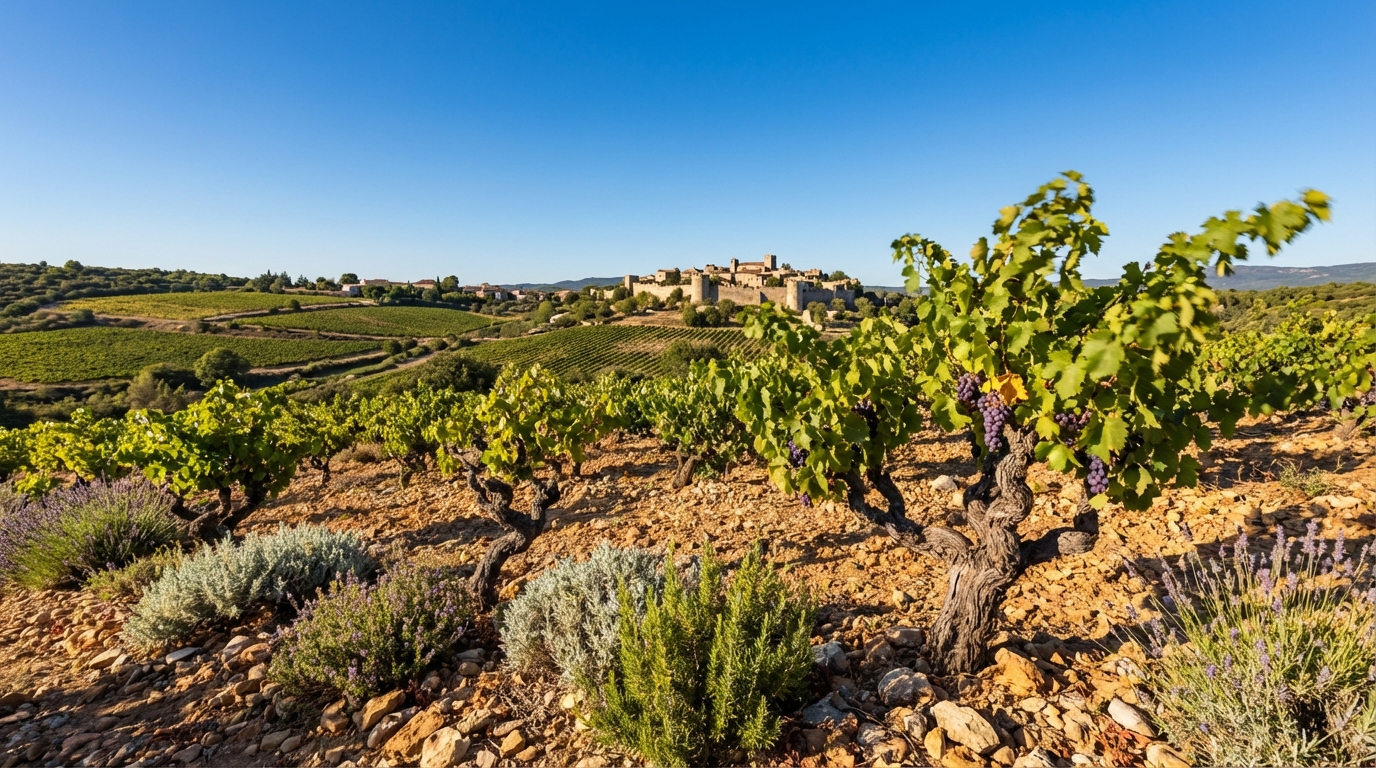
The Languedoc-Roussillon stretches over 240 kilometers of Mediterranean coastline, from the Rhône delta in the east to the Pyrenees foothills in the southwest, and inland toward the Massif Central. This enormous area encompasses a startling range of terroirs hidden beneath the umbrella of a single regional name.
The climate is classically Mediterranean: hot, dry summers exceeding 35°C, mild winters, and rainfall concentrated in autumn and spring. Annual precipitation averages 400–600 mm — low enough that drought stress is a real concern. The dominant Tramontane wind, a cold, dry northwesterly funneling between the Pyrenees and Massif Central, can blow 300 days per year in the Roussillon, drying the canopy and virtually eliminating fungal disease pressure.
The geological diversity is extraordinary. Coastal plains sit on alluvial clay and gravel that historically produced bulk wine. Inland, Corbières and Minervois are built on limestone, schist, and sandstone with thin topsoils that restrict vigor and concentrate flavor. Faugères sits on pure Devonian schist — the same formation found in the Priorat — giving wines unusual mineral intensity. La Clape, a former island near Narbonne, offers white limestone soils producing some of the south's most distinctive whites.
Altitude moderates the heat critically. The best parcels in Pic Saint-Loup sit at 200–400 meters, those in the Fenouillèdes at 300–500 meters, and Limoux vineyards at 200–500 meters — high enough to maintain acidity levels that lower sites rarely achieve.
Key Appellations: A Map of Quality
The sheer number of appellations in the Languedoc-Roussillon can overwhelm newcomers, but a handful of key names define the region's quality landscape.
Corbières, the largest appellation at over 10,000 hectares, produces muscular, garrigue-scented reds from Carignan, Grenache, and Syrah on rugged limestone and schist hillsides. Neighboring Minervois — and its more prestigious sub-zone Minervois-La Livinière — offers slightly more elegance, with rounder, darker-fruited reds from similar blends grown on tiered limestone terraces.
Faugères and Saint-Chinian sit side by side in the foothills of the Cévennes mountains. Faugères is entirely schist — every vineyard, without exception — producing wines with a distinctive slate-mineral character and fine, silky tannins. Saint-Chinian divides into two geological zones: schist in the north (similar to Faugères) and clay-limestone in the south, which yields denser, more powerful wines.
Pic Saint-Loup, north of Montpellier, has become arguably the most fashionable appellation in the region. Its combination of altitude, diurnal temperature variation (up to 20°C between day and night), and limestone soils produces reds of remarkable freshness and aromatic complexity — often compared to Northern Rhône Syrah in their peppery, cool-climate character, despite sitting firmly in the Mediterranean zone.
La Clape, elevated to full AOC status in 2015 after years as a Coteaux du Languedoc sub-zone, produces excellent whites from Bourboulenc, Grenache Blanc, and Marsanne alongside robust reds. Fitou, the oldest AOC in the Languedoc (dating from 1948), straddles the border between Languedoc and Roussillon with powerful Carignan-based reds.
Limoux, tucked into the cool foothills of the Pyrenees, stands apart as the region's sparkling-wine capital. Its Blanquette de Limoux — based on the indigenous Mauzac grape — claims to be the world's oldest sparkling wine, predating Champagne by over a century. The appellation also produces Crémant de Limoux (traditional method, Chardonnay-dominant) and increasingly good still Chardonnay.
In the Roussillon, Maury and Banyuls produce profound fortified wines (see below), while Collioure — sharing the same terroir as Banyuls on the steep schist hillsides above the Mediterranean — produces intense, age-worthy dry reds from old-vine Grenache and Mourvèdre.
Grape Varieties: The Southern French Palette
The Languedoc-Roussillon's grape repertoire reflects its position as a crossroads between the Rhône Valley, Provence, Catalonia, and the broader Mediterranean basin.
Grenache Noir is the most widely planted quality red variety, thriving in the region's heat and drought conditions. It delivers the warm, ripe red-fruit core of most blends, along with the signature garrigue aromatics — thyme, rosemary, lavender — that mark southern French reds. In the Roussillon, old-vine Grenache on schist (some parcels exceeding 100 years in age) produces wines of astonishing concentration and depth.
Syrah arrived from the Northern Rhône during the quality revolution and has become the region's most important blending partner with Grenache. It contributes color, structure, pepper, and dark-fruit intensity. At altitude — particularly in Pic Saint-Loup and the higher zones of Saint-Chinian — Syrah can produce monovarietal wines of genuine complexity.
Mourvèdre adds tannic backbone and meaty, savory complexity to blends, particularly in coastal appellations where it ripens fully. Carignan, once reviled as a bulk-wine workhorse, has been dramatically rehabilitated. Old-vine Carignan (typically from bush vines planted 50–80 years ago) — vinified by carbonic maceration or careful whole-cluster fermentation — produces wines of remarkable depth, with dark plum fruit and an earthy, mineral character that no other variety quite replicates. Many of the region's most characterful wines now proudly feature Carignan as a major component. Cinsault, the lightest of the traditional varieties, appears primarily in rosés and adds aromatic lift to red blends.
For whites, Picpoul de Pinet is the most commercially significant — a crisp, saline, lemon-zest white from vineyards around the Étang de Thau lagoon near Sète. Rolle (Vermentino) produces aromatic, medium-bodied whites across the coastal zones. Grenache Blanc, Marsanne, Roussanne, and Clairette form the backbone of serious white blends in La Clape, Minervois, and the Roussillon. Viognier appears in both monovarietal bottlings and blends, contributing its trademark apricot and floral aromatics. The indigenous Bourboulenc and Mauzac round out a diverse white portfolio.
Sweet Wine Traditions: Vins Doux Naturels
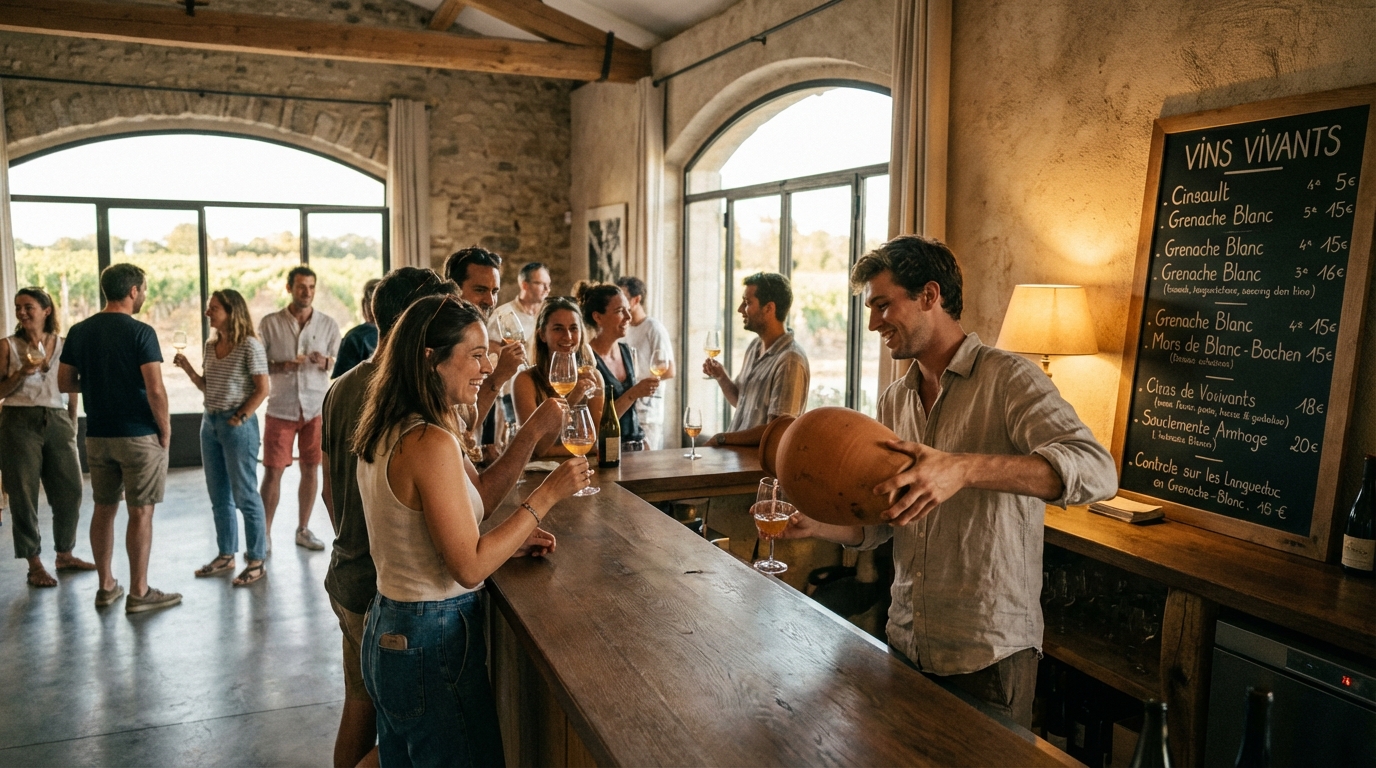
The Roussillon is one of the world's great — and tragically underappreciated — sources of sweet fortified wine. The tradition of Vins Doux Naturels (VDN) dates to the thirteenth century, when Arnaud de Villeneuve, a physician at the University of Montpellier, first applied the technique of mutage — arresting fermentation by adding grape spirit to the fermenting must, preserving natural residual sugar.
Banyuls, produced on vertiginous schist terraces above the Mediterranean near the Spanish border, is the flagship. Made primarily from Grenache Noir (minimum 50%, often 75–100%), Banyuls ranges from young, fruit-driven Rimage bottlings to profoundly complex Banyuls Grand Cru aged for a minimum of 30 months in barrel. The oxidative versions develop extraordinary aromas of walnut, cocoa, dried fig, coffee, and caramel, rivaling the finest Tawny Ports while possessing a distinctly Mediterranean personality.
Maury, inland on schist and limestone near Perpignan, produces a similar range of Grenache-based fortified wines. Since 2011 Maury has also been granted a dry red AOC (Maury Sec), but the traditional fortified bottlings remain among the Roussillon's most compelling wines.
Rivesaltes, the broadest VDN appellation, produces fortified wines from Grenache, Muscat, and Macabeu. Muscat de Rivesaltes — from Muscat à Petits Grains and Muscat of Alexandria — is the lightest style: golden, floral, and lusciously sweet, best served well-chilled. The aged amber and tuilé styles can reach extraordinary complexity after decades in barrel or glass demijohns exposed to the elements.
Muscat de Frontignan, in the Languedoc proper, produces a richer, more honeyed Muscat VDN from limestone slopes near the coast.
The Natural Wine Hub: A Culture of Independence
The Languedoc-Roussillon has become one of the world's most important centers of the natural wine movement. Land prices far below Burgundy or Bordeaux allow young winemakers to establish themselves without crippling debt. The dry, windy climate makes organic viticulture significantly easier than in cooler regions. And the lack of a rigid historic quality hierarchy fosters experimentation over conformity.
Domaine Léon Barral in Faugères was among the pioneers, converting to biodynamic viticulture in the early 1990s. Domaine Gauby in the Roussillon — Gérard Gauby's obsessive focus on soil health and minimal intervention — has become one of the most revered estates in southern France.
The hills around Faugères and Saint-Chinian, and the Roussillon villages of Calce, Maury, and Latour-de-France have attracted concentrations of natural winemakers. Producers like Clos des Fées (Hervé Bizeul), Domaine Matassa (Tom Lubbe), Olivier Pithon, and Roc des Anges (Marjorie Gallet) represent a generation making wines that are both avant-garde and deeply rooted in terroir.
Over 35% of Languedoc vineyards are now certified organic or in conversion — the highest proportion of any major French wine region.
Top Producers: The Region's Standard-Bearers
Mas de Daumas Gassac (Aniane) — The estate that proved the Languedoc could produce world-class wine. Founded by Aimé Guibert in the 1970s on unique glacial gravel soils, the red (Cabernet Sauvignon-based, unusually for the region) remains one of southern France's most celebrated wines.
Domaine de la Grange des Pères (Aniane) — Laurent Vaillé's tiny estate produces one red and one white in minuscule quantities. The red, from Syrah, Mourvèdre, and Cabernet Sauvignon, is frequently compared to great Northern Rhône wines for complexity and longevity.
Gérard Bertrand (Narbonne) — The largest quality-focused producer in the region, spanning multiple appellations. His Clos d'Ora from Minervois-La Livinière demonstrates genuine luxury-tier quality.
Mas Jullien (Jonquières) — Olivier Jullien was among the early revolutionaries of the 1990s. His reds from Mourvèdre, Carignan, Syrah, and Grenache — and whites from Chenin Blanc and Clairette — are benchmarks of terroir expression.
Domaine Gauby (Calce, Roussillon) — Gérard Gauby's whites, particularly Coume Gineste, rank among the finest in the Mediterranean basin. His reds from old-vine Grenache and Carignan on schist are equally profound.
Domaine Léon Barral (Faugères) — Didier Barral's biodynamic estate, where cattle graze the vineyards and old-vine Carignan receives the reverence Burgundy reserves for Pinot Noir.
Clos des Fées (Vingrau, Roussillon) — Hervé Bizeul, a former sommelier, produces powerful wines from old Grenache on schist. His top cuvée, Le Clos, is one of the Roussillon's most sought-after bottles.
Food Pairing: A Table Built for the Sun
The wines of Languedoc-Roussillon are inseparable from the cuisine they were born alongside — the robust, herb-laden, olive-oil-rich cooking of the French Mediterranean. Matching these wines with food is less about precision pairing and more about sharing a table that celebrates the same climate and ingredients.
Rich red blends from Corbières, Minervois, and Faugères are natural companions for cassoulet — the iconic bean and sausage casserole of Carcassonne and Toulouse. The tannin cuts through duck confit and Toulouse sausage, while garrigue herbal notes echo the thyme and bay leaf in the braise. Grilled lamb with herbes de Provence, wild boar stew with olives, and duck breast with figs are equally harmonious.
Picpoul de Pinet is one of the world's great oyster wines — its bright acidity and saline minerality mirror the briny character of Bouzigues oysters cultivated in the Étang de Thau just meters from the vineyards. It pairs equally well with grilled sardines, bouillabaisse, or anchovies with olive oil.
Banyuls and chocolate is one of wine's most celebrated pairings. The Grenache-based fortified wine's sweetness, tannin, and cocoa-coffee aromatics make it arguably the best match for dark chocolate desserts — better than Port, better than Madeira. Aged Banyuls and Rivesaltes also pair beautifully with Roquefort, hard aged sheep's milk cheeses, and walnut-based desserts.
For the region's rosés — from Cinsault, Grenache, and Syrah — think grilled vegetables, tapenade, ratatouille, and the full spectrum of Mediterranean summer cooking. These are outdoor wines, built for tables under plane trees.


