History and Overview
Tucked between Burgundy to the west and the Swiss border to the east, the Jura is one of France's smallest and most fiercely individual wine regions. Its approximately 2,000 hectares of vineyard — a fraction of Bordeaux's 110,000 or even Alsace's 15,500 — produce wines that exist nowhere else on Earth. This is the homeland of Vin Jaune, a golden, oxidative white aged under a veil of yeast for more than six years; of Vin de Paille, a honeyed straw wine of intense concentration; and of indigenous grape varieties like Savagnin, Poulsard, and Trousseau that have resisted globalization with quiet stubbornness.
The Jura's winemaking history stretches back to Roman antiquity, and by the medieval period the region's wines were prized across Europe. Pliny the Elder referenced wines from the area, and by the 14th century Jura wines were served at the French royal court. The region's most famous scientific son, Louis Pasteur, conducted his groundbreaking research on fermentation and microbiology in the 1860s partly using wines from Arbois, his hometown. Pasteur's house and vineyard remain a pilgrimage site for wine lovers and scientists alike — a reminder that the very foundations of modern enology were built with Jura wine in the glass.
By the early 20th century, however, the Jura had been devastated. Phylloxera, two World Wars, and rural depopulation reduced the vineyard area from roughly 20,000 hectares in the 19th century to barely 1,500 by the 1960s. For decades, the region slumbered in obscurity, its singular wines dismissed as curiosities. The revival began slowly in the 1980s and accelerated dramatically in the 2000s, driven by a convergence of the natural wine movement, a global appetite for authentic and unusual flavors, and a handful of visionary producers who understood that the Jura's supposed weaknesses — obscurity, tiny scale, odd grape varieties, oxidative winemaking — were in fact its greatest strengths.
Today the Jura enjoys cult status among sommeliers, collectors, and wine professionals worldwide. Allocations from top producers sell out instantly. Bottles of old-vintage Vin Jaune command prices that would have seemed unimaginable a generation ago. The region has gone from forgotten backwater to the most exciting frontier in French wine.
Terroir and Climate
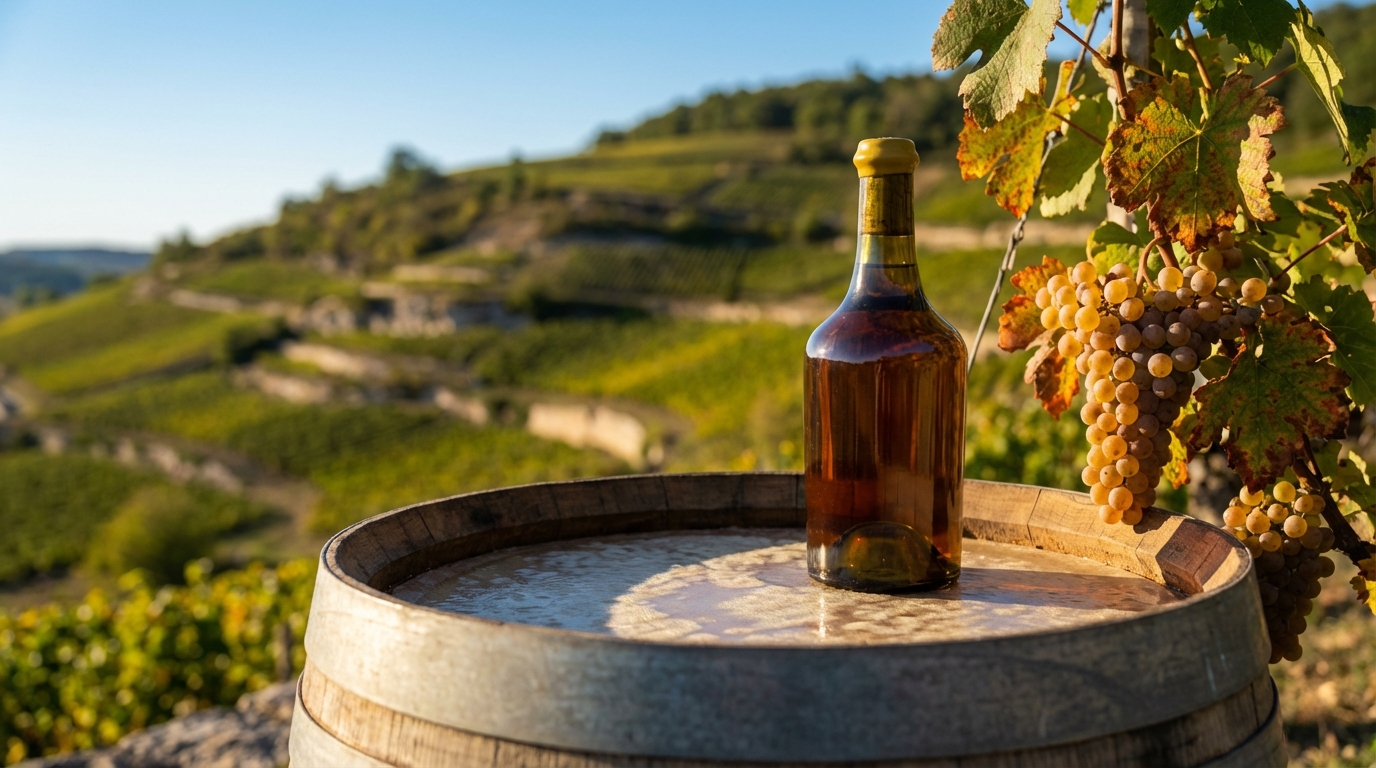
The Jura's vineyards occupy a narrow strip along the western edge of the Jura Mountains, running roughly 80 kilometers from north to south and rarely exceeding a few kilometers in width. The landscape is a patchwork of steep slopes, gentle hillsides, and small plateaus at elevations typically between 250 and 400 meters.
The geological signature of the region is written in its name. The Jurassic period (201–145 million years ago) takes its name from these very mountains, and the soils are overwhelmingly composed of Jurassic-era limestone, blue marl, and red marl — often layered in complex sequences that shift dramatically over short distances. Blue-grey lias marl (rich in clay and cool in temperature) dominates the lower slopes and is particularly prized for Savagnin, imparting a saline, stony minerality. Red marl (iron-rich, warmer, better drained) favors the red varieties Poulsard and Trousseau. Pure limestone scree and outcrops appear at higher elevations, adding chalky tension and verve to whites.
The climate is firmly continental, colder and more extreme than neighboring Burgundy. Winters are long and harsh, with heavy snowfall in the mountains; springs are unpredictable, with damaging frost a perennial threat; and summers, while warm, are shorter than in more southerly French regions. Annual rainfall of around 1,100 millimeters is significantly higher than Alsace or the southern Rhône, and the humidity can encourage both noble rot (useful for Vin de Paille) and less welcome fungal disease. These conditions demand resilient grape varieties and meticulous vineyard management — and they reward those who persevere with wines of uncommon freshness, acidity, and mineral complexity.
Grape Varieties
The Jura cultivates five principal grape varieties — three red (or near-red) and two white — each contributing a distinct voice to the region's polyphonic identity.
Savagnin is the Jura's signature white grape, genetically related to Traminer (the ancestor of Gewurztraminer) but producing a radically different wine. Savagnin is thick-skinned, late-ripening, and naturally high in acidity, making it ideally suited for the long oxidative aging required by Vin Jaune. Vinified in the oxidative (sous voile) style, Savagnin develops extraordinary aromas of walnut, curry, roasted apple, and beeswax. Vinified ouillé (topped up, without oxidation), it produces fresh, vibrant whites with notes of green apple, citrus, and mountain herbs. Savagnin occupies roughly 15% of the Jura's plantings.
Chardonnay is actually the most widely planted variety in the Jura, covering about 45% of vineyard area. Locally, Jura Chardonnay is sometimes still called Melon d'Arbois or Gamay Blanc. It is vinified in both ouillé and sous voile styles, and Jura Chardonnay — particularly from sites on blue marl — can be stunning: leaner and more mineral than Burgundy, with a wiry acidity and flinty precision that speaks clearly of limestone terroir. It also forms the backbone of Crémant du Jura.
Poulsard (also spelled Ploussard in certain communes) is the Jura's most planted red variety, covering about 20% of the vineyard. It is one of the most gossamer-fine red grapes in existence — so pale and thin-skinned that its wines often resemble dark rosés rather than reds. Do not be deceived by the color: great Poulsard delivers haunting aromas of wild strawberry, rose hip, dried herbs, and subtle earthiness, with a silky texture and saline mineral finish. Its delicacy has made it a darling of the natural wine world.
Trousseau is rarer and more demanding, occupying roughly 5% of plantings. It requires the warmest sites on red marl and gravel soils to ripen properly. When it does, Trousseau produces the Jura's most structured and deeply colored reds — wines with real tannic grip, dark-fruit intensity, and spicy, peppery complexity. Top Trousseau cuvées from producers like Stéphane Tissot and Domaine de la Tournelle reward several years of cellaring.
Pinot Noir rounds out the red roster at about 15% of plantings. Jura Pinot Noir tends to be lighter and more rustic than Burgundy, but at its best it brings a cherry-scented charm and earthy depth. It is often blended with Poulsard and Trousseau.
Vin Jaune: Wine Under the Veil
Vin Jaune ("yellow wine") is the Jura's most famous and most extraordinary creation — a wine unlike anything else produced in France, or indeed almost anywhere in the world. Its closest stylistic relative is fino Sherry from Jerez, Spain, though the two are made from different grapes, in different climates, using different techniques, and Vin Jaune is never fortified.
The process begins with fully ripe Savagnin grapes, which are vinified to dryness. The young wine is then transferred to old 228-liter Burgundian barrels (pièces) that are deliberately not filled completely, leaving a substantial air gap. Over the following weeks, a film of indigenous yeast — the voile (veil), composed primarily of species related to those found in Sherry bodegas — forms spontaneously on the surface of the wine, protecting it from outright oxidation while allowing a slow, controlled chemical transformation.
The wine remains under its voile for a minimum of six years and three months, during which time it loses roughly 40% of its volume to evaporation — the so-called part des anges (angel's share). The barrels are never topped up. This extraordinarily long, slow aging concentrates the wine and develops a flavor profile of staggering complexity: walnuts, curry spice, dried apricot, toasted almonds, saffron, beeswax, and a penetrating saline minerality. The texture is dense and oily, the acidity bracing, and the finish can last for minutes.
Vin Jaune is bottled exclusively in the iconic clavelin — a squat, 62-centiliter bottle (rather than the standard 75 cl) that represents the amount of wine remaining from an original liter after six years of evaporative aging. It is one of the most recognizable bottle shapes in the wine world.
The appellation Château-Chalon is dedicated entirely to Vin Jaune and is widely regarded as producing the finest, most age-worthy examples. Vin Jaune from Château-Chalon is subject to the most rigorous selection: in years when the tasting commission judges the wine unworthy, the entire vintage is declassified — a measure of quality control almost unique in French winemaking. Great Vin Jaune can age for 50 to 100 years or more, developing ever deeper layers of complexity.
Vin de Paille and Other Styles
Beyond Vin Jaune, the Jura produces a kaleidoscope of wine styles that reward exploration.
Vin de Paille ("straw wine") is the region's great sweet wine. Historically, selected bunches of Savagnin, Chardonnay, and Poulsard were laid on straw mats (paille) to dry and concentrate for a minimum of six weeks before pressing and fermentation. Today, most producers use hanging racks or perforated crates rather than actual straw, but the principle remains: passerillage (desiccation) concentrates sugars to extraordinary levels. The resulting wine is golden, unctuous, and intensely flavored — dried apricot, honey, quince, caramel, and spice — with enough acidity to maintain freshness across decades of aging. Vin de Paille is bottled in small 375-milliliter bottles and produced in tiny quantities.
Macvin du Jura is the region's vin de liqueur (mistelle), made by blending unfermented grape juice (must) with marc du Jura (grape brandy) aged in oak for at least 14 months. The result is sweet, grapey, and spiritous — served chilled as an apéritif or with foie gras and desserts. Macvin holds its own AOC designation.
Crémant du Jura is the region's traditional-method sparkling wine, produced primarily from Chardonnay with additions of Pinot Noir, Poulsard, Trousseau, and Savagnin permitted. Quality has risen dramatically in recent years, and the best Crémant du Jura — particularly those with extended lees aging — offer excellent value and genuine complexity. Production now accounts for a significant share of the region's output.
Ouillé whites (both Chardonnay and Savagnin vinified without oxidation, in topped-up barrels or stainless steel) represent the Jura's fastest-growing category. These fresh, precise wines have attracted a new generation of drinkers who appreciate the region's terroir without the challenging oxidative character of traditional styles. Ouillé Savagnin, in particular, has become one of the most sought-after white-wine styles among sommeliers.
Appellations
The Jura operates under four principal AOC designations, each with its own character and geographic scope.
Arbois is the largest and most historically significant appellation, centered on the town of Arbois — the Jura's unofficial wine capital and Pasteur's hometown. Arbois covers roughly 850 hectares and produces all styles: red (Poulsard, Trousseau, Pinot Noir, and blends), white (Chardonnay and Savagnin in both ouillé and oxidative styles), Vin Jaune, and Vin de Paille. The sub-commune of Arbois-Pupillin is particularly renowned for its Poulsard and has its own distinct identity.
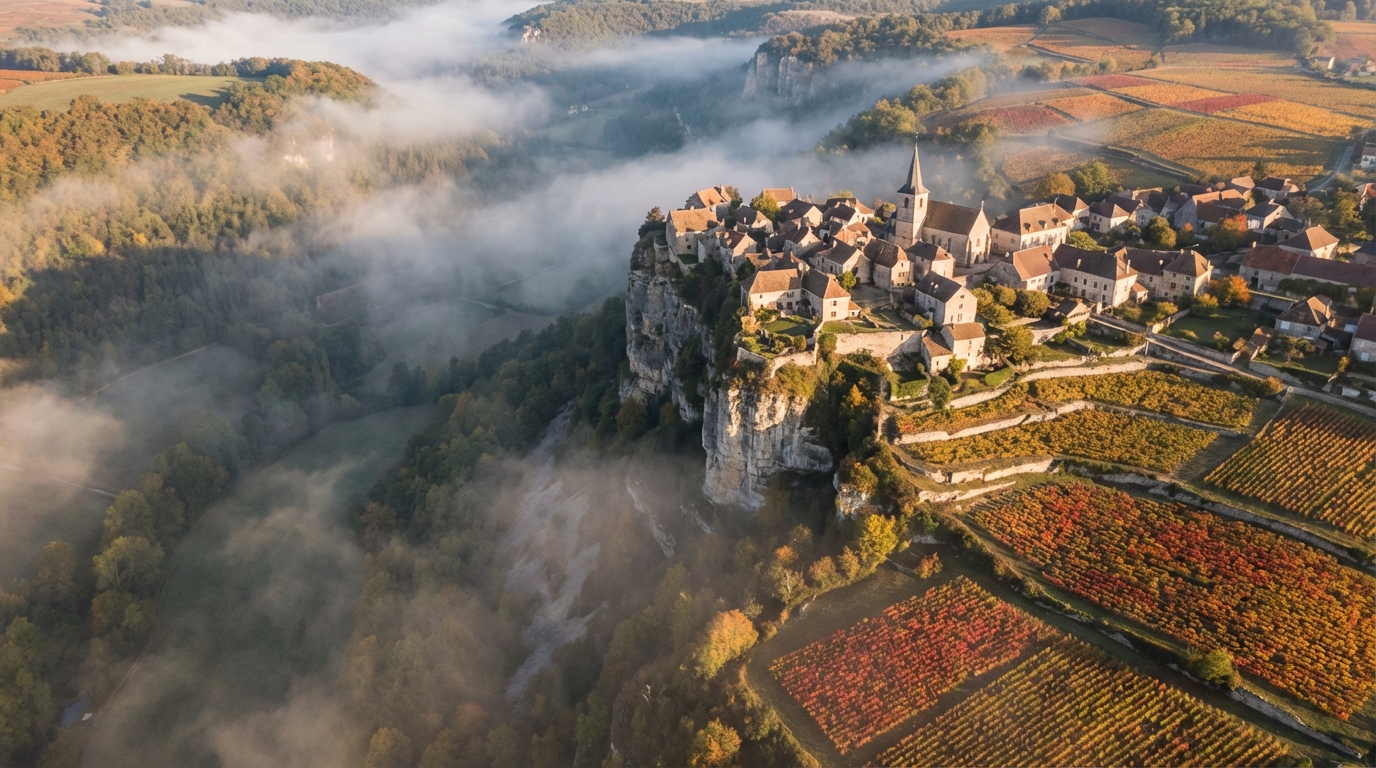
Château-Chalon is the Jura's most prestigious appellation, covering approximately 50 hectares on steep slopes of blue and grey marl overlooking the Seille valley. It is dedicated exclusively to Vin Jaune from Savagnin grapes. The tasting commission that oversees Château-Chalon is notoriously strict — entire vintages are refused in lesser years. The hilltop village itself, perched dramatically on its limestone bluff, is one of the most scenic in the region.
L'Étoile ("the star") takes its name from the tiny, star-shaped crinoid fossils found in its limestone soils. This small appellation of roughly 70 hectares produces exclusively white wines, Vin Jaune, Vin de Paille, and Crémant. Chardonnay dominates here, and L'Étoile whites are known for their particular elegance, mineral precision, and floral lift.
Côtes du Jura is the catch-all regional appellation covering the entire Jura vineyard area outside the three named appellations. At approximately 600 hectares, it produces the full range of Jura wine styles and includes many excellent individual terroirs. Some of the region's finest producers — including Jean-François Ganevat — work primarily within the Côtes du Jura appellation, demonstrating that great wine in the Jura is as much about the vigneron as the appellation hierarchy.
The Natural Wine Revolution
No account of the modern Jura is complete without acknowledging the region's central role in the natural wine movement. The Jura is, in many ways, the spiritual homeland of low-intervention winemaking in France, and its influence on global wine culture over the past three decades has been vastly disproportionate to its tiny size.
The towering figure is Pierre Overnoy, who began farming organically and making wines without added sulfur in Pupillin in the 1980s — decades before "natural wine" became a recognized concept. Overnoy's Poulsard and Savagnin, made with obsessive care in tiny quantities, proved that wines of extraordinary purity and longevity could be produced without chemical intervention. His bottles now sell for hundreds of euros and are among the most coveted wines in the world. Overnoy's protégé, Emmanuel Houillon, continues the estate's traditions with the same uncompromising philosophy.
Stéphane Tissot (Domaine André et Mireille Tissot) in Arbois has been instrumental in elevating the Jura's reputation internationally. Farming 50 hectares biodynamically — an enormous holding by Jura standards — Tissot produces a staggering range of wines across every Jura style, from crystalline ouillé Chardonnay to profound Vin Jaune, exceptional Trousseau, and some of the region's finest Crémant. His meticulous vineyard-by-vineyard bottlings have demonstrated the Jura's capacity for terroir expression rivaling Burgundy.
Jean-François Ganevat returned to his family estate in Rotalier in 1998 after years of working in Burgundy and has since become one of the most celebrated winemakers in France. Ganevat's approach combines Burgundian precision with Jurassien soul: he farms ancient vines on steep marl slopes, ferments with native yeasts, and handles each parcel as a distinct entity. His Côtes du Jura whites and reds — bottled under a dizzying array of cuvée names — are benchmarks of natural winemaking. Allocations are virtually impossible to obtain.
Other key figures in the Jura's natural wine constellation include Domaine de la Tournelle (Evelyne and Pascal Clairet in Arbois), Julien Labet (who bottles from individual parcels in the southern Jura with extraordinary precision), Domaine des Miroirs (Kenjiro Kagami, a Japanese producer making ethereal wines near L'Étoile), Alice Bouvot (Domaine de l'Octavin), and Philippe Bornard (Pupillin). Collectively, these producers have established the Jura as the world's most concentrated source of exceptional natural wine.
Food Pairing
The Jura's wines and cuisine exist in a relationship of perfect mutual dependence — this is one of those rare regions where the local food and the local wine seem to have evolved specifically for each other.
The supreme pairing is Vin Jaune with Comté cheese. Both are products of long, patient aging in the same terroir — Comté matures in caves along the Jura mountain chain, developing nutty, caramelized flavors that mirror and amplify the walnut and curry notes of Vin Jaune. A 10-year-old Vin Jaune with a 24-month Comté is one of the great gastronomic experiences of France.
Poulet au Vin Jaune et aux morilles (chicken in Vin Jaune cream sauce with morel mushrooms) is the Jura's most iconic dish. The rich, nutty reduction sauce demands the wine it is made from: serving Vin Jaune alongside the dish creates an echo chamber of flavors — walnut, cream, mushroom earth, and saline depth — that is profoundly harmonious.
Jura reds, with their delicacy and earthy charm, pair beautifully with charcuterie — the region produces excellent saucisse de Morteau (smoked sausage), jambon cru, and terrines. Poulsard, with its ethereal texture and strawberry-herbal aromatics, is exceptional with cold cuts, pâtés, and lightly dressed salads. Trousseau, with its greater tannic structure, stands up to heartier fare: braised meats, game birds, and gratins enriched with local cheese.
Ouillé Chardonnay and Savagnin are superb with freshwater fish from the Jura's lakes and rivers — trout, pike, and Arctic char — as well as with raclette, fondue, and other melted-cheese preparations. Crémant du Jura makes a lively apéritif and pairs admirably with gougères (cheese puffs) and smoked trout.
For dessert, Vin de Paille is a revelation alongside tarte aux noix (walnut tart), dried fruit, blue cheese, or simply a plate of roasted hazelnuts and honey. Its concentration and acidity make it far more than a simple sweet wine — it is a meditation in a glass, and a fitting conclusion to any Jura meal.


