The Oldest Wine Country You Have Been Ignoring
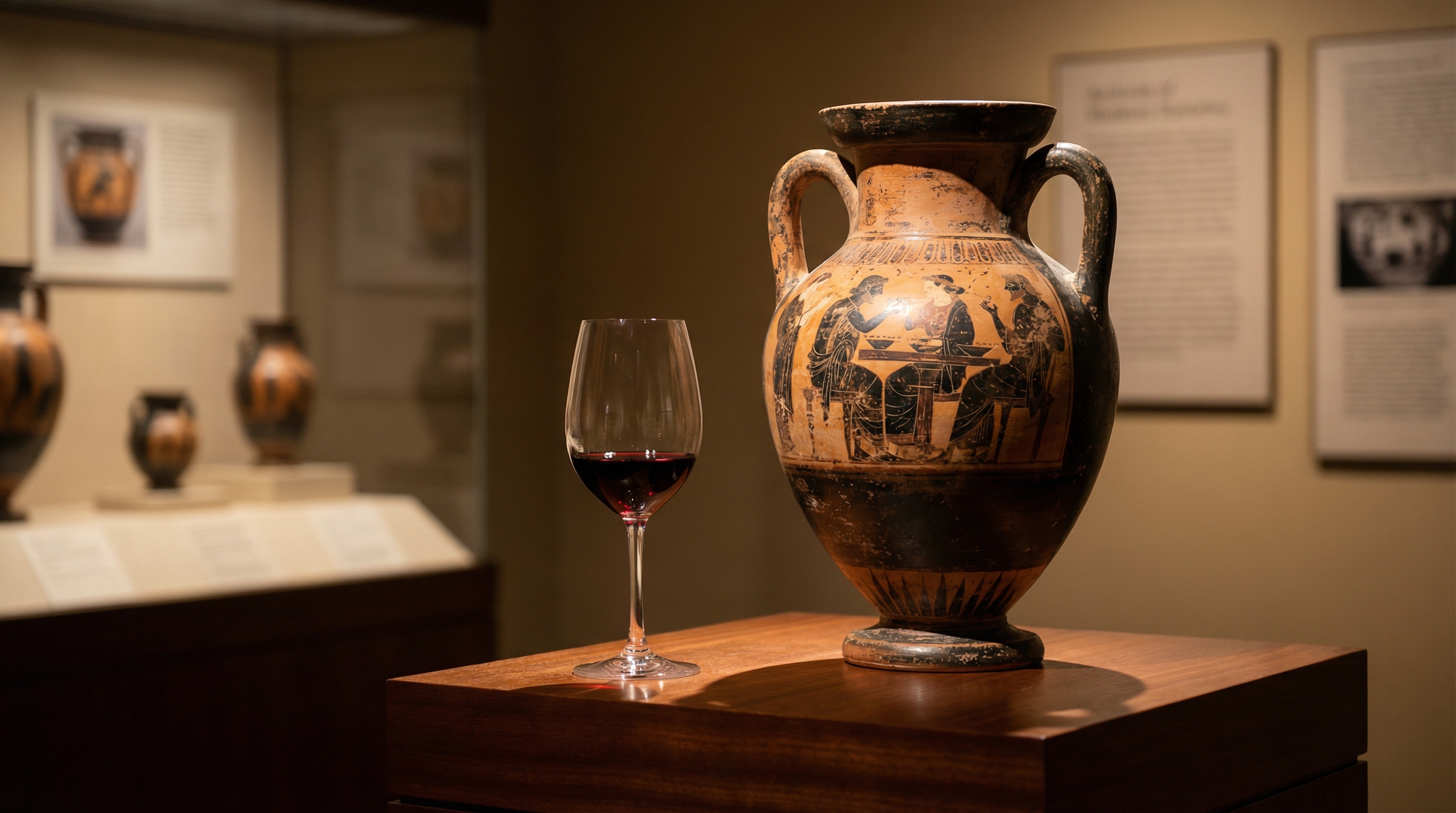
Greece has a stronger claim to being the birthplace of European wine culture than any other nation. Archaeological evidence confirms that wine was being produced on the Greek mainland and islands at least 6,500 years ago — predating the Romans by millennia. The ancient Greeks spread viticulture throughout the Mediterranean, from southern France to the Black Sea. Dionysus, the god of wine, was among the most revered figures in their pantheon. Greek amphoras have been found as far afield as Egypt, the Caucasus, and the Atlantic coast of Spain.
And yet, for most of the twentieth century, Greek wine was an afterthought on the world stage. It was associated with retsina — the pine-resin-flavored wine that tourists drank on vacation and swore never to drink again — and with cheap, oxidized bulk wine that bore little resemblance to the glories of the ancient past. A brutal combination of Ottoman occupation (during which viticulture was suppressed for centuries), phylloxera, two world wars, a civil war, and a military junta left the Greek wine industry shattered.
What has happened since the 1990s, however, is nothing short of revolutionary. A new generation of Greek winemakers — many educated in Bordeaux, Dijon, and Davis — has returned home to rediscover an astonishing treasure trove of indigenous grape varieties, volcanic terroirs, and high-altitude vineyards. They are making wines that compete with the best of Europe, at prices that represent extraordinary value. The Greek wine renaissance is one of the most exciting stories in the wine world today.
“Greece has more indigenous grape varieties than any other country in Europe. Each one is a unique voice waiting to be heard.”
— Yiannis Paraskevopoulos, Gaia Wines
The Indigenous Grape Advantage
Greece's greatest asset is its staggering biodiversity of indigenous grape varieties. More than 300 native varieties are catalogued, of which roughly 80 are in commercial production. While the international market has been fixated on Chardonnay, Sauvignon Blanc, Cabernet Sauvignon, and Merlot, Greece has quietly maintained a living library of unique cultivars that exist nowhere else on earth.
The most important indigenous varieties include:
White Grapes:
| Variety | Region | Character |
|---|---|---|
| Assyrtiko | Santorini, Macedonia | Piercing acidity, mineral, citrus, volcanic — Greece's greatest white |
| Malagousia | Macedonia, Attica | Aromatic, floral, peach — rescued from near-extinction in the 1970s |
| Moschofilero | Mantinia, Peloponnese | Aromatic, rose petal, crisp acidity — think Greek Gewurztraminer |
| Vidiano | Crete | Full-bodied, tropical, textured — Crete's rediscovered treasure |
| Robola | Cephalonia | Mineral, lemony, elegant — thrives on the limestone soils of the Ionian Islands |
| Athiri | Santorini, Rhodes | Light, floral, versatile — often blended with Assyrtiko |
Red Grapes:
| Variety | Region | Character |
|---|---|---|
| Agiorgitiko | Nemea, Peloponnese | Velvety, cherry, spice — Greece's most planted red, often called the "Blood of Hercules" |
| Xinomavro | Naoussa, Amyndeon | Tannic, tomato, olive, rose — Greece's answer to Nebbiolo |
| Mavrodaphne | Patras, Cephalonia | Sweet or dry, dark fruit, herbal — used for both fortified and table wines |
| Limnio | Lemnos, Macedonia | One of the oldest documented varieties, mentioned by Aristotle — earthy, herbal, savory |
| Mandilaria | Crete, Cyclades | Deep color, firm tannins — often blended to add structure |
| Kotsifali | Crete | Soft, fruity, aromatic — Crete's signature red, usually blended with Mandilaria |
The single most important variety in the Greek renaissance is Assyrtiko, a white grape that has become Greece's calling card on the international stage.
Santorini: Where Wine Meets Volcano
No discussion of Greek wine is complete without Santorini. This crescent-shaped volcanic island in the Cyclades produces some of the most distinctive and sought-after white wines in the Mediterranean — and does so under conditions that would defeat lesser vines.
Santorini's vineyards are among the most extreme in the world. The vines grow on volcanic ash and pumice deposits left by catastrophic eruptions, including the Minoan eruption of approximately 1600 BCE — one of the largest volcanic events in recorded history. There is virtually no clay or organic matter in the soil. Annual rainfall is a mere 350 millimeters. Temperatures in summer regularly exceed 35°C. Winds are relentless.
The vines — many of which are over a century old, because phylloxera never reached this waterless, sandy island — have adapted through a remarkable training system called kouloura (basket). Each vine is wound into a low, basket-shaped spiral that sits close to the ground, protecting the grapes from wind and capturing moisture from the morning dew.
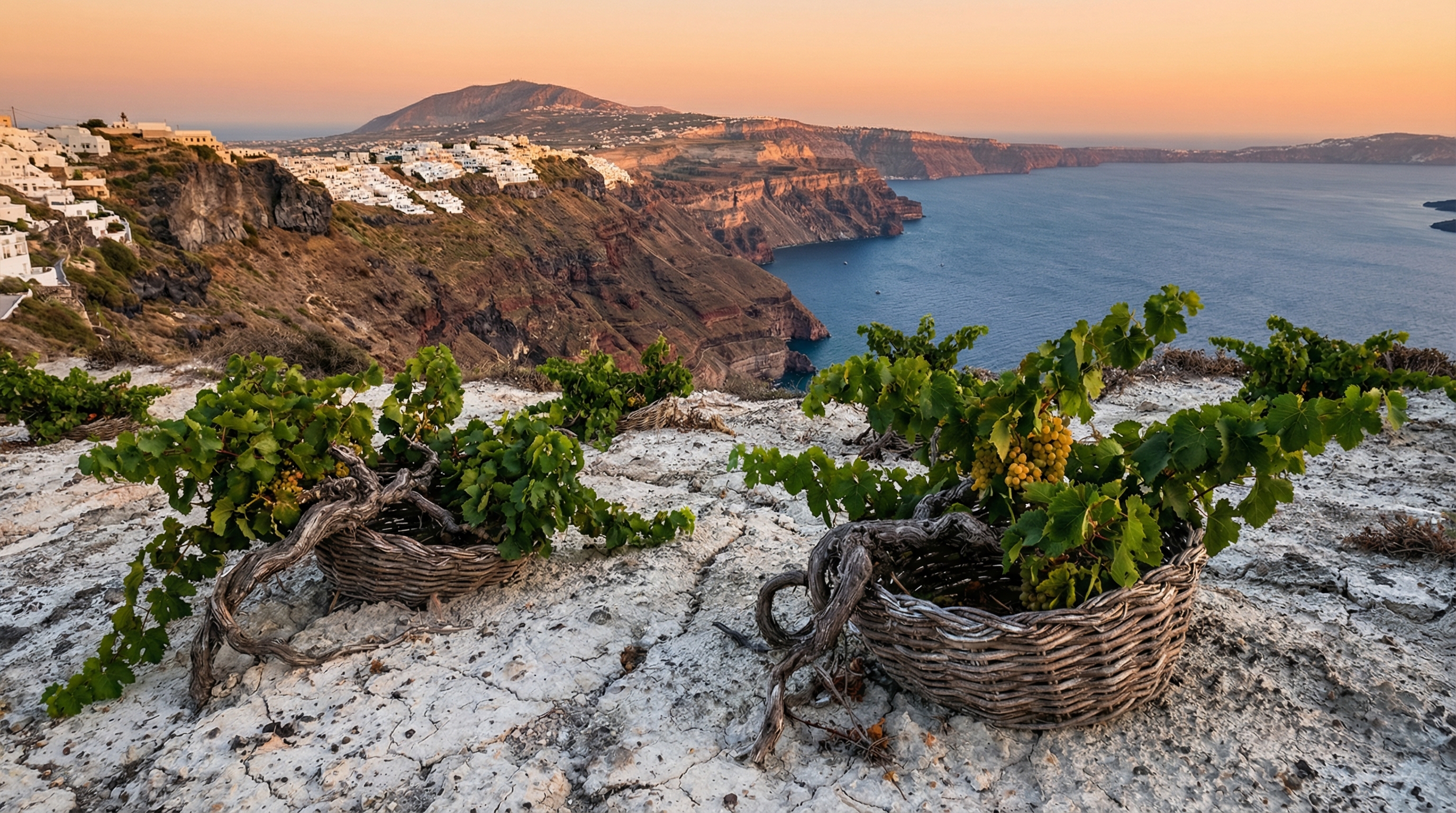
The wines produced from this otherworldly terroir are extraordinary. Santorini Assyrtiko combines electric, laser-like acidity with a saline minerality that speaks unmistakably of volcanic soil and sea air. The best examples age beautifully for a decade or more, developing complex notes of honey, lanolin, beeswax, and petrol that recall aged Riesling.
Key Santorini producers:
- Domaine Sigalas — Arguably Santorini's finest producer. Paris Sigalas's wines are paragons of precision and terroir expression. The barrel-fermented Assyrtiko is world-class.
- Estate Argyros — Fourth-generation family estate with some of the island's oldest vines. The Monsignori bottling, from vines over 200 years old, is breathtaking.
- Gaia Wines (Thalassitis) — Yiannis Paraskevopoulos's Santorini project, producing crystalline Assyrtiko that captures the essence of the island.
- Hatzidakis — The late Haridimos Hatzidakis was a visionary who proved Santorini could produce profound, age-worthy wines. His widow continues the legacy.
- Venetsanos — A historic winery perched dramatically on the caldera, combining spectacular views with excellent wines.
“Santorini is a place where the vine has been pushed to its absolute limit. What it gives back is wine of uncompromising purity.”
— Yiannis Paraskevopoulos, Gaia Wines
Nemea: The Blood of Hercules
If Santorini is Greece's white wine capital, Nemea is its red wine heartland. Located in the northeastern Peloponnese, Nemea is the home of Agiorgitiko — a versatile, generous red grape that has been cultivated here since antiquity. According to myth, the valley of Nemea is where Hercules slew the Nemean lion as the first of his twelve labors, and the deep crimson color of Agiorgitiko inspired the nickname "Blood of Hercules."
Nemea's terroir is remarkably diverse. Vineyards range from 250 meters on the valley floor to over 900 meters in the surrounding hills. This altitude variation produces dramatically different styles:
- Low-altitude (250-450m): Rich, ripe, soft Agiorgitiko with red fruit, spice, and approachable tannins — ideal for everyday drinking
- Mid-altitude (450-650m): More structured wines with better acidity, darker fruit, and aging potential
- High-altitude (650-900m): Taut, mineral, complex wines with firm tannins and remarkable longevity — the Grand Cru of Nemea
The best producers have learned to exploit this altitude gradient to produce wines of increasing sophistication:
- Domaine Skouras — George Skouras was among the first to demonstrate that Nemea could produce serious, age-worthy reds. His Grande Cuvée is a benchmark.
- Gaia Wines (Agiorgitiko by Gaia) — Elegant, site-specific bottlings that showcase the grape's potential.
- Semeli Estate — Consistent quality across a range of styles, from fresh rosé to concentrated reserves.
- Domaine Spiropoulos — Certified organic, producing Agiorgitiko with purity and finesse.
Naoussa: Greece's Barolo
If any Greek wine region can claim comparison with the great terroirs of Europe, it is Naoussa. Located in northern Greece on the southeastern slopes of Mount Vermion in Macedonia, Naoussa is home to Xinomavro — a grape of ferocious personality that has drawn inevitable comparisons to Nebbiolo and Pinot Noir.
Xinomavro (the name translates literally as "acid black") is not an easy grape to love on first encounter. It is tannic, high in acidity, and savory rather than fruity. Its aromatics lean toward tomato paste, sundried tomatoes, olive tapenade, dried roses, and dark earth. In youth, it can be stern and unapproachable. But with age — five, ten, twenty years — Xinomavro reveals a complexity and nuance that puts it in the company of the world's great red varieties.
Key Naoussa producers:
- Kir-Yianni — Founded by Yiannis Boutaris, one of the pioneers of modern Greek wine. The Ramnista bottling is Naoussa's benchmark — structured, complex, and age-worthy.
- Domaine Thymiopoulos — Apostolos Thymiopoulos is the young star of Naoussa, producing both fresh, vibrant Xinomavro and serious, terroir-driven single-vineyard wines from old vines.
- Boutari — The historic Boutari Grande Réserve Naoussa is one of the oldest continuously produced red wines in Greece, demonstrating Xinomavro's extraordinary aging potential.
- Domaine Dalamara — Kostis Dalamaras makes elegant, perfumed Xinomavro with a Burgundian sensibility.
- Alpha Estate — Based in nearby Amyndeon, producing stunning Xinomavro at even higher altitudes (620-710m), with brighter acidity and more delicate aromatics.
Crete: The Island of Wine
Crete is Greece's largest island and its most significant wine producer by volume. The island has been making wine for at least 4,000 years — the Minoan civilization was a major wine culture, and ancient Cretan wine was prized throughout the Mediterranean.
Today, Crete is experiencing its own renaissance. Indigenous varieties like Vidiano (white) and Kotsifali and Mandilaria (red) are being rediscovered and vinified with modern techniques. The island's diverse terroir — ranging from sea-level coastal plains to mountain vineyards above 800 meters — produces an extraordinary range of styles.
Notable Cretan producers include Lyrarakis, which has been instrumental in reviving rare varieties like Dafni and Plyto; Domaine Economou, which makes some of the most profound and age-worthy wines in Greece; and Douloufakis, which produces exceptional Vidiano.
The New Wave: Modern Greek Winemakers
The Greek wine revolution is driven by people — a generation of winemakers who combine international training with a deep reverence for their indigenous heritage:
- Yiannis Paraskevopoulos (Gaia Wines) — A PhD in oenology from Bordeaux, Paraskevopoulos is the intellectual godfather of modern Greek wine. His work with Assyrtiko on Santorini and Agiorgitiko in Nemea set the template for quality-focused Greek wine.
- Paris Sigalas (Domaine Sigalas) — A mathematician who became Santorini's most celebrated winemaker, producing Assyrtiko of crystalline precision.
- Apostolos Thymiopoulos (Domaine Thymiopoulos) — A young Naoussa winemaker whose energy and talent have focused international attention on Xinomavro.
- Vassilis Tsaktsarlis (Biblia Chora) — A Bordeaux-trained winemaker producing elegant wines in Pangeon, Macedonia, blending international and indigenous varieties with notable skill.
- Stellios Kechris — A pioneer working with the traditional retsina style, producing a barrel-aged "Tear of the Pine" that has won international acclaim and single-handedly rehabilitated retsina's reputation.
Greek Wine Regions at a Glance
| Region | Key Varieties | Style | Climate |
|---|---|---|---|
| Santorini | Assyrtiko, Athiri, Aidani | Mineral, volcanic, intense whites | Hot, dry, volcanic |
| Nemea | Agiorgitiko | Versatile reds, rosé | Warm Mediterranean, altitude variation |
| Naoussa | Xinomavro | Structured, age-worthy reds | Continental, cooler, higher altitude |
| Amyndeon | Xinomavro | Elegant reds, fine sparkling | Coolest mainland region |
| Macedonia (Pangeon) | Assyrtiko, Malagousia, Syrah | Modern blends, aromatic whites | Warm days, cool nights |
| Mantinia | Moschofilero | Aromatic, crisp whites, sparkling | High plateau (650m), cool |
| Cephalonia | Robola | Mineral, citrus whites | Maritime, limestone soils |
| Crete | Vidiano, Kotsifali, Mandilaria | Diverse reds and whites | Warm Mediterranean, mountain vineyards |
| Attica | Savatiano, Malagousia | Light whites, retsina | Warm, dry |
The Retsina Question
No article on Greek wine would be complete without addressing retsina — the resin-flavored wine that defined (and often embarrassed) Greek wine for generations. Retsina dates back to antiquity, when pine resin was used to seal amphoras and inadvertently flavored the wine. Over centuries, the flavor became intentional, and retsina became Greece's most recognizable wine.
Modern retsina has undergone its own revolution. Producers like Kechris, Mylonas, and Papagiannakos are making fresh, delicate versions that use subtle quantities of high-quality Aleppo pine resin, producing wines that are aromatic, balanced, and genuinely delicious — a far cry from the harsh, turpentine-like retsina of tourist memory. Paired with grilled seafood, mezes, and the Greek sun, good modern retsina is a revelation.
Visiting Greece for Wine
Greece is one of the most rewarding wine travel destinations in the world, combining extraordinary wines with ancient ruins, stunning landscapes, and legendary hospitality. Key tips:
- Santorini is a must-visit, but book winery visits in advance — the island is small and popular
- Naoussa and Amyndeon in Macedonia offer a completely different experience — rolling hills, cooler climate, and the chance to discover Xinomavro on home turf
- The Peloponnese (Nemea, Mantinia, Patras) combines wine with some of Greece's most important archaeological sites — ancient Nemea, Mycenae, and Olympia
- Crete is ideal for combining wine with history, beaches, and mountain hiking
- Athens has an excellent natural wine bar scene — Heteroclito is among the best wine bars in Europe, with an all-Greek wine list
Conclusion: A Country Reawakened
Greek wine is no longer a curiosity. It is a serious, diverse, and rapidly improving wine culture built on assets that no other country can match: thousands of years of continuous winemaking history, hundreds of indigenous grape varieties, volcanic and mountainous terroirs of extraordinary character, and a new generation of winemakers with the skill and ambition to realize their country's potential.
The wines offer astonishing value. A world-class Santorini Assyrtiko costs $20-$35. A top Naoussa Xinomavro — a wine that can age for two decades — is available for $25-$50. In an era of relentless fine wine inflation, Greece is a haven for the curious and the value-conscious.
The ancient Greeks gave wine to Western civilization. It is fitting that, 6,500 years later, they are reminding us why it matters.


