History and Overview of Beaujolais
Beaujolais is one of the most misunderstood wine regions in France — a place whose reputation was both made and nearly destroyed by a single product. Situated south of Burgundy, stretching from the granite hills above Villefranche-sur-Saône to the southern outskirts of Mâcon, the region covers approximately 15,500 hectares of vineyards across a remarkably varied landscape. For decades, the international market associated Beaujolais almost exclusively with Beaujolais Nouveau, the light, fruity wine released each November. That association obscured the fact that the region's finest wines — its ten crus — rank among the most compelling, terroir-driven reds in all of France.
The vineyards were historically worked by métayers, sharecroppers who paid their landlords in wine rather than cash. When négociants began promoting Nouveau as a global marketing event in the 1970s and 1980s, the resulting boom brought cash but encouraged a race to the bottom in quality. By the early 2000s, overproduction had plunged Beaujolais into crisis — millions of liters were distilled into industrial alcohol and vineyards were abandoned. What followed was a remarkable turnaround: a new generation of vignerons reclaimed cru vineyards, slashed yields, abandoned chemical farming, and began producing wines of startling depth. Today, cru Beaujolais is among the most sought-after red wine in the sommelier world.
The Gamay Grape
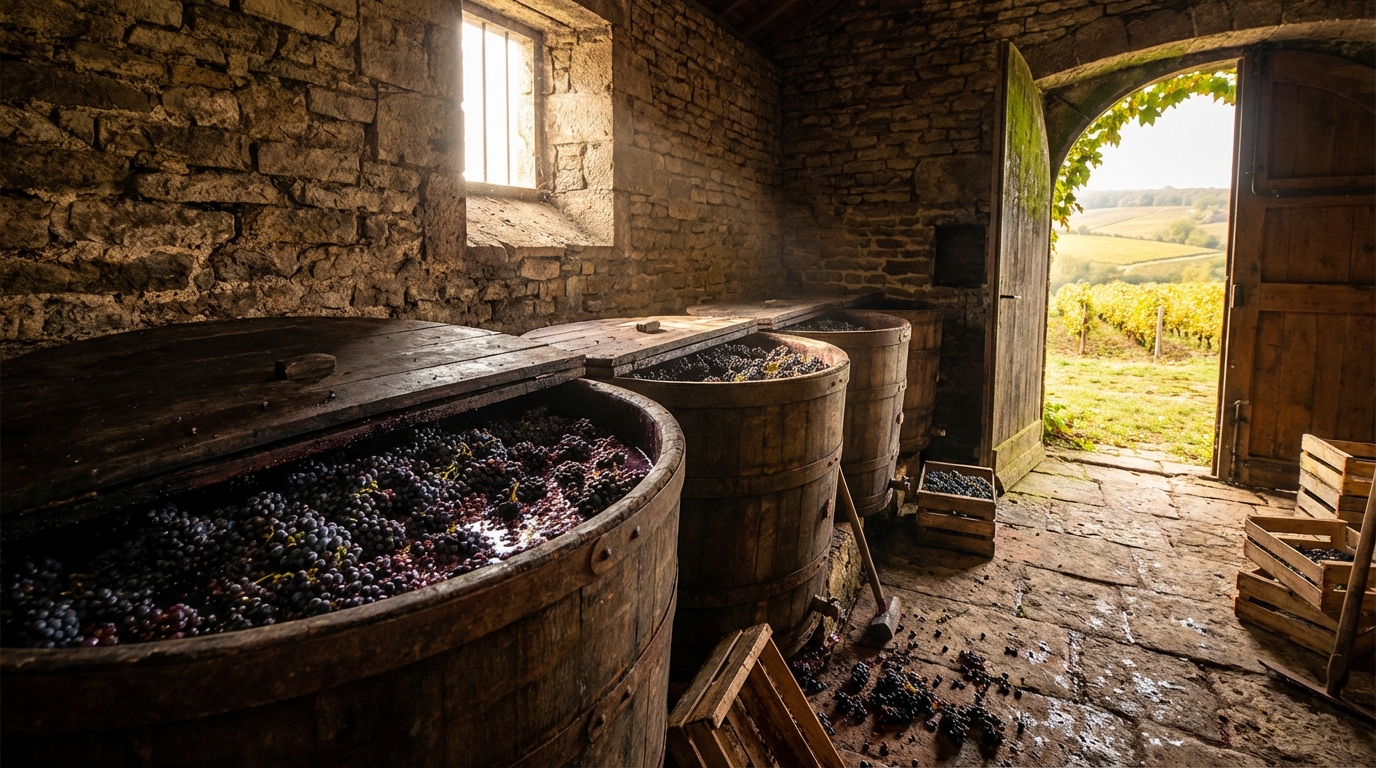
The story of Beaujolais is inseparable from Gamay — specifically Gamay Noir à Jus Blanc — the grape that accounts for roughly 96% of all plantings in the region. In 1395, Duke Philippe the Bold of Burgundy banned Gamay from the Côte d'Or, calling it "très mauvais et très déloyaux" and ordering it ripped out in favor of Pinot Noir. Gamay was exiled south to the granite hillsides of Beaujolais, where it found a home that suited it far better than the limestone of the Côte d'Or ever had.
Gamay is a thin-skinned, early-ripening variety that produces wines with bright acidity, low to moderate tannin, and vivid fruit aromatics — red cherry, raspberry, cranberry, and in some crus, darker notes of black cherry and plum. It thrives on the decomposed granite soils of northern Beaujolais, where the hard rock forces roots deep and produces concentrated, mineral-driven fruit. On the clay and limestone soils of the southern plains, Gamay produces lighter, simpler wines suited to early drinking. The grape is transparent to terroir in much the same way Pinot Noir is in Burgundy — plant it on different soils and the resulting wine tells you exactly where it comes from.
Beyond fruit, Gamay develops remarkable complexity with age. Bottles from top cru sites, aged five to ten years, show earthy, floral, and spicy notes — violets, crushed stone, black pepper, game — that bear little resemblance to the bright, grapey Nouveau the variety is too often reduced to.
Terroir and Climate
The geology of Beaujolais is the key to understanding why its wines vary so dramatically from south to north. The southern half sits on sedimentary soils — clay and limestone deposits that produce rounder, softer wines. The northern half, where all ten crus are located, is dominated by ancient granite and schist from the Massif Central's crystalline bedrock. These soils are poor, acidic, and well-drained — conditions that stress the vine and produce smaller berries with concentrated flavors.
The climate is semi-continental with Mediterranean influence from the south. The best cru vineyards sit between 250 and 500 meters elevation on east- and south-facing slopes, where warm days and cool nights preserve the natural acidity that makes Beaujolais one of the most food-friendly red wine regions in the world.
Individual crus demonstrate how geology shapes wine. Moulin-à-Vent sits on pink granite rich in manganese oxide, producing the most structured wines. Morgon, particularly the famous Côte du Py hill, features decomposed schist and blue granite that gives wines a flinty mineral character the French call "morgonner" — to taste like Morgon, a flavor unique enough to have earned its own verb. Fleurie, on lighter sandy granite, produces the most elegant and floral wines.
Classification System: Three Tiers of Quality
Beaujolais operates under a three-tier appellation system that maps neatly onto the region's geology.
Beaujolais AOC is the broadest designation, covering the flat, southern portion. Wines are typically light, fruity, and intended for immediate consumption. Most Beaujolais Nouveau comes from this tier.
Beaujolais-Villages AOC covers 38 communes in the hilly central and northern portions, where granite-influenced soils produce wines with more structure, depth, and aging potential. They offer some of the best value in all of French wine.
Cru Beaujolais sits at the pinnacle — 10 designated villages, each with its own appellation and distinct terroir signature. Crucially, cru wines are not labeled "Beaujolais" at all. A bottle of Morgon says "Morgon"; a bottle of Fleurie says "Fleurie." This has been both a mark of quality and a source of market confusion, since many consumers do not realize these wines come from Beaujolais.
The 10 Crus in Detail
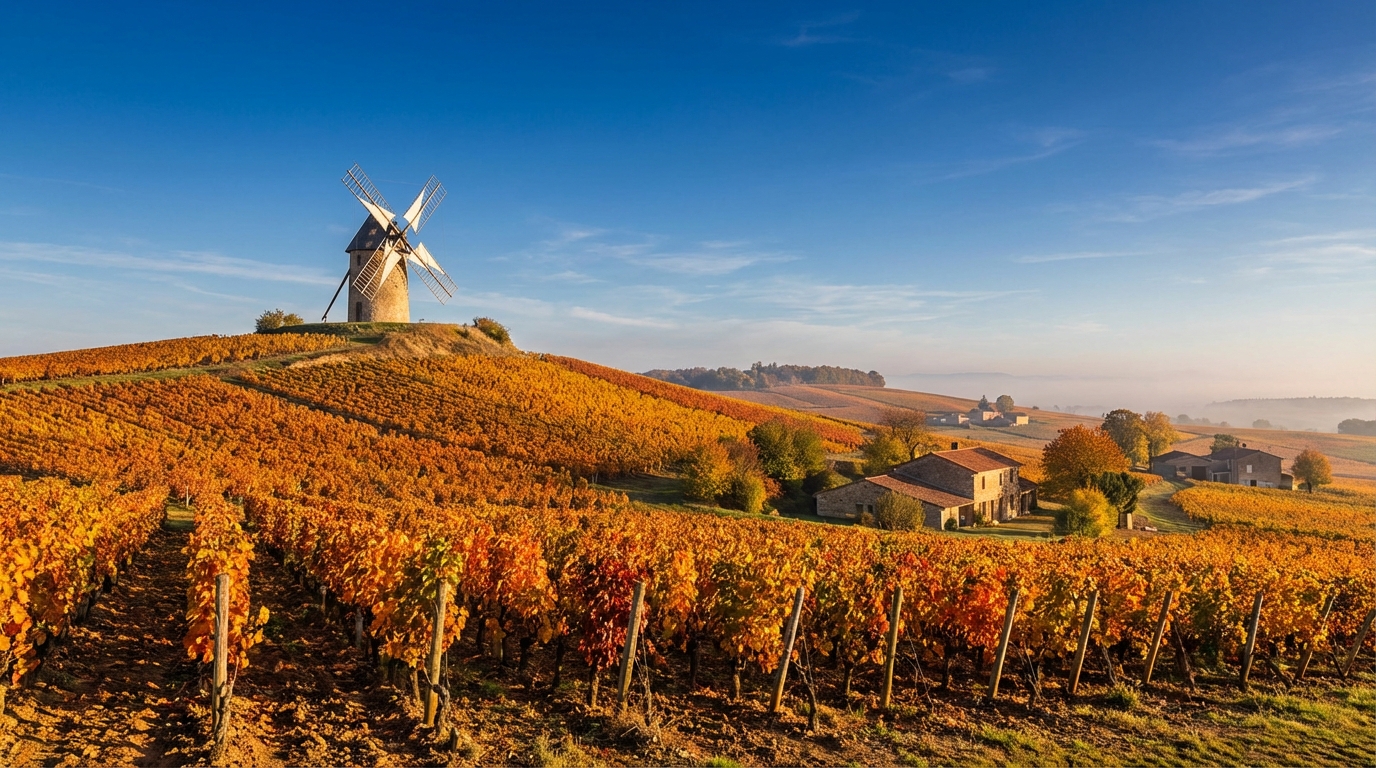
Each cru appellation produces wines with a recognizable character shaped by its specific soils, altitude, and microclimate. From north to south:
Saint-Amour is the most northerly cru, producing medium-bodied wines with soft tannins and red fruit. The name, meaning "sacred love," makes it a perennial Valentine's Day favorite in France.
Juliénas produces firm, structured wines with dark fruit and minerality. With about 580 hectares under vine, the cru's granite and schist soils deliver wines that benefit from two to five years of age.
Chénas is the smallest cru at roughly 250 hectares. Its wines share the power of neighboring Moulin-à-Vent, with notes of peony, rose, and dark fruit. Chénas often represents excellent value because it remains underappreciated.
Moulin-à-Vent is widely considered the most prestigious and age-worthy cru. Its pink granite soils are rich in manganese and iron oxides, producing wines of unusual depth and Burgundy-like structure. Top bottlings from producers like Louis-Claude Desvignes and Domaine de la Côte de l'Ange age gracefully for ten to fifteen years, developing truffle, game, and earthy complexity.
Fleurie lives up to its name with the most delicate and floral wines of the ten crus. Sandy granite soils produce elegant wines with violet, rose petal, and red fruit aromatics. The La Madone vineyard is among the most celebrated sites.
Chiroubles is the highest-altitude cru, with vineyards reaching 400 meters. The elevation produces the lightest, most charming wines — fresh, aromatic, and best within two to three years.
Morgon is the largest and arguably most complex cru, with approximately 1,100 hectares across multiple terroirs. The volcanic Côte du Py produces dense, mineral wines capable of long aging, while other sectors yield rounder styles. Morgon is the cru most compared to Burgundy for its structure and finesse.
Régnié is the newest cru, gaining its appellation in 1988. Wines tend toward red fruit and soft tannins — one of the most affordable entry points into cru Beaujolais.
Côte de Brouilly occupies the steep slopes of volcanic Mont Brouilly, whose blue granite soils produce more concentrated, mineral wines than the surrounding Brouilly appellation.
Brouilly is the largest cru by volume, wrapping around the base of Mont Brouilly. Wines are fruity, medium-bodied, and approachable — an accessible introduction to cru-level quality.
Carbonic Maceration and Winemaking
Beaujolais is the world capital of carbonic maceration. In this technique, whole bunches of uncrushed grapes are placed in a sealed tank flooded with carbon dioxide. An intracellular fermentation begins inside each intact berry, producing the distinctive aromatic compounds — banana, bubblegum, candied fruit — associated with the technique. The result is a wine with vivid fruit, low tannin, and a softness that makes it drinkable almost immediately.
In practice, most Beaujolais is made by semi-carbonic maceration: whole clusters are loaded into open-top vats without added CO₂. The bottom grapes crush under the weight of those above and begin fermenting conventionally, while intact berries at the top undergo carbonic maceration in the naturally produced CO₂. This hybrid approach yields wines with more structure while retaining the fruit-forward appeal.
Serious cru producers increasingly use longer maceration periods — two to three weeks rather than four to seven days for Nouveau — and some have moved toward destemming and traditional Burgundian fermentation for greater tannin and terroir expression. Where carbonic maceration once defined all Beaujolais, today's top cru wines are as likely to be made in a style closer to Burgundy.
Beaujolais Nouveau, Natural Wine, and the Region's Renaissance
Every year on the third Thursday of November, Beaujolais Nouveau is released worldwide. The modern craze was largely the creation of Georges Duboeuf, the charismatic négociant who transformed the release into a global media event in the 1970s. At its peak in the 1990s, Nouveau accounted for nearly half of all Beaujolais production and was exported to over 100 countries. The backlash came in the 2000s as critics argued Nouveau had trivialized the region. Today it accounts for roughly a third of production — still significant, but no longer the dominant narrative.
The true renaissance of Beaujolais came through the natural wine movement — arguably born in this very region. In the 1980s, Marcel Lapierre, a Morgon producer influenced by chemist Jules Chauvet, proved that structured, age-worthy wines could be made without chemical farming or added sulfur dioxide. His Morgon from old vines on the Côte du Py became the touchstone wine of the entire movement.
Around Lapierre gathered the "Gang of Four": Jean Foillard (Morgon), Jean-Paul Thévenet (Morgon), and Guy Breton (Morgon). Together they demonstrated that Beaujolais could produce wines of depth and seriousness while farming sustainably and intervening minimally. Their influence spread worldwide — first to other Beaujolais producers, then across France, and eventually to a global network of natural wine bars and importers.
Today, producers like Yvon Métras (Fleurie), Julien Sunier (Fleurie, Morgon, Régnié), and Domaine de la Côte de l'Ange (Moulin-à-Vent) carry the torch. Marcel Lapierre passed away in 2010, but his son Mathieu Lapierre continues with unwavering commitment. The wines of Beaujolais proved that "natural" and "serious" were never contradictions.
Food Pairing
Beaujolais is arguably the most versatile food wine in France. The combination of bright acidity, moderate alcohol, and low to medium tannin makes these wines exceptionally flexible at the table.
The classic regional pairing is charcuterie — the pork-based terrines, saucissons, and rosette de Lyon that are staples of Lyonnais cuisine. Lyon, just south of the vineyards and long considered France's gastronomic capital, claims Beaujolais as its house wine. A plate of saucisson sec with cornichons and a bottle of Brouilly is one of the great simple pleasures of French dining.
Cru Beaujolais pairs beautifully with roast chicken, grilled salmon, mushroom dishes, and soft cheeses like Saint-Marcellin and Époisses. The more structured crus — Morgon, Moulin-à-Vent, and Côte de Brouilly — stand alongside braised meats, duck confit, and hearty stews. Lighter crus like Chiroubles and Fleurie are ideal with salads, vegetable terrines, and mild Asian cuisine — the low tannin and bright acidity complement ginger, soy, and sesame without clashing.
Beaujolais Nouveau pairs with Thanksgiving turkey (the timing is no coincidence), pizza, and casual bistro fare. Its lack of tannin makes it one of the few red wines that genuinely works slightly chilled alongside nothing more complicated than good bread and butter.


