A Region Reborn from Silence
There are wine regions that have always been famous, their names trading for centuries as shorthand for quality. Priorat is not one of them. When Alvaro Palacios first drove his van up the winding mountain roads of this remote Catalan county in 1989, he found a landscape of abandoned vineyards, depopulated villages, and crumbling stone walls. The ancient vines were still there -- gnarled Garnacha and Carinena (Cari?ena) from the 19th century, pre-phylloxera survivors on their own rootstocks -- but nobody was making wine worth mentioning.
Today, Priorat (Priorato in Castilian) is one of only two DOCa (Denominacion de Origen Calificada) zones in all of Spain -- sharing that elite classification with Rioja -- and its most prestigious wines command prices that rival classified Bordeaux growths. The transformation took less than 35 years and began with five people, a shared commitment, and the most remarkable slate soil in the wine world.
The Carthusian Heritage: Monks, Wine, and a Thousand Years
The name Priorat derives from the Carthusian Priory of Scala Dei (Ladder of God) -- a monastery established in 1163 in the valley below the present village of Escaladei, according to legend on the site where a shepherd witnessed angels ascending to heaven on a ladder of stars. The Carthusian monks cultivated vines throughout the medieval period, and by the 16th and 17th centuries, Priorat wine was famous across Catalonia and beyond.
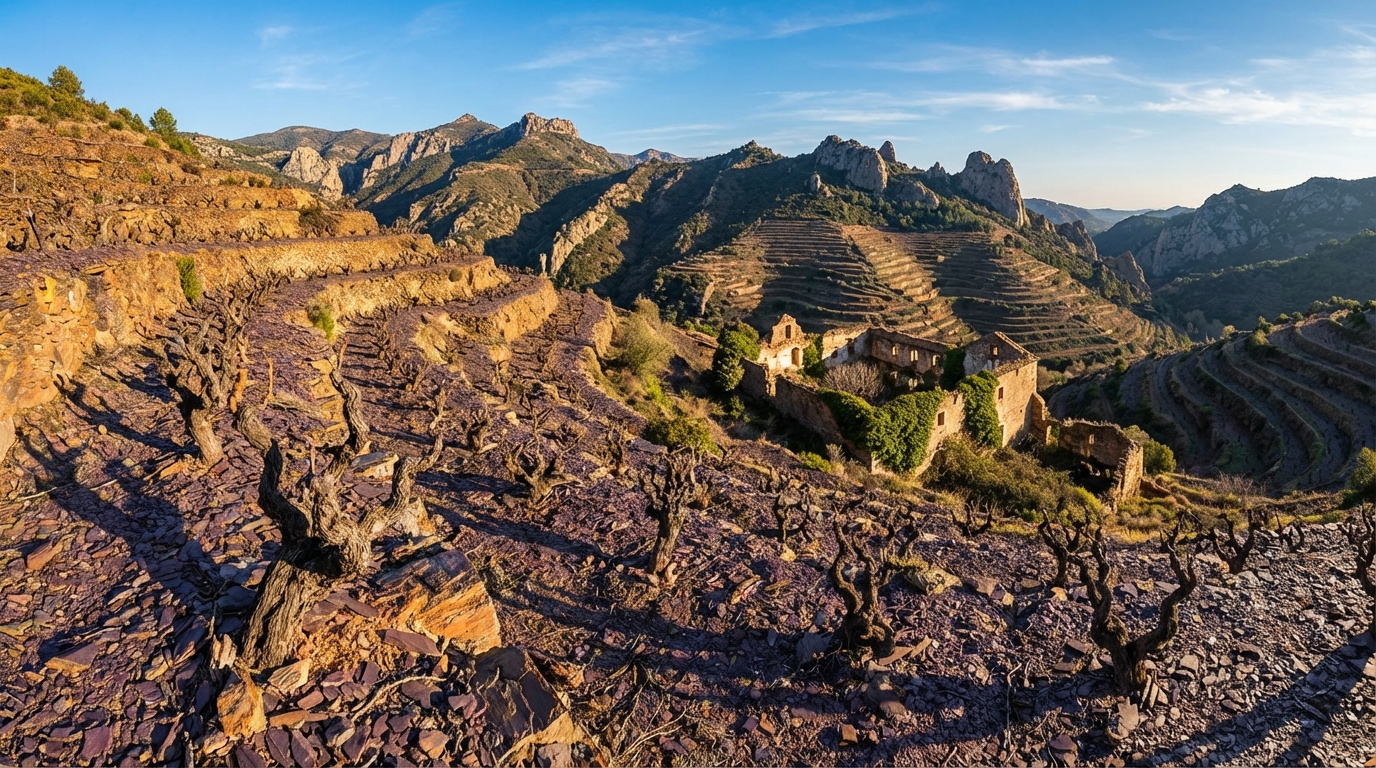
The monastery was sacked and burned during the Spanish Civil War (1936-39) and never recovered. The monks left. Phylloxera had already devastated the vineyards in the 1890s, and the combination of economic collapse, rural depopulation, and the abandonment of the monastery left Priorat's wine reputation to decay quietly for 60 years. By 1989, only a handful of small cooperative wineries were operating, producing rough wine of no commercial significance.
The Scala Dei ruins still stand at the foot of the Montsant mountain, a pilgrimage site and physical reminder of the tradition that inspired the region's modern renaissance. Scala Dei itself is now a winery -- one of the oldest commercial wine brands in Catalonia -- producing Garnacha-based wines from historic sites around the monastery ruins.
Llicorella: The Soil That Defines Everything
The defining characteristic of Priorat -- more than any grape variety, more than any producer, more than the altitude or the microclimate -- is the soil. Llicorella is the local name for the dark slate and quartz composite that underlies virtually all of Priorat's best vineyard land. It is ancient -- Silurian in geological origin, some 400-500 million years old -- and it is unlike anything else in the wine world.
Llicorella is composed of dark grey-brown schist (slate) with embedded veins of quartz and mica. The slate breaks into vertical sheets that reach deep into the hillsides, and vine roots follow these fractures downward -- in some documented cases, roots have been traced to depths of 20 metres in search of water and minerals. The soil is extremely poor in nutrients, forcing extraordinary vine stress that concentrates flavour into a very small quantity of berries.
The slate also has unusual thermal properties. It absorbs heat during the day and releases it slowly at night -- a natural temperature regulator that helps ripen grapes in Priorat's continental climate where summer temperatures can exceed 40 degrees Celsius. The heat retention also delays harvest by several weeks compared to lower-altitude Catalan regions.
The 1989 Renaissance: The Clos Quintet
The modern story of Priorat begins with five people who arrived in the region in the late 1980s, drawn by the ancient vines and the impossibly mineral terroir:
- Rene Barbier (of Mas de la Mola, now Clos Mogador) -- the visionary Frenchman who first identified Priorat's potential and invited the others
- Alvaro Palacios -- from the famous Rioja winemaking family, who went on to create L'Ermita, Spain's most expensive wine
- Daphne Glorian -- who established Clos de l'Obac (Costers del Siurana)
- Josep Lluis Perez -- viticulturist and academic who created Clos Martinet
- Carlos Pastrana -- who established Clos de l'Obac alongside Glorian
For the first years, the five worked together under the Clos Mogador project, sharing equipment and knowledge before each establishing their own estate. Their first vintage -- 1989 -- was divided into five separate bottlings under the individual Clos names, each showcasing a different parcel of old-vine Garnacha and Carinena. The wines were revelatory: dark, concentrated, mineral, and utterly unlike anything else being made in Spain.
Old Vine Garnacha and Carinena: The Living Heritage
Garnacha (Grenache) is the primary variety of Priorat, planted extensively since the Middle Ages and surviving in alberello (bush vine) form throughout the 60 years of abandonment. Many Priorat Garnacha vines are over 100 years old -- ancient, gnarled plants producing tiny quantities of intensely concentrated fruit that could not be replicated in younger vineyards on any timeline shorter than a century.
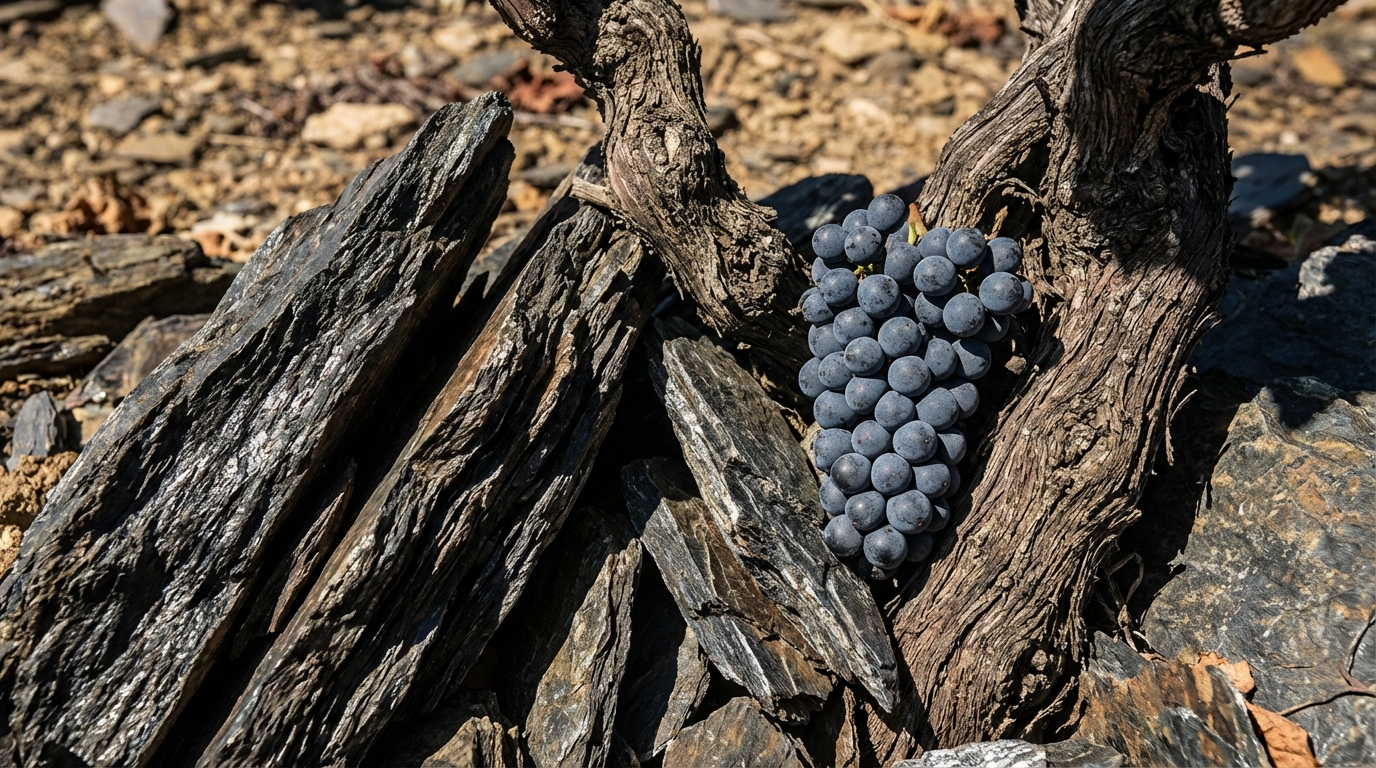
On llicorella soil, Garnacha produces wines very different from its expressions in the Rhone or Chateauneuf-du-Pape. The characteristic jammy, warm-fruit generosity of hot-climate Grenache is replaced by something denser and more mineral -- dark cherry and blackberry fruit underscored by graphite, dried herb, and a distinctive iron-rich savouriness. The alcohol can be very high (14-16.5%) but is integrated in the best examples, not hot or extractive.
Carinena (Carignan/Cari?ena) is the other major variety, traditionally used for structure and colour rather than aromatic interest. But old-vine Carinena from llicorella soils -- particularly from high-altitude sites in villages like Bellmunt and Torroja -- produces wines of extraordinary depth, with firm acidity and mineral intensity that Garnacha cannot always provide. The two varieties are natural partners in Priorat blends.
Priorat also permits Cabernet Sauvignon, Merlot, Syrah, and Grenache Blanc and Pedro Ximenez for whites, but the international varieties play supporting roles in the best wines. The trend among serious producers is toward increasing proportions of Garnacha and Carinena as they recognise that the most authentic Priorat expression comes from these indigenous Catalan varieties on their ancient rootstocks.
Sub-Zones: The Vi de Vila Classification
The Vi de Vila (Village Wine) classification, introduced by the DOQ in 2011, identifies 11 villages within Priorat whose wines express distinct terroir characteristics -- Priorat's own answer to Burgundy's village appellations. Each village wine must be made from grapes grown exclusively within the village's geographic boundaries.
The most significant village expressions:
Gratallops
Gratallops is the de facto capital of modern Priorat -- the village where Alvaro Palacios and Daphne Glorian established their estates in 1989. The village's llicorella is particularly rich in quartz, giving wines of benchmark mineral intensity with dark fruit and firm tannins. Clos Mogador and L'Ermita are both effectively Gratallops wines, though labeled under estate names rather than the village designation.
Torroja del Priorat
Torroja at higher altitude produces wines of greater elegance and finesse than the more powerful Gratallops expressions -- more aromatic lift, silkier tannins, and a delicacy that has drawn comparisons to Chambolle-Musigny. Clos de l'Obac (Costers del Siurana) sources from Torroja and demonstrates this more refined Priorat style.
Bellmunt del Priorat
Bellmunt vineyards are characterised by particularly iron-rich llicorella, giving wines a distinctive metallic mineral quality and deep colour. The tannins here tend to be firmer than Gratallops, requiring extended ageing before the wines show their best.
Porrera
Porrera is considered by many producers to produce the purest expression of llicorella -- an almost schist-driven mineral intensity with less of the black fruit concentration seen further south. Clos Martinet (Josep Lluis Perez) and the estate Manyetes from Porrera are benchmark examples.
Top Producers: The Priorat Canon
Alvaro Palacios: L'Ermita
Alvaro Palacios produces three Priorat wines that represent the full spectrum of the region's quality hierarchy: Les Terrasses (entry), Finca Dofi (mid-tier), and L'Ermita (icon). L'Ermita -- from a single 3.5-hectare plot of 100+ year old Garnacha vines on pure llicorella above Gratallops -- is consistently rated as the finest wine in Spain and one of the greatest in the world. Production is approximately 5,000 bottles per vintage. The wine commands EUR 900-1,200+ per bottle on release and considerably more at auction.
Clos Mogador
Clos Mogador (Rene Barbier) is the founding wine of modern Priorat -- the estate from which all five of the Clos pioneers originally worked together. The single estate wine (also called Clos Mogador) is a blend of Garnacha and Carinena from the estate's llicorella vineyards, unified with Syrah and Cabernet Sauvignon. It is one of the most consistent and long-lived wines of the DOCa, with the best vintages developing extraordinary complexity over 20-25 years.
Terroir al Limit
Terroir al Limit (Dominik Huber) represents the purest natural wine approach in Priorat -- minimal intervention, no new oak, indigenous yeasts, minimal sulphur. Huber has transformed the estate's old-vine Carinena and Garnacha into wines of precision and transparency that show the terroir's mineral character without the weight and extraction that characterised the first generation of Priorat wines.
Mas d'En Gil
Mas d'En Gil in Bellmunt is one of the most reliable mid-market Priorat estates, producing wines from estate vineyards on llicorella that demonstrate outstanding value relative to the Clos wines. Their Coma Alta and Coma Vella are particularly impressive, showing old-vine Garnacha and Carinena from high-altitude sites with genuine complexity and ageability.
The Priorat Style: Power With Mineral Precision
Priorat wines are among the most massively concentrated in the wine world. The combination of extreme vine stress from llicorella soils, very low yields from old alberello vines, and the intense Catalonian sunshine produces fruit of extraordinary concentration. Typical characteristics:
- Very deep colour -- near-opaque ruby to purple-black
- Dark fruit intensity -- blackberry, dark cherry, fig, prune
- Graphite, dark mineral, and iron notes from llicorella
- High alcohol -- typically 14.5-16%, occasionally higher
- Firm, grippy tannins from old-vine Carinena and Garnacha skins
- Incredible aging potential -- the finest wines evolve for 20-30+ years
The best Priorat wines of the 1990s and early 2000s were sometimes criticised for excessive extraction and new oak influence -- a style that appealed to international critics scoring by power rather than precision. The current generation has moved decisively toward less new oak, lower extraction, and a greater emphasis on the terroir's mineral character over sheer weight. The result is wines that are still massively concentrated but more elegant and more clearly site-specific.
Food Pairing: Catalan Tradition
Priorat's powerful, structured wines demand equally substantial food:
- Cal?ots with romesco sauce -- the classic Catalan winter feast of charred spring onions with nut and dried pepper sauce; the wine's mineral intensity is a perfect foil
- Bacalla a la llauna (baked salt cod) -- the classic Catalan preparation; Priorat Blanc (rare but excellent) for the fish, young Priorat Tinto for heavier preparations
- Wild boar stew (senglar) -- the quintessential Priorat pairing; the game and the wine's dark mineral character are natural partners
- Aged Manchego or Garrotxa -- the mineral quality in the wine echoes the nutty depth of these aged Catalan and Castilian cheeses
- Roast lamb with herbs -- classic southern European pairing with old-vine Garnacha
Wine Tourism: Gratallops and the Priorat Villages
Gratallops village (population around 200) has become one of Catalonia's most important wine tourism destinations. The village square, the cooperative winery, and the cellar doors of Alvaro Palacios and Daphne Glorian all lie within walking distance. The surrounding landscape -- steep llicorella terraces, ancient vines, and views toward the Montsant mountains -- is among the most dramatic in Spanish wine country.
Buying Guide and Practical Notes
- Entry level (EUR 18-30): Mas d'En Gil, Cellers de Scala Dei Cartoixa -- accessible Priorat character
- Mid-range (EUR 35-70): Terroir al Limit Les Tosses, Clos Martinet Manyetes -- serious terroir expression
- Premium (EUR 75-200): Clos Mogador, Clos de l'Obac, Finca Dofi -- the founding wines of modern Priorat
- Icon (EUR 300+): L'Ermita -- Spain's greatest wine; buy early release for best value, or seek older vintages at auction
Priorat is the proof that a wine region can be transformed from obscurity to international eminence within a single generation when the terroir is extraordinary and the winemakers are serious. The llicorella does not forgive mediocrity -- but in the right hands, it produces wines of startling mineral intensity and ageworthy grandeur. The Carthusian monks who first cultivated these impossible hillsides knew something about patience. Modern Priorat demands the same virtue from its admirers.


