Two Valleys, One River, a Thousand Styles
The Rhône Valley is France's second-largest AOC wine region after Bordeaux, stretching roughly 200 kilometers from the steep granite hillsides of Côte-Rôtie in the north to the sun-baked garrigue of Châteauneuf-du-Pape in the south. With approximately 77,000 hectares under vine and annual production exceeding 400 million bottles, the Rhône punches far above its weight in terms of quality-to-price ratio.
What makes the Rhône fascinating is its split personality. The Northern Rhône is a world of single-varietal precision — Syrah in its purest, most elegant expression. The Southern Rhône is a tapestry of blends, where Grenache, Mourvèdre, and a dozen other varieties combine to create wines of warmth, complexity, and generosity. Understanding this duality is the key to unlocking the region.
The river itself is the unifying thread. The Rhône carves a corridor that channels the Mistral — that fierce, cold northerly wind that defines viticulture here. It dries the grapes, reduces disease pressure, and forces vines to root deep into the region's diverse soils. Without the Mistral, the Rhône would be a very different wine region.
The Northern Rhône: Where Syrah Reaches Its Zenith
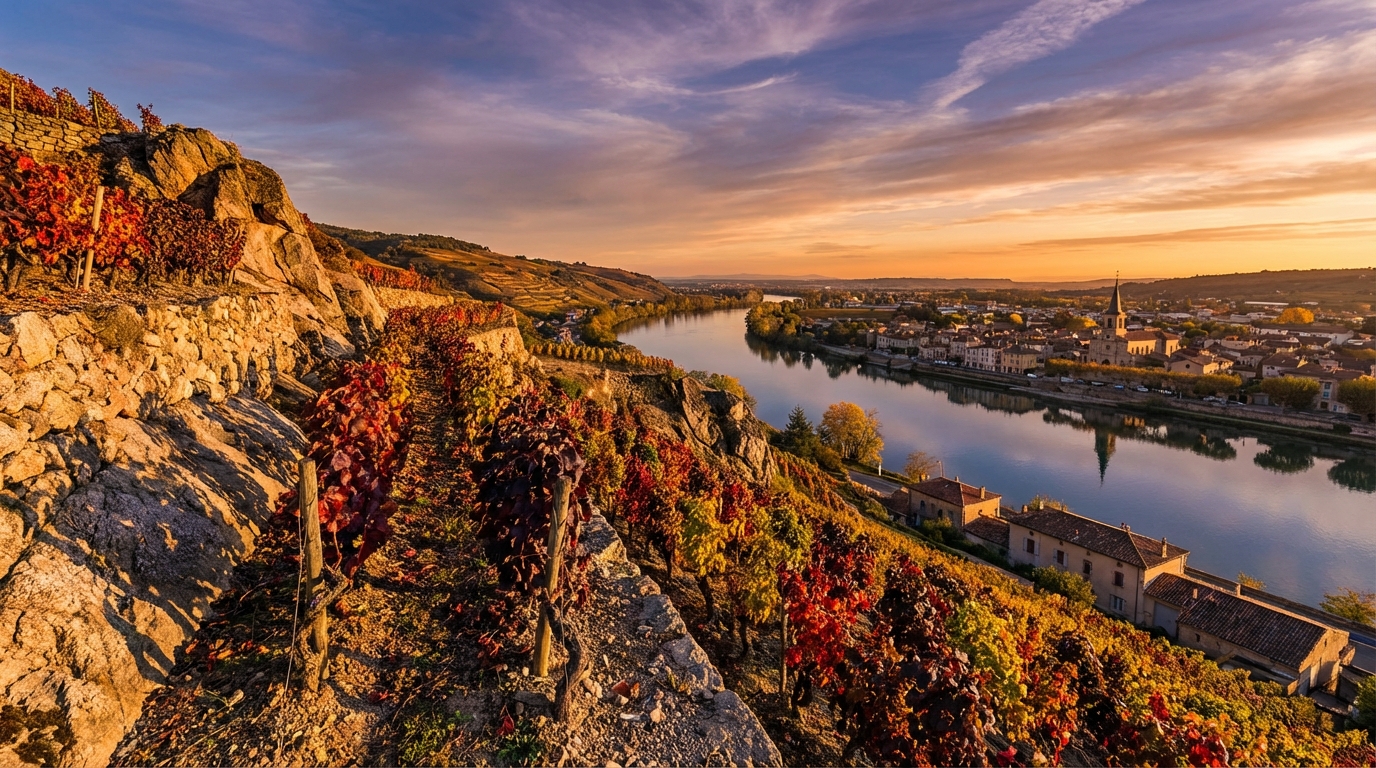
The Northern Rhône is a sliver of steep, terraced vineyards clinging to granite and schist hillsides along both banks of the river. It accounts for only about 5% of total Rhône production, but its finest wines are among France's most sought-after.
Côte-Rôtie ("the roasted slope") sits at the very top, its vineyards tilted at angles of up to 60 degrees. The best plots — La Mouline, La Landonne, La Turque (all monopoles of the legendary E. Guigal) — produce Syrah of astonishing aromatic complexity: violet, smoked meat, black olive, and iron. Uniquely, up to 20% Viognier may be co-fermented with the Syrah, adding floral perfume and softening the structure.
Hermitage is the Northern Rhône's most prestigious appellation. The hill of Hermitage, rising above the town of Tain-l'Hermitage, has been producing wine for over 2,000 years. Jaboulet's La Chapelle, Chave, and Chapoutier's L'Ermite are benchmark producers. Hermitage Syrah is denser and more structured than Côte-Rôtie, built for decades of aging. White Hermitage from Marsanne and Roussanne is one of France's great white wines, gaining honeyed complexity with age.
Cornas is the dark horse — 100% Syrah from granite soils, no blending allowed, producing inky, powerful wines that reward patience. Thierry Allemand and Auguste Clape (now run by his grandson Pierre-Marie) are essential producers. Crozes-Hermitage, the largest Northern Rhône appellation, surrounds the hill of Hermitage and offers excellent value Syrah. Saint-Joseph stretches along the western bank, producing both red and white wines of increasing quality.
Condrieu deserves special mention as the spiritual home of Viognier — an aromatic white grape that nearly went extinct in the 1960s when only 8 hectares remained. Today Condrieu's 200 hectares produce opulent, peach-and-apricot-scented whites that are best enjoyed young. Within Condrieu lies Château-Grillet, a tiny 3.5-hectare monopole that has its own AOC — one of France's smallest.
The Southern Rhône: Land of the Great Blends
South of the town of Montélimar, the landscape transforms dramatically. Steep terraced hillsides give way to rolling plains, Mediterranean scrubland (garrigue), and vineyards spread across a much wider area. The Southern Rhône produces roughly 95% of the region's total volume.
Châteauneuf-du-Pape is the flagship — and one of the most historically significant appellations in France. It was here, in the 1920s and 1930s, that Baron Pierre Le Roy de Boiseaumarié created the regulatory framework that became the template for the entire French AOC system. Today, Châteauneuf allows 13 grape varieties (some sources say 18, counting sub-varieties), though most wines are built on a backbone of Grenache (typically 60-80%), with supporting roles from Syrah, Mourvèdre, Cinsault, and Counoise.
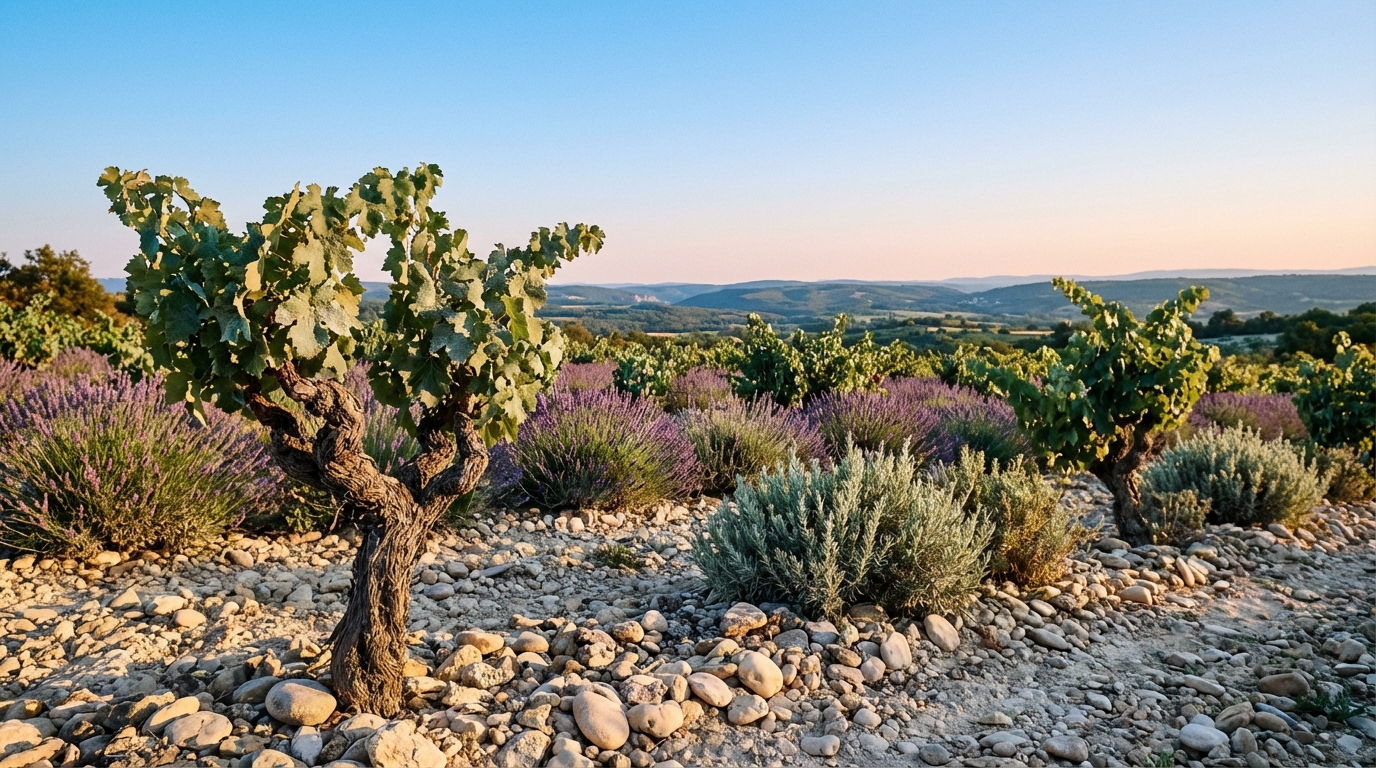
The great estates read like a wine lover's bucket list: Château Rayas (100% Grenache from sandy soils, hauntingly ethereal), Château Beaucastel (all 13 varieties, the Mourvèdre-heavy house style), Clos des Papes, Vieux Télégraphe, and Domaine du Pegau. The famed galets roulés — large, smooth river stones that carpet many vineyards — retain heat during the day and radiate it back onto the vines at night, helping Grenache reach full ripeness.
| Feature | Northern Rhône | Southern Rhône |
|---|---|---|
| Key grape (red) | Syrah (single varietal) | Grenache (blends) |
| Key grapes (white) | Viognier, Marsanne, Roussanne | Grenache Blanc, Clairette, Bourboulenc |
| Climate | Continental with Mediterranean influence | Full Mediterranean |
| Soil | Granite, schist, gneiss | Limestone, clay, galets roulés |
| Vineyard style | Steep terraces | Rolling plains, plateaus |
| Production | ~5% of Rhône total | ~95% of Rhône total |
| Top appellations | Côte-Rôtie, Hermitage, Cornas | Châteauneuf-du-Pape, Gigondas |
| Aging potential | 15-40+ years | 8-25 years |
Gigondas and Vacqueyras are the rising stars, producing Grenache-based reds of real depth and character at more accessible prices than Châteauneuf. Gigondas wines from the Dentelles de Montmirail hillsides — producers like Domaine Santa Duc, Saint Cosme, and Domaine Les Pallières — can rival their more famous neighbor.
Côtes du Rhône: The Region's Beating Heart
The vast Côtes du Rhône appellation is where most people first encounter the Rhône Valley. It covers roughly 31,000 hectares across 171 communes and produces wines ranging from simple and fruity to surprisingly complex. The best are labeled Côtes du Rhône-Villages, with 22 specific communes permitted to add their village name to the label.
Among the named villages, Cairanne (promoted to its own appellation in 2016), Rasteau (known for both dry reds and fortified Vin Doux Naturel), and Sablet offer outstanding value. A good Côtes du Rhône-Villages from a conscientious producer can provide more drinking pleasure per euro than almost any other French wine.
The White Wines Nobody Talks About
The Rhône's white wines are criminally underrated. In the north, Condrieu and white Hermitage command serious attention, but the south produces whites of real interest too. Châteauneuf-du-Pape Blanc — blends of Grenache Blanc, Clairette, Roussanne, and sometimes Bourboulenc or Picardan — can be wonderfully rich and textured, with notes of white flowers, beeswax, and stone fruit.
Lirac, just across the river from Châteauneuf, produces excellent rosé and increasingly impressive whites. Beaumes-de-Venise is famous for its Muscat Vin Doux Naturel — a sweet, grapey fortified wine that makes a perfect aperitif or dessert partner.
The white wines of Saint-Péray, at the southern tip of the Northern Rhône, include both still and traditional-method sparkling wines from Marsanne and Roussanne. These sparklers are virtually unknown outside France and represent remarkable value.
Terroir and the Mistral Factor
The Mistral is not just a weather phenomenon — it is the defining force of Rhône viticulture. This cold, dry wind funnels down the Rhône corridor at speeds that can exceed 100 km/h, particularly in winter and spring. It keeps vineyards dry, dramatically reducing the need for fungicide treatments and making organic and biodynamic farming more viable than in many French regions.
The diversity of soils is equally important. Northern Rhône's granite and schist give Syrah its mineral tension and aromatic precision. Southern Rhône's varied terroir includes the famous galets roulés of Châteauneuf, the red clay and limestone of Gigondas, and the sandy soils that give Rayas its ethereal Grenache. Each soil type imparts a distinct personality to the wines.
The Mediterranean climate in the south means abundant sunshine — Châteauneuf-du-Pape averages over 2,800 hours of sun annually, making it one of France's sunniest appellations. This warmth drives alcohol levels that regularly reach 14.5-15.5%, giving Southern Rhône reds their characteristic richness and body.
Modern Trends and the Next Generation
The Rhône is experiencing a quiet revolution. A new generation of winemakers is challenging established norms: working with organic and biodynamic methods, experimenting with whole-cluster fermentation, reducing extraction times, and bottling earlier to preserve freshness. The result is wines that are more elegant and drinkable young, without sacrificing the region's essential character.
Climate change is also reshaping the landscape. Producers in the south are planting at higher elevations and exploring north-facing slopes to maintain acidity. Some are reviving forgotten grape varieties like Counoise and Vaccarèse that tolerate heat better than Grenache. In the north, vineyards that once struggled to ripen now achieve full maturity with ease, producing richer, more opulent Syrah than previous generations could have imagined.
Natural wine has found fertile ground in the Rhône, with producers like Domaine Gramenon and Marcel Richaud in the south, and Hervé Souhaut (Romaneaux-Destezet) in the north, crafting wines of remarkable purity and energy. The region's naturally low disease pressure and warm climate make minimal-intervention winemaking more feasible here than in cooler, wetter regions.
How to Start Your Rhône Journey
Building a Rhône collection is one of wine's great pleasures — and one of its best values. Start with a Crozes-Hermitage or Saint-Joseph to understand Northern Syrah, then a Gigondas or Côtes du Rhône-Villages to grasp the Southern blend philosophy. Graduate to Hermitage and Châteauneuf-du-Pape as your palate develops.
For immediate drinking, Southern Rhône wines are generally more approachable young. For cellar candidates, Northern Rhône Syrah from top vintages (2015, 2017, 2019, 2020) will reward decades of patience. And don't overlook the whites — a mature white Hermitage from Chave or Chapoutier is a life-changing wine experience.
The Rhône Valley proves that great wine doesn't require a single famous grape variety or a centuries-old classification system. It requires terroir, tradition, and the vision to let both express themselves fully in the glass.


