A Region Like No Other
No wine region on earth inspires the same level of obsession, devotion, and, frankly, bewilderment as Burgundy. While Bordeaux may produce more wine and Napa Valley may command higher prices for individual bottles, Burgundy remains the spiritual heartland of terroir-driven winemaking — the place where a shift of a few meters in vineyard position can mean the difference between a $40 village wine and a $4,000 Grand Cru.
Stretched across the rolling limestone hills of eastern France, from Chablis in the north to the Mâconnais in the south, Burgundy is deceptively small. Its entire annual production could be swallowed by a single large Bordeaux château's output. Yet within this modest territory lies a mosaic of vineyards so finely parsed, so meticulously understood, that the region has become the world's ultimate reference for the relationship between place and wine.
“In Burgundy, we do not make wine. We translate the earth.”
— Aubert de Villaine, Co-Director of Domaine de la Romanée-Conti
The Obsession with Terroir
The word terroir is French, but it was Burgundy that gave it meaning. Where other regions might classify wines by producer, grape, or price, Burgundy classifies by vineyard — by the specific piece of earth where the grapes grow. This classification, formalized over centuries by Cistercian monks who painstakingly mapped the region's geological diversity, remains the organizing principle of Burgundy to this day.
The Cistercians of the Abbey of Cîteaux, beginning in the 12th century, were among the first to systematically identify how different vineyard plots — sometimes separated by a narrow path or a low stone wall — produced wines of markedly different character. They called these plots climats, and in 2015, the Climats of Burgundy were inscribed as a UNESCO World Heritage Site.
What makes Burgundy's terroir so expressive? Several factors converge:
- Geology — A complex patchwork of limestone, marl, clay, and gravel soils, the product of millions of years of geological activity. The Jurassic limestone that dominates the best vineyards provides excellent drainage and imparts the signature minerality
- Topography — The gentle east-facing slopes of the Côte d'Or catch the morning sun and are sheltered from prevailing westerly rain. Altitude, gradient, and aspect all vary dramatically within short distances
- Climate — Continental, with cold winters and warm but unpredictable summers. Vintage variation is extreme, which is both Burgundy's great challenge and its great fascination
- Grape variety — Burgundy uses essentially two grapes: Pinot Noir for reds and Chardonnay for whites. These thin-skinned, transparent varieties act like amplifiers, broadcasting every nuance of soil, slope, and season
The Hierarchy: From Regional to Grand Cru
Burgundy's classification is a four-tier pyramid, ascending in quality, prestige, and price:
| Classification Level | % of Production | Example | Character |
|---|---|---|---|
| Regional (Bourgogne) | ~52% | Bourgogne Rouge, Bourgogne Aligoté | Everyday wines; simple, approachable |
| Village (Communale) | ~35% | Gevrey-Chambertin, Meursault, Pommard | Wines named for their village; distinct terroir |
| Premier Cru (1er Cru) | ~11% | Gevrey-Chambertin 1er Cru "Clos Saint-Jacques" | Named vineyard sites of superior quality |
| Grand Cru | ~2% | Chambertin, Musigny, Montrachet | The pinnacle; the most exceptional vineyard sites |
There are 33 Grand Cru vineyards in Burgundy — a tiny fraction of the region's total vineyard area. These vineyards are so revered that they carry no village name on the label; the vineyard name alone is sufficient. When you see "Chambertin" on a bottle, that is a Grand Cru. When you see "Gevrey-Chambertin," that is the village wine. It is a subtle but crucial distinction that trips up many newcomers.
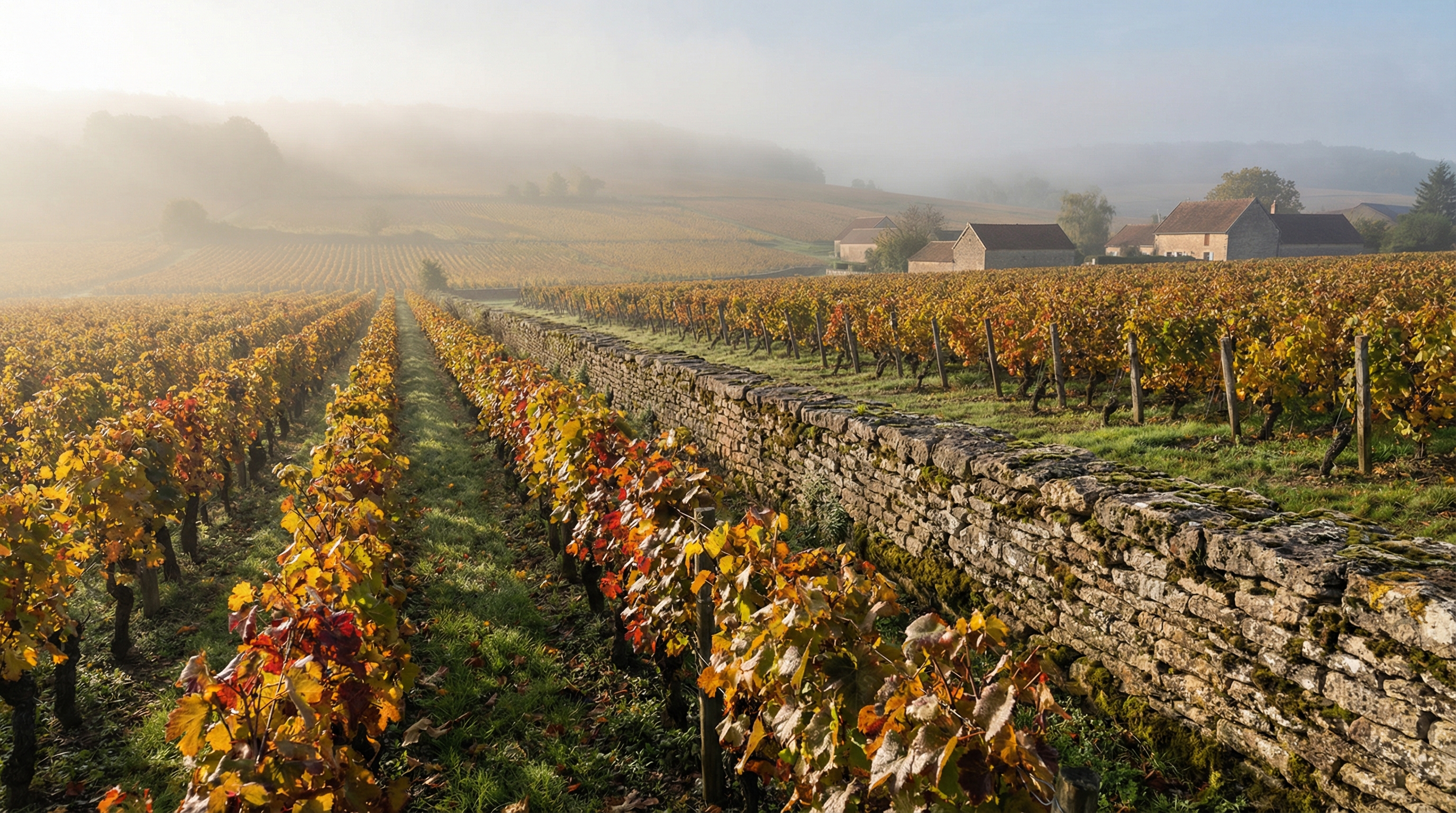
The Côte d'Or: Heart of Burgundy
The Côte d'Or — the "Golden Slope" — is a narrow limestone escarpment running roughly 50 km from Dijon to Santenay. It is divided into two halves:
Côte de Nuits (Northern Half) — Primarily red wine from Pinot Noir. Home to the most legendary and expensive Grand Cru vineyards in the world. Key villages, from north to south:
- Gevrey-Chambertin — The largest Grand Cru village. Chambertin and Chambertin-Clos de Bèze produce some of Burgundy's most powerful, structured reds. Napoleon famously refused to drink anything else
- Morey-Saint-Denis — Often overlooked, which means relative value. Grand Crus include Clos de la Roche and Clos Saint-Denis
- Chambolle-Musigny — The most ethereal, perfumed wines on the Côte. Grand Crus: Musigny (possibly the single greatest vineyard in Burgundy) and Bonnes-Mares
- Vougeot — Dominated by the walled Clos de Vougeot, a 50-hectare Grand Cru owned by over 80 different producers, making quality wildly variable. Choose your producer carefully
- Vosne-Romanée — The holy of holies. Home to Romanée-Conti, La Tâche, Richebourg, and La Romanée — vineyards that produce the most sought-after and expensive wines on the planet
- Nuits-Saint-Georges — No Grand Crus, but exceptional Premier Crus like Les Saint-Georges and Les Vaucrains. Often more muscular and earthy than its neighbors
Côte de Beaune (Southern Half) — Both red and white, but best known for producing the world's greatest white wines from Chardonnay:
- Pommard — Full-bodied, structured reds with more tannin than typical Burgundy
- Volnay — Elegant, silky reds; the Chambolle-Musigny of the Côte de Beaune
- Meursault — Opulent, nutty, buttery Chardonnay from village-level vineyards. No Grand Crus, but Premier Crus like Les Perrières rival Grand Cru quality
- Puligny-Montrachet — Razor-sharp, mineral Chardonnay of extraordinary purity. Home to parts of Le Montrachet and the Grand Crus Chevalier-Montrachet and Bienvenues-Bâtard-Montrachet
- Chassagne-Montrachet — Shares Le Montrachet with Puligny; also produces excellent reds that remain undervalued
Beyond the Côte d'Or
Chablis — Located 150 km northwest of the Côte d'Or, Chablis is a world unto itself. Its Chardonnay grows on Kimmeridgian limestone — ancient seabed packed with fossilized oyster shells — producing wines of piercing acidity, flinty minerality, and remarkable longevity. There are 7 Grand Cru vineyards (Les Clos, Vaudésir, Blanchot, Bougros, Grenouilles, Preuses, and Valmur), all on a single south-facing slope above the Serein River. Top producers include William Fèvre, Raveneau, and Vincent Dauvissat.
Côte Chalonnaise — South of the Côte de Beaune, this region offers some of Burgundy's best values. The villages of Mercurey (red), Givry (red), Rully (white and sparkling), and Montagny (white) produce wines of genuine character at a fraction of Côte d'Or prices.
Mâconnais — The warmest part of Burgundy, known for round, fruit-forward Chardonnay. Pouilly-Fuissé, recently elevated with its own Premier Cru vineyards, is the flagship. The co-operative-dominated region also produces vast quantities of simple Mâcon-Villages, though domaine-bottled wines from Pouilly-Fuissé and Saint-Véran can be excellent.
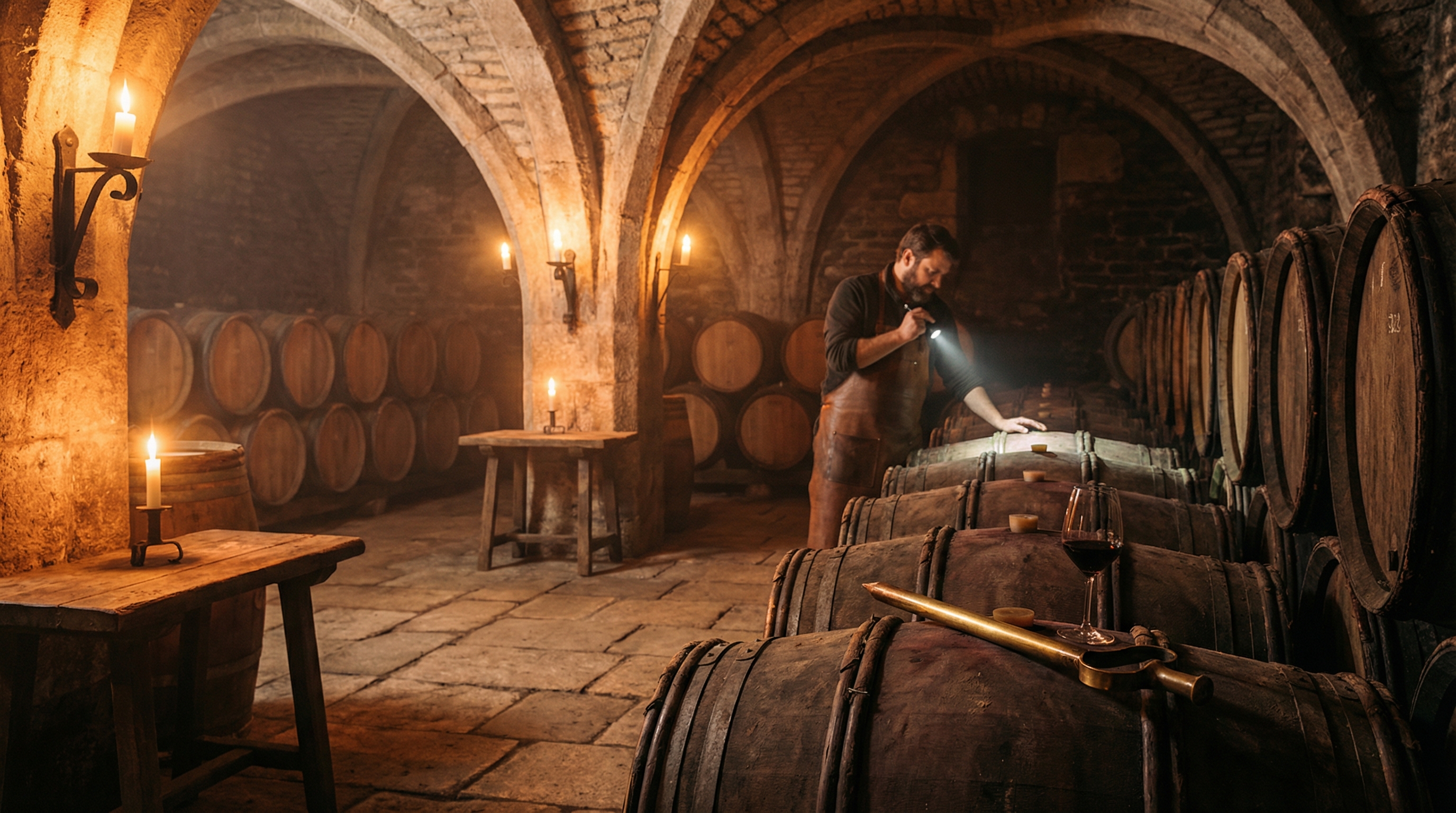
The Producers: Domaines, Négociants, and the DRC Phenomenon
Burgundy's fractured vineyard ownership — a consequence of Napoleonic inheritance laws that divided estates among all heirs — means the same vineyard may be farmed by dozens of different producers. This is why the producer matters as much as the vineyard in Burgundy. A mediocre producer in Chambertin can make a worse wine than a great producer in a humble village appellation.
Domaine — A grower who farms their own vineyards and makes their own wine. This is the romantic ideal of Burgundy, embodied by legendary domaines like Domaine de la Romanée-Conti (DRC), Domaine Leroy, Domaine Dujac, and Domaine Coche-Dury.
Négociant — A merchant who buys grapes or juice from growers and makes wine under their own label. Historically seen as inferior, but today the best négociants — including Louis Jadot, Joseph Drouhin, Maison Leroy, and the brilliant Olivier Bernstein — produce exceptional wines through careful grape sourcing and meticulous winemaking.
The Domaine de la Romanée-Conti (DRC) stands in a category of its own. Co-directed by Aubert de Villaine and Perrine Fenal, DRC owns or co-owns some of Burgundy's most legendary vineyards: the monopole Romanée-Conti itself (just 1.81 hectares), La Tâche, Richebourg, Romanée-Saint-Vivant, Grands Échezeaux, Échezeaux, Corton, and Le Montrachet. The wines are produced in tiny quantities, allocated to select importers, and command prices that start at several thousand dollars per bottle. Romanée-Conti itself regularly sells for $15,000–$25,000 per bottle at auction.
“Romanée-Conti is not simply a wine. It is a place that has been understood and cared for over centuries. Our job is simply not to ruin it.”
— Aubert de Villaine
Vintage Guide
Burgundy is more vintage-sensitive than perhaps any other region. The difference between a great year and a difficult one is stark. Here are recent standout vintages:
| Vintage | Reds | Whites | Notes |
|---|---|---|---|
| 2022 | ★★★★ | ★★★★ | Warm year; ripe, generous wines with surprising freshness |
| 2021 | ★★★ | ★★★★ | Small crop; cool year produced elegant, classical wines |
| 2020 | ★★★★★ | ★★★★★ | Exceptional across the board; warm but balanced |
| 2019 | ★★★★★ | ★★★★ | Rich, ripe, opulent; a hedonistic vintage |
| 2018 | ★★★★ | ★★★ | Generous fruit; drink reds medium-term |
| 2017 | ★★★★ | ★★★★ | Elegant and balanced; frost-reduced yields |
| 2016 | ★★★ | ★★★★ | Frost-ravaged but survivors are excellent |
| 2015 | ★★★★★ | ★★★★★ | Outstanding; concentrated and complete |
| 2010 | ★★★★★ | ★★★★★ | Classical; still youthful and evolving |
| 2005 | ★★★★★ | ★★★★★ | Entering prime drinking; profound complexity |
Buying and Drinking Burgundy
The harsh reality is that demand for Burgundy far exceeds supply, especially at the Grand Cru level. Prices have risen steeply over the past decade, driven by growing global demand — particularly from Asia — and a series of small harvests due to frost, hail, and drought.
For newcomers, the key strategies are:
- Focus on lesser-known villages — Marsannay, Fixin, Saint-Romain, Auxey-Duresses, and Santenay offer genuine Burgundy character at more accessible prices
- Trust the producer over the appellation — A great producer's village wine will almost always outperform a mediocre producer's Premier Cru
- Explore Chablis and the Côte Chalonnaise — Exceptional quality-to-price ratio
- Be patient — Good Burgundy needs time. Premier Cru reds typically need 5–10 years; Grand Crus often need 10–20+
- Build relationships — Many top domaines allocate their wines to loyal customers through mailing lists and local retailers
For authoritative information on Burgundy appellations and classifications, consult the Bureau Interprofessionnel des Vins de Bourgogne (BIVB) and Allen Meadows' Burghound.
The Eternal Allure
What draws people to Burgundy — and keeps them coming back despite the prices, the complexity, and the frequent heartbreak of a corked or prematurely oxidized bottle — is something that transcends rational analysis. At its best, Burgundy produces wines of haunting beauty: a great Musigny that tastes of roses, iron, and ancient earth; a Montrachet of such intensity and mineral depth that it seems to vibrate on the palate; a simple Bourgogne Rouge from a great producer that delivers more pleasure and sense of place than most regions' finest bottles.
Burgundy is not easy. It is not always good value. It is sometimes maddening in its inconsistency. But for those who catch the Burgundy bug, no other wine region will ever fully satisfy. That is its eternal, infuriating, glorious allure.
For an excellent introduction to Burgundy's estates and terroirs, explore Jasper Morris MW's Inside Burgundy.


