Why Glass Shape Matters: The Science Behind Wine Glassware
Pour the same wine into a coffee mug and a properly shaped wine glass, and you will taste two demonstrably different wines. This is not marketing hyperbole — it is observable physics and well-documented sensory science. The shape of a wine glass controls three critical variables that directly influence your perception of the wine: aroma concentration, liquid surface area, and delivery point on the palate.
Aroma concentration is the most significant factor. Roughly 80% of what we perceive as "taste" actually originates in the olfactory system — the nose, not the tongue. A wine glass functions as an aroma-focusing device. The bowl captures volatile aromatic compounds released from the wine's surface, and the rim diameter determines how those compounds are channeled toward your nose as you tilt the glass to drink. A wider bowl provides more surface area for volatiles to evaporate, while a tapered rim concentrates those vapors into a narrower stream directed at the nostrils. The ratio of bowl width to rim opening is the single most important design variable in wine glass engineering.
Surface area affects how much oxygen interacts with the wine at any given moment. A glass with a wide, shallow bowl exposes more wine to air, encouraging rapid aeration — ideal for young, tannic reds that need to "open up." A narrow, tall glass minimizes surface exposure, preserving delicate aromatics and maintaining the freshness of white wines, rosés, and aged reds whose fragile compounds would dissipate quickly in a broad bowl.
Rim diameter and glass curvature determine where wine lands on your tongue when you sip. A wide-rimmed glass spreads the wine broadly across the palate, emphasizing fruit and sweetness. A narrow rim delivers a more concentrated stream toward the center and back of the tongue, highlighting acidity and minerality. Modern glass designers use these principles to steer each wine style toward its most flattering sensory presentation — showcasing the ripe fruit of a Cabernet Sauvignon, the crisp acidity of a Riesling, or the delicate effervescence of a Champagne.
The thickness of the rim also plays a subtle but real role. A thin, laser-cut rim creates a seamless transition from glass to lip, allowing the wine to flow smoothly onto the palate without interruption. A thick, rolled rim creates a small lip that forces the drinker to sip more aggressively, subtly changing the flow pattern and the initial impression of the wine. This is why high-end glass manufacturers invest enormous effort in producing the thinnest possible rims — it is not merely aesthetics, but functional design.
Anatomy of a Wine Glass
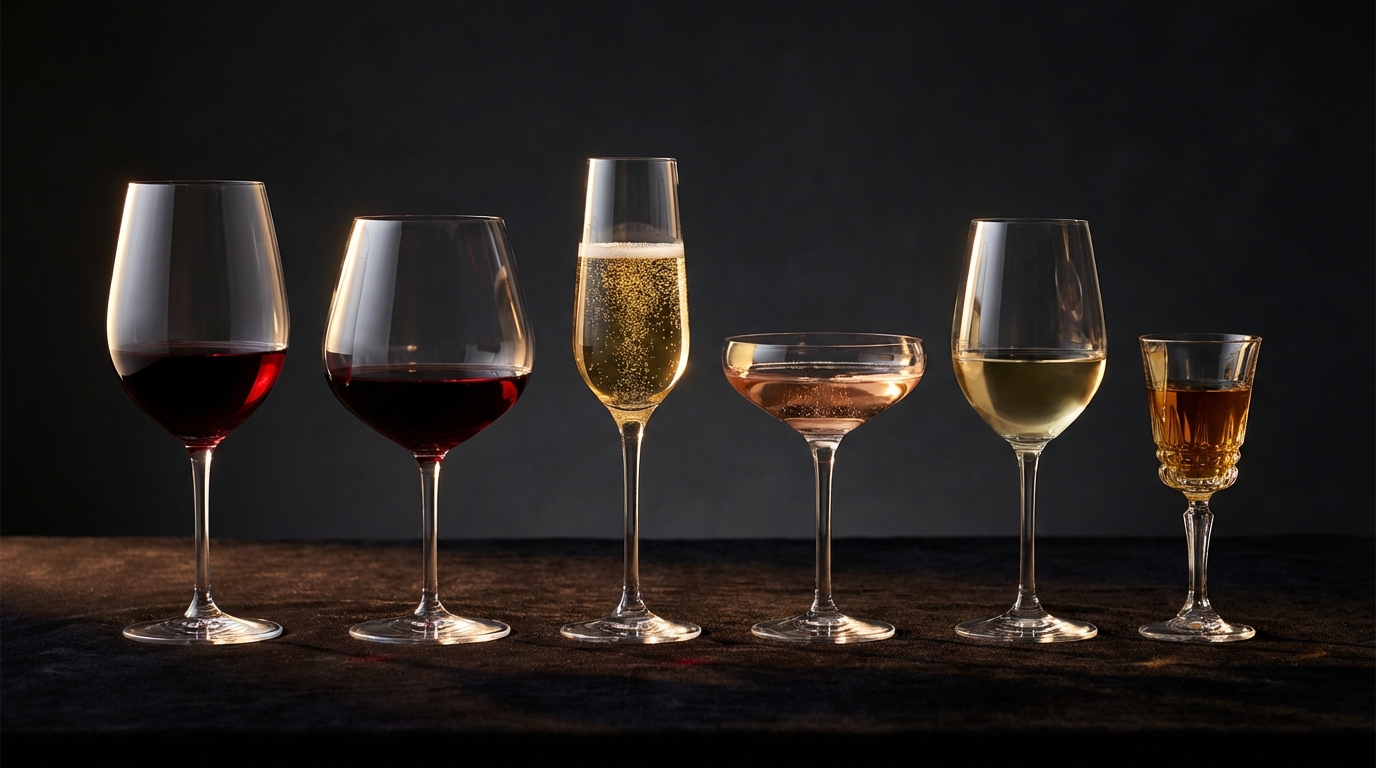
Understanding the four components of a wine glass helps explain why certain shapes work better for specific wines.
The bowl is the most important element. Its volume, width, and curvature determine how much surface area the wine has for aeration, how aromas collect in the headspace above the liquid, and how the wine flows when you tilt the glass. Bowls range from the generous 25-ounce capacity of a Burgundy balloon to the slender 6-ounce flute of a Champagne glass. The ideal pour fills the bowl roughly one-third full, leaving ample headspace for aromas to develop.
The rim is where the wine meets your lips. The best wine glasses feature a thin, cut rim (sometimes called a "laser-cut" rim) rather than a thick, rolled edge. Rim diameter determines whether aromas are funneled tightly toward the nose or dispersed broadly. Glasses that taper inward at the rim — like a Burgundy glass — concentrate aromas more effectively than those with a flared opening.
The stem serves two practical functions. First, it keeps your hand away from the bowl, preventing body heat from warming the wine prematurely — particularly important for whites, rosés, and sparkling wines served chilled. Second, it keeps fingerprints off the bowl, maintaining visual clarity so you can properly assess the wine's color, viscosity, and clarity. The stem also provides a natural grip point for swirling the wine to release aromatics.
The base (or foot) provides stability. A well-designed base is wide enough to prevent tipping but proportional to the overall glass. Some modern designs feature a slightly weighted base that lowers the center of gravity, making the glass more stable despite its delicate appearance.
Bordeaux and Cabernet Sauvignon Glasses
The Bordeaux glass — sometimes marketed as a "Cabernet" glass — is the tallest of the standard red wine glass family. Its defining characteristics are a tall, broad bowl with relatively straight sides and a wide opening that is only slightly narrower than the widest point of the bowl.
This shape is engineered for full-bodied, tannic red wines: Cabernet Sauvignon, Merlot, Cabernet Franc, Malbec, and Bordeaux blends. These wines contain high levels of tannin — astringent polyphenolic compounds extracted from grape skins, seeds, and oak barrels — that can taste harsh and grippy in youth. The wide bowl provides generous surface area for oxygen contact, which softens tannins through micro-aeration as you swirl and sip. The relatively wide opening directs wine across the full width of the palate, allowing the fruit concentration and mid-palate richness of these wines to be perceived before the tannin astringency registers on the finish.
A typical Bordeaux glass holds 20 to 24 ounces at full capacity, though you should pour only 5 to 6 ounces (roughly one-third of the bowl). The extra headspace is not wasted — it is the aroma chamber where ethanol-carried volatiles accumulate and develop complexity.
Best wines for this glass: Bordeaux blends (both Left Bank and Right Bank), Napa Valley Cabernet Sauvignon, Argentine Malbec, Australian Shiraz, Italian Super Tuscans, and any full-bodied red with significant tannin structure.
Burgundy and Pinot Noir Glasses
The Burgundy glass is the most distinctive shape in the wine glass family — a wide, balloon-like bowl that narrows significantly at the rim, creating the most dramatic bowl-to-rim ratio of any standard glass type. The maximum diameter of a Burgundy bowl can reach 4.5 to 5 inches, yet the rim narrows to just 2.5 to 3 inches.
This exaggerated shape serves the specific needs of Pinot Noir and other delicate, aromatic red wines. Pinot Noir produces wines with lower tannin, lighter body, and an intensely complex aromatic profile dominated by red fruit, earth, spice, and floral notes. These aromas are more volatile and fragile than those of Cabernet Sauvignon, so they dissipate faster in open air. The wide bowl provides ample surface area for the wine to breathe, while the dramatically tapered rim traps and concentrates those fleeting aromatics, funneling them directly to the nose with each sip.
The shape also directs wine to the tip of the tongue first, emphasizing fruit sweetness and finesse before the wine spreads to the sides and back where acidity and tannin are more prominently perceived. This sequence flatters Pinot Noir's naturally silky texture and bright acidity.
Best wines for this glass: Red Burgundy (Pinot Noir), Oregon Pinot Noir, New Zealand Pinot Noir, Nebbiolo (Barolo and Barbaresco), aged Rioja, Gamay (Beaujolais cru wines), and Barbera.
Chardonnay and Full-Bodied White Wine Glasses
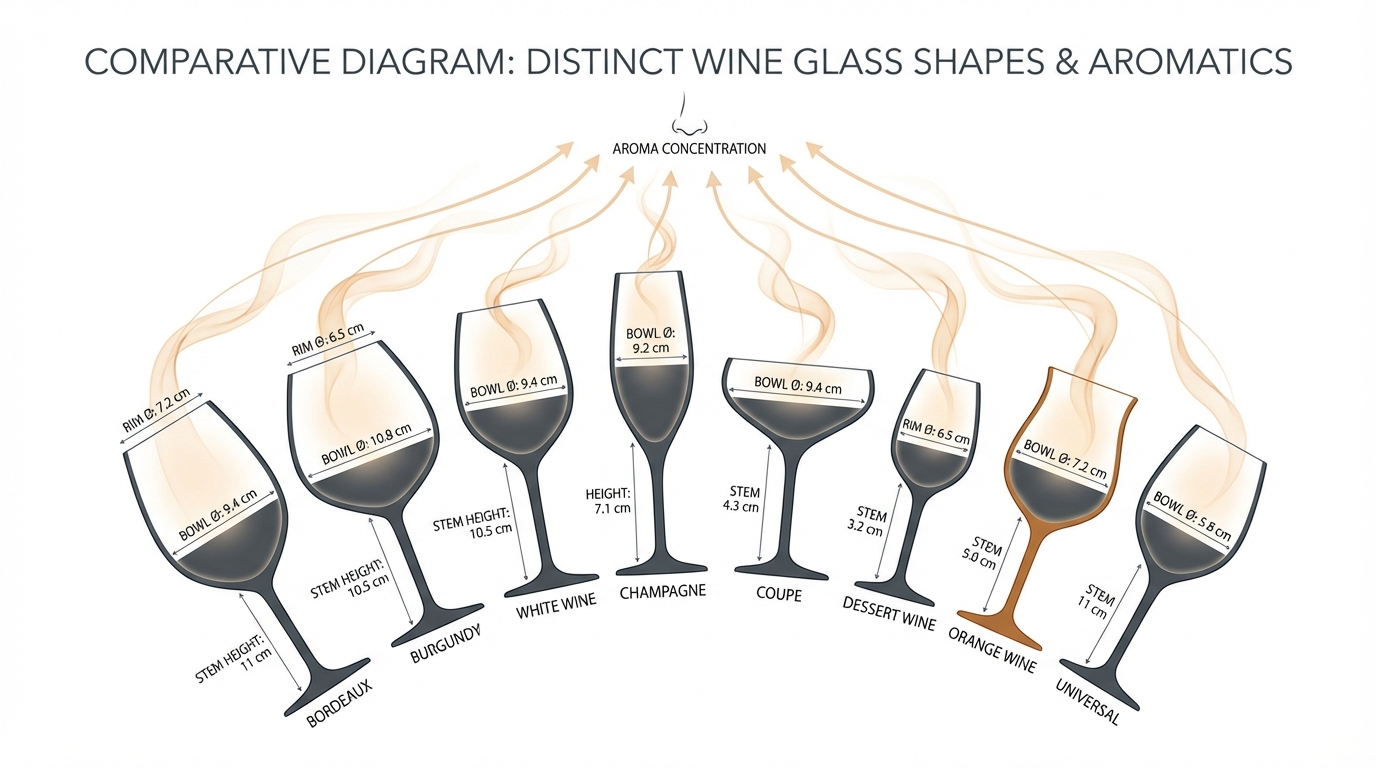
White wine glasses are generally smaller than red wine glasses, reflecting the fact that whites are served chilled and benefit from smaller pours that stay cool longer. However, within the white wine category, there is meaningful variation.
The Chardonnay glass features a medium-sized bowl — wider and more rounded than a Sauvignon Blanc glass but narrower and more tapered than a Burgundy glass. The bowl diameter typically sits between 3 and 3.5 inches, with a slightly tapered rim that concentrates aromas without the extreme narrowing of a Pinot Noir glass.
This shape balances the dual nature of Chardonnay. Oak-aged, full-bodied Chardonnays (white Burgundy, many Californian and Australian examples) develop rich, creamy textures and complex aromas of butter, toast, vanilla, and tropical fruit that benefit from some aeration and a moderately wide aromatic chamber. A glass that is too narrow would compress these generous aromas; one that is too wide would let them dissipate before you can appreciate their layered complexity.
For unoaked Chardonnay (Chablis, many modern examples from Burgundy and the Southern Hemisphere), the same glass shape works because the moderate taper preserves the wine's mineral freshness and citrus aromatics while still providing enough bowl width for the wine's natural texture to express itself.
Best wines for this glass: White Burgundy (Meursault, Puligny-Montrachet, Chablis), California Chardonnay, white Rhône blends (Viognier, Marsanne, Roussanne), Chenin Blanc (especially barrel-aged examples from Vouvray or South Africa), and Grüner Veltliner.
Sauvignon Blanc, Riesling, and Light White Wine Glasses
Aromatic white wines and high-acid white wines demand a fundamentally different glass shape: a tall, narrow, U-shaped bowl with a relatively small opening. This design minimizes surface area exposure, preserving the fresh, volatile aromatics that define these wine styles — citrus zest, green herbs, white flowers, stone fruit, and petrol notes — while directing the wine toward the center of the palate where acidity is perceived most pleasantly.
The narrow shape also keeps the wine colder for longer, since less surface area means less heat absorption from the surrounding air. This matters enormously for wines like Riesling, Sauvignon Blanc, Albariño, and Grüner Veltliner that lose their essential character when served too warm. The ideal pour in this glass is generous enough to enjoy multiple sips but small enough to finish before the wine warms appreciably — roughly 4 to 5 ounces.
A common mistake is using a wide Chardonnay glass for Riesling or Sauvignon Blanc. The broader bowl disperses the delicate, fleeting aromatics of these wines and exposes them to too much warmth, flattening the very acidity and freshness that makes them compelling.
Best wines for this glass: Sauvignon Blanc (Loire Valley, New Zealand, Bordeaux Blanc), Riesling (Alsace, Germany, Australia), Albariño, Muscadet, Vermentino, Grüner Veltliner (young and fresh styles), Pinot Grigio, and rosé wines.
Champagne and Sparkling Wine Glasses: Flute vs. Tulip vs. Coupe
No wine glass debate generates more passionate opinions than the Champagne glass question. Three shapes compete for dominance, and the answer depends on whether you prioritize spectacle, tradition, or serious tasting.
The flute is the most recognized Champagne glass: a tall, narrow cylinder on a stem. Its virtues are visual — the slender shape creates a dramatic column of rising bubbles, and the small surface area preserves carbonation for extended periods. Flutes are universally associated with celebration, and their narrow profile makes them easy to hold at crowded receptions. However, serious tasters increasingly criticize the flute for compressing aromas and making it nearly impossible to swirl the wine or appreciate its aromatic complexity. The narrow opening channels a concentrated stream of CO2 directly at the nose, which can overwhelm delicate notes of brioche, citrus, and chalk.
The coupe (or saucer) is the romantic choice — a wide, shallow bowl legendarily (and apocryphally) modeled on the breast of Marie Antoinette. Coupes are beautiful and evoke the glamour of 1920s cocktail culture. However, they are functionally terrible for Champagne: the enormous surface area causes bubbles to dissipate within minutes, the wide opening lets aromas escape immediately, and the shallow bowl makes swirling impossible without spilling. Use coupes for champagne towers and cocktail parties, not for tasting.
The tulip is the modern consensus choice for serious Champagne and sparkling wine appreciation. It combines elements of both: a moderately wide bowl that allows aromatics to develop and permits gentle swirling, tapering to a narrower rim that concentrates aromas and maintains a steady bead of bubbles. The tulip shape lets you appreciate the full complexity of a vintage Champagne — the toasty, autolytic notes from extended lees aging, the mineral precision from chalk soils, the fruit purity from Chardonnay and Pinot Noir — while still providing the visual pleasure of watching bubbles stream upward through the wine.
Many Champagne producers now serve their prestige cuvées in tulip-shaped glasses at their own cellars. When Dom Pérignon hosts tastings, they use a wide-bowled glass similar to a white wine glass. Chef de cave Vincent Chaperon has publicly stated that the flute "kills the wine" and prevents proper appreciation. This professional shift toward wider glasses reflects the broader movement to treat Champagne as serious wine rather than mere celebration beverage.
Best wines for the tulip glass: Vintage and prestige Champagne, Crémant d'Alsace, Crémant de Bourgogne, Franciacorta, English sparkling wine, and aged Cava.
Universal Wine Glasses: The One-Glass Solution
Not everyone can — or wants to — maintain a cabinet full of specialized glassware. The universal wine glass emerged to address this reality, offering a single shape that performs reasonably well across all wine styles.
The best universal glasses feature a medium-sized bowl (roughly 17 to 21 ounces capacity), a moderate taper at the rim, a thin, cut rim, and a generous but not excessive width that balances aeration for reds with preservation for whites. The design philosophy is deliberate compromise: no single wine style will be showcased at its absolute theoretical best, but no wine will be actively undermined either.
Gabriel-Glas StandArt is widely considered the gold standard of universal wine glasses, designed by Austrian wine critic René Gabriel specifically as a one-glass solution. Its subtle diamond-shaped bowl cross-section (slightly wider than it is deep) provides exceptional aromatic performance across reds, whites, and sparkling wines. The Zalto Universal and Grassl Liberté are equally respected alternatives that take slightly different design approaches to the same goal.
For most home wine drinkers, a set of six high-quality universal glasses represents the single best investment in wine enjoyment per dollar spent. You can always add specialized shapes later, but a good universal glass covers 90% of daily drinking scenarios admirably.
Dessert Wine and Fortified Wine Glasses
Dessert wines and fortified wines — Port, Sherry, Madeira, Sauternes, Tokaji, late-harvest Riesling, Vin Santo — are served in significantly smaller glasses with typical capacities of 6 to 10 ounces. The standard pour is just 2 to 3 ounces, reflecting these wines' concentrated flavors, higher alcohol, and often higher price per bottle.
The ideal dessert wine glass has a small, tapered bowl that concentrates the intense aromatics — dried fruit, honey, caramel, spice, oxidative complexity — while the small volume limits the amount of high-alcohol vapor reaching the nose. Too large a glass can allow the elevated alcohol (15% to 22% ABV for most fortified wines) to dominate the aromatic impression, masking the subtle flavors beneath.
Port glasses are traditionally shaped like miniature Bordeaux glasses — a small bowl with a slight taper. Sherry copitas are tulip-shaped tasting glasses originally designed for professional evaluation in Jerez, now widely used for all styles of Sherry from bone-dry Fino to lusciously sweet Pedro Ximénez. The copita's narrow rim and small capacity make it ideal for any wine where you want to concentrate aromas from a small pour.
Crystal vs. Glass: Material Matters
The material of your wine glass affects both performance and experience. The two main categories are soda-lime glass (ordinary glass) and crystal (or lead-free crystal).
Soda-lime glass is the standard material for everyday glassware. It is durable, dishwasher-safe, inexpensive, and perfectly functional for casual wine drinking. However, it has limitations: the glass walls must be relatively thick (typically 1.5 to 2mm) to maintain structural integrity, the rim cannot be cut as thin, and the surface is completely smooth at the microscopic level.
Crystal (traditionally lead crystal, now predominantly lead-free crystal using barium oxide, zinc oxide, or titanium) offers several advantages. Crystal can be blown much thinner — as thin as 0.4mm in premium examples — creating glasses that are astonishingly light and allow wine to flow over the rim without resistance. The material's refractive index is higher, producing more brilliant light refraction and sparkle. Most importantly for wine, the microscopic surface of crystal is rougher than glass, creating tiny nucleation points that encourage the release of aromatic compounds and — in sparkling wines — produce finer, more persistent streams of bubbles.
Lead-free crystal has become the industry standard since health concerns about lead leaching led to regulatory changes across Europe. Modern lead-free crystal (used by Riedel, Zalto, Schott Zwiesel, and most premium brands) matches or exceeds the performance of traditional lead crystal in thinness, clarity, and durability. Tritan crystal, developed by Schott Zwiesel, adds remarkable break resistance — the glasses flex slightly under stress rather than shattering, making them a practical choice for hospitality environments.
Stemmed vs. Stemless: When Each Makes Sense
The stemless wine glass — popularized by Riedel's "O" series in 2004 — removed the traditional stem entirely, creating a tumbler-shaped wine glass that sits directly in the palm. These glasses sparked controversy in the wine world and remain divisive.
Advantages of stemless glasses: They are extremely stable (virtually impossible to tip over), casual and modern in aesthetic, easy to store (they stack and nest), and generally less expensive. For everyday drinking, outdoor entertaining, picnics, and situations where breakage risk is high, stemless glasses are entirely practical.
Disadvantages of stemless glasses: Your hand wraps around the bowl, transferring body heat directly to the wine. For whites and sparkling wines served at 45°F to 55°F, this warming effect is significant and rapid. Fingerprints on the bowl obscure visual assessment. And for serious tasting, the inability to hold the glass by a stem makes controlled swirling more awkward.
The practical recommendation: Use stemmed glasses for serious tasting, formal dining, and any wine you want to evaluate carefully — especially whites, rosés, and sparkling wines where temperature matters most. Use stemless glasses for casual entertaining, outdoor events, robust reds served at room temperature, and any situation where durability and stability outweigh precision tasting requirements.
Premium Wine Glass Brands: A Buyer's Guide
The wine glass market ranges from $3 supermarket tumblers to $100+ hand-blown crystal stems. Here are the brands that define the premium tier.
Riedel is the undisputed pioneer. Founded in Bohemia in 1756 and now based in Kufstein, Austria, Riedel is a family-owned company led by the 11th generation of glassmakers. Claus Riedel revolutionized wine glass design in 1958 when he created the first grape-variety-specific glasses, establishing the principle that glass shape affects wine perception. The company's range spans from the affordable Ouverture series (machine-made, $10–15 per glass) through the excellent Vinum series (machine-made crystal, $20–30) to the benchmark Sommeliers series (hand-blown, mouth-blown crystal, $80–120). For most wine enthusiasts, the Vinum or Performance series offers the best balance of quality and value.
Zalto is the cult favorite of sommeliers and wine professionals worldwide. This small Austrian manufacturer produces hand-blown, lead-free crystal glasses of extraordinary thinness (approximately 0.4mm at the rim) and almost supernatural lightness. Zalto's defining design feature is the use of 24°, 48°, and 72° angles — the same angles as the earth's axial tilt — which the company claims optimize swirling dynamics. Whether the geometry claim has scientific merit is debatable, but the performance is not: Zalto glasses consistently win blind comparisons against all competitors. The Denk'Art Universal is perhaps the single finest all-purpose wine glass available. At $30–40 per glass, Zalto represents remarkable value for hand-blown crystal. The catch: they are extremely fragile and require hand-washing.
Gabriel-Glas was created by Swiss wine critic René Gabriel as the ultimate one-glass solution. The StandArt model (machine-made, $15–20) and Gold Edition (mouth-blown, $40–50) feature a distinctive diamond-shaped cross-section bowl designed to channel aromas effectively regardless of wine style. Gabriel-Glas has earned a devoted following among collectors who want simplicity without compromise.
Grassl is a rising Austrian brand gaining rapid recognition. The Liberté (universal), Vigneron (Burgundy), and Cru (Bordeaux) shapes are designed by winemaker-turned-glass-designer Gernot Grassl and offer exceptional aromatic performance at competitive prices ($25–35 per glass, hand-blown).
Lehmann Glass is the choice of the French wine establishment. Based in Alsace, Lehmann supplies glassware to many Michelin-starred French restaurants and is the official glass provider for several major French wine competitions. The Jamesse series, designed by sommelier Philippe Jamesse, is particularly well-regarded for Burgundy and Champagne.
The Georg Riedel Revolution
No discussion of wine glassware is complete without acknowledging the seismic impact of Georg Riedel, the 10th-generation Riedel glassmaker who transformed wine glass marketing and democratized the concept of grape-specific glassware.
While his father Claus designed the first varietal-specific glasses in 1958, it was Georg who in the 1980s and 1990s turned glassware from a commodity purchase into an aspirational wine accessory. Georg conducted thousands of comparative tasting workshops around the world, inviting wine professionals and consumers to taste identical wines from different glass shapes. These "Riedel tastings" were revelatory for participants — the differences in aroma, flavor intensity, and perceived balance between glass shapes were dramatic enough to convert even hardened skeptics.
Georg launched the Vinum series in 1986 — the first machine-made crystal glass series designed by varietal — making high-quality, shape-specific glasses accessible at moderate prices for the first time. This single product line arguably did more to change everyday wine drinking habits than any other innovation in wine accessories. He followed with the Ouverture series for entry-level drinkers and the Wine Wings collection for extreme performance.
Georg's greatest achievement may have been shifting the conversation: before Riedel's marketing campaigns, most consumers thought of wine glasses as generic serving vessels. After Riedel, the idea that the glass matters — that it is a tool, not just a container — became mainstream wine knowledge. Even if you choose a competitor's glass, you are benefiting from the cultural shift that Georg Riedel initiated.
How to Wash, Store, and Care for Wine Glasses
Fine wine glasses are an investment, and proper care dramatically extends their lifespan.
Washing: Hand-washing is ideal for crystal glasses, especially thin-walled examples from Zalto, Riedel Sommeliers, and similar premium ranges. Use warm (not hot) water, a small amount of unscented dish soap, and a soft sponge. Avoid abrasive scrubbers that can scratch crystal. Rinse thoroughly to remove all soap residue, which can affect wine aromatics and suppress foam formation in sparkling wines. For machine-made crystal (Riedel Vinum, Schott Zwiesel, and similar), most modern dishwashers on a gentle cycle work well — use a small amount of detergent and avoid high-heat drying cycles that can cause thermal stress cracking.
Drying: Air drying is safest but leaves water spots in hard-water areas. Microfiber polishing cloths designed for glassware produce streak-free results. Hold the glass by the bowl (not the base) while polishing the stem, and hold the stem while polishing the bowl — never twist the bowl and base in opposite directions, which is the number one cause of stem breakage.
Storage: Store glasses upright on their base, not inverted on the rim. Storing glasses upside-down puts stress on the thin, delicate rim and can cause chipping. Glasses stored upside-down also trap stale air in the bowl, which can impart musty odors to wine. If cabinet space requires inverted storage, give the glass a quick rinse before use to refresh the interior.
Reviving musty glasses: If stored glasses develop stale aromas, rinse them with a mixture of white vinegar and warm water, then air-dry. Alternatively, swirl a small splash of the wine you intend to drink in the glass before pouring your tasting measure — this "rinse pour" conditions the glass with the wine's own compounds.
How Many Glasses Do You Really Need?
For the minimalist: Six universal glasses (Gabriel-Glas StandArt, Zalto Universal, or Grassl Liberté) will serve you admirably for every wine style, every occasion, and every day of the week. This is the recommendation for most wine drinkers, especially those with limited storage space.
For the enthusiast: Add six Bordeaux/Cabernet glasses and six Burgundy/Pinot Noir glasses to your universal set. This gives you dedicated shapes for the two most important red wine families, with the universals handling whites, rosés, sparkling wines, and casual drinking. Total: 18 glasses.
For the serious collector: Build a full suite — six each of Bordeaux, Burgundy, Chardonnay, Sauvignon Blanc/Riesling, Champagne tulips, and dessert/fortified glasses, plus six universals for daily use. Total: 42 glasses. This is the "wine room" setup for someone who regularly hosts formal tastings and dinners.
For everyone: Start with six universals. Add specialized shapes only when you find yourself regularly drinking a specific wine style and wanting to experience it at its best. The marginal improvement from the 7th glass type is far smaller than the leap from a mediocre tumbler to your first proper wine glass. Invest in quality before quantity — six excellent glasses outperform twelve mediocre ones every time.
Final Thoughts: The Glass Is a Tool, Not a Fetish
Wine glassware can become an obsession, and the industry has a financial incentive to convince you that you need dozens of hyper-specialized shapes. The truth is more measured. The difference between a bad glass and a good glass is enormous — it genuinely transforms the tasting experience. The difference between a good glass and a perfect glass is real but subtle — appreciable to professionals, often invisible to casual drinkers.
The most important thing is to drink wine from a glass that has a proper bowl shape, a thin rim, and enough volume to swirl without spilling. Whether that glass costs $15 or $100, whether it was designed for Pinot Noir or marketed as universal, matters far less than those basic parameters. Start with one good set of universal glasses, learn what you enjoy drinking most often, and expand from there. The glass should enhance the wine, not complicate the experience of enjoying it.


