The Land of Fog and Nebbiolo
The Langhe hills of southeastern Piedmont — Italy's northwestern corner — produce two of the most revered and age-worthy red wines on earth: Barolo and Barbaresco. These wines share a single grape variety, Nebbiolo, but express it through a mosaic of soils, exposures, and microclimates that yields an extraordinary diversity of character. Understanding Barolo and Barbaresco means understanding how one grape, in one relatively compact stretch of hillside terrain, can produce wines that range from ethereally perfumed to massively structured, from approachable in youth to impenetrably tannic for decades.
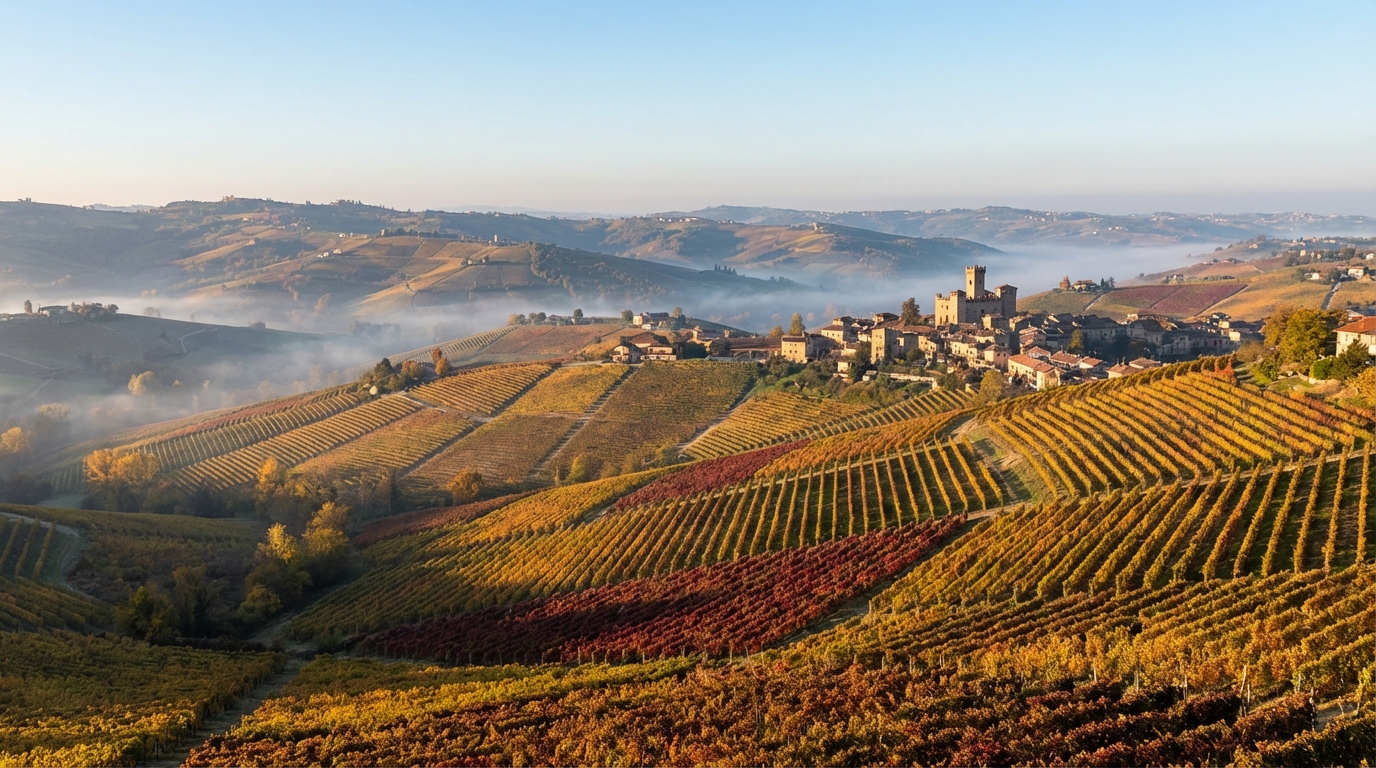
The name Nebbiolo itself offers a clue to the landscape. It derives from nebbia, the Italian word for fog — the thick autumn mists that roll through the Langhe valleys each October and November, blanketing the vineyards as the grapes reach their final stages of ripeness. These fogs moderate temperature swings, extend the growing season, and create the conditions for Nebbiolo's extraordinarily late ripening cycle. Nebbiolo is typically the last grape harvested in Piedmont, often not picked until mid- to late October, when most other varieties have long since been brought in from the vineyards.
The broader geography is defined by the Alps to the north and west, which shield Piedmont from the harshest Atlantic weather systems while creating a semi-continental climate — warm summers, cold winters, and significant diurnal temperature variation during the growing season. The Tanaro River curves through the region, separating the Barolo zone to the southwest from Barbaresco to the northeast. Elevations in the prime vineyard sites range from roughly 200 to 500 meters, with the best parcels occupying south- to southwest-facing slopes that maximize sun exposure during Nebbiolo's critical ripening period in September and October.
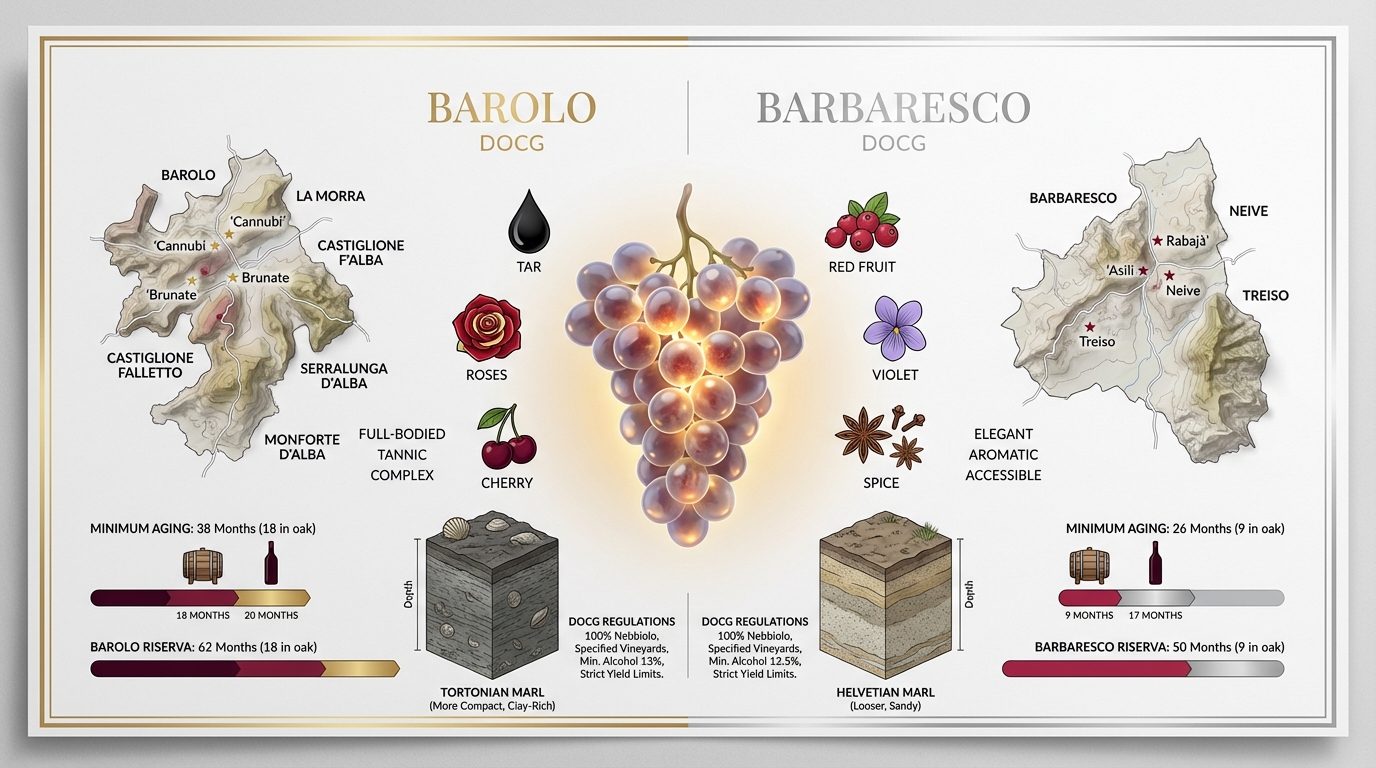
The soils of the Langhe are sedimentary in origin, deposited when the region lay beneath an ancient sea. Two broad geological formations dominate: the Tortonian formation (roughly 11 to 7 million years old), characterized by sandstone and less compact marls, and the Helvetian (or Serravallian) formation (roughly 14 to 11 million years old), marked by more calcareous, limestone-rich, and compact marls. The interplay between these two formations — and their countless local variations — is the key to understanding why a Barolo from Serralunga d'Alba tastes fundamentally different from one produced in La Morra, even though both are made from the same grape using similar techniques.
Nebbiolo: The Grape of a Thousand Faces
Nebbiolo is one of the most paradoxical grapes in the wine world. It is thin-skinned — visually, its wines are among the palest reds you will encounter, often garnet to brick-orange even in youth, lightening to translucent amber with age. Yet despite that pale color, Nebbiolo produces wines of ferocious tannin — firm, gripping, and astringent in their youth, requiring years or even decades to resolve into silky complexity. The disconnect between color and structure is Nebbiolo's signature contradiction and the reason it startles so many first-time tasters.
The aromatic profile is equally distinctive. Young Nebbiolo offers notes of red cherry, rose petal, violet, and fresh tar — the famous "tar and roses" descriptor that has become shorthand for the variety. With age, the perfume evolves to include dried herbs, leather, tobacco, truffle, forest floor, dried orange peel, camphor, and licorice. Great aged Barolo or Barbaresco achieves an aromatic complexity that rivals the finest Burgundy, unfolding in the glass over hours as the wine breathes and warms.
Nebbiolo's tannins deserve special attention. Unlike Cabernet Sauvignon, whose tannins derive primarily from thick skins and seeds, Nebbiolo's tannin structure comes from an unusually high concentration of polymeric tannins in its thin skins. These tannins are aggressive in youth — drying the palate and clenching the mouth — but they have a remarkable capacity for polymerization over time, gradually softening and integrating to create a velvety, almost ethereal texture. This evolution is why Barolo has traditionally been called "the wine of patience."
The grape is notoriously site-sensitive. Outside Piedmont and a handful of outposts in Lombardy's Valtellina (where it is called Chiavennasca) and Valle d'Aosta, Nebbiolo has failed to produce wines of comparable quality. Attempts to grow it in California, Australia, and other New World regions have yielded technically correct but spiritually hollow wines — proof that Nebbiolo's greatness is inseparable from the specific geology, climate, and tradition of its homeland. The Italians call it the "grape of a thousand faces" because even within the Langhe, Nebbiolo expresses itself differently in every vineyard, every exposure, every soil type.
Barolo DOCG: The King of Wines
Barolo was formally designated a DOCG (Denominazione di Origine Controllata e Garantita) in 1980, cementing its status as one of Italy's most prestigious appellations. The production zone encompasses 11 communes in the Langhe hills south of Alba: Barolo, La Morra, Castiglione Falletto, Serralunga d'Alba, Monforte d'Alba, Novello, Grinzane Cavour, Verduno, Diano d'Alba, Cherasco, and Roddi. Of these, five are considered the historic heartland: Barolo, La Morra, Castiglione Falletto, Serralunga d'Alba, and Monforte d'Alba. The vast majority of the finest wines originate from these five communes.
The regulations require that Barolo be made from 100% Nebbiolo (locally known as Lampia, Michet, or Rosé clonal selections). The wine must age for a minimum of 38 months from November 1 of the harvest year, with at least 18 months in wood (oak barrels of any size). Barolo Riserva requires 62 months of total aging, with 18 months minimum in wood. Minimum alcohol is 13%.
The character of Barolo varies dramatically by commune, reflecting the underlying geology.
La Morra sits on predominantly Tortonian soils — blue-grey marls with significant clay and sand content. The wines tend to be the most aromatic and approachable of the Barolo communes, with perfumed floral notes, softer tannins, and earlier drinkability. Key crus include Brunate (shared with Barolo commune), Cerequio, Rocche dell'Annunziata, and Arborina.
Barolo (the village) offers a diverse geological profile, producing wines that bridge elegance and structure. The legendary Cannubi vineyard — often called the Grand Cru of Barolo — sits at the heart of the commune, its south-facing slope of mixed calcareous marl and sand producing wines of extraordinary perfume and complexity. Other notable sites include Sarmassa, Brunate (partially in La Morra), and Liste.
Castiglione Falletto occupies a transitional position between the softer Tortonian soils of the west and the harder Helvetian formations of the east. The wines combine aromatic finesse with firm structure — a best-of-both-worlds character that makes this commune a favorite among many collectors. Top crus include Rocche di Castiglione, Monprivato (the monopole of Giuseppe Mascarello), Villero, and Bricco Boschis.
Serralunga d'Alba is built on compact Helvetian calcareous marl — the so-called "Lequio formation" — that produces Barolo's most powerful, tannic, and long-lived wines. These are the wines that truly demand decades of cellaring. The great vineyards here include Vigna Rionda (source of some of the most collectible Barolos ever made), Lazzarito, Francia, Falletto, and Ornato.
Monforte d'Alba shares much of Serralunga's geological character but adds its own complexity through varied elevations and exposures. The wines are structured and concentrated, with dark fruit and earthy depth. Bussia — one of the largest and most historically important Barolo vineyards — lies here, along with Ginestra, Mosconi, Gramolere, and Castelletto.
The MGA System: Piedmont's Answer to Burgundy
In 2010, the Barolo Consorzio formally codified the Menzioni Geografiche Aggiuntive (MGA) system — a classification of 181 named vineyard sites within the Barolo DOCG. The MGA system is Piedmont's equivalent of Burgundy's climat system: a recognition that specific parcels of land produce wines of distinctive and repeatable character, deserving of individual identification on the label.
The MGA classification was decades in the making. Individual producers had been labeling wines by vineyard name since the 1960s — pioneers like Beppe Colla of Prunotto and Renato Ratti of Marcenasco were among the first to vinify and bottle single-vineyard Barolo. Ratti created an influential vineyard map of the Barolo zone in 1971 that became the de facto reference for understanding the region's terroir. The 2010 codification formalized what the market already recognized: that a Barolo from Cannubi and a Barolo from Vigna Rionda are fundamentally different wines, even though both carry the Barolo DOCG designation.
Unlike Burgundy, the MGA system does not rank vineyards hierarchically — there are no Grand Crus or Premiers Crus. All 181 sites are nominally equal. This is both a strength and a limitation: it avoids the political controversies that plague hierarchical classifications, but it also means that the market, not the authorities, must determine which MGAs are truly exceptional. In practice, a clear hierarchy has emerged through decades of critical acclaim and auction prices. Vineyards like Cannubi, Brunate, Cerequio, Rocche dell'Annunziata, Monprivato, Rocche di Castiglione, Villero, Vigna Rionda, Francia, Bussia, and Ginestra command significant premiums over less renowned sites.
Barbaresco followed suit with its own MGA classification in 2007, identifying 66 named subzones across its four communes. Key Barbaresco MGAs include Asili, Rabajà, Pajé, Sorì Tildin, Sorì San Lorenzo, Montestefano, Gallina, Ovello, Albesani, and Starderi.
Barbaresco DOCG: Nebbiolo's Elegant Expression
Barbaresco received its DOCG designation in 1980, the same year as Barolo. The production zone is significantly smaller, encompassing just four communes: Barbaresco, Neive, Treiso, and the tiny San Rocco Seno d'Elvio (absorbed into the Barbaresco commune administratively but sometimes listed separately). Total vineyard area under vine is roughly 700 hectares, compared to Barolo's approximately 2,000 hectares.
Barbaresco's regulations are slightly less demanding than Barolo's, reflecting the wines' generally earlier-maturing character. Minimum aging is 26 months from November 1 of the harvest year (compared to 38 for Barolo), with at least 9 months in wood. Barbaresco Riserva requires 50 months of total aging. Minimum alcohol is 12.5%.
The Barbaresco commune itself sits along the banks of the Tanaro River, benefiting from the thermal moderation of the waterway. Its most celebrated vineyard is Asili — a south-facing amphitheater of calcareous marl that produces Barbaresco of breathtaking elegance and aromatic purity. Rabajà, just above Asili, is almost equally revered, producing slightly more structured wines with extraordinary aging potential. Other key sites include Pajé, Pora, Montefico, and Montestefano.
Neive is the largest of the four communes and produces the most structured, tannic Barbarescos — sometimes described as "the Serralunga of Barbaresco." Top crus include Gallina, Santo Stefano (historically bottled by Bruno Giacosa as one of the greatest Italian wines ever made), Starderi, and Albesani.
Treiso occupies higher elevations and produces wines with notable freshness and mineral precision. Key vineyards include Pajorè, Bernadot, and Marcarini. San Rocco Seno d'Elvio is tiny but contributes some fine sites at higher altitudes.
Barbaresco's reputation was profoundly shaped by two individuals. Angelo Gaja — the most famous Italian winemaker of the 20th century — elevated Barbaresco to international prominence through his single-vineyard bottlings: Sorì Tildin, Sorì San Lorenzo, and Costa Russi, all from the Barbaresco commune. These wines, produced with modern techniques and marketed with unrelenting ambition, demonstrated that Barbaresco could command prices rivaling the world's greatest wines. Controversially, Gaja declassified his single-vineyard wines to Langhe DOC in 1996 to include a small percentage of Barbera, though they remain de facto reference Barbarescos.
The Produttori del Barbaresco cooperative, founded in 1958, took the opposite approach: traditional winemaking, honest pricing, and unflinching transparency. The cooperative produces nine single-vineyard Riservas — Asili, Rabajà, Pajé, Pora, Montestefano, Montefico, Ovello, Muncagota, and Rio Sordo — that collectively constitute the most comprehensive terroir survey in Barbaresco. These wines, priced at a fraction of Gaja's offerings, have won the devotion of critics and collectors worldwide.
Traditional vs. Modern: The Great Barolo Debate
No discussion of Barolo and Barbaresco is complete without addressing the traditionalist-modernist divide that convulsed the region in the 1980s and 1990s — a debate that, while now largely resolved, fundamentally shaped the wines we drink today.
Traditional Barolo winemaking, as practiced for centuries, involves extended maceration — fermentation and skin contact lasting 30 to 60 days or more — followed by aging in large Slavonian oak casks (botti) of 20 to 100 hectoliters for three to five years or longer. The botti are typically old and neutral, contributing minimal oak flavor while allowing slow, gentle oxidative development. Traditional Barolo can be austere and forbidding in youth — massively tannic, with brick-tinged color and austere fruit — but it develops extraordinary complexity over decades. Proponents argue that only this approach captures Nebbiolo's full terroir expression.
The modernist revolution began in the late 1970s and 1980s, led by producers like Elio Altare, Luciano Sandrone, Roberto Voerzio, Domenico Clerico, and Paolo Scavino. Inspired by Burgundy and Bordeaux, these winemakers adopted shorter maceration periods (8 to 15 days), rotary fermenters to extract color and fruit quickly, and aging in new French barriques (225-liter barrels) that imparted vanilla, spice, and toast to the wine. The results were dramatic: modernist Barolos were darker in color, richer in fruit, softer in tannin, and drinkable much younger than their traditional counterparts. Critics, particularly American critics led by Robert Parker, enthusiastically embraced the style, awarding high scores that drove international demand.
The "Barolo Wars" of the 1990s pitted traditionalists against modernists with genuine bitterness. Bartolo Mascarello famously produced a label reading "No Barrique, No Berlusconi" — linking the use of small French oak to political corruption. Traditionalists accused modernists of producing standardized, internationally styled wines that obscured terroir. Modernists countered that traditional Barolo was often flawed — oxidized, dirty, and undrinkable by the time it softened enough to enjoy.
By the 2000s and 2010s, the debate had largely subsided into a pragmatic middle ground. Most contemporary producers use a combination of techniques: moderate maceration periods of 15 to 30 days, a mix of botti and barrique (or medium-sized casks of 500 to 2,500 liters), and gentler extraction methods. The new French barrique, once omnipresent, has fallen out of favor — many producers who used 100% new oak in the 1990s now use only 10% to 30% new wood, or have returned entirely to botti. The consensus is that great Nebbiolo needs oak for structure and micro-oxygenation, but not for flavor.
The most revered producers today — Giacomo Conterno, Bruno Giacosa, Bartolo Mascarello (now run by Maria Teresa Mascarello), Giuseppe Rinaldi, and Giovanni Rosso — are firmly in the traditional camp. Yet producers who emerged from the modernist movement — Sandrone, Scavino, G.D. Vajra — have progressively dialed back oak and extraction, producing wines that honor terroir while remaining approachable. The old battle lines have blurred beyond recognition.
Great Producers of Barolo and Barbaresco
Giacomo Conterno is, by near-universal critical consensus, the greatest producer of Barolo. The estate's Monfortino Riserva — sourced from the Francia vineyard in Serralunga and released only in exceptional vintages after seven or more years of aging in large botti — is among the most profound and long-lived wines made anywhere. The Cascina Francia bottling, the estate's "regular" Barolo, would be the crown jewel of virtually any other cellar. Under Roberto Conterno's meticulous stewardship, the wines combine monumental structure with breathtaking purity of fruit.
Bruno Giacosa (d. 2018) was the undisputed master of Barbaresco and a towering figure in Barolo. His red-label Riservas — particularly those from Santo Stefano di Neive and Asili in Barbaresco, and Falletto di Serralunga and Le Rocche del Falletto in Barolo — are legendary wines that rank among the greatest Italian bottles of the 20th century. The estate continues under his daughter Bruna's direction.
Bartolo Mascarello produced one of the most celebrated traditional Barolos — a single wine blended from multiple vineyards in the Barolo commune, including Cannubi, San Lorenzo, and Rué. Maria Teresa Mascarello now continues her father's uncompromising vision: no barrique, no single-vineyard bottlings, no concession to fashion.
Giuseppe Rinaldi crafted ethereal, hauntingly perfumed Barolos from Brunate, Le Coste, Ravera, and Tre Tine. Now run by Marta and Carlotta Rinaldi, the estate remains a beacon of traditional winemaking with a cult following.
G.D. Vajra in Barolo village produces wines of extraordinary finesse across the full range — from the entry-level Langhe Nebbiolo to the stunning Bricco delle Viole and Ravera Barolos. The Vaira family's commitment to organic farming and meticulous vineyard work results in wines that are simultaneously powerful and graceful.
Angelo Gaja revolutionized the marketing and ambition of Piedmontese wine. His Barbaresco bottlings — Sorì Tildin, Sorì San Lorenzo, and Costa Russi — remain benchmarks, even if the decision to declassify them to Langhe DOC frustrates purists. Gaja's Barolo estate, Gaja Sperss and Conteisa, produces similarly ambitious wines from Serralunga.
Produttori del Barbaresco is simply the finest cooperative in Italy and one of the best in the world. Their nine single-vineyard Riservas offer an unparalleled education in Barbaresco terroir at prices that remain remarkably accessible. In top vintages like 2016 and 2019, these wines rival the greatest Barbarescos from any producer.
Roagna in Barbaresco produces profoundly traditional wines from some of the oldest vines in the region. Their Crichet Pajé Barbaresco, from a parcel of vines planted in the 1950s, is one of the most hauntingly beautiful wines made in Piedmont. The Pajé and Asili bottlings are equally compelling.
Other essential producers include Vietti (particularly the Ravera, Brunate, and Lazzarito Barolos), Aldo Conterno (Granbussia Riserva), Luciano Sandrone (Le Vigne, Cannubi Boschis), Elvio Cogno (Ravera), Brovia (Rocche di Castiglione, Ca' Mia), and Cappellano (the cult-status Otin Fiorin bottlings from Serralunga).
Vintages: Navigating Barolo and Barbaresco Through Time
Barolo and Barbaresco are profoundly vintage-dependent wines. The late-ripening nature of Nebbiolo means that the grape is vulnerable to autumn rain, hail, and premature cold — a challenging September or October can derail what otherwise appeared to be a promising growing season. Understanding vintages is essential for buying wisely.
2010 is considered one of the all-time great Barolo vintages — a classic, cool-to-moderate year that produced wines of extraordinary structure, acidity, and aging potential. The best 2010 Barolos will drink superbly for 30 to 50 years. Giacomo Conterno's 2010 Monfortino has been called one of the greatest wines ever made in Piedmont.
2013 was a late-ripening vintage that tested growers' nerves but rewarded patience with refined, elegant wines of crystalline purity. Some critics initially underrated 2013, but the wines have blossomed in bottle and now command strong prices. A vintage for lovers of finesse over power.
2016 is the consensus "vintage of the decade" — a warm, balanced growing season that produced wines of exceptional concentration, ripe tannins, and immediate appeal without sacrificing structure or aging potential. The 2016 Barbarescos are particularly outstanding, with the Produttori del Barbaresco Riservas earning near-universal critical acclaim.
2019 combined warmth with freshness to produce wines of rich fruit and supple tannins — more approachable in youth than 2010 or 2016 but with genuine substance. An excellent vintage for drinkers who prefer not to wait decades.
2020 was shaped by a cooler, wetter spring followed by a warm, dry summer. The wines are aromatic, medium-bodied, and elegant — not blockbusters but beautifully balanced and likely to develop well over 15 to 25 years. A vintage that rewards careful producer selection.
Other noteworthy recent vintages include 2015 (warm, generous, immediately appealing), 2014 (underrated, classical, excellent value), and 2017 (hot year, powerful wines, drink earlier).
How to Approach Barolo and Barbaresco
These are wines that demand attention and patience — both in the cellar and at the table.
Decanting is almost always advisable, particularly for wines under 15 years of age. Young Barolo benefits from 2 to 4 hours of decanting to soften tannins and allow the bouquet to open. Older Barolos (20+ years) should be decanted briefly — 30 minutes to 1 hour — to separate the wine from any sediment without excessive exposure to oxygen, which can cause fragile old wines to fade rapidly.
Serving temperature is critical. Barolo and Barbaresco are best served at 16°C to 18°C (61°F to 64°F) — slightly cooler than most people serve red wine. At room temperature (especially in heated dining rooms), the alcohol can seem hot and the tannins astringent. A brief period in the refrigerator — 15 to 20 minutes — brings the wine into its ideal range.
Aging windows vary dramatically by commune, producer, and vintage. As a general framework:
- Entry-level Langhe Nebbiolo: 2 to 7 years from vintage
- Commune-level Barolo/Barbaresco: 8 to 20 years from vintage
- Single-vineyard (MGA) Barolo: 10 to 30 years from vintage
- Barolo Riserva (top producers): 15 to 40+ years from vintage
- Barbaresco Riserva (top producers): 10 to 30 years from vintage
The most collectible wines — Monfortino, Giacosa Riservas, Rinaldi Brunate — can age for 50 years or more in great vintages, though finding perfect storage is essential for such longevity.
Food Pairing: Barolo and Barbaresco at the Table
Barolo and Barbaresco are quintessentially food wines — their high acidity and firm tannins make them natural partners for the rich, savory cuisine of Piedmont.
Tajarin (hand-cut egg pasta with 30 to 40 yolks per kilogram of flour) dressed with a simple butter and sage sauce or, in autumn, shaved white truffles from Alba is the canonical Barolo pairing. The egg-rich pasta provides the fat and protein to tame Nebbiolo's tannins, while the truffle's earthy perfume harmonizes with the wine's evolved aromatics.
Agnolotti del plin — tiny pinched pasta parcels stuffed with braised meat and served in roasting juices — is another Piedmontese classic that sings with young to medium-aged Barolo. The braised filling echoes the savory complexity of the wine.
Brasato al Barolo (beef braised in Barolo) creates a magnificent circular pairing — the wine in the glass mirrors the wine in the pot, with the long-cooked meat providing the unctuousness to match tannic structure.
White truffles from Alba (Tuber magnatum pico), available from October through December, are Piedmont's greatest culinary treasure and Barolo's spiritual partner. Shaved over tajarin, risotto, or a simple fried egg, the truffle's intoxicating aroma of garlic, honey, and earth merges seamlessly with aged Nebbiolo.
Fonduta (Piedmontese cheese fondue made with Fontina d'Aosta) is a rich, warming pairing that works particularly well with younger, more structured wines. Castelmagno cheese — one of Italy's rarest and most complex aged cheeses — is exceptional with mature Barolo.
For Barbaresco's slightly more delicate structure, consider vitello tonnato (cold veal with tuna sauce), risotto al Barolo (despite the name, equally suited to Barbaresco), roasted guinea fowl, or braised rabbit with herbs.
Barolo and Barbaresco Today: A Golden Age
The current era represents an unprecedented golden age for Barolo and Barbaresco. Viticultural knowledge has never been deeper, winemaking has never been more precise, and the false binary between traditional and modern has given way to a nuanced, terroir-focused consensus. A new generation of producers — many of them women, including Marta and Carlotta Rinaldi, Maria Teresa Mascarello, Bruna Giacosa, and Elena Penna of Roagna — is carrying forward family legacies while quietly innovating.
Climate change presents both opportunities and challenges. Warmer growing seasons have made ripe vintages more consistent — the string of poor years that plagued the 1970s and 1980s is less likely to recur. But excessive heat threatens the acidity and freshness that give Nebbiolo its distinctive elegance. Higher-altitude vineyards and north-facing exposures, once considered marginal, are increasingly valued for their ability to produce balanced wines in warm years.
The MGA system has transformed how consumers understand and buy these wines. Where once "Barolo" was a monolithic category, today an educated buyer can navigate by commune, vineyard, producer, and vintage with a sophistication that approaches what Burgundy collectors have practiced for generations. This specificity has driven prices upward — top single-vineyard Barolos from the best producers now compete with Premier Cru Burgundy — but it has also deepened appreciation for the region's extraordinary terroir diversity.
Whether you are opening a bottle of Produttori del Barbaresco's Riserva Asili with friends or cellaring a Monfortino for your grandchildren, these wines reward every level of engagement. They are wines that connect you to a specific place — the fog-shrouded Langhe hills, the ancient soils, the centuries of human effort — with a directness and authenticity that few wine regions can match. Barolo and Barbaresco are not merely great wines. They are among the most complete and profound expressions of terroir that the wine world has to offer.


