What Is En Primeur?
En primeur — literally "in its first state" — is the centuries-old practice of purchasing wine while it is still aging in barrel, typically 18 to 24 months before bottling. The system is most closely associated with Bordeaux, where it has evolved into one of the most sophisticated commodity markets in the wine world, though futures programs now exist for wines from Burgundy, the Rhône Valley, Port, and several Italian regions.
The concept originated in the 17th and 18th centuries, when Bordeaux's powerful merchant class — the négociants — began purchasing wine from châteaux shortly after the harvest to secure supply and lock in prices. This arrangement benefited both parties: châteaux received immediate cash flow to fund operations and barrel purchases for the incoming vintage, while négociants secured allocations of the most sought-after wines before they reached the open market.
The modern en primeur system crystallized in the 1970s and 1980s, when legendary vintages like 1982 demonstrated that buying futures could yield extraordinary returns. Robert Parker's influential 96–100 point score for the 1982 vintage — awarded from barrel — fundamentally changed the dynamics, injecting speculative energy into what had been a trade-focused distribution mechanism. By the 2000s, en primeur had become both a commercial tradition and a financial marketplace, attracting collectors, investors, and speculators alongside traditional wine merchants.
The annual ritual is known as the campaign (la campagne des primeurs). Each spring, the Bordeaux wine trade opens its doors to journalists, critics, and merchants who taste the previous autumn's harvest from barrel samples. These tastings generate scores and reviews that heavily influence release pricing. The campaign is simultaneously a trade fair, a media event, and a price-discovery mechanism — a unique intersection of agriculture, luxury, and finance that has no true parallel in any other food or beverage industry.
How the En Primeur Campaign Works
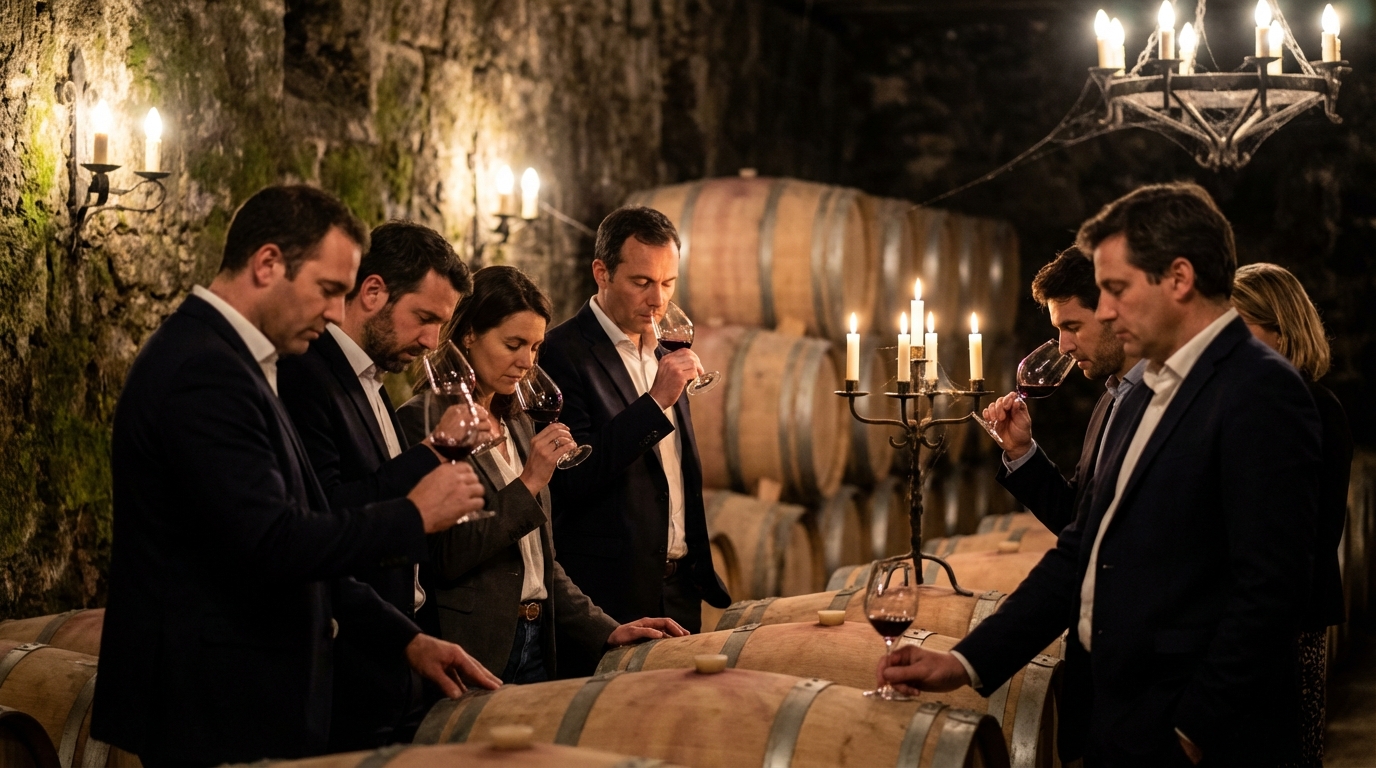
The en primeur campaign follows a remarkably consistent annual calendar, though the specific dates shift by a few weeks depending on the vintage.
September–October: The harvest takes place in Bordeaux. By late autumn, the wines have completed fermentation and begin their barrel aging. Early reports from winemakers and consultants give the trade initial impressions of vintage quality — warm, dry years generate early excitement, while challenging conditions temper expectations.
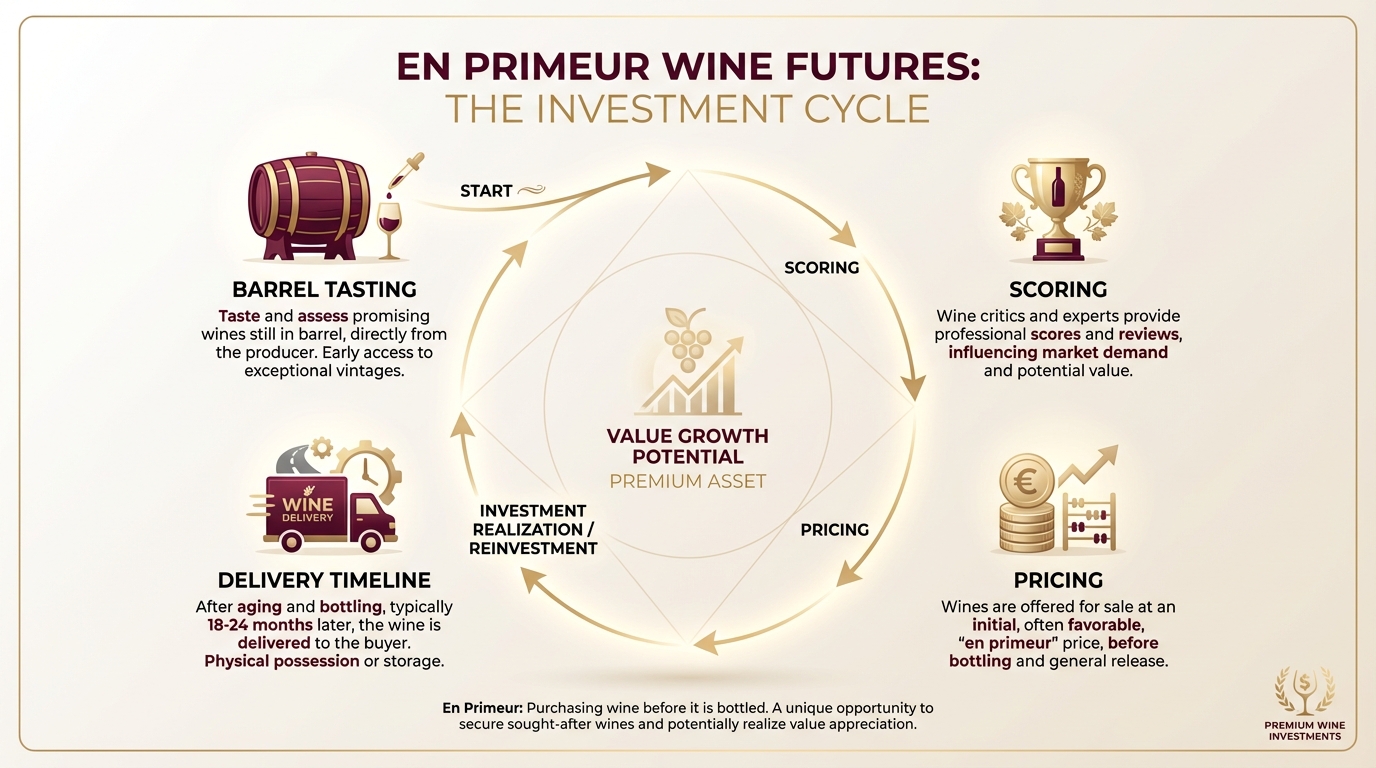
March–April: The Union des Grands Crus de Bordeaux and individual châteaux host a series of intensive barrel tastings over approximately two weeks. Several hundred journalists, critics, and merchants taste through hundreds of wines from barrel. Publications like The Wine Advocate, Vinous, Jancis Robinson MW, James Suckling, and Jeff Leve (The Wine Cellar Insider) publish tasting notes and preliminary scores that set the market's expectations. These barrel-sample scores have become enormously influential — a 98–100 point rating from a major critic can make or break a release price.
April–June: Châteaux release their wines in tranches (batches) through the Place de Bordeaux distribution system. The Place de Bordeaux is the traditional exchange through which Bordeaux's classified growths and most other estates sell their production. The system operates through a three-tier chain: the château sells to a courtier (broker), who facilitates the sale to a négociant (merchant), who then distributes to importers and retailers worldwide. Release prices are set by the château in consultation with their courtiers, informed by critic scores, vintage reputation, and market demand.
The release order is strategic. Smaller estates and value-oriented wines typically release first, testing the market's appetite. The First Growths — Lafite Rothschild, Latour, Margaux, Haut-Brion, and Mouton Rothschild — traditionally release last, after gauging how the market has received lower-tier releases. This staggered approach creates a multi-week drama of pricing signals, market reactions, and tactical positioning.
Delivery occurs 2 to 3 years after purchase. A wine bought en primeur from the 2025 vintage will typically be bottled in early to mid-2027 and delivered to the buyer by late 2027 or early 2028. During this waiting period, the buyer's money is committed and the wine exists only as a promise — a contractual obligation backed by the reputation of the château and the merchant.
Pricing Strategy and Value Assessment
The central question for any en primeur buyer is deceptively simple: is this wine cheaper to buy now than it will be when it reaches the market as a finished bottle? If the en primeur price offers a meaningful discount to the likely secondary-market value, the purchase makes financial sense. If the release price matches or exceeds what the wine will trade for on the secondary market, the buyer is paying a premium for the privilege of waiting.
Evaluating this requires examining several factors.
Historical price trends provide essential context. The 2005, 2009, and 2010 vintages demonstrated en primeur at its most rewarding — buyers who purchased futures at release prices saw values appreciate by 50% to 300% within five years for top estates. Conversely, the 2011 and 2012 campaigns were widely regarded as overpriced, with release prices set above secondary-market values for many wines — meaning buyers would have saved money by waiting to buy the finished bottles.
Vintage quality relative to price is the critical equation. A great vintage released at moderate prices is the ideal scenario. The 2014 and 2016 Bordeaux campaigns were considered strong value propositions: high-quality wines released at prices that left room for appreciation. The 2009 campaign, despite producing magnificent wines, saw aggressive price increases that eroded much of the value proposition for all but the very top wines.
Comparison to back vintages provides a reality check. Before buying a 2025 en primeur, check what the same wine's 2018, 2019, and 2020 vintages currently trade for on the secondary market. If the en primeur price is higher than an older, ready-to-drink vintage of comparable quality, the futures purchase is difficult to justify on value grounds alone.
Critic scores drive short-term price dynamics. A wine scoring 98+ from Parker's Wine Advocate or Vinous will almost certainly appreciate from its release price, regardless of whether the overall vintage is considered exceptional. Scores in the 94–97 range tend to hold value but may not generate significant gains. Below 94, price appreciation is unlikely for most estates.
Top Wines to Buy En Primeur
Not all Bordeaux wines benefit equally from en primeur purchasing. The calculus varies dramatically depending on the estate's market position, rarity, and pricing strategy.
First Growths (Lafite Rothschild, Latour, Margaux, Haut-Brion, Mouton Rothschild) are the most liquid assets in the wine market. In great vintages, they almost always appreciate from their en primeur release price because global demand consistently outstrips supply. However, their release prices are now so high — often €300 to €600 per bottle for top vintages — that the percentage gain is smaller than it once was, and the absolute capital at risk is substantial. Note that Château Latour withdrew from the en primeur system in 2012, choosing instead to release wines only when they are deemed ready to drink.
Super Seconds — estates like Léoville Las Cases, Pichon Longueville Comtesse de Lalande, Cos d'Estournel, Ducru-Beaucaillou, and Montrose — often represent the sweet spot for en primeur buying. Their quality frequently approaches First Growth levels in strong vintages, but their release prices remain significantly lower. These wines have historically generated the strongest percentage returns for en primeur buyers.
Right Bank stars including Pétrus, Le Pin, Lafleur, Vieux Château Certan, and L'Église-Clinet in Pomerol, plus the leading Saint-Émilion estates, command fierce demand. Pomerol wines in particular are produced in tiny quantities — Pétrus averages roughly 2,500 cases per year — making en primeur one of the only reliable ways to secure an allocation.
Value picks represent perhaps the most intellectually satisfying en primeur purchases. Wines from the Cru Bourgeois tier, estates in Fronsac, Lalande-de-Pomerol, Côtes de Bourg, and lesser-known appellations like Moulis and Listrac can be purchased en primeur for €10 to €25 per bottle. The financial upside is limited, but the drinking value is excellent — you secure well-made claret at a modest price and enjoy it three years later with minimal risk.
Diversification is the sensible strategy. Rather than concentrating your entire en primeur budget on one or two blue-chip wines, spread your purchases across multiple price tiers and both banks. A well-balanced en primeur portfolio might combine one or two cases of a Super Second, a case of a Right Bank producer, and two or three cases of value wines — maximizing both investment potential and drinking pleasure.
Risks and Pitfalls
En primeur is not without significant risks, and prudent buyers should understand them before committing capital.
Merchant insolvency is the most catastrophic risk. When you buy en primeur, you pay a wine merchant who has not yet received the physical wine. If that merchant goes bankrupt during the 2–3 year waiting period, your money and your wine allocation may both be lost. This is not theoretical — the collapse of several UK merchants in the 2008–2012 period resulted in buyers losing substantial sums. Purchasing only from long-established, financially stable merchants with segregated client accounts is essential.
Price depreciation occurs when release prices are set too high relative to demand. The 2011 Bordeaux campaign is the canonical example: châteaux maintained or increased prices despite a vintage widely rated below the preceding trio of 2009 and 2010. Many wines released en primeur in 2011 traded below their release price for years afterward. The buyer lost money not because the wine was bad, but because the price was wrong.
Vintage variation from barrel to bottle introduces quality uncertainty. The wine you taste from barrel — or, more realistically, the wine a critic tasted from barrel — is not the finished product. Wines evolve during aging, and the final blend may differ from the barrel sample presented during the campaign. While this variation is usually minor at top estates, it occasionally surprises, particularly for wines from difficult vintages where the élevage (barrel aging) is doing heavy lifting.
Storage and insurance costs add to the true cost of ownership. Wine purchased en primeur arrives 2–3 years later and typically requires professional storage in a bonded warehouse at £10 to £15 per case per year in the UK, with comparable costs elsewhere. Over a decade of storage, these fees accumulate meaningfully — especially for lower-priced wines where storage costs can represent a significant percentage of the wine's value.
Opportunity cost is the silent expense. Money locked into en primeur purchases earns no return during the waiting period. In a higher interest-rate environment, the implicit cost of having capital tied up for 2–3 years is material. A buyer must believe the wine will appreciate enough to justify both the carrying costs and the foregone returns on alternative investments.
Beyond Bordeaux En Primeur
While Bordeaux dominates the en primeur conversation, futures programs have expanded to other regions — with varying degrees of sophistication and value.
Burgundy does not have a formal en primeur campaign comparable to Bordeaux's, but several high-profile domaines and négociants offer futures allocations to trusted customers. Producers like Domaine de la Romanée-Conti, Domaine Leroy, and Domaine Leflaive allocate wines to their mailing lists and trade partners well before bottling. Given Burgundy's extreme scarcity — Grand Cru production is often measured in hundreds rather than thousands of cases — securing a futures allocation may be the only way to obtain these wines at all. Pricing is typically non-negotiable and has escalated sharply over the past decade.
The Rhône Valley, particularly the northern Rhône, has developed a modest en primeur market for its top wines. Guigal's single-vineyard Côte-Rôtie bottlings (La Mouline, La Landonne, La Turque) and Chapoutier's Hermitage cuvées are occasionally offered as futures, though the system is less structured than in Bordeaux.
Italy has embraced futures in several forms. Brunello di Montalcino producers sometimes offer en primeur pricing, and top Barolo estates increasingly accept advance orders for new vintages. Tuscany's Super Tuscans — Sassicaia, Ornellaia, Tignanello — are occasionally offered through futures programs, though the practice is less formalized.
Port has a long-standing tradition of selling Vintage Port en primeur during declared vintage years. Port shippers typically declare a vintage roughly two years after the harvest, and the wines are offered to the trade at initial release prices before bottling. Given that Vintage Port is declared only three to four times per decade, the en primeur offering has a scarcity dynamic that supports pricing.
Practical Buying Tips
Successfully navigating en primeur requires preparation, discipline, and the right commercial relationships.
Choosing a merchant is the most consequential decision. Buy only from established, reputable wine merchants with a proven track record in en primeur. In the UK, firms like Berry Bros. & Rudd, Justerini & Brooks, Corney & Barrow, Farr Vintners, and Lay & Wheeler have conducted en primeur business for decades (or centuries). In France, the major négociants on the Place de Bordeaux — CVBG, Joanne, Millésima — offer direct access. Verify that the merchant holds client stock in segregated accounts separate from their own business assets — this protects your wine in the event of merchant insolvency.
Duty paid versus in bond is a critical distinction for UK and European buyers. Wine purchased in bond (IB) is held in a government-licensed bonded warehouse without excise duty or VAT being paid. This preserves the wine's investment value — professional storage, documented provenance, and deferred tax liability. Wine purchased duty paid (DP) includes all taxes and is delivered to your door, ready to drink. In bond is the preferred option for wines intended for long-term holding or eventual resale; duty paid suits wines you plan to drink within a few years.
Storage options vary in cost and convenience. Bonded warehousing through firms like London City Bond, Octavian, or your merchant's own facilities typically costs £10 to £15 per case per year. Temperature and humidity are professionally controlled, and the wine's provenance remains intact for resale purposes. Home storage in a temperature-controlled cellar or wine fridge eliminates ongoing costs but breaks the chain of professional provenance — important if you ever intend to resell.
When to sell versus drink depends on your objectives. If you bought en primeur as an investment, monitor secondary-market prices through platforms like Liv-ex (the London International Vintners' Exchange), which tracks over 20,000 fine wine prices in real time. Top Bordeaux wines typically reach their first trading peak 3–5 years after delivery, then plateau before a second wave of appreciation as the wine enters its drinking window 15–25 years after vintage. If you bought for personal consumption, ignore the market entirely and open the wine when it is ready — there is no financial logic that should override the pleasure of drinking what you love.
Start modestly. First-time en primeur buyers should resist the temptation to make large speculative purchases. Begin with a mixed case of value wines and one or two premium bottles. Experience the full cycle — purchase, wait, receive, and either drink or sell — before committing significant capital. The en primeur market rewards patience and knowledge, not enthusiasm alone. Over time, your allocations from top merchants will grow as you establish yourself as a reliable buyer, giving you access to increasingly sought-after wines at each year's campaign.


