Why France Is the World's Premier Wine Tourism Destination
France receives more than 10 million wine-related visitors annually, making it the undisputed global leader in oenotourism — a term the French essentially invented. No other country offers the same combination of historically significant wine estates, stunning landscapes intimately shaped by centuries of viticulture, world-class gastronomy at every price level, and a deeply embedded cultural relationship between wine and daily life.
What makes French wine tourism uniquely compelling is the sheer diversity of experiences available within a single country. In a two-week trip, you can taste barrel samples at a classified growth Bordeaux château, walk the ancient stone-walled vineyard parcels of Burgundy's Côte d'Or, descend into chalk cellars 30 meters beneath the streets of Reims, cycle through the lavender-bordered rosé vineyards of Provence, and drink muscadet with oysters overlooking the Atlantic in Nantes — each experience culturally and vinously distinct from the last.
The French government and wine industry have invested heavily in oenotourism infrastructure over the past two decades. The Vignobles & Découvertes certification program, created in 2009, identifies wine tourism destinations that meet national quality standards for visitor experience across accommodation, restaurants, wine estates, museums, and cultural sites. Over 70 destinations now hold this label, providing travelers with a reliable framework for planning visits. Major investments like the Cité du Vin in Bordeaux (opened 2016) and the Cité des Climats et Vins de Bourgogne network (opened 2023) have added world-class museum experiences to complement traditional cellar-door visits.
Bordeaux: Grand Cru Classé Châteaux and the Cité du Vin
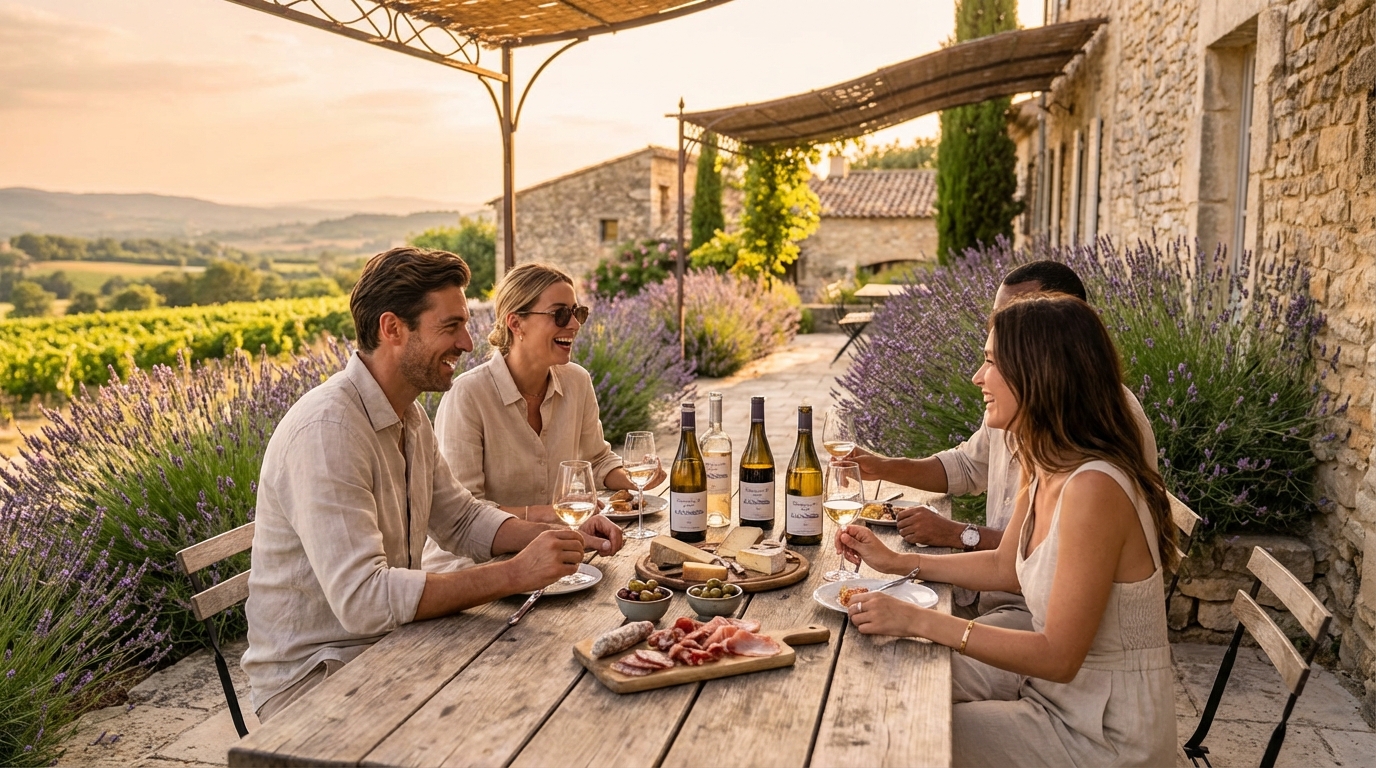
Bordeaux is the symbolic capital of the fine wine world, and its wine tourism infrastructure reflects this status. The region attracts approximately 6 million visitors per year, drawn by the legendary names of its classified growth estates, the architectural splendor of its châteaux, and the gastronomic culture of southwestern France.
The Route des Châteaux (Médoc)
The Route des Châteaux — formally the D2 road — runs north from Bordeaux through the Médoc peninsula, passing through the communes of Margaux, Saint-Julien, Pauillac, and Saint-Estèphe. This 60-kilometer stretch contains the highest concentration of classified growth estates in the world. On a single drive, you pass the gates of Château Margaux, Château Latour, Château Lafite Rothschild, Château Mouton Rothschild, and dozens of other names that appear on every collector's wish list.
Most classified growth châteaux welcome visitors by appointment only — this is not a casual drop-in region. Contact the estate's hospitality department at least two weeks in advance (longer for First Growths). Expect to pay €20 to €80 for a guided tour and tasting, with prices rising sharply for prestigious estates and special experiences. Many châteaux offer tiered visits: a standard tour covering the winemaking facilities and a tasting of the current vintage, a premium experience adding library vintages, and exclusive options including lunch with the winemaker or private barrel tastings.
Practical tip: The village of Pauillac makes an ideal base for Médoc exploration. Its modest size belies its significance — three of Bordeaux's five First Growth estates (Lafite, Latour, Mouton) surround the village. The Maison du Tourisme et du Vin in Pauillac provides maps, booking assistance, and a tasting bar featuring wines from dozens of local estates.
La Cité du Vin
Opened in 2016 on the banks of the Garonne River in Bordeaux city, La Cité du Vin is a 13,350-square-meter museum and cultural center dedicated to wine civilizations worldwide. Designed by architects Anouk Legendre and Nicolas Desmazières of XTU, the building's flowing, organic shape evokes swirling wine in a glass, vine knotwood, and the currents of the Garonne. Inside, the permanent exhibition spans 20 themed zones covering wine history from ancient Georgia to modern biodynamics, sensory experience installations, projection rooms, and interactive displays. The visit concludes on the 8th-floor Belvedere — a panoramic tasting bar with 360-degree views over Bordeaux where visitors sample a glass of wine from the museum's rotating international selection.
La Cité du Vin is not a Bordeaux-centric institution — it deliberately presents wine as a global cultural phenomenon. Budget 2 to 3 hours for the permanent collection, plus time for temporary exhibitions and the Belvedere tasting.
Saint-Émilion
Saint-Émilion, a UNESCO World Heritage Site since 1999, is one of the most visually spectacular wine villages in the world. Its medieval limestone buildings cascade down a hillside overlooking a sea of Merlot vineyards. The village's underground monolithic church — the largest in Europe, carved entirely from a single limestone cliff in the 11th and 12th centuries — is an extraordinary architectural experience.
Saint-Émilion's estates are generally more intimate and accessible than the grand châteaux of the Médoc. Many Right Bank properties welcome visitors without appointment during business hours, and the village itself is packed with tasting rooms, wine shops, and restaurants. A walk through the village naturally leads to estates like Château Ausone, Château Cheval Blanc, and Château Angélus, though the most prestigious properties still require advance booking.
Burgundy: The Route des Grands Crus and Hospices de Beaune
Burgundy offers an entirely different wine tourism experience from Bordeaux — more intimate, more intellectual, and more profoundly connected to the land itself. Here, the concept of terroir — the idea that a specific vineyard's soil, exposure, and microclimate create wines of unique and unreplicable character — reaches its fullest expression.
The Route des Grands Crus
The Route des Grands Crus runs approximately 60 kilometers from Dijon south to Santenay, following the narrow strip of east-facing limestone slopes known as the Côte d'Or (Golden Slope). This is arguably the most valuable agricultural land on earth — Grand Cru vineyard parcels in Vosne-Romanée and Chambolle-Musigny regularly sell for €15 to €30 million per hectare.
Unlike Bordeaux's grand château architecture, Burgundy's viticultural landscape is defined by stone walls (clos) and small vineyard plots. Walking between the parcels of Romanée-Conti, La Tâche, Musigny, and Chambertin — some as small as a suburban backyard — is a meditative experience that connects you directly to 1,000 years of viticultural history. The climats of Burgundy — the precisely defined vineyard parcels — were inscribed as a UNESCO World Heritage Site in 2015, recognizing their cultural and historical significance.
The Côte de Nuits (the northern half, from Dijon to Corgoloin) is the heartland of Pinot Noir, producing the most prestigious and expensive red wines on earth. The Côte de Beaune (the southern half, from Ladoix to Santenay) is home to the world's greatest Chardonnay vineyards — Montrachet, Corton-Charlemagne, Meursault — alongside excellent reds from Pommard and Volnay.
Hospices de Beaune
The Hospices de Beaune (Hôtel-Dieu) is the iconic building of Burgundy wine country — a 15th-century hospital with a stunning polychrome tiled roof in geometric patterns of red, green, gold, and black. Founded in 1443 by Nicolas Rolin, Chancellor of the Duchy of Burgundy, it served as a hospital for the poor until 1971 and now operates as a museum.
Each November, the Hospices holds the world's most famous charity wine auction, selling wines produced from the institution's own 60-hectare vineyard holdings across the Côte de Beaune and Côte de Nuits. The auction, traditionally held on the third Sunday of November, sets the tone for Burgundy prices and attracts buyers, collectors, and media from around the world. The weekend surrounding the auction — the Trois Glorieuses — is Burgundy's most festive period, with banquets, tastings, and celebrations across the region.
Clos de Vougeot
The Château du Clos de Vougeot, originally built by Cistercian monks in the 12th century, is the spiritual home of Burgundy wine. The 50-hectare walled vineyard was cultivated as a single estate by the monks for over 600 years before being divided after the French Revolution. Today, the château serves as the headquarters of the Confrérie des Chevaliers du Tastevin, a wine brotherhood that holds elaborate ceremonial dinners (chapitres) in the medieval cellier. The château is open to visitors and offers an immersive history of Burgundy viticulture from the Cistercian era to the present.
Champagne: Underground Cellars and the Avenue de Champagne
The Champagne region offers one of the most dramatic wine tourism experiences anywhere — a journey underground into kilometers of chalk cellars (crayères) carved from the ancient seabed that gives Champagne wines their mineral character.
The Grande Maison Cave Visits
The major Champagne houses in Reims and Épernay offer spectacular underground cave tours. In Reims, Taittinger's cellars occupy 4th-century Gallo-Roman chalk pits and 13th-century Benedictine abbey crypts, descending 18 meters underground into a hauntingly beautiful network of tunnels where millions of bottles age in constant cool darkness. Veuve Clicquot, Ruinart (the oldest Champagne house, founded 1729), and Pommery offer equally impressive underground experiences, each with their own historical character and aesthetic.
In Épernay, the Avenue de Champagne — declared a UNESCO World Heritage Site in 2015 — is arguably the most valuable street in the world. Beneath its elegant 19th-century mansions lie an estimated 200 million bottles of aging Champagne in an underground network stretching over 110 kilometers. Moët & Chandon alone has 28 kilometers of cellars, the largest in Champagne, accommodating tours that can last 90 minutes and include tastings of the iconic Dom Pérignon in favorable vintages.
Grower Champagne Visits
For a more intimate experience, seek out the small récoltant-manipulant (grower) producers in villages like Aÿ, Avize, Le Mesnil-sur-Oger, and Ambonnay. These family-run estates farm their own vineyards and produce Champagne under their own labels, often in quantities of just 30,000 to 100,000 bottles per year (compared to millions for the grandes maisons). Grower visits are typically personal affairs — you may be hosted by the winemaker or a family member in a modest tasting room, sampling wines that never appear in export markets.
Recommended grower visits: Jacques Selosse (Avize) for radical, terroir-driven Champagne — though appointments are extremely difficult to secure. Egly-Ouriet (Ambonnay) for powerful Pinot Noir-dominant cuvées. Pierre Gimonnet (Cuis) for elegant Chardonnay. Laherte Frères (Chavot) for the new wave of grower Champagne innovation.
Loire Valley: Châteaux, Caves, and the Muscadet Trail
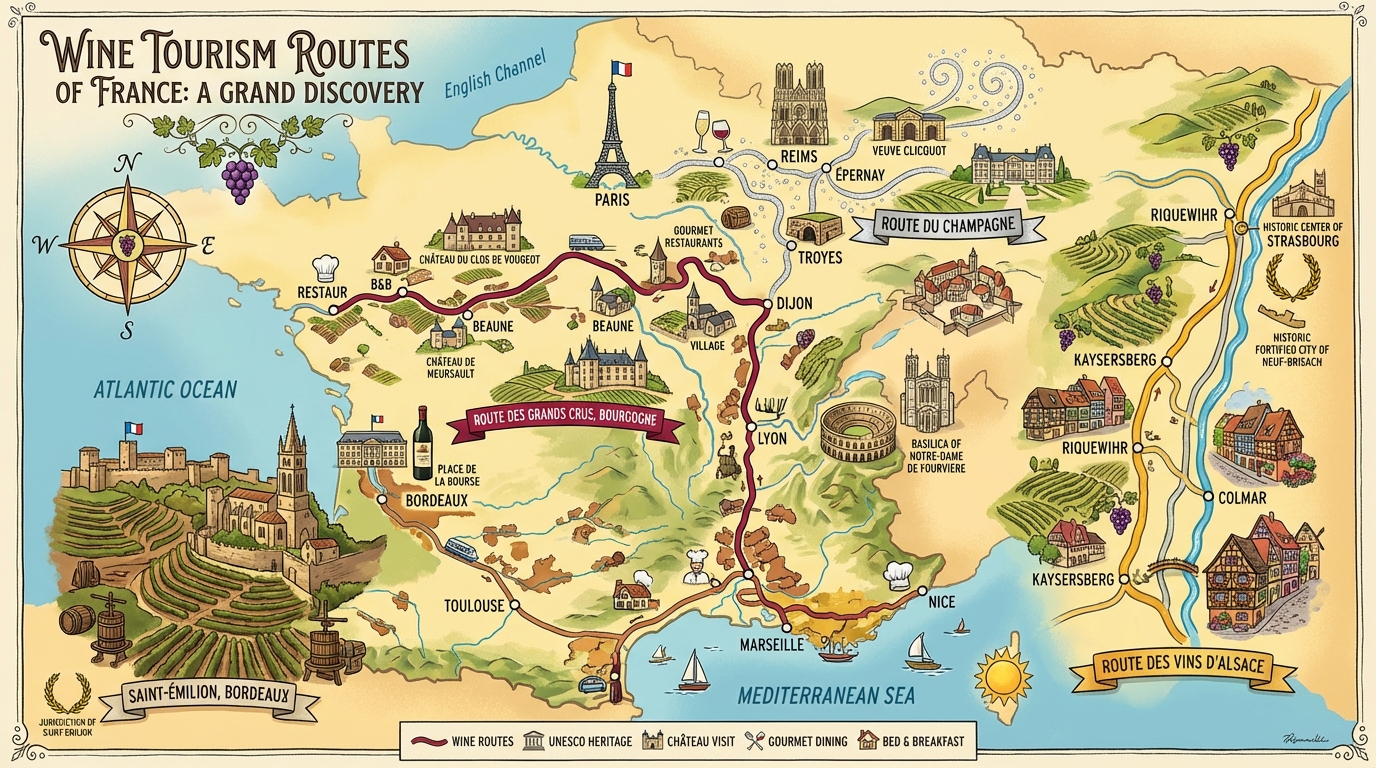
The Loire Valley is France's longest wine region — over 1,000 kilometers following the Loire River from the Atlantic coast at Nantes to the volcanic hills of Auvergne — and offers wine tourism that seamlessly blends viticulture with France's most spectacular Renaissance architecture.
Castle and Wine Combinations
The Loire is uniquely positioned to combine wine visits with grand château tours. The great Renaissance castles of Chambord, Chenonceau, Amboise, and Villandry sit within minutes of some of France's most distinctive wine appellations. A morning visit to the fairy-tale architecture of Chenonceau can be followed by an afternoon tasting Vouvray Chenin Blanc in the tufa caves that riddle the hillsides along the river — many of these natural and man-made caves have been used for both wine storage and human habitation since the Middle Ages.
Vouvray is particularly rewarding for wine tourists. The appellation's troglodyte caves — tunnels carved into soft tufa limestone cliffs — provide naturally temperature-controlled cellars that have been used for winemaking and aging since at least the 8th century. Producers like Domaine Huet (one of Vouvray's greatest estates and a biodynamic pioneer) welcome visitors to taste their extraordinary range of dry, off-dry, and sweet Chenin Blanc within these atmospheric underground galleries.
The Muscadet Oyster Trail
Near the Atlantic coast, the Muscadet appellation offers an entirely different experience — and one of France's greatest food-and-wine pairings experienced at source. The Muscadet-Sèvre et Maine vineyards surround Nantes, and several producers have created oyster-and-Muscadet tasting experiences that combine cellar visits with platters of freshly shucked Atlantic oysters — a marriage of saline Melon de Bourgogne wine with briny shellfish that simply cannot be replicated away from the coast.
Alsace: The Route des Vins and Winstub Culture
The Alsace Wine Route (Route des Vins d'Alsace) is the oldest and perhaps the most visually enchanting designated wine route in France, established in 1953 and stretching 170 kilometers from Marlenheim in the north to Thann in the south along the eastern foothills of the Vosges Mountains.
The route passes through a succession of impossibly picturesque half-timbered villages — Riquewihr, Kaysersberg, Eguisheim, Ribeauvillé, and Colmar — each with flower-bedecked facades, cobblestone streets, and multiple domaines offering tastings. Alsace has one of the most visitor-friendly wine cultures in France: many producers maintain open tasting rooms (called caveaux de dégustation) that welcome walk-in visitors without appointment, a tradition rooted in the region's historical role as a crossroads of French and Germanic wine culture.
The wines of Alsace — Riesling, Gewurztraminer, Pinot Gris, Muscat, and Crémant d'Alsace — are sold in the distinctive tall flute bottles unique to the region. Tastings typically move through the full range of varieties and sweetness levels, from bone-dry Grand Cru Riesling to lusciously sweet Vendange Tardive and Sélection de Grains Nobles dessert wines.
Winstub culture is an essential part of the Alsace wine experience. A winstub (literally "wine parlor") is a traditional Alsatian restaurant serving regional dishes — choucroute garnie, tarte flambée, baeckeoffe, munster cheese — paired with local wines in a convivial, wood-paneled setting. The winstub tradition is to the Alsace wine region what the bistro is to Paris — an institution of gastronomy, sociability, and regional identity.
Christmas market season (late November through December) transforms Alsace into a wine tourism wonderland. The Marché de Noël de Strasbourg — the oldest Christmas market in France, dating to 1570 — and the markets in Colmar, Kaysersberg, and Riquewihr feature hot spiced wine (vin chaud), regional wines by the glass, Alsatian pastries, and a magical atmosphere of illuminated villages against snow-dusted vineyards.
Provence: The Rosé Trail and Coastal Cellars
Provence is France's rosé heartland — the region produces roughly 40% of all French rosé and nearly 6% of the world's total — and its wine tourism experience is inseparable from the broader Provençal lifestyle of Mediterranean sun, lavender fields, olive groves, and coastal beauty.
The quintessential Provence wine tourism experience combines cellar visits with the region's spectacular landscape. Routes through the Côtes de Provence appellation wind through limestone hills dotted with pines and lavender, past honey-colored stone villages like Lorgues, Cotignac, and Tourtour, to modern tasting rooms with panoramic terrace views. Estates like Château d'Esclans (home of Whispering Angel), Domaines Ott, and Château Miraval (the Brad Pitt estate that helped globalize Provence rosé) have invested heavily in visitor facilities.
Bandol, on the Mediterranean coast between Marseille and Toulon, offers a more serious wine tourism experience. The appellation is known for powerful, age-worthy Mourvèdre-based reds alongside its rosés, and visits to estates like Domaine Tempier and Château de Pibarnon combine cliff-top vineyard tours with tastings of wines that bear no resemblance to the easy-drinking rosé stereotype. The coastal setting — vineyards overlooking the Mediterranean — is among the most dramatic in France.
Rhône Valley: Steep Slopes, Papal Estates, and Hermitage
The Rhône Valley stretches from the steep, terraced slopes of Côte-Rôtie near Lyon to the flat, garrigue-covered plains of Châteauneuf-du-Pape near Avignon, offering two contrasting wine tourism experiences in a single region.
Northern Rhône: Côte-Rôtie and Hermitage
The Northern Rhône is defined by its dramatic hillside vineyards. Côte-Rôtie ("the roasted slope") features vertiginous granite terraces rising above the town of Ampuis, producing some of France's most distinctive Syrah wines. Visits to producers like E. Guigal, Stéphane Ogier, and Pierre Gaillard combine cellar tastings with the physical experience of standing among vines on slopes so steep that all work must be done by hand.
The town of Tain-l'Hermitage, located directly across the Rhône from Tournon, sits at the foot of the famous Hermitage hill — a south-facing granite amphitheater that has produced revered wines since Roman times. The Maison M. Chapoutier tasting room in Tain offers comprehensive flights through the Northern Rhône appellations, and the steep walk up the Hermitage hill to the small chapel at its summit rewards visitors with panoramic views of the valley and a visceral understanding of why this terroir produces wines of such concentration and longevity.
Southern Rhône: Châteauneuf-du-Pape
Châteauneuf-du-Pape — literally "the Pope's new castle" — is the most famous appellation of the Southern Rhône, named for the 14th-century papal summer palace whose ruins still crown the hilltop village. The appellation allows 13 grape varieties (the most of any French AOC), and its wines — predominantly Grenache-based blends — are among the most richly flavored in France.
The village is compact and walkable, with numerous tasting rooms clustered along its main streets. Visits to legendary estates like Château Rayas, Château Beaucastel, and Clos des Papes reveal the extraordinary diversity of styles possible within a single appellation. The flat, stony vineyards covered in large rounded galets roulés (river stones) are visually iconic and photographically irresistible.
Beaujolais: Nouveau Festival and Cru Village Visits
Beaujolais sits just south of Burgundy and is often overlooked by wine tourists — an oversight that rewards those who make the detour. The region's rolling granite hills, planted with Gamay vines, produce wines ranging from the light and fruity Beaujolais Nouveau to serious, age-worthy bottlings from the 10 cru villages: Morgon, Moulin-à-Vent, Fleurie, Brouilly, Côte de Brouilly, Chénas, Juliénas, Saint-Amour, Chiroubles, and Régnié.
The third Thursday of November marks the release of Beaujolais Nouveau — a wine bottled just weeks after harvest. The celebrations in Beaujolais are France's most festive wine event: village squares fill with bands, fireworks, and barrel-tapping ceremonies at midnight. The villages of Beaujeu (the historical capital) and Villefranche-sur-Saône host the largest parties, but every cru village has its own celebrations.
Outside festival season, Beaujolais offers remarkably accessible and affordable wine tourism. Many cru producers welcome visitors without appointment, and tasting fees are modest compared to Bordeaux or Burgundy. The landscape — steep granite hillsides covered with old-vine Gamay, punctuated by Romanesque churches and stone-built hamlets — is gorgeous and uncrowded. Marcel Lapierre, Jean Foillard, Yvon Métras, and Julien Sunier are among the natural wine pioneers who have brought international attention and a new generation of visitors to the region.
Practical Tips for Wine Tourism in France
Booking Etiquette
Always contact estates in advance. While some regions (Alsace, Beaujolais, parts of the Loire) have an open-door tradition, most prestigious estates require appointments. Email is the preferred communication method — write in English if necessary, but a few words of French effort are always appreciated. Book at least one to two weeks ahead for standard visits, and one to two months for classified growths, First Growths, and cult producers. Many estates close during harvest (September–October) and over Christmas/New Year.
Timing Your Visit
April through June offers pleasant weather, blooming vineyards, and moderate tourist crowds. September through mid-October is harvest season — the most exciting time but also the busiest, and many estates are too occupied with winemaking to host visitors. November brings the Beaujolais Nouveau festival and Hospices de Beaune auction. Winter (December–March) is the quietest period — many estates are closed, but those that remain open offer the most intimate visits with undivided attention from winemakers.
Getting Around
A rental car is essential for rural wine regions — public transportation in the French countryside is limited, and many estates are accessible only by small departmental roads. However, drinking and driving laws in France are strict (the legal limit is 0.5 g/L blood alcohol, lower than in many countries). Designate a driver, hire a private guide with transportation, or use the growing network of wine taxis and tour operators available in major regions. Cycling is excellent in flat regions like Alsace, the Médoc, and parts of the Loire.
Shipping Wine Home
Most estates can arrange international shipping through specialized carriers like VinoShip or WineBroker. Expect to pay €15 to €30 per bottle for international shipping, plus import duties and taxes in your home country. An increasingly popular alternative is to purchase wines and have them shipped to a consolidation warehouse in France, then arrange a single bulk shipment once you have finished touring multiple regions. Within the EU, personal transport of wine across borders is unrestricted in reasonable quantities.
The Vignobles & Découvertes Label
Look for the Vignobles & Découvertes label when planning your trip. This French government certification identifies wine tourism destinations — including estates, restaurants, accommodations, and activity providers — that meet national quality standards. Over 70 certified destinations across France guarantee a minimum level of service, expertise, and visitor-focused infrastructure. The label's website provides searchable directories for each region, making it an invaluable planning resource.
Final Thoughts: Wine Tourism as Cultural Immersion
The finest French wine tourism experiences go beyond the cellar door. They place wine in its full cultural context — the soil it grows from, the food it accompanies, the architecture it has financed, the communities it sustains, and the centuries of human knowledge that have shaped each bottle. Whether you are tasting a €500 First Growth Bordeaux in a gilded salon or a €8 Muscadet in a fisherman's cooperative on the Atlantic coast, you are participating in a living tradition that connects agriculture, craftsmanship, gastronomy, and place in a way that has no parallel anywhere else in the world. The best souvenir from a French wine trip is not the bottles you ship home — it is the understanding of why those wines exist and what they mean to the people who make them.


