The Two Worlds of Champagne
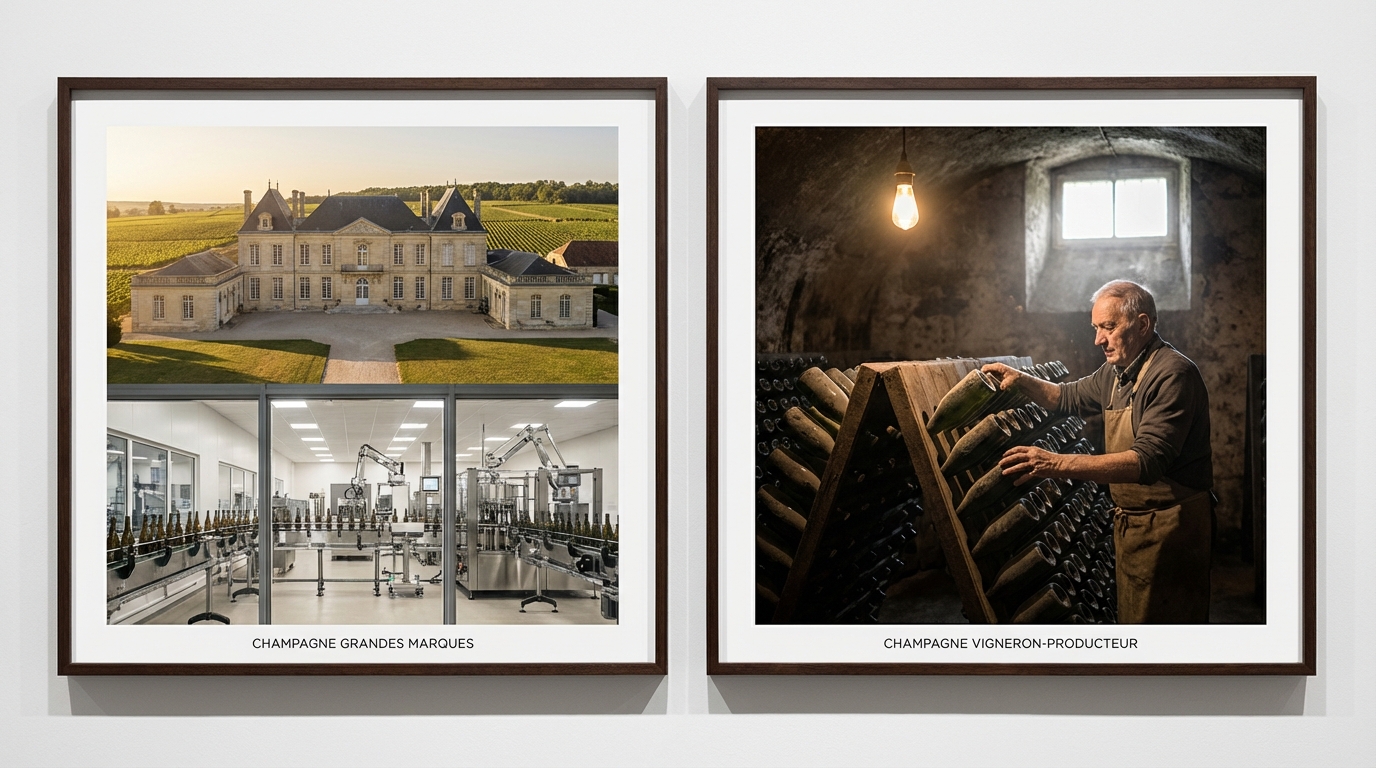
Champagne operates as two parallel wine industries housed within a single appellation. On one side stand the Grandes Maisons — the famous houses whose names adorn billboards, sponsor yacht races, and fill the shelves of every wine shop on earth: Moët & Chandon, Veuve Clicquot, Dom Pérignon, Krug, Bollinger, Louis Roederer, Pol Roger, Taittinger, Laurent-Perrier, Perrier-Jouët. On the other side are the grower-producers — the thousands of small, often family-run estates that farm their own vineyards and make their own wine, selling under their own name to an increasingly devoted and knowledgeable clientele.
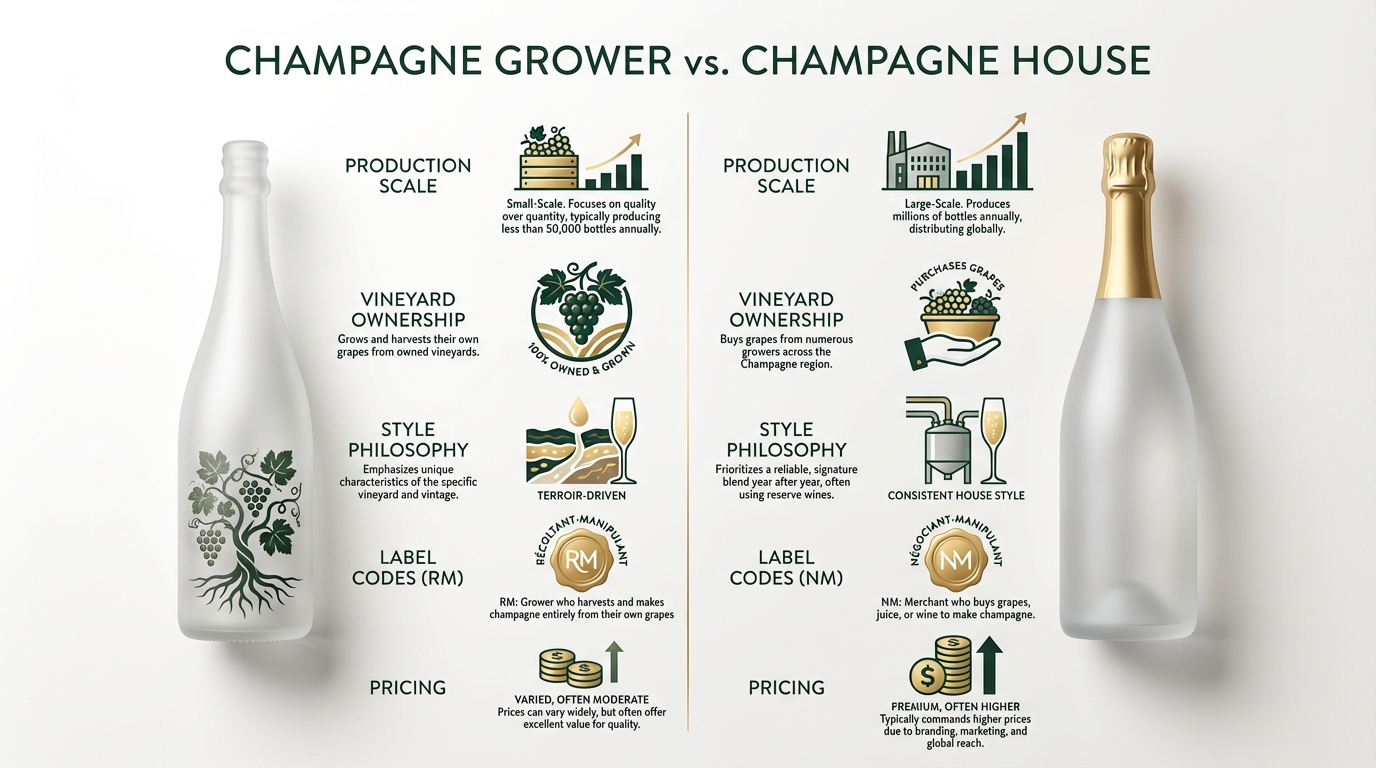
The distinction between these two worlds is far more than a question of scale. It reflects fundamentally different philosophies about what Champagne should be, how it should taste, and what role terroir — the specific character of individual vineyard sites — should play in the finished wine. The Grandes Maisons have historically prioritized consistency: blending wines from dozens or even hundreds of vineyard sources across the entire Champagne region to create a house style that tastes reliably the same year after year. Grower producers, by contrast, typically work with a small number of vineyard plots — often in a single village or even a single site — and their wines reflect the vintage character and site-specific personality of those parcels.
Understanding this distinction — and knowing how to identify each type on the label — is arguably the single most important skill for any serious Champagne drinker. It opens a door to a world of wines that are more diverse, more expressive, and often dramatically better value than the familiar Grandes Maisons brands.
The Champagne Label Codes Explained
Every bottle of Champagne carries a two-letter code on its label (usually in small print near the base), preceded by a registration number. This code identifies the type of producer and is the key to understanding what you are actually buying. Knowing these codes transforms Champagne shopping from brand-name navigation into informed terroir exploration.
NM (Négociant-Manipulant) designates a house that buys grapes (or finished wine) from growers and produces Champagne under its own label. All the famous Grandes Maisons are NM producers. A large NM house like Moët & Chandon purchases grapes from over 1,000 different growers across the region, blending them to achieve its signature style. NM producers account for roughly 70% of all Champagne sales by volume, though they own only about 10% of the region's vineyard area. This asymmetry — controlling the majority of the market while owning a minority of the vineyards — is the structural tension at the heart of the Champagne economy.
RM (Récoltant-Manipulant) identifies a grower who cultivates their own vineyards and produces Champagne entirely from their own grapes on their own premises. This is the code that defines grower Champagne. RM producers number approximately 2,000 out of the roughly 16,000 grape growers in Champagne, representing those who have chosen to vinify, age, and bottle their own production rather than selling their grapes to the houses. RM producers may purchase a small amount of grapes to supplement their own — up to 5% of total production — but the wine must be made overwhelmingly from their own harvest.
CM (Coopérative de Manipulation) designates a cooperative cellar that receives grapes from its member growers, vinifies them, and sells the resulting Champagne under the cooperative's label. The large cooperative of Nicolas Feuillatte is the most prominent CM producer, responsible for enormous volumes of reliable, competitively priced Champagne.
RC (Récoltant-Coopérateur) identifies a grower who sends their grapes to a cooperative for vinification but then takes back the finished wine to sell under their own label. This is an important distinction: an RC wine may appear to be a grower Champagne from its presentation, but the wine was actually made in a cooperative facility. Quality can be good but the terroir expression is typically less precise than genuine RM production.
SR (Société de Récoltants) designates an association of related growers — typically a family — who pool their resources to produce Champagne from their combined vineyards. MA (Marque d'Acheteur) indicates a buyer's own brand — essentially a private label produced by someone else. ND (Négociant-Distributeur) identifies a company that buys finished wine and sells it under its own name without being involved in production.
The Grandes Maisons: History and Philosophy
The great Champagne houses are among the most iconic luxury brands in the world, many with histories stretching back to the 17th and 18th centuries. Their rise was driven by a combination of entrepreneurial genius, aristocratic patronage, and the unique demands of the méthode champenoise — a production process that requires enormous capital investment in cellar space, reserve wines, and years of aging stock.
Moët & Chandon, founded in 1743 by Claude Moët, is the world's largest Champagne house by volume, producing an estimated 30 million bottles annually. Its extensive vineyard holdings — over 1,200 hectares, the largest of any house — span the best villages of the Côte des Blancs, Montagne de Reims, and Vallée de la Marne. The house's prestige cuvée, Dom Pérignon, is released only in declared vintages and is aged a minimum of 7 years on lees before disgorgement.
Veuve Clicquot, established in 1772 and transformed into a powerhouse by the legendary Barbe-Nicole Clicquot Ponsardin (the "Grande Dame" who invented riddling — remuage — in 1816), produces approximately 18 million bottles per year. The house style is distinctly Pinot Noir-driven: rich, powerful, toasty, with excellent aging potential in its vintage wines and prestige cuvée La Grande Dame.
Krug, founded in 1843 by Johann-Joseph Krug, occupies a singular position among the houses. Every Krug wine — including the non-vintage Grande Cuvée — is fermented in small oak barrels (a practice almost universal in Champagne in the 19th century but now exceedingly rare) and aged for a minimum of six years on lees. The result is Champagne of extraordinary complexity and depth. Grande Cuvée is a blend of roughly 120 wines from 10 or more vintages, making it the most complex assembled Champagne in production.
Bollinger, established in 1829, is celebrated for its Pinot Noir-dominant style, use of barrel fermentation for its base wines, and the iconic R.D. (Récemment Dégorgé) series — vintage Champagnes given extended aging on lees and then recently disgorged to capture maximum freshness and complexity. The legendary Vieilles Vignes Françaises bottling is made entirely from ungrafted, pre-phylloxera Pinot Noir vines — one of the rarest and most expensive Champagnes in existence.
Pol Roger, founded in 1849, was Winston Churchill's favorite Champagne — the house renamed its prestige cuvée Cuvée Sir Winston Churchill in his honor. The style is elegant, balanced, and refined, with a distinctly creamy texture and fine mousse. Louis Roederer, founded in 1776, combines house-scale production with an unusual degree of estate ownership — approximately 240 hectares of prime vineyard, supplying around 70% of its grape needs. Its prestige cuvée, Cristal (created in 1876 for Tsar Alexander II of Russia), is one of the most sought-after Champagnes in the world.
Other major houses include Taittinger (known for its Chardonnay-driven elegance and the prestige cuvée Comtes de Champagne), Laurent-Perrier (whose non-dosé Ultra Brut was a pioneer of the zero-dosage style in 1981), Perrier-Jouët (whose Art Nouveau Belle Epoque bottle is among the most recognizable in wine), and Ruinart (the oldest Champagne house, founded in 1729, known for its Chardonnay-focused style and spectacular chalk cellars).
The Grower Revolution
The emergence of grower Champagne as a recognized category is one of the most significant developments in the wine world over the past quarter century. While growers have always made their own Champagne in small quantities — the tradition stretches back centuries — their wines were historically consumed locally or sold to the domestic French market. The international breakthrough came in the late 1990s and 2000s, driven by several converging forces.
The pivotal figure was Anselme Selosse, whose domaine Jacques Selosse in Avize (Côte des Blancs) almost single-handedly demonstrated that Champagne could be a terroir wine — not just a brand or a style, but an expression of a specific place, vintage, and viticultural approach. Selosse's methods were radical by Champagne standards: Burgundian-style barrel fermentation, minimal dosage, extended lees aging, vineyard-designated cuvées, and a philosophical commitment to the primacy of terroir over technique. The wines were — and remain — polarizing, but their influence on a generation of younger Champagne producers was transformative.
The internet and wine criticism played an equally important role. As writers like Peter Liem, Antonio Galloni, and Tyson Stelzer began covering grower Champagne in detail, a global audience of enthusiasts discovered that brilliant Champagne existed outside the Grandes Maisons framework — often at significantly lower prices. Specialist importers in the United States (Terry Theise, Kermit Lynch), the UK (Lea & Sandeman, Berry Bros. & Rudd), and Japan began building portfolios of grower producers, creating an international distribution network that had not previously existed.
The economic dynamics of Champagne also fueled the shift. As Grande Maison prices climbed steadily through the 2000s and 2010s — driven by luxury-market positioning and emerging-market demand — grower Champagne offered a compelling value proposition: wines of equal or superior quality at 30% to 60% less than comparable house bottlings. A superb grower blanc de blancs from the Côte des Blancs might retail for €35 to €50, while a house vintage blanc de blancs of similar quality from the same villages commanded €70 to €120.
Key Grower Producers
Jacques Selosse
Anselme Selosse is the godfather of the grower movement. Based in Avize on the Côte des Blancs, his estate encompasses roughly 7.5 hectares across some of the most prestigious Chardonnay villages in Champagne: Avize, Cramant, Oger, Le Mesnil-sur-Oger, and Ambonnay. Selosse ferments entirely in small oak barrels, uses native yeasts, applies minimal sulfur, and ages his wines for extended periods — the non-vintage Initial sees roughly 4 to 5 years on lees.
The single-vineyard Lieux-dits wines — Les Carelles, Les Chantereines, Chemin de Châlons, La Côte Faron, Le Bout du Clos, and Sous le Mont — are among the most coveted and expensive Champagnes in existence, commanding prices that rival or exceed prestige cuvées from the top houses. Selosse's influence extends beyond his own wines through the generation of winemakers he has mentored and inspired.
Egly-Ouriet
Francis Egly farms 12 hectares in the Grand Cru village of Ambonnay and the Premier Cru village of Vrigny, producing Champagnes of exceptional depth and power. His approach combines meticulous vineyard work — old vines, low yields, hand-harvesting — with barrel fermentation and extended lees aging (the non-vintage Brut Tradition spends 4 years on lees). The Blanc de Noirs Vieilles Vignes from ancient Pinot Noir vines in Ambonnay is one of the greatest Champagnes made, with the structure and complexity of a grand cru Burgundy in sparkling form.
Pierre Gimonnet & Fils
The Gimonnet family cultivates 28 hectares entirely on the Côte des Blancs, making them one of the larger grower estates. Their vineyards span the Grand Cru villages of Cramant, Chouilly, and Oger, and their wines are classic expressions of Côte des Blancs Chardonnay: precise, mineral, elegant, with a crystalline purity that showcases the chalk terroir without the oxidative influence of oak. The Cuvée Gastronome and Special Club bottlings are benchmark grower Champagnes.
Larmandier-Bernier
Pierre Larmandier farms 16 hectares biodynamically in the Grand Cru village of Cramant and surrounding villages on the Côte des Blancs. His wines emphasize purity, minerality, and zero dosage — most of his range is Extra Brut or Brut Nature, allowing the chalk-driven character of the terroir to speak without the masking effect of sugar. The Terre de Vertus non-dosé blanc de blancs, from a single Premier Cru vineyard, is a masterclass in terroir-driven Champagne.
Cédric Bouchard
Cédric Bouchard of Roses de Jeanne represents the most radical minimalist approach to grower Champagne. Working with tiny parcels — some less than 0.3 hectares — in the Côte des Bar (the southern sector of Champagne, in the Aube department), Bouchard produces single-vineyard, single-vintage, single-variety wines with zero dosage. Each cuvée — La Bolorée (Chardonnay), Les Ursules (Pinot Noir), La Haute-Lemble (Pinot Blanc), Presle (Pinot Noir) — is made from a single parcel in a single year, with no reserve-wine blending. The production is minuscule and the wines are intensely site-specific.
Other Essential Growers
Agrapart et Fils in Avize — vineyard-designated blanc de blancs of exceptional precision and complexity. Bérêche et Fils in Ludes — innovative blending across all three Champagne grapes with single-vineyard expressions. Jérôme Prévost (La Closerie) — a single vineyard of old-vine Pinot Meunier in the Montagne de Reims, producing just one wine of hypnotic complexity. Vouette et Sorbée (Bertrand Gautherot) — biodynamic Pinot Noir specialist in the Côte des Bar. Emmanuel Brochet — micro-production from a single hectare in the Montagne de Reims. Laherte Frères — brilliantly crafted multi-variety blends from the Vallée de la Marne.
Terroir: The Four Districts of Champagne
Understanding Champagne's geography is essential for appreciating both house and grower wines, as each of the region's four major districts has a distinct character shaped by its soil, aspect, altitude, and grape variety.
Côte des Blancs
The Côte des Blancs is Champagne's most prestigious white-grape territory: a long, east-facing escarpment running south from Épernay through the Grand Cru villages of Cramant, Avize, Oger, and Le Mesnil-sur-Oger. The soils are deep chalk — belemnite limestone from the Cretaceous period — which provides exceptional drainage, reflects sunlight, and imparts the distinctive mineral, flinty, citrus-driven character that defines Côte des Blancs Chardonnay. These are the vineyards behind the greatest blanc de blancs Champagnes, both house (Comtes de Champagne, Clos du Mesnil) and grower (Selosse, Gimonnet, Larmandier-Bernier).
Montagne de Reims
The Montagne de Reims is a broad, forested plateau south of the city of Reims, with vineyards planted on its north-facing, south-facing, and east-facing slopes. This is prime Pinot Noir country, and the Grand Cru villages of Ambonnay, Bouzy, Verzenay, Verzy, and Mailly produce the most powerful, structured Pinot Noir in Champagne. The soils vary from chalk to clay-limestone, and the exposures create a wide range of styles — from the sinewy, mineral Pinot of north-facing Verzenay to the richer, fruit-forward expression of south-facing Bouzy.
Vallée de la Marne
The Vallée de la Marne follows the Marne River westward from Épernay through Aÿ (a Grand Cru village for Pinot Noir) and into the broader, cooler western reaches of the region. This is the heartland of Pinot Meunier — a variety long dismissed as the "workhorse grape" of Champagne but now increasingly celebrated for its aromatic generosity, roundness, and approachability. The clay-rich soils of the western Vallée produce ripe, fruity Meunier that adds flesh and forward charm to blends, and single-variety Meunier Champagnes from producers like Jérôme Prévost have demonstrated the grape's capacity for complexity.
Côte des Bar
The Côte des Bar (also known as the Aube) is Champagne's southern frontier, located approximately 110 kilometers southeast of Épernay in the département of the Aube. Geologically and climatically, it has more in common with Burgundy than with the chalky plains around Reims — the soils are predominantly Kimmeridgian marl and limestone (the same clay-limestone formation found in Chablis), and the climate is slightly warmer. Pinot Noir dominates here, producing wines of notable richness and fruit intensity. Once dismissed as a second-tier source by the northern Champagne establishment, the Côte des Bar has emerged as one of the most exciting terroirs in the region, driven by visionary growers like Cédric Bouchard, Vouette et Sorbée, and Fleury.
Dosage Levels: How Sweet Is Your Champagne?
Dosage — the small addition of sugar (dissolved in wine) added to Champagne after disgorgement — is one of the most significant stylistic variables in the finished wine. The dosage level is expressed on the label according to a legally defined scale, and understanding it is essential for matching Champagne to your taste preferences and food pairings.
Brut Nature (also called Pas Dosé, Dosage Zéro, or Non Dosé): 0 to 3 grams per liter of residual sugar with no sugar added after disgorgement. These are the purest, most austere expressions of Champagne terroir — every flavor comes from the grape, the fermentation, and the lees aging. Brut Nature wines demand high-quality base wines with sufficient richness and acidity to stand alone without the rounding effect of sugar. The category has surged in popularity with the grower movement.
Extra Brut: 0 to 6 grams per liter. A minimal dosage that softens the edges very slightly while still allowing terroir to dominate. Many top grower producers work in this range — enough sugar to integrate the wine without masking its character.
Brut: 0 to 12 grams per liter. This is the dominant style for both houses and growers, covering an enormous range from essentially dry (6–7 g/L, typical of many quality producers) to perceptibly off-dry (10–12 g/L, more common in entry-level house Champagnes). When people say "Champagne," they almost always mean Brut.
Extra Dry (or Extra Sec): 12 to 17 grams per liter. Despite the name, Extra Dry is perceptibly sweeter than Brut — an artifact of 19th-century labeling conventions when Champagne was consumed far sweeter than today. This style is relatively uncommon in the modern market.
Sec: 17 to 32 grams per liter. Noticeably sweet, Sec Champagne is rare today but can be excellent with desserts or spicy food.
Demi-Sec: 32 to 50 grams per liter. The sweetest category widely produced, Demi-Sec Champagne is the traditional pairing for wedding cake and fruit-based desserts. Moët & Chandon's Nectar Impérial and Veuve Clicquot's Rich are prominent examples.
Doux: Over 50 grams per liter. Essentially extinct in the modern market, Doux was the dominant style in the 19th century, when Champagne was frequently consumed with residual sugar levels that would strike contemporary palates as dessert wine.
Vintage vs Non-Vintage: Understanding the Hierarchy
The non-vintage (NV) blend is the backbone of Champagne production, accounting for roughly 80% to 85% of all bottles produced. An NV Champagne combines wines from the current harvest with reserve wines — wines from previous vintages held in tank, barrel, or bottle to add complexity, consistency, and depth. The proportion of reserve wine varies enormously: entry-level house NV Champagnes may include 20% to 30% reserve wine, while the Krug Grande Cuvée incorporates wines from 10 or more vintages, with some reserve wines over 15 years old.
The purpose of the NV blend is consistency — the house or grower aims to produce a wine that expresses their signature style regardless of variations between harvests. This is an extraordinary winemaking challenge: Champagne's marginal climate means that no two years are alike, yet the consumer expects their preferred brand to taste familiar with every purchase.
Vintage Champagne is produced only in years deemed exceptional by the producer — typically three to four vintages per decade for the major houses, though the frequency has increased in the warming climate of recent years. Vintage Champagne must be aged on lees for a minimum of 36 months by law, though serious producers routinely age for 5 to 10 years or more. The wine must be made entirely from a single harvest year and reflects the specific character of that vintage.
Prestige cuvées represent the pinnacle of each house's production: Dom Pérignon (Moët & Chandon), La Grande Dame (Veuve Clicquot), Grande Cuvée (Krug, though technically non-vintage), Cristal (Louis Roederer), Comtes de Champagne (Taittinger), Cuvée Sir Winston Churchill (Pol Roger), R.D. (Bollinger), Belle Epoque (Perrier-Jouët). These are typically vintage wines from the finest parcels, given extended aging — Dom Pérignon's minimum lees contact is 7 years, and P2 and P3 releases receive 12 and 20+ years respectively.
In the grower world, the vintage/non-vintage distinction is often less clear-cut. Many growers produce single-vintage wines as their standard offering rather than maintaining a multi-vintage blend, and the concept of the "prestige cuvée" translates into single-vineyard bottlings or parcels of old vines rather than the house model of reserving the best lots for a top-tier blend.
Price Comparison: Value in the Glass
One of the most compelling arguments for grower Champagne is the quality-to-price ratio. The economics of the two production models are fundamentally different, and the savings flow directly to the consumer.
A Grande Maison NV Brut typically retails for €35 to €55 — a price that reflects not only the cost of grapes, production, and aging but also the substantial overhead of global marketing, sponsorship deals, luxury-brand positioning, and distribution margins. A grower NV Brut of comparable quality typically retails for €20 to €35, reflecting lower marketing costs, direct sales relationships, and the fact that the grower owns their own vineyards rather than purchasing grapes at market rates.
The gap widens further at the vintage level. A house vintage Champagne commands €60 to €120, while a grower vintage from equivalent Grand Cru or Premier Cru terroir typically sells for €35 to €65. At the prestige-cuvée level, the disparity becomes extreme: Dom Pérignon and Cristal retail for €180 to €350+, while grower equivalents — single-vineyard, extended-aging Champagnes of extraordinary quality — can be found for €50 to €100 (though the most in-demand growers, like Selosse and Egly-Ouriet, now command prices that rival or exceed the houses).
This does not mean that Grande Maison Champagne is overpriced. The houses offer something that most growers cannot: consistency across enormous volume and global availability. Moët's Brut Impérial tastes recognizably the same whether you buy it in Tokyo, São Paulo, or London — a feat of blending artistry that should not be underestimated. Grower Champagnes, by contrast, are produced in tiny quantities (often 5,000 to 30,000 bottles versus millions for the houses), vary from vintage to vintage, and can be difficult to find outside specialist retailers.
The informed Champagne drinker develops a portfolio approach: Grandes Maisons for reliability, celebration, and gifting; grower producers for exploration, terroir discovery, and intellectual pleasure. The two categories are not competitors so much as complementary facets of the world's most complex sparkling-wine region.
How to Build a Grower Champagne Collection
For drinkers ready to explore beyond the familiar house names, grower Champagne offers an extraordinarily rich field of discovery. The key is to approach it systematically.
Start with a blanc de blancs from the Côte des Blancs — a Gimonnet, Larmandier-Bernier, or Agrapart — to understand how pure Chardonnay expresses itself on chalk. Then try a Pinot Noir-dominant grower from the Montagne de Reims — Egly-Ouriet, Bérêche, or Marguet — to experience the power and structure of the northern slopes. Add a Pinot Meunier specialist from the Vallée de la Marne — Jérôme Prévost or Laherte — to discover the grape's underappreciated complexity. Finally, explore the Côte des Bar through Cédric Bouchard or Vouette et Sorbée to see how Champagne's southern frontier produces wines of completely different character.
Compare dosage levels by tasting a Brut alongside a Brut Nature from the same producer. Notice how even a small dosage of 4 to 6 grams changes the texture, length, and flavor profile. These side-by-side tastings sharpen your palate more rapidly than any amount of reading.
And always check the label codes. The letters RM are your guarantee that the person who grew the grapes is the person who made the wine — and that guarantee, more than any brand name or marketing narrative, is what makes grower Champagne one of the most exciting and rewarding categories in the wine world.


