Why Vintage Matters More in Burgundy
In most of the world's wine regions, vintage variation is a footnote — a minor inflection in an otherwise consistent product. In Burgundy, vintage is everything. The difference between a great year and a mediocre one is not a matter of nuance; it is the difference between transcendence and disappointment, between a wine worth cellaring for decades and one that should be drunk within five years.
The reason is structural. Pinot Noir and Chardonnay — the only two grape varieties permitted in the Côte d'Or — are among the most climate-sensitive cultivars in the viticultural world. Pinot Noir's thin skin offers minimal buffering against rot, sunburn, and uneven ripening. Chardonnay, while more resilient, expresses its terroir with such fidelity that every shift in growing-season temperature, rainfall, and sunshine is imprinted in the finished wine. Unlike Bordeaux, where blending across multiple varieties can smooth out vintage irregularities, Burgundy's single-variety wines carry the fingerprint of the growing season with unfiltered clarity.
Burgundy's continental climate amplifies this sensitivity. The region sits at the northern limit of reliable grape ripening for Pinot Noir — roughly the 47th parallel — where the margin between adequate and insufficient ripeness can be measured in a handful of sunny days during September. Spring frosts regularly threaten yields, summer hailstorms can devastate individual villages while leaving neighbors untouched, and autumn rain at harvest time can dilute what had been a promising vintage in a matter of hours. This climatic volatility is both Burgundy's curse and its fascination: the very conditions that make great Burgundy so rare are what give it unmatched emotional depth.
Understanding vintages is therefore not academic — it is the single most important factor in purchasing Burgundy intelligently. A village-level wine from a great vintage will routinely outperform a premier cru from a weak one, and at a fraction of the price. The vintage chart is not merely a convenience; it is the essential navigation tool for one of the most complex and expensive wine regions on earth.
Climate and Terroir: The Burgundy Equation
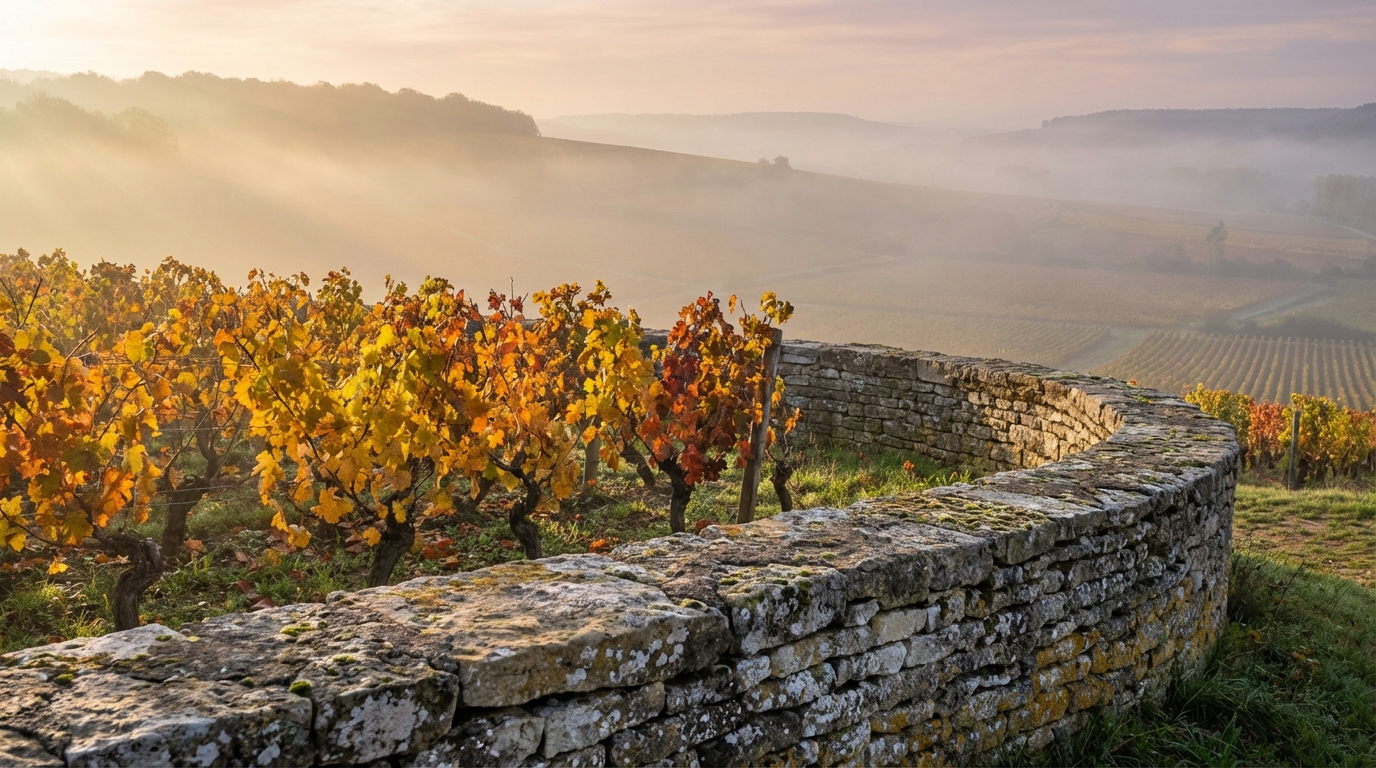
Burgundy's terroir operates as an extraordinarily precise amplifier of climatic conditions. The Côte d'Or — the narrow escarpment running from Dijon south to Santenay — faces predominantly east and southeast, catching the morning sun and sheltering from the prevailing westerly rain. Within this strip, elevation, slope angle, soil depth, drainage, and exposure create microclimates that can differ measurably within a few hundred meters. The grand cru vineyards occupy the sweet spot: mid-slope, with optimal drainage and sun exposure. But even these privileged sites are at the mercy of the growing season.
Pinot Noir requires a long, slow ripening period to develop the aromatic complexity — the haunting perfume of red fruit, earth, spice, and undergrowth — that defines great Burgundy. Heat spikes produce jammy, overripe flavors; insufficient warmth yields green, stalky tannins. The ideal Pinot Noir vintage delivers warm (not hot) days, cool nights to preserve acidity, and a dry harvest period. Vintages like 2005 and 2019 achieved this balance with rare precision.
Chardonnay is more forgiving but equally expressive. In warm vintages, Burgundy whites lean toward richness and generosity — tropical fruit, butterscotch, sometimes a honeyed weight. In cooler years, the wines are taut, mineral, and precise, with citrus and white-flower aromatics. Crucially, red and white Burgundy do not always have the same vintage quality. Some years favor Chardonnay's resilience while Pinot Noir struggles (1996 is the classic example), while others produce magnificent reds but overripe, flabby whites (2003). Any serious vintage assessment must evaluate the two colors independently.
The terroir's limestone and clay soils interact with vintage conditions in complex ways. Clay-heavy sites (common in the Côte de Beaune) retain moisture and buffer against drought, while thin limestone soils on upper slopes (typical of the Côte de Nuits) stress vines more quickly in dry years but produce wines of greater minerality when conditions are right. A hot, dry vintage like 2018 tends to favor the clay sites; a wet, cool vintage like 2013 advantages the better-drained limestone slopes.
The 1990s: A Decade of Classics
The 1990s established many of the benchmarks by which all subsequent Burgundy vintages are measured. This was the decade that solidified Burgundy's status as the world's most prestigious — and most volatile — wine region.
1990: The Legendary Vintage
1990 remains one of the greatest Burgundy vintages of the modern era — a year of extraordinary warmth and concentration that produced reds of exceptional depth and longevity. A hot, dry summer delivered fully ripe Pinot Noir with deep color, rich tannins, and an opulence that was almost unprecedented in Burgundy. The best reds combined power with elegance in a way that defined the word "complete." Top wines from Domaine de la Romanée-Conti, Domaine Leroy, and Domaine Dujac remain profoundly moving three decades later, with decades of life still ahead. The whites were generous and full-bodied, though some lacked the incisive acidity of the best cool-vintage Chardonnays. Drinking window for reds: the very best are still maturing; lesser wines are now past their peak. Whites: drink now.
1993: The Undervalued Vintage
1993 was dismissed on release — a rainy September depressed expectations — but has aged beautifully. The reds, picked by growers who waited out the rain or sorted rigorously, show classic cool-climate Pinot Noir character: red fruit, earth, and silky texture. This vintage is a powerful lesson in Burgundy's capacity to surprise. Many 1993 Burgundies are drinking superbly now and represent some of the best value in mature Burgundy.
1995: The Structured Classic
1995 produced structured, serious reds with firm tannins and excellent concentration. A warm summer and dry September gave healthy, ripe fruit. The wines were slow to open and were often overshadowed by the flashier 1996 whites, but the best 1995 reds — from villages like Gevrey-Chambertin, Chambolle-Musigny, and Vosne-Romanée — have evolved into complex, fully mature wines of great distinction. Drinking window: at peak now through 2030 for premier and grand crus.
1996: The White Burgundy Triumph
1996 is revered for its white Burgundy — widely considered one of the two or three greatest Chardonnay vintages in living memory. A long, cool growing season produced whites of laser precision: vibrant acidity, mineral tension, and a crystalline purity that only Burgundy can deliver. The best Meursault, Puligny-Montrachet, and Corton-Charlemagne from 1996 remain magnificent, with an architectural quality that few other vintages match. The reds were good but not exceptional — firm and somewhat austere, lacking the flesh and charm of 1990 or 1999. White drinking window: grand crus still have decades ahead; village wines at peak. Red drinking window: drink now.
1999: The Complete Vintage
1999 is one of the most universally successful Burgundy vintages of the decade. Both reds and whites achieved an ideal balance of ripeness, structure, and freshness. The reds are seductive — rich in red and dark fruit with supple tannins and excellent length — while the whites combine generosity with acidity in harmonious proportion. A vintage that delivered across every quality level, from regional to grand cru. Drinking window: reds at peak for premier crus; grand crus will hold through 2035+.
The 2000s: From Crisis to Benchmark
The 2000s brought both extraordinary quality and new challenges. Climate change began to assert itself visibly, and the decade produced some of the most sought-after vintages in Burgundy's history alongside some genuine disappointments.
2002: The Exceptional Vintage
2002 is often cited alongside 1990 and 2005 as one of the greatest Burgundy vintages of the past half-century. A late-season heatwave in September brought flawless ripening conditions after a cool, slow growing season, producing wines that combine the concentration of a warm year with the acidity and tension of a cool one. The reds have extraordinary aromatic complexity — rose petal, cherry, earth, spice — with structure that continues to support graceful aging. The whites are equally superb: rich but precisely drawn, with a mineral backbone that gives them remarkable longevity. Drinking window: reds will evolve for another 10–15 years at grand cru level. Whites: grand crus still improving; village wines at peak.
2005: The Benchmark Vintage
2005 has become the modern reference point for Burgundy — the vintage against which all others are measured. A textbook growing season delivered warm days, cool nights, and a completely dry harvest. The result was wines of extraordinary purity and precision: deeply colored reds with fine-grained tannins, impeccable acidity, and a sense of effortless balance. The whites are similarly benchmark: concentrated but never heavy, with the taut mineral framework that defines great white Burgundy. Every producer, from humble Bourgogne rouge to Romanée-Conti, seemed to produce wines of unusual quality. The 2005 vintage commands premium prices, but its quality justifies the investment for patient cellaring. Drinking window: reds entering their plateau — premier crus drinking well now; grand crus will improve through 2040+. Whites: premier crus at peak; grand crus still developing.
2009: The Rich, Generous Vintage
2009 was Burgundy's warmest vintage up to that point, producing full-bodied, opulent wines that seduced critics and consumers on release. The reds are deep, rich, and immediately appealing — dark fruit, spice, and generous tannins. Some purists found them too voluptuous, arguing that the Burgundian finesse was overwhelmed by the sheer weight of fruit. With time, many 2009 reds have developed beautifully, gaining complexity without losing their generous personality. The whites were rich and broad, best from producers who managed to retain freshness. Drinking window: reds drinking superbly now; grand crus will hold through 2035. Whites: drink now — most have reached their peak.
2010: The Classic Counterpoint
If 2009 was Burgundy in a warm embrace, 2010 was Burgundy in a perfectly tailored suit — structured, precise, and restrained. A cooler growing season produced wines of classical proportions: moderate alcohol, bright acidity, firm tannins, and an elegance that stands in dramatic contrast to the preceding vintage. The 2010 reds are Burgundy for purists, requiring patience but rewarding it with extraordinary aromatic development. The whites are brilliant: taut, mineral, and energetic, with the kind of driving acidity that ensures decades of graceful evolution. Many consider 2010 the greatest white Burgundy vintage since 1996. Drinking window: reds are beginning to open but have decades ahead at grand cru level. Whites: premier and grand crus still improving; this vintage demands cellaring.
The 2010s: Heat, Frost, and Brilliance
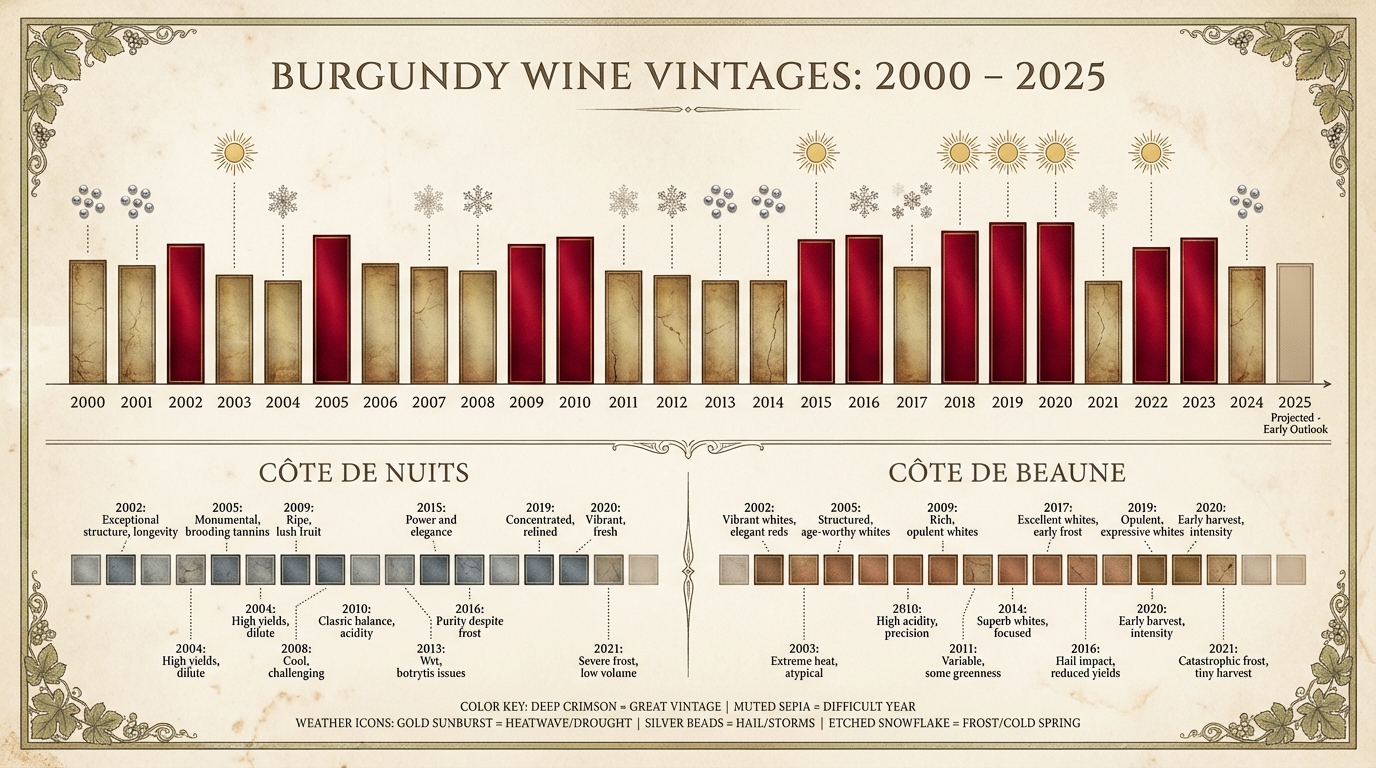
The 2010s were defined by extremes. Climate change accelerated visibly, bringing both extraordinary quality in several vintages and devastating frost events that reshaped expectations about Burgundy's vulnerability.
2012: The Compact Vintage
2012 was a difficult growing season — frost, hail, and cool weather reduced yields drastically — but the small quantities that survived were concentrated and well-balanced. The reds have a quiet intensity: moderate in weight but persistent on the palate, with pure red-fruit character and fine tannins. Whites are fresh and mineral, though production was so small that availability remains extremely limited. A vintage that rewards careful selection — the best are excellent; the weakest are dilute. Drinking window: reds at or near peak; whites drink now.
2014: The Late-Harvest Surprise
2014 was written off during a cold, grey August, then rescued by a spectacular September — warm, sunny, and dry — that delivered perfect late-season ripening. The wines have a crystalline purity that recalls 2010: bright acidity, moderate alcohol, and precise fruit definition. The whites are particularly successful — taut, mineral, and lifted — while the reds offer charm and freshness rather than power. This is Burgundy for drinkers who value elegance over muscle. Drinking window: reds drinking well now; whites have considerable aging potential. An underrated vintage that offers excellent value.
2015: The Generous Year
2015 was warm and sunny throughout, producing generous, accessible wines with ripe fruit and supple tannins. The reds are deeply colored and immediately appealing, with dark cherry and plum flavors framed by soft, rounded tannins. This is one of the most crowd-pleasing Burgundy vintages of the decade — wines that seduce from the first sip without requiring years of patience. The whites are full-bodied and sometimes lack the precision of cooler vintages, though the best producers crafted beautifully balanced Chardonnays. Drinking window: reds drinking beautifully now; village and premier cru wines at peak. Grand crus will hold through 2035. Whites: drink now.
2016: The Frost-Ravaged Vintage
The growing season of 2016 began with catastrophe. A devastating late April frost — one of the worst in decades — destroyed up to 70% of production in parts of Chablis, the Côte de Beaune, and the Mâconnais. Yields were slashed to historically low levels. The wines that survived, however, are excellent: a warm, balanced summer and a dry, protracted autumn produced reds of classic structure and definition, with bright acidity and fine-grained tannins. Whites are precise, mineral, and long-lived. The challenge with 2016 is purely availability and price — tiny quantities mean fierce competition for allocations. Drinking window: reds will age beautifully; whites are built for the long term. Cellar with confidence.
2017: The Early-Ripening Vintage
2017 was one of the earliest harvests in Burgundy's history, with many growers picking in late August — weeks ahead of traditional timing. A warm spring and hot July accelerated the growing cycle, though timely rain prevented excessive stress. The reds are medium-bodied and aromatic, with bright red fruit and soft tannins — charming rather than profound. Whites are ripe and round, with less tension than 2014 or 2016. An enjoyable, forward vintage for near-term drinking. Drinking window: reds at or near peak; whites drink now through 2030.
2018: The Very Hot Vintage
2018 was the hottest and driest vintage Burgundy had experienced up to that point. Heatwaves in June and July pushed temperatures well above 35°C, and the harvest began in late August under scorching conditions. The wines polarize opinion. Advocates praise the exceptional concentration, deep color, and full-bodied richness of the reds, arguing that the best producers managed heat with skill and produced wines of surprising freshness. Critics point to elevated alcohol, diminished acidity, and a loss of the ethereal delicacy that defines classical Burgundy. The whites are powerful and sometimes heavy, though top Meursault and Puligny producers maintained balance. Drinking window: reds are accessible now; the best will age but most lack the acidity framework for truly long evolution. Whites: drink within 5–10 years.
2019: The Balanced Beauty
2019 is widely regarded as one of the finest Burgundy vintages of the decade — a year that combined the generosity of 2015 with the structural integrity of 2010. A warm growing season with well-timed rainfall delivered fully ripe, healthy fruit without the extreme heat stress of 2018. The reds are radiant: pure, deep-fruited, and precisely structured, with silky tannins and vibrant acidity. The whites are equally impressive — rich and concentrated but lifted by excellent natural acidity, giving them both immediate appeal and long-term aging potential. This is a vintage that delivered across every appellation and every quality tier. Drinking window: reds will reward cellaring for 15–25 years at premier and grand cru level. Whites: exceptional aging potential; cellar the best for 10–20 years.
The 2020s: Navigating a New Climate Reality
The 2020s have already demonstrated that Burgundy's climate has fundamentally shifted. Warm vintages are now the norm rather than the exception, and the challenges of frost, heat, and drought are reshaping how growers approach their craft.
2020: The Solar Vintage
2020 was another warm, early vintage — the third in succession — with a dry, sun-drenched growing season that delivered concentrated, ripe wines. The reds are dense and powerful, with dark fruit, ample tannins, and high extract. Like 2018, this vintage tests whether you prefer Burgundy in its opulent mode or its classical one. The best 2020 reds, however, show more finesse than 2018, thanks to cooler night-time temperatures that preserved a crucial thread of acidity. Whites are full-bodied and generous. Production was affected by drought, keeping yields low and prices high. Drinking window: reds will benefit from 5–10 years of cellaring; the best will age 15–20 years. Whites: drink within 7–12 years.
2021: Classic Burgundy Reborn (at a Cost)
2021 will be remembered for two things: devastating frost and extraordinary quality. An April frost — even more destructive than 2016 — ravaged the Côte de Beaune, Chablis, and parts of the Côte de Nuits, destroying up to 80% of production in some villages. The frost of April 7–8, 2021 was catastrophic, with temperatures plunging to -8°C in some vineyards after an unusually warm March had triggered early budburst. Mâconnais, Chablis, and Beaune were hardest hit, while parts of Nuits-Saint-Georges and Gevrey-Chambertin escaped with lighter damage.
The wines that survived are superb. A cool, long growing season — the kind that old-timers remember from the 1980s and 1990s — produced wines of classical proportions: moderate alcohol, bright acidity, delicate red fruit, and fine-grained tannins. The 2021 reds have the translucent, perfumed quality that defines Burgundy at its most hauntingly beautiful. Whites are taut, mineral, and precise — more 1996 than 2015 in character. This is a cellar vintage in the truest sense. The challenge: minuscule quantities and prices that reflect the scarcity. Drinking window: reds will age magnificently — 15–30 years for the best. Whites: exceptional long-term potential; patience will be richly rewarded.
2022: The Heat Challenge
2022 continued the pattern of extreme warmth. France's hottest year on record brought searing temperatures to Burgundy, and the harvest was among the earliest ever. The reds are concentrated and deeply colored, with ripe tannins and generous dark fruit. Acidity levels are lower than 2021 or 2019, which may limit the very longest-term aging potential, though the best producers managed to retain freshness through careful vineyard management and early picking. Whites are rich and powerful — drink them in the medium term rather than cellaring for decades. A solid but not exceptional vintage that will drink well relatively young. Drinking window: reds accessible from 2027; most will peak by 2035. Whites: drink within 5–8 years.
2023: Frost Challenges and Resilience
2023 was another year shaped by frost — though less devastating than 2021 — followed by an uneven summer with both heat spikes and periods of rain. The growing season tested growers' nerves, with rot pressure at harvest requiring rigorous sorting. The best producers made excellent wines with a profile that splits the difference between the richness of warm years and the freshness of cool ones. Yields varied enormously between villages and even between neighboring vineyards. Reds show a mix of red and dark fruit with moderate tannins; whites are fresh and energetic, with better acidity than 2022. An inconsistent vintage where producer selection is paramount. Drinking window: early assessments suggest medium-term aging for reds (10–15 years); whites for 5–10 years. Choose carefully.
2024–2025: Early Outlook
2024 saw a challenging spring but a warm, balanced summer that generated early optimism. Initial reports suggest a classic to warm profile for both reds and whites, with moderate yields and good concentration. The vintage appears promising, though definitive assessment awaits barrel tastings in early 2026.
2025 is still in its early stages at the time of writing, with budburst just beginning along the Côte d'Or. Early-season conditions have been favorable, but as every Burgundy grower knows, the vintage is decided in September.
Climate Change and Burgundy's Future
The vintage patterns of the past decade tell an unmistakable story: Burgundy's climate has shifted fundamentally. Harvest dates have advanced by two to three weeks compared to the 1990s. Hot vintages that would once have been exceptional (2003, 2009) are now routine. The frequency of extreme frost events has paradoxically increased — warmer springs trigger earlier budburst, making vines more vulnerable to late cold snaps.
The consequences for Pinot Noir are profound. Higher temperatures produce darker, more extracted wines with higher alcohol — a style that can be impressive but risks losing the ethereal transparency that makes great Burgundy unlike any other wine on earth. The finest producers are adapting: picking earlier to preserve acidity, farming organically to deepen root systems and improve soil moisture retention, pruning later to delay budburst and reduce frost risk, and increasingly experimenting with whole-cluster fermentation, which adds freshness and structural tannin.
For Chardonnay, the equation is somewhat more forgiving. White Burgundy's finest recent vintages (2014, 2017, 2019, 2021) demonstrate that great Chardonnay can still be produced in a warming climate, provided the grower prioritizes acidity over sheer ripeness. But even here, the trend is clear: the razor-sharp, mineral whites of the 1990s are giving way to richer, more generously fruited styles.
Burgundy's long-term viability as a premium wine region is not in question — there is simply too much terroir quality, too much accumulated expertise, and too much market demand for it to falter. But the character of the wines is evolving, and understanding vintage variation has never been more important for the consumer navigating this new reality.
When to Drink vs. When to Cellar
The cellar-worthiness of Burgundy varies dramatically by vintage, quality tier, and color. Here are the general principles.
Grand cru reds from great vintages (2005, 2010, 2015, 2019, 2021) can age 30 to 50 years. Premier cru reds from these vintages will peak between 10 and 25 years of age. Village-level reds are typically best between 5 and 15 years.
Grand cru whites from top vintages (1996, 2002, 2010, 2014, 2021) have comparable longevity — 20 to 40 years — though the premox (premature oxidation) crisis of the 2000s taught collectors to be cautious with white Burgundy storage. Premier cru whites peak between 7 and 20 years; village whites between 3 and 10.
Hot vintages (2003, 2009, 2018, 2020, 2022) generally evolve faster and should be consumed earlier. Cool vintages (1996, 2010, 2014, 2021) have the acidity architecture for the longest aging.
The single most important variable, after vintage, is the producer. A top-tier domaine's village wine will outlast a mediocre producer's grand cru in virtually every vintage. When in doubt, invest in the maker rather than the appellation.
Red vs. White: Assessing Each Vintage Independently
One of the most common mistakes in Burgundy buying is assuming that red and white vintage quality always correlates. History demonstrates otherwise.
Vintages where whites outperformed reds: 1996 (the definitive white vintage of the modern era), 2004 (underrated whites, dilute reds), 2014 (superb, crystalline whites).
Vintages where reds outperformed whites: 1990 (legendary reds, sometimes overripe whites), 2003 (concentrated reds that divided opinion; frequently flat whites), 2015 (generous reds of great charm; some heavy whites).
Vintages where both excelled equally: 1999, 2002, 2005, 2010, 2019, 2021.
Always evaluate the two colors on their own merits. A red Burgundy vintage assessment should never be applied uncritically to the same year's whites, and vice versa.
How to Buy: En Primeur vs. Secondary Market
Buying Burgundy en primeur is fundamentally different from Bordeaux futures. Burgundy's production is fragmented across hundreds of small domaines, most producing fewer than a few hundred cases of any given wine. There is no equivalent of the Place de Bordeaux to centralize distribution. Instead, en primeur purchases are made through a network of négociants (such as Maison Louis Jadot, Joseph Drouhin, and Bouchard Père & Fils) and specialist importers who maintain direct relationships with domaines.
The advantage of buying en primeur in Burgundy is allocation access. For the most sought-after domaines — Domaine de la Romanée-Conti, Domaine Leroy, Domaine Coche-Dury, Domaine Leflaive, Domaine Armand Rousseau — the only way to obtain wine at release price is through a merchant's allocation list, which often requires years of loyal purchasing to climb. En primeur is not primarily about price savings in Burgundy; it is about securing wine that will otherwise be unobtainable.
The secondary market (auction houses, specialist retailers, and trading platforms like Liv-ex) offers access to mature vintages and domaines where you lack an allocation. Prices are market-driven and often steep, but the advantage is immediacy and the ability to buy wines with known provenance that are ready to drink or approaching their peak. For older vintages from the 1990s and early 2000s, the secondary market is the only option.
Practical buying strategy: Build relationships with two or three specialist Burgundy merchants. Place consistent orders — even modest ones — across multiple vintages to demonstrate loyalty and earn allocation upgrades over time. Supplement with secondary-market purchases for specific vintages or domaines that your merchants cannot supply. And always, always check provenance: Burgundy's small-format bottles and global demand make it one of the wine world's most counterfeited categories.
A Vintage Summary at a Glance
For quick reference, here is a simplified assessment of the key vintages covered in this guide.
Outstanding (both colors): 1990, 1999, 2002, 2005, 2010, 2019, 2021
Excellent reds, very good whites: 2009, 2015
Excellent whites, good reds: 1996, 2014
Very good overall: 1995, 2012, 2016, 2020
Good but drink soon: 1993, 2017
Challenging / divisive: 2003, 2018, 2022
Too early to assess definitively: 2023, 2024, 2025
This guide should serve as a framework, not a gospel. The extraordinary diversity of Burgundy's producers, appellations, and vineyard sites means that brilliant wines can be found in mediocre vintages, and disappointing bottles lurk in great ones. The vintage is the starting point; the producer and the specific vineyard complete the story.


