Austria’s Wine Identity: A Nation Defined by Grüner Veltliner
Austria sits at the crossroads of old Europe — geographically, culturally, and vinously. Its wine identity is shaped by a native grape found almost nowhere else on earth at the same quality level: Grüner Veltliner. This peppery, mineral-driven white variety covers roughly a third of all Austrian vineyard land and produces wines of extraordinary range, from crisp, everyday Heurigen pours to profound, age-worthy bottlings that rival the world’s finest whites.
Yet Austrian wine is far more than a single grape. The country’s 65,000 hectares of vineyards span dramatically different terroirs — from the cool, steep terraces above the Danube in the Wachau to the sun-baked, lake-influenced plains of Burgenland and the granite hills of the Kamptal. Austria produces both red and white wines of international standing, alongside some of the world’s most celebrated sweet wines, but it is the whites — particularly Grüner Veltliner and Riesling — that have earned Austria its place on the global fine wine stage.
The renaissance of Austrian wine began in earnest after the 1985 glycol scandal, in which a small number of producers were caught adulterating wines with diethylene glycol. The fallout was catastrophic in the short term but ultimately transformative: Austria overhauled its wine laws, introduced rigorous controls, and the generation of producers that emerged from the crisis proved themselves among the world’s most committed to quality and authenticity. Today, Austrian wine is synonymous with precision, transparency, and a deep respect for terroir.
The Wachau: Austria’s Most Celebrated Wine Region
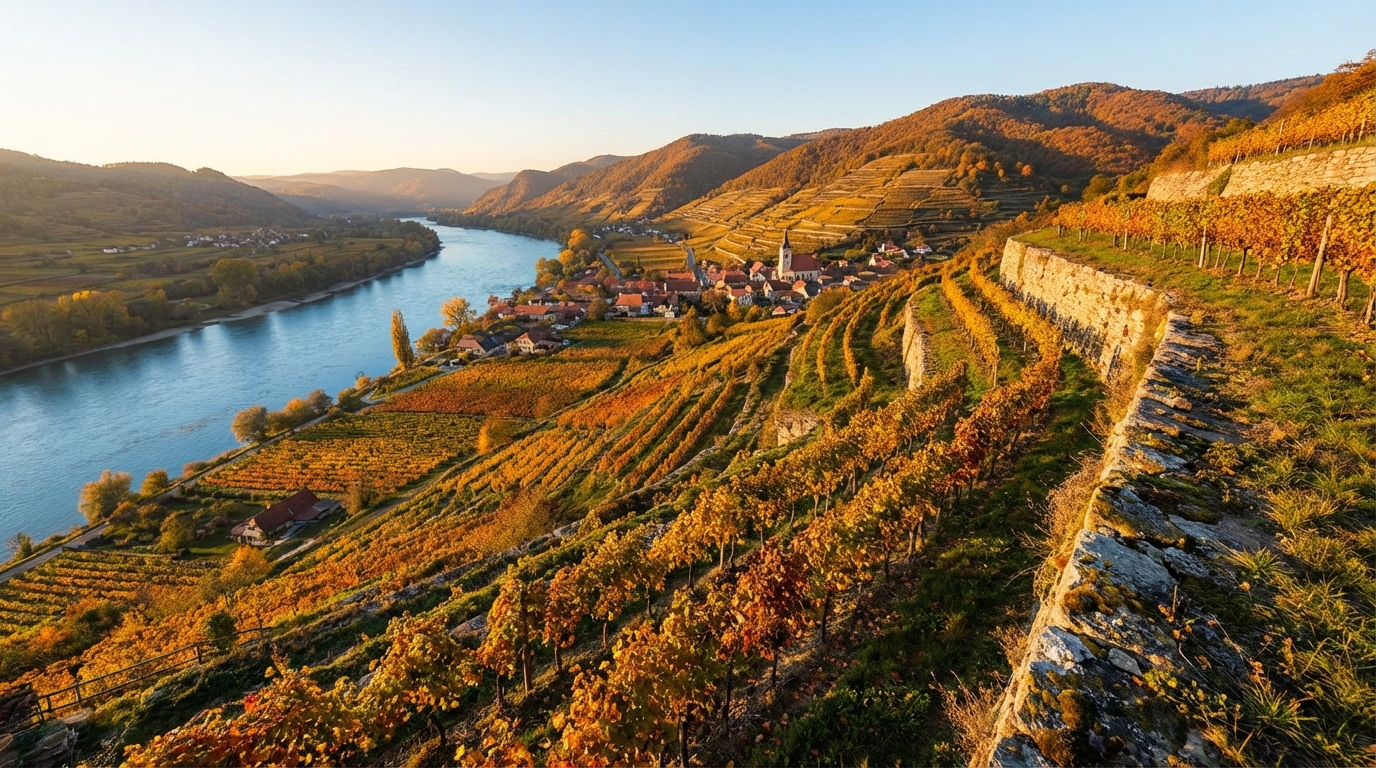
The Wachau is a 35-kilometre stretch of the Danube west of Vienna, a UNESCO World Heritage landscape of vertiginous terraced vineyards, ruined medieval fortresses, and monastery cellars that date back to Charlemagne. It is, by any measure, one of the most spectacular wine regions on earth — and its wines match the drama of the setting.
The Three Tiers of Wachau Wine
The Wachau operates under its own classification system, the Vinea Wachau quality pyramid, codified by the region’s growers’ association and entirely independent of Austria’s national wine law:
Steinfeder (literally “feathergrass,” the delicate grass that grows on rocky slopes) is the lightest tier — dry whites with a maximum of 11.5% alcohol, intended for early drinking. These are wines of effortless freshness, the archetypal Heurigen wine drunk young in the vine gardens.
Federspiel (“falcon’s feather,” named for the lure used in falconry on the Danube) covers the mid-range — wines between 11.5% and 12.5% alcohol, with more body and structure than Steinfeder. These represent the everyday quality benchmark of the Wachau: balanced, mineral, and reliably expressive.
Smaragd is the pinnacle — named for the iridescent green lizard (Lacerta bilineata) that basks on the warm stone walls of the terraces. Smaragd wines must be dry with a minimum 12.5% alcohol, but the best examples push considerably higher in a natural sense, concentrated by late harvesting on the steepest, most sun-drenched plots. These are the wines that age for decades and compete with grand cru Alsace and the Mosel’s finest.
The Soils and Geography of the Wachau
The Wachau’s vineyards occupy the narrow strip of land between the river and the steep valley walls. The soils are extraordinarily diverse: gneiss and granite on the left bank around Spitz and Weißenkirchen, giving wines of particular mineral tension; loess (wind-deposited silt) on the right bank around Loiben and Dürnstein, delivering rounder, richer textures. Porphyry — a volcanic intrusive rock — appears in key parcels and contributes distinctive saline, stony characters.
The climate is moderated by the Danube itself, which acts as a thermal regulator, keeping temperatures from dropping too sharply at night during growing season. Cold Alpine air funnels through the valley from the west, extending the growing season and preserving acidity even at high sugar levels. The result is Riesling and Grüner Veltliner of remarkable precision — wines that are simultaneously ripe and refreshing.
Top Wachau Producers
Knoll (Unterloiben): The benchmark estate for intellectual, ageworthy Grüner Veltliner and Riesling. Emmerich Knoll’s Ried Schütt Smaragd is among Austria’s most collectible whites.
Hirtzberger (Spitz): Franz Hirtzberger produces some of the Wachau’s most graceful, aromatic wines from the Singerriedel and Honivogl vineyards — Riesling of extraordinary floral precision.
FX Pichler (Oberloiben): The late Franz Xaver Pichler and his son Lucas make the region’s most powerful, concentrated wines. The M-label Grüner Veltliner Smaragd is a collector’s cult item and routinely cited as one of Austria’s greatest whites.
Alzinger (Unterloiben): Leo Alzinger crafts wines of quietly devastating complexity — less showy than Pichler, but perhaps more purely terroir-driven. The Steinertal Riesling Smaragd rewards decades of patience.
Veyder-Malberg (Spitz): The estate of Peter Veyder-Malberg is among the Wachau’s rising stars — small production, biodynamic farming, and wines of extraordinary focus and energy.
Kremstal and Kamptal: The Danube’s Inland Reaches
Immediately east of the Wachau, the Danube opens onto a wider landscape where Kremstal and Kamptal produce wines of comparable ambition if somewhat different character.
Kremstal
The Kremstal surrounds the historic city of Krems and encompasses a mix of loess terraces and primary rock vineyards. Grüner Veltliner and Riesling are the dominant varieties, and the best wines — particularly from the Ried Kremser Pfaffenberg — match Wachau Smaragd in quality. The Kremstal style tends toward slightly more generous texture than the Wachau, with the loess soils lending a creamy weight to Grüner Veltliner.
Key producers: Stadt Krems (the city-owned winery) and Nigl (whose Piri Riesling and Privat Grüner Veltliner are benchmarks for the region’s potential).
Kamptal
The Kamptal follows the Kamp River north from Langenlois — Austria’s largest wine town — into a landscape of loess and crystalline primary rock. The DAC rules here mandate Grüner Veltliner and Riesling, and the region’s undisputed standard-bearer is Bründlmayer, whose Alte Reben (old vines) Grüner Veltliner and Heiligenstein Riesling are among Austria’s most internationally recognized wines.
The Heiligenstein is Kamptal’s most celebrated single vineyard — a volcanic dacite rock formation that produces Riesling of extraordinary mineral tension and aromatic complexity. Wines from this site age magnificently and are frequently compared to Alsatian grand crus.
Weinviertel: The Heartland of Everyday Grüner Veltliner
North of the Danube, the rolling hills of the Weinviertel (“wine quarter”) form Austria’s largest wine region and the spiritual home of everyday Grüner Veltliner. This is wine country of a different register — less dramatic in landscape than the Wachau, less intellectually complex in its wines, but arguably more important for defining what Austrian wine means to Austrians themselves.
The Weinviertel DAC, Austria’s first DAC designation (2003), is dedicated exclusively to Grüner Veltliner of a specific style: light, peppery, fresh-bodied wines designed for immediate pleasure. The characteristic white pepper note — a signature of Grüner Veltliner at all quality levels — is most immediately readable in Weinviertel wines, making them an ideal introduction to the variety.
Burgenland: Sweet Wine Legends and Powerful Reds
Southeastern Austria’s Burgenland region is a world apart from the cool Danube valleys. Here the Neusiedlersee — a vast, shallow lake on the Hungarian border — creates the conditions for one of wine’s great natural phenomena: botrytis cinerea, the noble rot that shrivels and concentrates grapes into liquid gold.
Ruster Ausbruch: Austria’s Greatest Sweet Wine
The town of Rust on the western shore of the Neusiedlersee has produced sweet wines for over 400 years. Ruster Ausbruch is Austria’s most prestigious sweet wine style — historically the equal of Tokaji Aszú or Sauternes, though far less internationally known. Made primarily from Furmint, Welschriesling, and Grüner Veltliner, Ausbruch wines combine the oxidative richness of botrytis concentration with a striking natural acidity that prevents them from cloying.
Feiler-Artinger and Wenzel are the leading Ruster Ausbruch producers, making wines of astonishing complexity that deserve far greater international attention.
Neusiedlersee: Trockenbeerenauslese and the Pannonian Plains
Across the lake in the flat Neusiedlersee sub-region, the humid microclimate reliably generates botrytis of extraordinary intensity. Alois Kracher — the late “king of sweet wines” — built a global reputation here with his Trockenbeerenauslese bottlings, blending Austrian tradition with the influence of Sauternes. His estate, now run by his son Gerhard, continues to produce some of the world’s finest dessert wines.
Blaufränkisch: Austria’s Red Wine Identity
Burgenland is also the spiritual home of Blaufränkisch, Austria’s most important red grape. Known as Lemberger in Germany and Kékfrankos in Hungary, this thick-skinned variety produces wines of deep color, vibrant acidity, and complex flavors ranging from dark cherry and blackberry to earth, leather, and black pepper.
The Mittelburgenland DAC is dedicated entirely to Blaufränkisch, where it reaches its most powerful expression. The Eisenberg DAC in southern Burgenland produces lighter, more elegant Blaufränkisch from iron-rich soils. Key producers include Moric (whose old-vine Blaufränkisch from Neckenmarkt and Lutzmannsburg redefined the variety internationally), Gesellmann, and Heinrich.
The DAC System: Austria’s Appellation Architecture
Austria’s DAC (Districtus Austriae Controllatus) system has progressively mapped the country’s wine geography since 2003. Today’s 17 DACs range from the Wachau (which uses its own Vinea Wachau system but is encompassed within DAC rules) to Vulkanland Steiermark in the southeast. The system operates on two levels: a regional DAC for variety-typical wines from the whole appellation, and a reserve/single vineyard DAC for wines from classified sites.
The Österreichische Traditionsweingüter (ÖTW), a growers’ association operating separately from the DAC system, has classified over 300 individual vineyard sites (Erste Lagen — “first sites”) in a system deliberately modeled on Burgundy’s premier and grand cru structure. This classification, covering the Wachau, Kremstal, Kamptal, and other regions, provides an additional layer of terroir transparency for the most discerning consumers.
Key Vocabulary for Austrian Wine
Smaragd: The highest quality tier of Wachau wine — dry whites with minimum 12.5% alcohol, named for the emerald lizard of the Danube valley.
Federspiel: Mid-range Wachau dry white, 11.5–12.5% alcohol, named for the falconer’s lure.
Steinfeder: Lightest Wachau tier, maximum 11.5% alcohol, for early drinking.
Loess: Wind-deposited silt soil found throughout Niederösterreich, contributing textural roundness to wine.
Porphyry: Volcanic intrusive rock found in key Wachau parcels, associated with saline mineral characters.
Ausbruch: Traditional Austrian sweet wine style, particularly from Rust, made from botrytis-affected grapes.
Heurigen: Traditional Viennese wine taverns serving the year’s new wine — an institution as important culturally as wine itself in Austria.
Erste Lage: “First site” — a classified single vineyard in the ÖTW classification system, analogous to premier cru.
Buying Guide: Austrian Wine at Every Price Point
Austrian wine represents exceptional value across the price spectrum. At the entry level, a Weinviertel DAC Grüner Veltliner can be found for under €10 and will deliver the variety’s signature white pepper freshness with no apology. At mid-range (€15–30), Kamptal and Kremstal DAC wines from producers like Bründlmayer and Nigl offer complexity that punches well above their price point. And at the top — Wachau Smaragd from Knoll, FX Pichler, or Hirtzberger (€40–80+) — Austrian wine stands comparison with the finest whites produced anywhere in the world.
Austria’s wine story is one of the most compelling in the wine world — a small country that nearly destroyed its reputation, rebuilt it on a foundation of honesty and terroir, and emerged as one of Europe’s most exciting and underappreciated wine nations. For anyone serious about white wine, Austria is essential.


