The Greatest White Wine You're Probably Not Drinking
There is a strong case to be made — and many of the world's finest sommeliers, critics, and winemakers do make it — that Riesling is the single greatest white grape variety on earth. Not the most popular, not the most fashionable, not the most widely planted. But the greatest.
No other grape variety combines Riesling's ability to express terroir with such crystalline precision, its extraordinary range from bone-dry to lusciously sweet, its capacity to age for decades while gaining rather than losing complexity, and its uncanny ability to pair with virtually any cuisine. A great German Riesling can be simultaneously powerful and delicate, rich and refreshing, simple in its purity and endlessly complex in its nuance.
And yet Riesling remains, in the minds of many wine drinkers, synonymous with cheap, cloying sweetness — a reputation that is both historically understandable and profoundly unfair. This guide is an attempt to correct that misunderstanding and to reveal German Riesling for what it truly is: one of the wine world's greatest treasures.
“Riesling is the truth-teller of the wine world. It hides nothing. Every vintage, every vineyard, every winemaker's decision is laid bare.”
— Stuart Pigott, Best White Wine on Earth
The Sweetness Myth — and How It Began
The misconception that all German Riesling is sweet has its roots in the 1970s and 1980s, when mass-produced, low-quality, sugary wines like Liebfraumilch and Blue Nun flooded international markets. These wines — often made from inferior grape varieties like Müller-Thurgau rather than Riesling — were cheap, simple, and sweet. They sold in enormous quantities and defined an entire generation's perception of German wine.
The damage was catastrophic and long-lasting. While other wine regions successfully reinvented their images — Australia moved from bag-in-box to premium Shiraz, New Zealand burst onto the scene with Sauvignon Blanc — Germany struggled under the weight of its "sweet and cheap" reputation.
The irony is that Germany's finest winemakers were producing extraordinary wines throughout this period, and the tradition of dry, age-worthy Riesling stretches back centuries. Today, more than half of all German Riesling is fermented dry (trocken), and the country's best dry Rieslings stand proudly alongside the great white wines of Burgundy and the Loire Valley.
“German Riesling is arguably the most undervalued great wine in the world. People pay $50 for a mediocre Chardonnay and $15 for a Riesling that is infinitely more interesting.”
— Ernst Loosen, Weingut Dr. Loosen
Understanding the Prädikat System
Germany's wine classification is built around the Prädikat system, which ranks wines by the ripeness of the grapes at harvest — not by vineyard quality (though a separate vineyard classification, the VDP system, addresses that). Understanding the Prädikat levels is the key to navigating German wine labels.
| Prädikat Level | Minimum Must Weight (Oechsle) | Typical Character |
|---|---|---|
| Kabinett | 67–82° | Light, elegant, low alcohol (7.5–9%). Can be dry or off-dry. The most refreshing style |
| Spätlese | 76–90° | "Late harvest." Richer and more intense than Kabinett. Can be dry or off-dry |
| Auslese | 83–100° | "Select harvest." Concentrated, often noticeably sweet, though dry versions exist |
| Beerenauslese (BA) | 110–128° | "Selected berry harvest." Very sweet; made from individually selected overripe/botrytized grapes |
| Trockenbeerenauslese (TBA) | 150–154° | "Dry selected berry harvest." Intensely sweet, rare, and expensive; the pinnacle of German sweet wine |
| Eiswein | 110–128° | "Ice wine." Made from grapes frozen on the vine; concentrated sweetness with piercing acidity |
A crucial point: the Prädikat level indicates grape ripeness at harvest, not necessarily the sweetness of the finished wine. A Spätlese can be fermented completely dry (labeled trocken), creating a powerful, rich, dry wine — or fermented with residual sugar for a sweeter style. The terms trocken (dry), halbtrocken or feinherb (off-dry), and the absence of these terms (indicating a sweeter style) tell you about the actual sweetness in the glass.
The VDP Classification: Germany's Grand Cru System
While the Prädikat system classifies by ripeness, the VDP (Verband Deutscher Prädikatsweingüter) — an association of roughly 200 of Germany's top producers — has established a Burgundy-inspired vineyard classification that ranks sites by quality:
| VDP Level | Equivalent | Description |
|---|---|---|
| VDP.Gutswein | Regional wine | Estate-level wine; the entry point |
| VDP.Ortswein | Village wine | From a single village; more specific character |
| VDP.Erste Lage | Premier Cru | First-class vineyard sites; must be hand-harvested |
| VDP.Grosse Lage | Grand Cru | The finest vineyard sites; the pinnacle of German terroir |
Wines from VDP.Grosse Lage vineyards, when dry, are labeled Grosses Gewächs (GG) — literally "great growth." These are Germany's answer to Grand Cru Burgundy: single-vineyard, dry wines that express the specific terroir of their site with extraordinary precision. The best GG wines — from producers like Keller, Dönnhoff, Emrich-Schönleber, and Wittmann — are among the most compelling dry white wines in the world.
The Great Regions of German Riesling
Germany has 13 official wine regions (Anbaugebiete), but four stand supreme for Riesling:
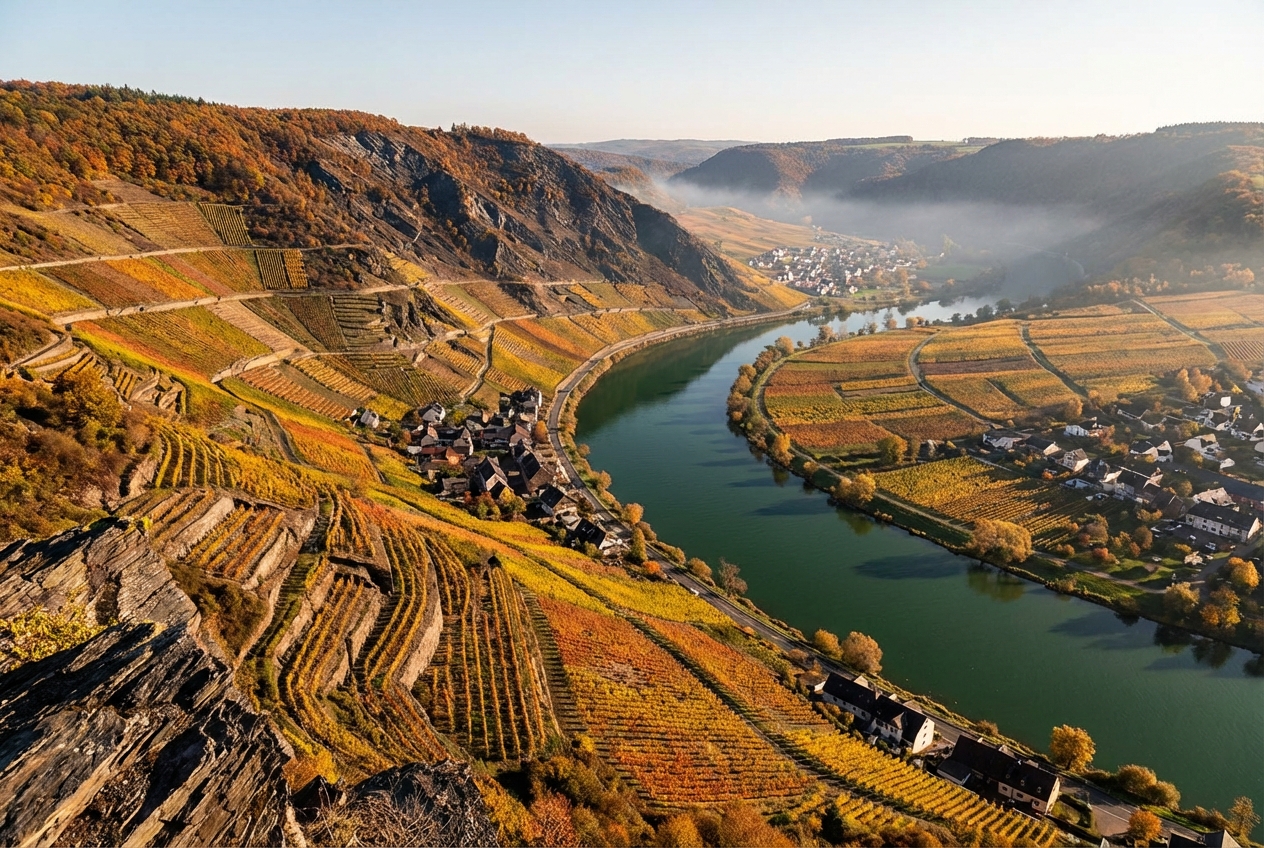
The Mosel is Riesling's spiritual home and arguably its most dramatic expression. The river carves a sinuous path through steep hillsides of blue Devon slate, creating vineyards so precipitous that they must be worked entirely by hand, often with the aid of monorail systems. The slate soils retain heat during the day and release it at night, helping grapes ripen in this cool, northerly climate.
Mosel Riesling is defined by its lightness — low alcohol (often 7.5–9% for Kabinett), razor-sharp acidity, and ethereal delicacy. The best wines from the Mosel's legendary vineyards — Wehlener Sonnenuhr, Ürziger Würzgarten, Scharzhofberger, Brauneberger Juffer-Sonnenuhr — are masterpieces of finesse, with flavors of white peach, lime blossom, wet slate, and a smoky minerality that is utterly unique.
Key producers: Joh. Jos. Prüm (the benchmark for off-dry Mosel Riesling), Egon Müller (whose Scharzhofberger TBA is among the most expensive white wines in the world), Fritz Haag, Willi Schaefer, Clemens Busch (biodynamic pioneer), Markus Molitor.
Rheingau
Historically the most prestigious German wine region, the Rheingau is where the Rhine River turns west, creating a south-facing bank of slopes that is perfectly angled to capture sunlight. The warmer, more sheltered conditions produce fuller, more structured Rieslings than the Mosel — wines with greater body, often fermented dry, and with the ability to age for decades.
The Rheingau's greatest vineyards — Schloss Johannisberg (where Spätlese was reportedly discovered by accident in 1775), Marcobrunn, Steinberg, and Berg Schlossberg in Rüdesheim — have been recognized as exceptional sites for centuries. The region also has a proud tradition of noble sweet wines, particularly from the village of Hattenheim and the monastic estate of Kloster Eberbach.
Key producers: Robert Weil (monumental sweet wines and powerful dry GGs), Peter Jakob Kühn (biodynamic pioneer), Leitz, Breuer, Schloss Johannisberg.
Pfalz (Palatinate)
Germany's warmest major wine region, the Pfalz lies along the eastern flanks of the Haardt Mountains (an extension of the Vosges range in Alsace, just across the French border). The sheltered, sunny climate produces the richest, most opulent German Rieslings — wines with tropical fruit notes, fuller body, and a generous warmth that makes them particularly appealing to drinkers accustomed to Chardonnay or other full-bodied whites.
The Pfalz has experienced a quality revolution in recent decades, driven by ambitious producers who have elevated its best vineyards to world-class status. The village of Forst and its legendary vineyards — Kirchenstück, Pechstein, Jesuitengarten, Ungeheuer — are the benchmarks, but excellent wines come from across the region.
Key producers: Bürklin-Wolf (one of Germany's largest and finest estates; fully biodynamic), Christmann (biodynamic; president of the VDP), Müller-Catoir (explosive aromatics), Von Winning, Reichsrat von Buhl.
Rheinhessen
Germany's largest wine region by area, Rheinhessen was long associated with bulk production. But a revolution centered on the village of Westhofen and the extraordinary vineyards of Morstein, Kirchspiel, and Hubacker — championed by producers like Klaus-Peter Keller — has catapulted the region to the very summit of German wine. Keller's Riesling GG from Morstein and Abtserde are routinely among the highest-rated German wines of any vintage.
Key producers: Keller (the benchmark; allocated and difficult to find), Wittmann (biodynamic; brilliant GGs), Battenfeld-Spanier, Wagner-Stempel (excellent value).
Why Dry German Riesling Deserves Your Attention
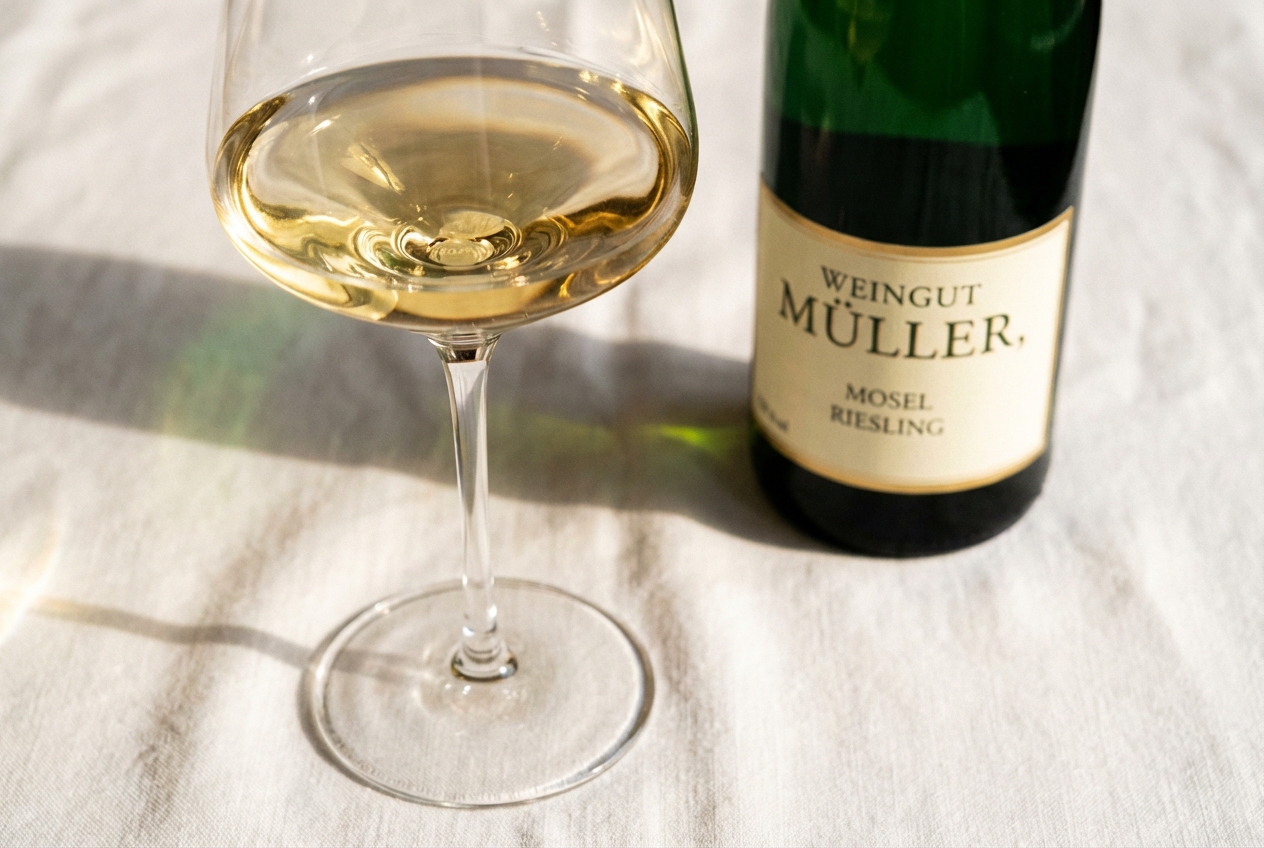
The rise of Grosses Gewächs (GG) — dry Riesling from classified vineyard sites — is one of the most significant developments in the wine world over the past two decades. These wines offer:
Terroir expression — Riesling's transparent character means GG wines from different sites taste genuinely, meaningfully different. A GG from the slate soils of the Mosel tastes nothing like one from the limestone of Rheinhessen or the basalt of the Pfalz. This is terroir expression at its purest.
Aging potential — The best GGs improve for 10, 20, even 30+ years, developing complex notes of petrol, honey, dried herbs, and smoked nuts while retaining their acid backbone. Great aged Riesling is one of wine's most transcendent experiences.
Food versatility — Dry Riesling's combination of moderate alcohol, high acidity, and intense flavor makes it one of the most food-friendly wines in existence. It excels with Asian cuisine, seafood, pork, poultry, and vegetable dishes. Many sommeliers consider it the ultimate restaurant wine.
Value — Even at the GG level, German Riesling offers extraordinary quality-to-price ratio. A Grosses Gewächs from a top producer typically costs $30–$80 — a fraction of what equivalent-quality wines from Burgundy, Napa, or Champagne would command.
The Sweet Side: Auslese, BA, TBA, and Eiswein
While dry Riesling is ascendant, Germany's sweet wines remain among the most extraordinary — and underappreciated — wines on earth. The top Prädikat levels produce wines of astonishing concentration and longevity:
Auslese — Made from selected clusters of very ripe grapes, often touched by botrytis (noble rot). Rich, sweet, and complex, with enough acidity to remain vibrant. These are versatile wines — wonderful with foie gras, blue cheese, or fruit desserts.
Beerenauslese (BA) — Made from individually selected botrytized berries. Nectar-like concentration with flavors of dried apricot, honey, and exotic spices. Produced in tiny quantities and only in exceptional vintages.
Trockenbeerenauslese (TBA) — The rarest and most expensive German wine. Made from grapes that have shriveled almost to raisins on the vine through botrytis infection. The resulting wines are intensely sweet, viscous, and complex, with flavors that can evolve for a century or more. Egon Müller's Scharzhofberger TBA has sold for over $12,000 per bottle at auction.
Eiswein — Made from grapes that freeze naturally on the vine, then pressed while still frozen so that only the concentrated sweet juice is extracted (the water remains as ice). Pure, piercing, and intensely sweet, Eiswein is becoming increasingly rare as climate change reduces the likelihood of the necessary hard frosts.
“A great TBA is not just a wine. It is a natural miracle — the product of a specific combination of grape, soil, climate, and the unpredictable magic of botrytis that may occur once in a decade.”
— Stuart Pigott
Riesling at the Table: Essential Pairings
Riesling's combination of acidity, aromatic complexity, and stylistic range makes it the most versatile food wine in the world. Here are essential pairings:
| Riesling Style | Perfect Pairings |
|---|---|
| Kabinett (off-dry) | Thai green curry, sushi, spicy noodle dishes, Vietnamese pho |
| Spätlese (off-dry) | Chinese dim sum, Indian butter chicken, glazed pork belly |
| GG / Trocken (dry) | Grilled white fish, roast chicken, Wiener Schnitzel, pork roast with apple |
| Auslese (sweet) | Foie gras, blue cheese, tarte Tatin, crème brûlée |
| BA / TBA (very sweet) | Fruit tarts, tropical fruit desserts, or simply on their own as meditation wines |
Producers to Know
A selection of essential German Riesling producers across all price levels:
Icon tier (allocated, expensive, worth every cent):
- Egon Müller (Mosel) — The undisputed king of sweet Riesling
- Keller (Rheinhessen) — Possibly the greatest dry Riesling producer alive
- Joh. Jos. Prüm (Mosel) — Timeless elegance; wines that age for half a century
World-class (widely available, exceptional quality):
- Dönnhoff (Nahe) — Crystalline purity from the underrated Nahe region
- Emrich-Schönleber (Nahe) — Mineral-driven, precise, age-worthy
- Dr. Loosen (Mosel) — Ernst Loosen's advocacy for old vines and steep-slope viticulture has been transformative
- Robert Weil (Rheingau) — Benchmark for both dry and sweet Rheingau Riesling
- Bürklin-Wolf (Pfalz) — One of Germany's oldest and finest estates; fully biodynamic
Excellent value (outstanding wines under $25):
- Leitz (Rheingau) — "Dragonstone" Riesling is a benchmark for entry-level quality
- Dr. Thanisch (Mosel) — Classic Mosel from legendary vineyards
- Selbach-Oster (Mosel) — Johannes Selbach is an ambassador for Mosel Riesling worldwide
- Müller-Catoir (Pfalz) — Explosive, aromatic, and immensely food-friendly
For comprehensive information on German wine regions and classifications, visit the German Wine Institute (Deutsches Weininstitut). For in-depth reviews and vintage reports, consult JancisRobinson.com's German wine section and Stuart Pigott's columns on Riesling.
The Future of German Riesling
Climate change is a double-edged sword for German Riesling. On one hand, warmer temperatures mean more consistent ripeness and fewer catastrophically poor vintages. Red varieties like Pinot Noir (Spätburgunder) are thriving as never before. On the other hand, the cool-climate tension and delicacy that define the greatest German Rieslings — particularly from the Mosel — could be at risk.
Forward-thinking producers are adapting. There is renewed interest in north-facing slopes and higher-altitude vineyards that were historically too cool for reliable ripening. Organic and biodynamic viticulture is expanding, with producers like Clemens Busch, Peter Jakob Kühn, and the Bürklin-Wolf estate demonstrating that sustainable farming enhances rather than compromises quality. The GG category continues to gain international recognition and respect.
Perhaps most encouragingly, a new generation of wine drinkers — drawn to lighter, lower-alcohol wines with distinct personality — is discovering German Riesling and finding exactly what they have been looking for. After decades in the wilderness, Riesling is finally getting the audience it has always deserved.
“The world is slowly waking up to what those of us who love Riesling have known all along: there is no more thrilling, no more versatile, no more age-worthy white wine on the planet.”
— Ernst Loosen
The great German Rieslings are not for everyone. They demand attention, curiosity, and a willingness to set aside preconceptions. But for those who make the effort, the rewards are immense — wines of crystalline purity, electrifying acidity, and haunting complexity that linger in the memory long after the glass is empty.


