The World’s Southernmost Wine Region
At 45 degrees south latitude, Central Otago occupies a position of geographical superlatives: the world’s southernmost significant wine region, the only wine region in New Zealand with a continental rather than maritime climate, and one of the most dramatically beautiful wine landscapes on earth. Surrounded by the Southern Alps, cut through by glacial lakes and schist rock gorges, and overlooked by the jagged Remarkables mountain range, Central Otago is wine country that looks like no other place on the planet.
The region’s emergence as a serious wine destination is recent — the first commercial vines were planted only in 1981 — but its rise has been one of the most remarkable in modern wine history. In less than 40 years, Central Otago has established itself as one of the world’s benchmark regions for Pinot Noir, producing wines that stand comparison with the finest examples from Burgundy, Oregon’s Willamette Valley, and Sonoma’s Russian River Valley.
What makes Central Otago distinct from every other New Zealand wine region is its climate. While Marlborough, Hawke’s Bay, and the other major NZ wine regions experience the moderating influence of the Pacific Ocean, Central Otago is landlocked by mountain ranges on all sides. The result is a true continental climate: cold winters, hot summers, and dramatic diurnal temperature variation that is the key to the region’s wine identity.
The Landscape: Schist, Ice, and Alpine Grandeur
Central Otago’s landscape was shaped by ancient geological forces and refined by glaciation. The dominant rock type is schist — a metamorphic rock formed under intense pressure and heat that cleaves into flat, shiny sheets. The region’s characteristic schist soils are thin, free-draining, and low in organic matter, forcing vines to root deeply and struggle for nutrients. This stress produces small berries with concentrated flavors, and the schist contributes a distinctive mineral quality to the region’s wines — a stony, flinty precision that is one of Central Otago Pinot Noir’s most recognizable characteristics.
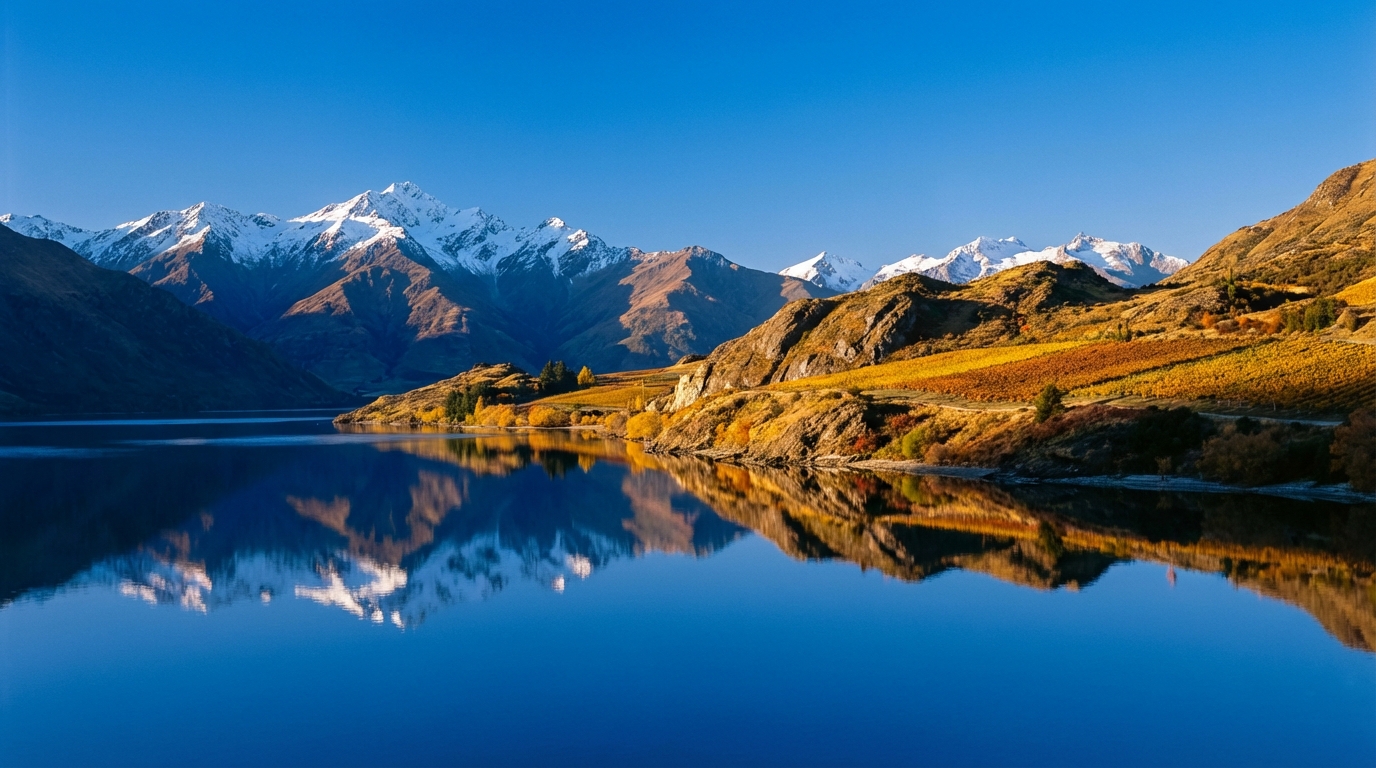
The glacial lakes — Lake Wanaka, Lake Hawea, Lake Dunstan (formed by the Clyde Dam on the Clutha River), and Lake Wakatipu — act as thermal moderators, storing heat during the day and releasing it at night, extending the growing season in their immediate surroundings and buffering against the most extreme temperature drops.
The topography is dramatic by any measure. Vineyards are typically planted on elevated terraces and hillsides, south-facing (equivalent to north-facing in the northern hemisphere) to maximize solar exposure. Views from most Central Otago wineries encompass mountains, gorges, and glittering lakes in compositions that have made the region one of New Zealand’s fastest-growing wine tourism destinations.
The Sub-Regions: Central Otago’s Wine Geography
Central Otago encompasses several distinct sub-regions, each with its own microclimate and wine character, separated by mountain ranges and varying significantly in altitude, aspect, and soil composition:
Gibbston Valley: The Coolest, Most Delicate
The Gibbston Valley sub-region, carved by the Kawarau River east of Queenstown, is Central Otago’s coolest and highest sub-region — and historically its pioneer. The Gibbston Valley Winery, established by Alan Brady in 1981, was the first commercial winery in the region. At 320–450 metres altitude, with a narrow gorge that limits sunlight hours, Gibbston produces Central Otago’s most delicate and finesse-driven Pinot Noir: lighter in color than Bannockburn, with bright red fruit (cherry, raspberry), earthy complexity, and a translucency that owes something to Burgundy’s Chambolle-Musigny.
The Kawarau Gorge — also home to the original AJ Hackett bungy jump site — acts as a wind corridor that reduces disease pressure and slows ripening. Gibbston wines have higher natural acidity and lower alcohol than other Central Otago sub-regions, making them some of the most food-friendly in the region.
Bannockburn: The Warmest, Most Concentrated
Bannockburn, in the Cromwell Basin south of Cromwell township, is Central Otago’s warmest and most concentrated sub-region. The basin is sheltered from southerly winds by the Cairnmuir Range, allowing temperatures to build during summer and producing Pinot Noir of greater weight and density than Gibbston. Bannockburn Pinot Noir is typically darker in color, with black cherry and plum notes, more substantial tannin structure, and greater cellaring potential.
The sub-region is home to some of Central Otago’s most celebrated estates: Felton Road (whose Block 3, Block 5, and Calvert single-vineyard bottlings are the region’s benchmarks), Burn Cottage (biodynamic; owner Mark Krauss has invested heavily in fine-tuning the vineyard), and Mount Difficulty (whose Bannockburn single-vineyard range is consistently outstanding).
Cromwell Basin: The Productive Heart
The broader Cromwell Basin encompasses Bannockburn and extends to flat terraces around Cromwell and Lowburn. The combination of schist bedrock, alluvial terraces, long warm days, and cold nights makes this the commercial heart of the region. Many larger producers source fruit from Cromwell Basin for their regional blends.
Wanaka: Alpine Elegance
The Wanaka sub-region is one of Central Otago’s most scenic and most photographed. The lake’s moderating influence creates conditions for wines of particular delicacy and aromatic complexity. Rippon Vineyard — with vineyards descending to Lake Wanaka against a mountain backdrop — farms biodynamically and produces wines of exceptional purity.
Alexandra: The Southern Frontier
The Alexandra Basin, at the southernmost extent of Central Otago, is the most marginal sub-region: highest altitude (up to 500m) and most extreme climate. When vintages cooperate, the wines are of striking intensity and minerality. Two Paddocks (actor Sam Neill’s estate) is the most celebrated producer here.
Pinot Noir: Central Otago’s Defining Wine
Central Otago Pinot Noir occupies a distinctive stylistic position. Compared to Burgundy, it is deeper in color, more fruit-forward (red and black cherry, boysenberry, plum), with silkier tannins. Compared to Oregon’s Willamette Valley, it is warmer and more concentrated; compared to Russian River Valley Pinot, it is more structured and mineral.
What Central Otago Pinot Noir shares with the finest examples worldwide is natural acidity — a consequence of dramatic diurnal swings — that gives the wines energy, freshness, and aging potential. Top examples from Felton Road, Burn Cottage, and Rippon age gracefully for 10–15 years.
The region’s most celebrated producers share a commitment to minimal intervention winemaking: native yeast fermentation, minimal fining and filtration, gravity-flow cellars, and careful French oak aging (typically 30–50% new). Biodynamic farming has a strong following: Felton Road, Burn Cottage, and Rippon are all certified biodynamic.
Top Producers: The Essential Guide
Felton Road (Bannockburn): The region’s benchmark estate. Biodynamic farming; single-vineyard bottlings Block 3, Block 5, Calvert, and Cornish Point are among NZ’s finest wines.
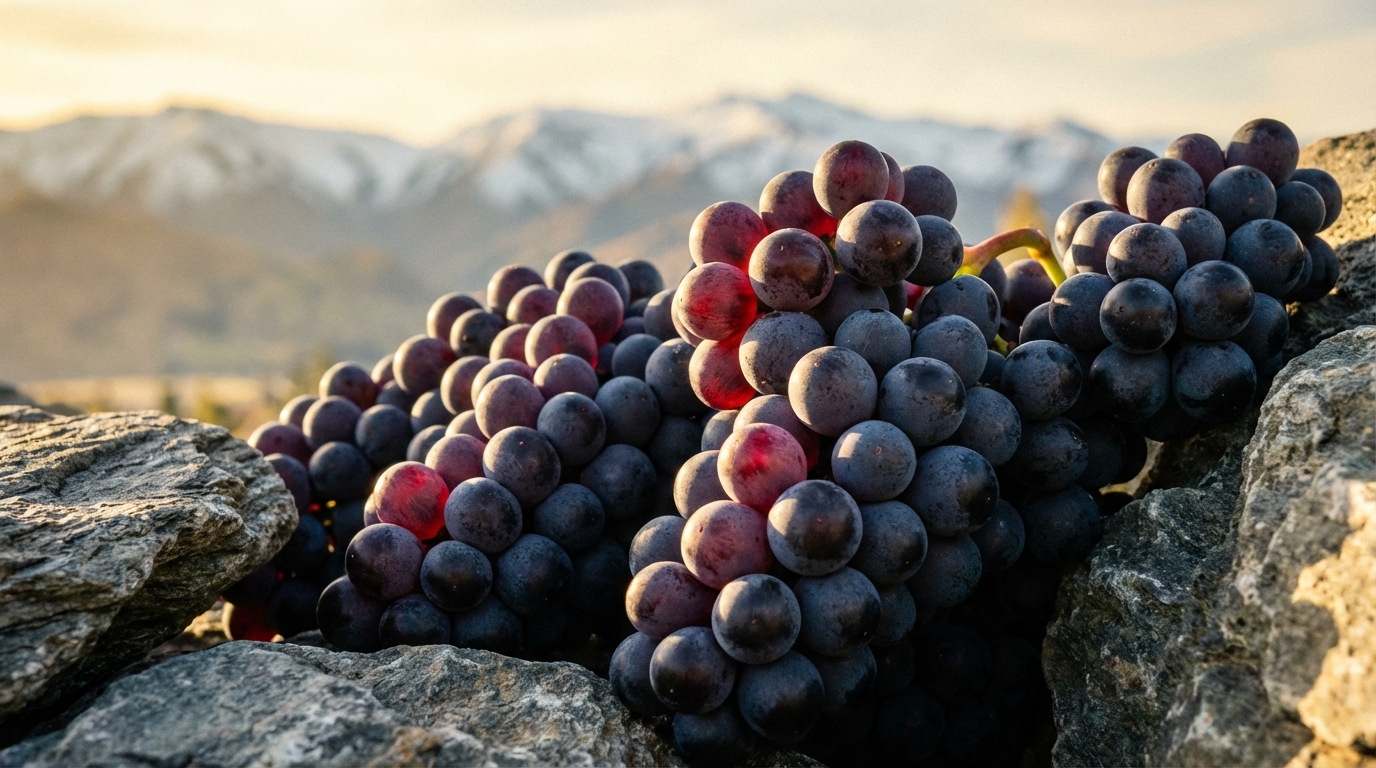
Burn Cottage (Bannockburn): Biodynamic; small production of extraordinary precision and elegance.
Mount Difficulty (Bannockburn): Produces a reliable range from Roaring Meg blend to single-vineyard Bannockburn.
Rippon (Wanaka): Biodynamic lakeside estate; Mature Vine and Emma’s Block Pinot Noir are references for Wanaka elegance.
Two Paddocks (Alexandra/Gibbston): Sam Neill’s estate; The Last Chance and Picnic Pinot Noir are benchmarks.
Quartz Reef (Cromwell Basin): Also outstanding for Methode Traditionnelle sparkling wine from Pinot Noir and Chardonnay.
Pinot Gris: The Secondary Star
While Pinot Noir dominates, Pinot Gris has emerged as Central Otago’s most significant secondary variety. The long, warm days and cold nights are ideal for developing Pinot Gris’s characteristic stone fruit (peach, apricot, nectarine) with well-balanced acidity and texture. Unlike the thin Pinot Grigio of northern Italy, Central Otago Pinot Gris has genuine substance and character. Mount Difficulty and Felton Road produce excellent examples.
Agritourism: Wine and Adventure Combined
Central Otago is uniquely positioned at the intersection of fine wine and adventure tourism. Queenstown — the adventure capital of the world — is just 40 minutes from Gibbston Valley and 50 minutes from Bannockburn. Wineries have invested heavily in hospitality: cellar doors with mountain views, vineyard restaurants, and cycling trails through vineyard landscapes. The Otago Central Rail Trail — a 150km cycling route through the heart of wine country — has become one of NZ’s premier food and wine experiences.
Vintages and Cellaring
Vintage variation in Central Otago is significant. The best recent vintages for Pinot Noir are 2013, 2015, 2019, and 2021 — all delivering excellent ripeness with good natural acidity. The 2020 vintage produced excellent wines despite logistical challenges. Avoid 2014 and 2017, affected by rain at harvest.
Central Otago Pinot Noir from quality producers peaks between 5 and 10 years from vintage; single-vineyard bottlings from Felton Road and Burn Cottage can develop for 15 years or more. The wines’ natural acidity — a product of extreme diurnal variation — is their primary aging structure.


