The Bet Nobody Believed In
In 1965, a young UC Davis graduate named David Lett loaded a truck with 3,000 grape cuttings and drove north from California into the Willamette Valley of Oregon. His friends thought he was crazy. His professors told him it was a mistake. The prevailing wisdom in American viticulture was unambiguous: great wine came from warm climates, and Oregon — rainy, cool, and covered in Douglas fir forests — was simply too cold and too wet to ripen wine grapes. California was the future. Oregon was a dead end.
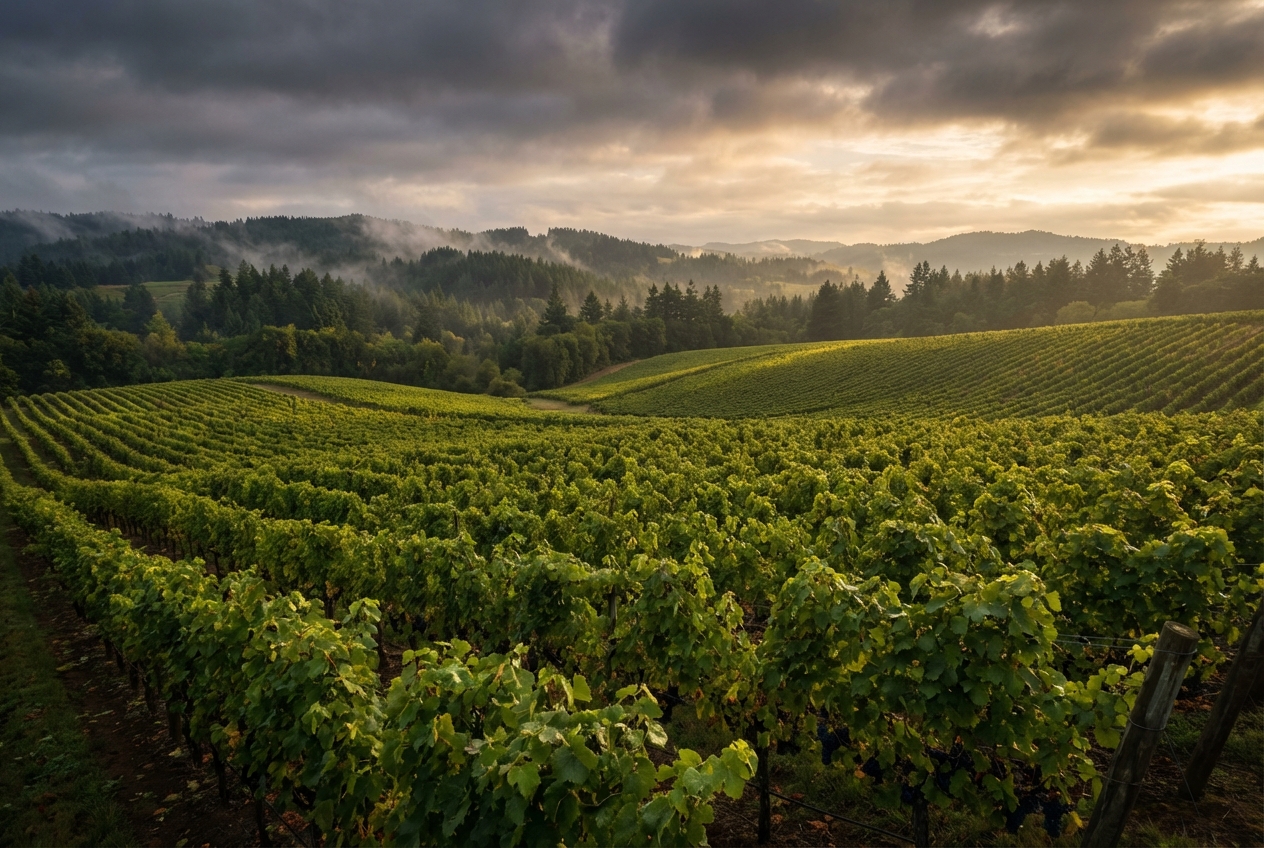
David Lett disagreed. He had studied the climate data, and he saw something that others missed: the Willamette Valley, nestled between the Coast Range and the Cascade Mountains at latitudes between 44° and 46° north, shared a remarkable climatic kinship with Burgundy. The same marginal conditions that made Burgundy the world's most celebrated Pinot Noir region — long, cool growing seasons, moderate rainfall, and just enough warmth to coax the grape to ripeness without losing its soul — existed in western Oregon.
“I didn't come to Oregon to make another California wine. I came here because this is where Pinot Noir wants to live in America. The climate doesn't lie.”
— David Lett, founder of The Eyrie Vineyards
Lett planted his vineyard in the Dundee Hills, a ridge of ancient volcanic soil (Jory series) that rises above the valley floor. He called it The Eyrie Vineyards, after the red-tailed hawks that nested in the firs above his vines. For years, he struggled with tiny yields, difficult vintages, and near-total indifference from the American wine market, which wanted bold, ripe Cabernet Sauvignon — not delicate, pale Pinot Noir from a state better known for lumber and rain.
But Lett was stubborn, and his wines were genuine. And in 1979, something happened that changed everything.
The Tasting That Shook Burgundy
In 1979, the French food and wine magazine Gault-Millau organized a blind tasting of Pinot Noirs in Paris, pitting the best of Burgundy against challengers from around the world. Lett entered his 1975 Eyrie Vineyards South Block Reserve — a wine made from young vines in a region nobody had heard of. It finished in the top ten, placing third behind a Drouhin Chambolle-Musigny and a Drouhin Clos de Bèze. The Burgundian establishment was horrified. An Oregon wine, outperforming Grand Cru Burgundy?
Robert Drouhin, the head of Maison Joseph Drouhin and one of Burgundy's most respected figures, demanded a rematch. In 1980, he organized a second blind tasting under more rigorous conditions. This time, the Eyrie Vineyards 1975 finished second, just two-tenths of a point behind Drouhin's own 1959 Chambolle-Musigny. The message was unmistakable: Oregon could produce Pinot Noir of world-class quality.
Drouhin's response was remarkable. Rather than dismissing the result, he sent his daughter, Véronique Drouhin, to investigate Oregon in person. What she found convinced the family to make an extraordinary commitment. In 1987, Robert Drouhin purchased land in the Dundee Hills — not far from Lett's Eyrie Vineyards — and established Domaine Drouhin Oregon. A Burgundy dynasty had placed its bet on Oregon. The validation was seismic.
“When my father decided to invest in Oregon, people in Burgundy thought he had lost his mind. But he understood that Pinot Noir had found a true home there. The soils, the climate, the spirit of the people — it reminded him of Burgundy at its best.”
— Véronique Drouhin-Boss
The Pioneers
David Lett was the first, but he was not alone for long. Through the 1970s and early 1980s, a small band of idealists — many of them refugees from academic or professional careers — followed him to the Willamette Valley.
Dick Erath arrived in 1968, establishing Erath Vineyards (originally Knudsen Erath) and becoming a tireless advocate for Oregon wine. His wines were more accessible and fruit-forward than Lett's austere style, and they helped build the state's commercial reputation.
Dick Ponzi and his wife Nancy founded Ponzi Vineyards in 1970 in the Chehalem Mountains. An engineer by training, Ponzi brought a methodical approach to viticulture that proved invaluable in understanding Oregon's challenging conditions.
Susan Sokol Blosser and her husband Bill established Sokol Blosser Winery in 1971. Susan would become one of the Oregon wine industry's most effective leaders, serving as chairman of the Oregon Winegrowers Association and championing sustainable farming.
David and Diana Adelsheim founded Adelsheim Vineyard in 1971 in the Chehalem Mountains. David Adelsheim became the intellectual engine of Oregon wine, leading efforts to establish the state's appellation system and clone research programs.
These pioneers shared certain characteristics: they were educated, idealistic, collaborative rather than competitive, and committed to quality over quantity. They established an industry culture that persists to this day — one in which winemakers share equipment, knowledge, and even grapes, and where the focus has always been on the grape rather than the brand.
The Oregon Wine Laws
Oregon's wine regulations, shaped by these early pioneers, are among the strictest in the United States. If a label says "Pinot Noir," the wine must contain at least 90% Pinot Noir — far above the federal minimum of 75%. If a label names an AVA, 95% of the grapes must come from that appellation. These regulations reflect the founders' belief that Oregon wine should be honest, transparent, and rooted in place.
Understanding Oregon's AVAs
The Willamette Valley, which stretches 150 miles from Portland south to Eugene, contains the vast majority of Oregon's Pinot Noir vineyards. But within this broad valley lies a remarkable diversity of sub-appellations (AVAs), each with distinct soils, elevations, and mesoclimates.
| AVA | Soils | Elevation | Character | Key Producers |
|---|---|---|---|---|
| Dundee Hills | Jory (volcanic, red clay) | 200-1,000 ft | Rich, earthy, dark fruit, spice; Oregon's most iconic terroir | Eyrie, Domaine Drouhin, Domaine Serene, Archery Summit |
| Eola-Amity Hills | Volcanic and sedimentary | 200-1,100 ft | Wind-exposed; bright acidity, mineral, savory; firm structure | Evening Land, Cristom, Bethel Heights |
| Chehalem Mountains | Mixed volcanic, loess, sedimentary | 200-1,600 ft | Complex, layered, balanced; great diversity within a single AVA | Ponzi, Adelsheim, Rex Hill |
| Ribbon Ridge | Marine sedimentary | 200-700 ft | Supple, silky, perfumed; the smallest Willamette AVA | Beaux Frères, Brick House |
| Yamhill-Carlton | Marine sedimentary | 200-1,000 ft | Fragrant, red-fruited, elegant; excellent aging potential | Ken Wright, Shea, Penner-Ash |
| McMinnville | Volcanic and sedimentary | 200-1,000 ft | Structured, muscular, dark-fruited; slightly warmer exposure | Maysara, Youngberg Hill |
| Laurelwood District | Laurelwood (wind-blown loess over basalt) | 300-1,000 ft | Fine-grained tannins, floral lift; Oregon's newest AVA (2020) | Trisaetum, David Hill |
| Van Duzer Corridor | Varied | 200-800 ft | Strong afternoon winds; the coolest sites in the valley | Johan Vineyards, Namasté |
The Dundee Hills: Oregon's Grand Cru
The Dundee Hills remain the spiritual and qualitative heart of Oregon Pinot Noir. The distinctive Jory soil — a deep, reddish volcanic clay derived from ancient basalt lava flows — gives wines a particular earthy richness, dark berry character, and savory depth that many consider Oregon's signature. At higher elevations, the volcanic soils become thinner and rockier, producing wines of greater intensity and mineral complexity.
Walking through a Dundee Hills vineyard, you notice the soil immediately: it stains your boots rust-red and clings to everything. This iron-rich clay drains well despite its density, and its thermal properties help moderate temperature swings — warming slowly in spring and retaining heat into the cool autumn evenings, allowing the grapes to complete their slow, gentle ripening.
The Eola-Amity Hills: Oregon's Emerging Star
If the Dundee Hills are Oregon's Chambolle-Musigny — generous, perfumed, and seductive — the Eola-Amity Hills are its Gevrey-Chambertin — structured, savory, and built for the long haul. This is the windiest AVA in the Willamette Valley, funneling cool Pacific air through the Van Duzer Corridor, a gap in the Coast Range that channels ocean breezes directly into the vineyards.
Cristom Vineyards, under the direction of winemaker Steve Doerner (who spent 14 years at Calera in California before moving to Oregon), produces some of the most compelling single-vineyard Pinot Noirs in the state. The Jessie Vineyard, Louise Vineyard, and Marjorie Vineyard bottlings show how profoundly site influences wine character even within a single estate.
Climate, Vintage, and the Pinot Noir Advantage
Oregon's climate is defined by a single word: marginal. The Willamette Valley sits at the northernmost edge of where Vitis vinifera can reliably ripen, and this marginality is precisely why Pinot Noir thrives here. Unlike Cabernet Sauvignon, which needs sustained warmth to achieve physiological ripeness, Pinot Noir is a cool-climate variety that loses its complexity and elegance in hot conditions. In warm vintages, Pinot Noir can become jammy and one-dimensional. In cool vintages, it may not ripen at all. Oregon's growing season — typically warm enough but never too warm — is the Goldilocks zone for this temperamental grape.
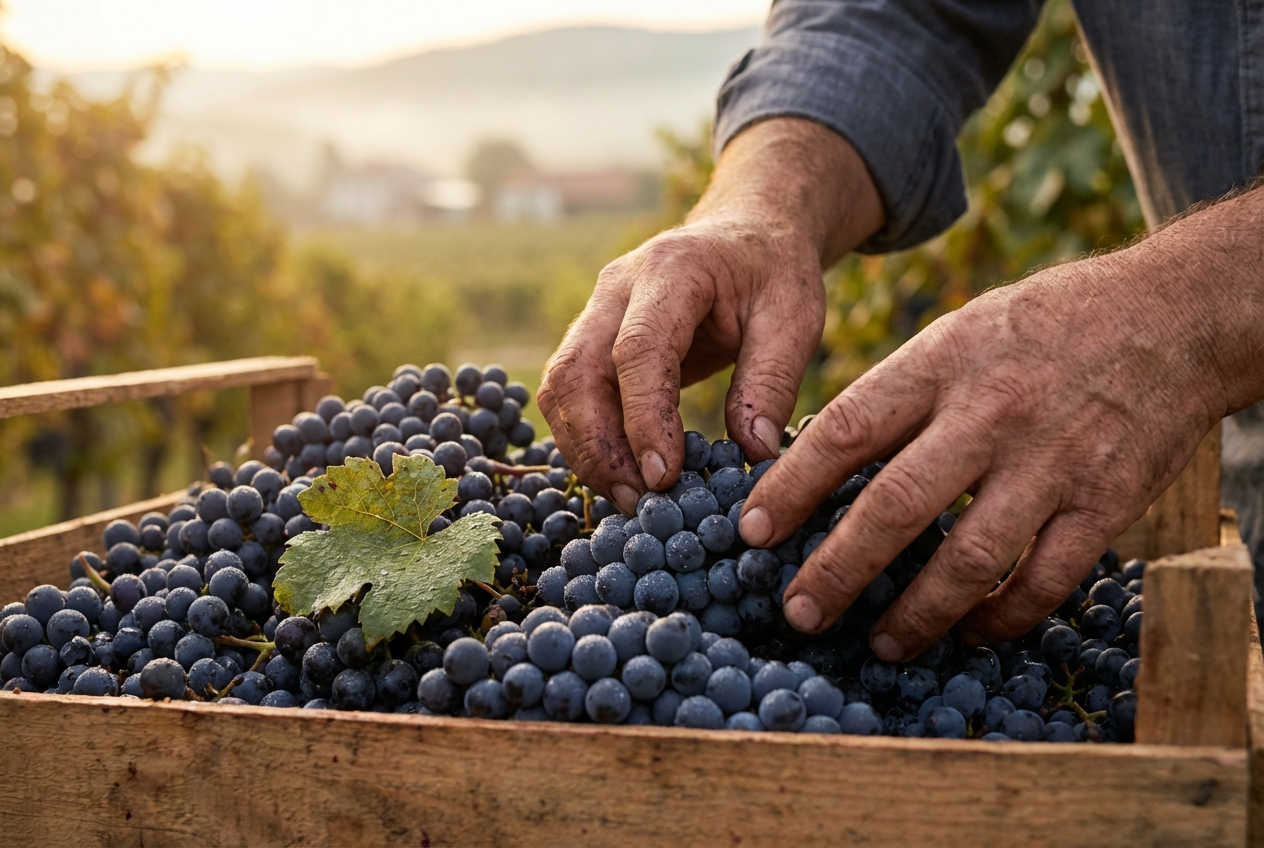
The growing season typically runs from April bud break through October harvest, with warm, dry summers and cool nights. Rain during harvest is the great risk — September and October storms can dilute fruit or promote rot. Vintage variation is significant, and knowing the character of each year is essential for Oregon Pinot Noir collectors.
Diurnal Shift: Oregon's Secret Weapon
One of Oregon's greatest viticultural assets is its dramatic diurnal temperature variation — the difference between daytime highs and nighttime lows. During the growing season, days regularly reach 30°C (86°F) while nights drop to 10°C (50°F) or lower. This 20°C swing allows grapes to accumulate sugar and flavor during the warm days while retaining the bright natural acidity that gives Oregon Pinot Noir its energy and aging potential.
By comparison, Burgundy has a more moderate diurnal shift but benefits from higher latitude and longer summer days. The result is that Oregon Pinot Noir tends to be slightly riper and more fruit-forward than Burgundy, with a broader, more generous mid-palate, while maintaining comparable acidity and structure.
Modern Oregon: Beyond the Pioneers
The Oregon wine industry has evolved enormously since Lett's pioneering days. The state now has over 900 wineries and more than 37,000 acres planted — though it remains a fraction of California's production. What has changed most dramatically is investment and ambition.
Domaine Serene, founded by Ken and Grace Evenstad, has become Oregon's most commercially successful estate, producing Pinot Noir and Chardonnay of undeniable polish and concentration. Their Evenstad Reserve Pinot Noir is widely regarded as one of Oregon's most consistent wines.
Beaux Frères, founded by Robert Parker's brother-in-law Michael Etzel in partnership with the famous critic, brought international attention to Ribbon Ridge. The estate Pinot Noir, from biodynamically farmed vines, is dense, complex, and age-worthy.
Evening Land Vineyards, with winemaker Rajat Parr (one of America's most celebrated sommeliers), has championed the Eola-Amity Hills with Pinot Noir and Chardonnay of extraordinary elegance and mineral precision. Parr's wines are resolutely Burgundian in philosophy — whole-cluster fermented, gently extracted, and unfined and unfiltered.
Lingua Franca, founded by Master Sommelier Larry Stone with winemaking by Dominique Lafon (of Meursault's Domaine des Comtes Lafon), represents perhaps the ultimate convergence of Burgundy expertise and Oregon terroir. The AVNI Pinot Noir and Chardonnay are among the state's most refined wines.
For those seeking outstanding value, producers like Willamette Valley Vineyards, A to Z Wineworks, and Sokol Blosser offer well-made Pinot Noir at accessible prices ($20-$35), while the single-vineyard wines from Ken Wright Cellars provide a masterclass in site expression for $45-$65.
Oregon Chardonnay: The Next Chapter
While Pinot Noir remains king, Oregon Chardonnay is emerging as one of America's most exciting white wines. Planted in the same cool-climate sites that favor Pinot Noir, Oregon Chardonnay tends to be leaner, more mineral, and higher in acidity than its California counterpart — closer to Chablis or Meursault than to Napa Valley.
The Dijon clones (76, 95, and 96), planted extensively since the 1990s, have proven ideally suited to Oregon's conditions. Producers like Domaine Drouhin, Lingua Franca, Roco, and Evening Land are making Chardonnay that can stand alongside good white Burgundy at a fraction of the price.
Visiting Oregon Wine Country
The Willamette Valley is one of the most welcoming wine regions in the world. Unlike Napa Valley, where tastings can feel commercial and expensive, Oregon tasting rooms maintain an informal, personal atmosphere. You may well find yourself being poured wine by the winemaker or owner.
McMinnville is the ideal base — a charming small town with excellent restaurants (Thistle, Nick's Italian Café), craft breweries, and easy access to the surrounding AVAs. Carlton and Dundee offer concentrated clusters of tasting rooms within walking distance.
Practical Advice
- Best time to visit: July through September for guaranteed dry weather. Late September through October for the harvest atmosphere, but bring rain gear.
- Reservations: Most wineries welcome walk-ins, but appointments are recommended for smaller producers and during busy weekends.
- Tasting fees: Typically $20-$40, often waived with purchase. Far more reasonable than Napa Valley.
- Designated driver: The back roads between wineries are narrow and winding. Use a tour service or designate a driver.
- Don't miss: The International Pinot Noir Celebration (IPNC), held annually in McMinnville each July, is the world's premier gathering of Pinot Noir producers and enthusiasts.
Oregon's Place in the World
Six decades after David Lett's audacious bet, Oregon has earned its place among the world's elite Pinot Noir regions. The state's wines are regularly compared to — and sometimes preferred over — Burgundy by international critics and collectors. At its best, Oregon Pinot Noir offers something that neither Burgundy nor any other New World region quite matches: the purity and transparency of fruit from cool-climate volcanic and sedimentary soils, combined with a generosity of flavor that makes the wines approachable in youth yet capable of aging gracefully for 15-20 years.
The story of Oregon wine is, at its core, a story about belief — about trusting the land, ignoring conventional wisdom, and having the patience to let a region discover its identity over decades rather than years. David Lett, who passed away in 2008, lived to see his vision vindicated beyond anything he could have imagined. His son, Jason Lett, now makes the wines at The Eyrie Vineyards, continuing a legacy that began with a truck full of cuttings and a conviction that one cool, rainy valley in the Pacific Northwest could produce wine to rival the world's finest.


