Sauvignon Blanc's Spiritual Home
If New Zealand put Sauvignon Blanc on the global map with its exuberant, tropical-fruited Marlborough wines, the Central Loire Valley is where the grape finds its most profound and nuanced expression. The twin appellations of Sancerre and Pouilly-Fumé, facing each other across the Loire River in the heart of France, produce Sauvignon Blanc of a character so distinct from the New World template that they might be mistaken for an entirely different variety. Where Marlborough delivers explosive aromatics and generous fruit, the Central Loire offers restraint, minerality, and terroir transparency — wines that taste not of grape but of place.
This is not accidental. Sauvignon Blanc is believed to have originated in the Loire Valley, with genetic studies confirming its parentage as a natural cross between Savagnin (the grape of Jura's vin jaune) and an obscure variety now lost to history. The grape has been cultivated in the Sancerre hills for centuries, long before it was planted in Bordeaux, let alone the Southern Hemisphere. The deep limestone and flint soils of the Central Loire — ancient seabeds pushed up by tectonic forces millions of years ago — have been shaped by Sauvignon Blanc and have shaped it in return. This is a relationship of terroir and variety honed over generations, producing wines that are as much an expression of geology as of viticulture.
The region's continental climate — cold winters, warm summers, and significant diurnal temperature variation — provides the conditions that Sauvignon Blanc needs to achieve its finest expression: sufficient warmth to ripen fully, but cool nights that preserve the bright, nervous acidity that gives these wines their signature energy. Rainfall is moderate, humidity is low, and the ever-present winds channeled by the Loire corridor keep the vineyards naturally ventilated, reducing disease pressure and allowing many growers to farm organically or biodynamically with relative ease.
Sancerre: Three Soils, Three Expressions
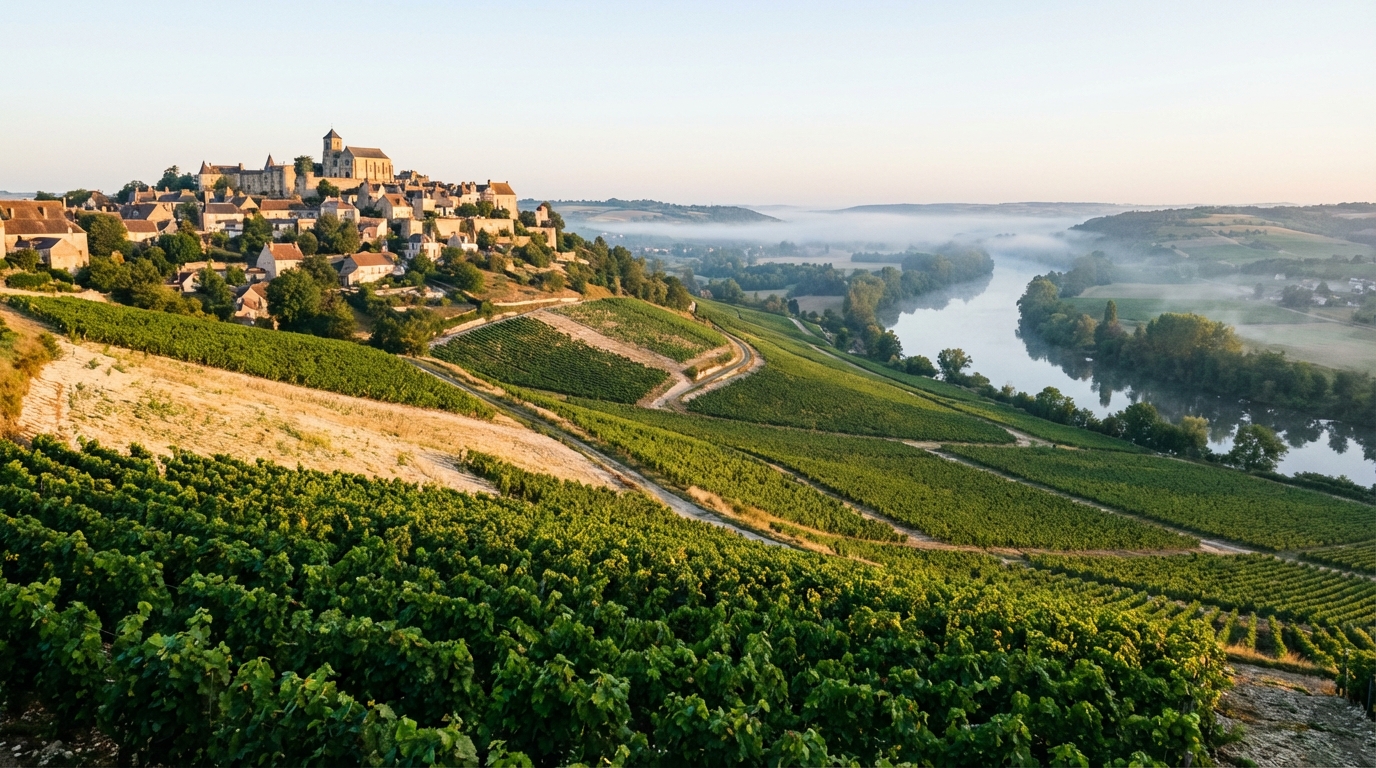
The appellation of Sancerre encompasses approximately 3,000 hectares of vineyards scattered across 14 communes on the left bank of the Loire, with the hilltop town of Sancerre itself perched dramatically at the center. The appellation produces white, rosé, and red wines, though white Sauvignon Blanc accounts for roughly 80% of production and defines Sancerre's international reputation.
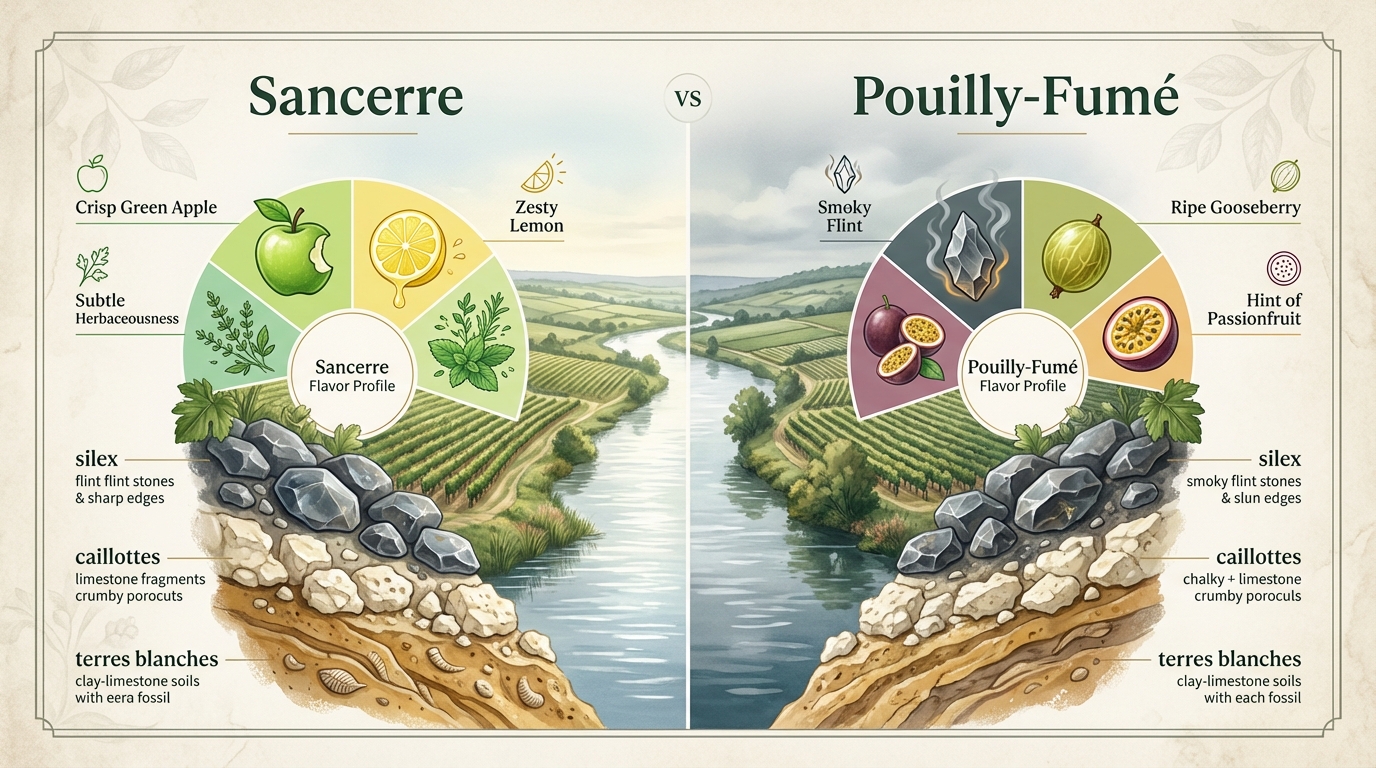
What makes Sancerre genuinely remarkable — and what distinguishes it from virtually every other Sauvignon Blanc appellation on earth — is its geological diversity. Three distinct soil types dominate the appellation, each producing a recognizably different style of wine from the same grape variety. Understanding these soils is the key to understanding Sancerre.
Silex (Flint)
The most celebrated and sought-after of Sancerre's soil types, silex consists of flint nodules embedded in a clay or clay-limestone matrix. These soils are found primarily in the western and southwestern parts of the appellation, particularly around the communes of Saint-Satur, Ménétréol-sous-Sancerre, and parts of Bué. The flint stones absorb and radiate heat, promoting even ripening and lending the wines their distinctive character.
Silex Sancerre is the most powerful and age-worthy style. The wines are marked by an unmistakable gunflint or struck-match minerality — a smoky, almost metallic note that emerges after a year or two in bottle and intensifies with age. Behind this mineral signature lies concentrated citrus fruit (grapefruit, lime zest), white peach, and often a flinty reduction that gradually unfolds into extraordinary complexity. These are the Sancerres that challenge the assumption that Sauvignon Blanc is a simple, drink-young variety. Top silex cuvées from producers like Didier Dagueneau (before his untimely death in 2008, and continued by his son Louis-Benjamin) and Domaine Vacheron can age 10 to 15 years or more, developing a honeyed, almost Burgundian richness while retaining piercing acidity.
Terre Blanche (Kimmeridgian Clay-Limestone)
Terre blanche — literally "white earth" — refers to the Kimmeridgian marl and clay-limestone soils that define much of the eastern and central portions of the appellation. These are the same geological formations found in Chablis and Champagne, laid down during the late Jurassic period when the Paris Basin was covered by a shallow tropical sea. The soils are pale, chalky, and rich in fossilized oyster shells — a visible reminder of their marine origin.
Wines from terre blanche soils are Sancerre at its most rounded and generous. The clay component retains moisture, buffering vines against drought and producing wines with more body and fruit intensity than silex or caillottes versions. The aromatics tend toward white flowers, ripe pear, and acacia honey, with a broad, supple palate and a chalky, saline finish that reflects the limestone bedrock. These Sancerres are often the most immediately appealing style — approachable in youth, with a gentle minerality that flatters rather than challenges. The communes of Verdigny and Crézancy-en-Sancerre are particularly associated with terre blanche.
Caillottes (Limestone Pebbles)
Caillottes are soils dominated by small, broken Portlandian limestone pebbles — angular, well-drained stones that force vine roots deep into the bedrock in search of water. Found predominantly on the slopes around the town of Sancerre itself and in the communes of Chavignol, Amigny, and Bué, caillottes soils produce what many consider the most classically Sancerre style of wine.
Caillottes Sancerre is defined by freshness, precision, and delicacy. The wines are lighter-bodied than terre blanche examples, with vibrant citrus aromatics (lemon, grapefruit), a crisp green-apple acidity, and a stony, chalky minerality on the finish. They are the most versatile Sancerres at the table — lively and refreshing, with enough complexity to reward attention without demanding it. The finest caillottes wines, particularly those from the legendary slopes of Chavignol (the village that gives its name to the famous goat cheese), combine this freshness with a surprising depth that emerges after a few years of bottle age.
Pouilly-Fumé: The Smoky Twin
Directly across the Loire from Sancerre, Pouilly-Fumé occupies approximately 1,300 hectares on the right bank, centered on the town of Pouilly-sur-Loire. The appellation produces exclusively white wine from Sauvignon Blanc — there is no rosé or red, and the lesser appellation of Pouilly-sur-Loire (which permits the neutral Chasselas grape) is a distinct, largely moribund category.
The name Fumé — meaning "smoky" — has been the subject of much romantic speculation. The most commonly cited explanation attributes it to the grey, smoke-like bloom (the natural waxy coating) that covers Sauvignon Blanc grapes as they approach ripeness, giving the clusters a hazy, fumé appearance in the vineyard. A more poetic theory connects the name to the smoky, gunflint character of the wines themselves, particularly those grown on the appellation's extensive silex soils. In either case, the name captures something essential about Pouilly-Fumé's identity: a wine of mystery, subtlety, and mineral-driven complexity.
The terroir of Pouilly-Fumé shares much with Sancerre — both regions sit on the same ancient Jurassic and Cretaceous geological formations — but the details differ in ways that matter. Pouilly-Fumé's vineyards face generally south to southeast, catching more direct afternoon sun than Sancerre's more varied exposures. The soils include significant tracts of silex (particularly around the communes of Saint-Andelain and Tracy-sur-Loire), as well as Kimmeridgian marls and Portlandian limestone similar to Sancerre's terre blanche and caillottes. However, the relative proportions differ, and the right bank's slightly warmer mesoclimate tends to produce wines that are marginally fuller-bodied and more overtly mineral than their Sancerre counterparts.
The classic Pouilly-Fumé profile emphasizes smoky minerality, white-fleshed stone fruit (white peach, nectarine), and a textured, almost waxy palate that gives the best wines a sense of weight and substance. Where Sancerre often leads with citrus and freshness, Pouilly-Fumé tends to lead with texture and mineral depth. The finest examples — particularly from silex soils — develop extraordinary complexity with 5 to 10 years of bottle age, gaining layers of honey, toasted almond, and smoky flint that can recall great white Burgundy.
Key Producers: Sancerre
The quality landscape in Sancerre ranges from industrial-scale négociant brands to some of the most meticulous and terroir-focused vignerons in France. The following producers represent the pinnacle of the appellation.
Domaine Vacheron (Sancerre): One of the appellation's finest estates, farmed biodynamically since 2004. Brothers Jean-Dominique and Jean-Laurent Vacheron produce single-vineyard cuvées of remarkable precision, including "Les Romains" from old-vine silex soils and "Le Paradis" from Kimmeridgian clay. Their whites combine mineral intensity with textural richness, and their Sancerre Rouge is among the finest Pinot Noirs in the Loire. Wines that reward cellaring.
François Cotat (Chavignol): The legendary micro-producer whose minuscule output — a few thousand bottles per year — from old vines in the steep slopes of Chavignol commands almost cult-level demand. Cotat's style is unabashedly rich and concentrated, fermented and aged in old oak barrels, producing Sancerres of extraordinary depth that age like grand cru white Burgundy. The "Les Monts Damnés," "La Grande Côte," and "Les Culs de Beaujeu" cuvées are among the most coveted white wines in France.
Alphonse Mellot (Sancerre): A family estate tracing its winemaking lineage to 1513 — 19 generations in the same family. The flagship "Génération XIX" bottling is a powerful, oak-fermented Sancerre from old vines that demonstrates the appellation's capacity for serious, cellar-worthy wine. Now farmed biodynamically, the domaine produces both whites and an excellent Sancerre Rouge from Pinot Noir.
Vincent Pinard (Bué): One of the rising stars of Sancerre, producing wines of crystalline purity from three distinct soil types. Pinard's "Florès" (silex), "Harmonie" (terre blanche), and "Nuance" (caillottes) bottlings are a masterclass in the influence of soil on Sauvignon Blanc expression. The estate converted to biodynamic farming in 2012, and the wines have gained further precision and energy since.
Lucien Crochet (Bué): A benchmark producer whose consistent quality has made the domaine a reference point for classic Sancerre. The "Prestige" cuvée demonstrates that carefully made Sancerre can develop beautifully over 5 to 8 years, while the village bottling is one of the most reliable everyday Sancerres on the market.
Pascal Jolivet (Sancerre and Pouilly-Fumé): A négociant-producer who combines volume with surprising quality. Jolivet's Sancerres are clean, precise, and well-priced, making them an excellent entry point for consumers discovering the appellation. The "Le Chêne Marchand" single-vineyard bottling shows more depth and terroir character.
Key Producers: Pouilly-Fumé
Didier Dagueneau (Saint-Andelain): The late Didier Dagueneau — who died tragically in a microlight accident in 2008 — was the visionary who single-handedly elevated Pouilly-Fumé from a respected regional appellation to one of the world's great white wine addresses. Dagueneau's uncompromising approach — biodynamic viticulture, severe yield reduction, indigenous yeast fermentation, and barrel aging in a mix of new and used oak — produced wines of breathtaking concentration and complexity. The flagship "Silex" bottling, from pure flint soils, is one of France's greatest white wines: smoky, mineral-drenched, and capable of aging 20 years or more. His son Louis-Benjamin Dagueneau has continued his father's legacy with equal rigor, maintaining the domaine's position at the summit of Loire Sauvignon Blanc. Other cuvées include the powerful "Pur Sang" and "Buisson Renard", each drawn from distinct terroirs within the appellation.
Baron de Ladoucette (Pouilly-sur-Loire): The largest and most commercially visible Pouilly-Fumé producer, whose flagship "Baron de L" cuvée — from old vines in the best silex parcels — represents the more refined side of a portfolio that also includes the widely distributed standard bottling. The estate's historic Château du Nozet dominates the landscape above the Loire, and the wines, if sometimes lacking the intensity of smaller artisan producers, are consistently well-made and widely available.
Jonathan Pabiot (Pouilly-sur-Loire): A fourth-generation vigneron producing terroir-driven Pouilly-Fumé from several distinct soil types. Pabiot's "Prédilection" cuvée from silex soils shows the smoky, mineral intensity that defines the best of the appellation, while the "Florilège" and standard bottlings offer accessible, fruit-forward expressions. The domaine farms sustainably and represents excellent value.
Sancerre Rouge: Pinot Noir in the Loire
While Sancerre's reputation rests overwhelmingly on its white wines, the appellation also produces red and rosé wines from Pinot Noir that have been gaining serious attention in recent years. Red Sancerre accounts for approximately 15% of the appellation's production, with rosé contributing another small fraction.
Sancerre Rouge has historically been considered a minor category — pleasant but insubstantial wines that served as a local curiosity rather than a serious proposition. This perception is changing rapidly. A combination of climate change (which has improved Pinot Noir ripeness in the Loire), better viticulture (lower yields, more careful canopy management), and increased ambition among top producers has transformed the quality of the best Sancerre reds.
The finest Sancerre Rouge — from producers like Domaine Vacheron, Alphonse Mellot, Vincent Pinard, and Sébastien Riffault — offers a style of Pinot Noir that is distinctly different from Burgundy. Where Burgundy Pinot Noir tends toward dark fruit, earth, and structure, Sancerre Rouge emphasizes bright red fruit (cherry, raspberry, redcurrant), a floral lift (violet, peony), and a mineral, chalky tannin structure that reflects the limestone soils. The best examples have a crunchy, vibrant energy — think Burgundy's freshness without its weight — and can be genuinely age-worthy, developing savoury, earthy complexity after 5 to 8 years in bottle.
The Satellite Appellations: Hidden Treasures
The success of Sancerre and Pouilly-Fumé has — understandably — overshadowed several neighboring appellations that produce wines of genuine quality at significantly lower prices. For value-conscious consumers, these satellite appellations are among the most rewarding discoveries in French wine.
Menetou-Salon
Located just 25 kilometers southwest of Sancerre, the appellation of Menetou-Salon produces both white Sauvignon Blanc and red Pinot Noir on Kimmeridgian clay-limestone soils virtually identical to Sancerre's terre blanche. The whites are fresh, mineral, and aromatic — classic Central Loire Sauvignon with a slightly softer, more approachable character than Sancerre at its most intense. The reds, from Pinot Noir, are light-bodied and charming. Top producers include Domaine de Châtenoy, Domaine Henry Pellé, and Domaine Philippe Gilbert. Prices are typically 30% to 50% less than equivalent-quality Sancerre, making Menetou-Salon the most obvious value alternative.
Quincy
Quincy claims the distinction of being one of France's oldest AOCs, receiving its appellation status in 1936 — only a year after the original five. The tiny appellation (approximately 250 hectares) produces exclusively white Sauvignon Blanc on sandy gravel soils over Kimmeridgian limestone. Quincy's style is lean, flinty, and precise — austere in youth but developing a waxy, honeyed character with a few years of bottle age. The best producers, including Domaine Mardon and Domaine Sylvain Bailly, make wines of surprising complexity. Prices are remarkably modest — often under €12 per bottle.
Reuilly
Just west of Quincy, Reuilly produces white, rosé, and red wines from Sauvignon Blanc and Pinot Noir (plus a small amount of Pinot Gris for rosé). The appellation covers approximately 250 hectares on sandy-clay soils with a limestone base. The whites are fresh and aromatic, with a slightly tropical fruit character that distinguishes them from Sancerre's more mineral-driven profile. Reuilly rosé — made from Pinot Gris — is a local specialty, producing pale, delicately flavored wines quite unlike Provençal rosé. Domaine Denis Jamain and Domaine Claude Lafond are the benchmark producers. Like Quincy, Reuilly offers extraordinary value.
These three satellite appellations collectively demonstrate that the Central Loire's exceptional terroir for Sauvignon Blanc and Pinot Noir extends well beyond the famous names of Sancerre and Pouilly-Fumé. For consumers willing to explore, they offer wines of genuine character at prices that recall an earlier, less speculative era of French wine.
Vintage Variation and Aging Potential
The persistent myth that Sauvignon Blanc is a drink-young variety — best consumed within a year or two of release — collapses entirely when confronted with the evidence of aged Sancerre and Pouilly-Fumé. While it is true that the majority of commercially produced Sancerre is designed for early consumption (and that most mass-market examples lack the concentration and structure to age meaningfully), the best wines from top producers are genuinely cellar-worthy, capable of developing for a decade or more.
The aging trajectory of great Sancerre follows a pattern distinct from white Burgundy. In youth (1–3 years), the wines are fresh, citrus-driven, and mineral. Between 3 and 5 years, they enter a closed phase where the primary fruit recedes and the wine can seem muted and austere. After 5 to 7 years, the best examples emerge into a secondary complexity — the citrus notes soften into honey and beeswax, the mineral character deepens into a smoky, flinty intensity, and a textural richness develops that recalls great Burgundy or aged Champagne. The finest silex cuvées from producers like François Cotat and Dagueneau can evolve beautifully for 15 to 20 years, becoming wines of profound depth and originality.
Vintage variation in the Central Loire follows a pattern broadly similar to northern Burgundy, though the Loire's marginally more maritime influence provides some buffering. The best recent vintages for Sancerre and Pouilly-Fumé include 2018 (warm and concentrated), 2019 (balanced and precise), 2020 (rich and generous), and 2022 (warm but well-structured). The 2021 vintage was challenging — frost damage reduced yields significantly — but the surviving wines show excellent concentration and classical freshness. 2014 and 2016 are also outstanding, with the high natural acidity that supports long aging.
The key to aging Sancerre successfully lies in selecting wines with adequate concentration and structure from top producers, and storing them in consistently cool, dark conditions. Wines from silex soils generally age better than those from caillottes, while terre blanche examples fall in between. And provenance matters enormously — a poorly stored Sancerre will oxidize rapidly regardless of its origin.
Food Pairing: A Marriage of Terroir
The Central Loire is not merely a wine region — it is a gastronomic landscape where food and wine have co-evolved over centuries. The food pairings that work best with Sancerre and Pouilly-Fumé are not arbitrary suggestions but deeply rooted cultural traditions.
Crottin de Chavignol is the essential pairing — the one combination that every wine lover should experience at least once. This small, round goat cheese takes its name from the village of Chavignol, located in the heart of the Sancerre appellation. Made from raw goat's milk, Crottin de Chavignol ranges from soft and creamy when young (two weeks old) to firm, crumbly, and intensely flavored when aged (several months). The classic pairing is a young, fresh Crottin with a crisp, mineral Sancerre — the cheese's tangy lactic acidity mirrors the wine's citrus freshness, while its creamy texture is cut by the wine's acidity in a relationship of perfect complementarity. An aged, firmer Crottin demands a slightly richer Sancerre — one from terre blanche soils or with a year or two of bottle age — to match its more assertive flavor.
Asparagus — particularly the white asparagus prized throughout the Loire Valley in spring — is another classic partner. Sauvignon Blanc's herbal, grassy notes (when present in controlled measure) echo the vegetable character of asparagus, while the wine's acidity cuts through the richness of the classic beurre blanc or hollandaise accompaniment. Green asparagus, with its more assertive vegetal flavor, pairs particularly well with Pouilly-Fumé's smokier, more mineral profile.
Seafood — particularly oysters, langoustines, and freshwater fish from the Loire itself — finds a natural partner in Sancerre's briny minerality. The silex-grown wines, with their gunflint and struck-match notes, are especially compelling with raw oysters, creating a synergy of mineral-on-mineral that neither component achieves alone. Grilled river fish (pike, perch, sandre) with a simple herb butter sauce is a traditional Loire combination of disarming simplicity and satisfaction.
Goat cheese salad — warm Crottin de Chavignol on a bed of dressed greens, often with walnuts and a light vinaigrette — is perhaps the most iconic bistro pairing with Sancerre. The combination works because of the shared terroir: the goats graze on the same limestone hillsides where the vines grow, creating an invisible but palpable connection between what is on the plate and what is in the glass. This is terroir as a complete sensory system, not just a winemaking concept.
Herb-crusted chicken, pork rillettes (a Loire specialty), and light charcuterie all pair beautifully with Sancerre's food-friendly acidity and moderate alcohol. For red Sancerre, the ideal partners are grilled salmon, duck breast, or aged Crottin — dishes with enough flavor to complement the Pinot Noir's red-fruit intensity without overwhelming its delicate structure.
Practical Buying Advice
For consumers approaching Sancerre and Pouilly-Fumé for the first time, the landscape can seem bewildering — hundreds of producers, multiple soil types, varying quality levels, and prices ranging from €8 to €80 per bottle. Here is a practical framework.
Entry level (€10–€15): Look to the satellite appellations — Menetou-Salon, Quincy, and Reuilly — for exceptional value. At the same price point within Sancerre itself, the négociant bottlings of Pascal Jolivet and the cooperative wines of the Cave de Sancerre offer reliable quality. These are wines for immediate drinking.
Mid-range (€15–€30): The heart of Sancerre's quality. Standard bottlings from top domaines — Lucien Crochet, Vincent Pinard, Domaine Vacheron — deliver terroir transparency and genuine complexity. Jonathan Pabiot's standard Pouilly-Fumé falls in this range and offers excellent value. These wines benefit from 1 to 3 years of bottle age.
Premium (€30–€60): Single-vineyard and prestige cuvées from the finest producers — Vacheron's "Les Romains," Pinard's "Florès," Mellot's "Génération XIX," Dagueneau's "Buisson Renard." These are wines that challenge preconceptions about Sauvignon Blanc, offering complexity and aging potential that rival premier cru Burgundy. Best with 3 to 8 years of cellaring.
Collectors (€60+): François Cotat's single-vineyard cuvées, Dagueneau's "Silex" and "Pur Sang." Wines of extraordinary depth and longevity that stand among the greatest whites produced in France. Treat them as you would grand cru white Burgundy: cellar for 5 to 15 years and serve with reverence.
The Central Loire remains one of the most rewarding regions in the wine world for the curious consumer — a place where terroir speaks clearly, where tradition and innovation coexist, and where great wine is still available at prices that have not yet caught up with quality. For how long this remains the case is another question entirely.


