The Climate Is Already Changing
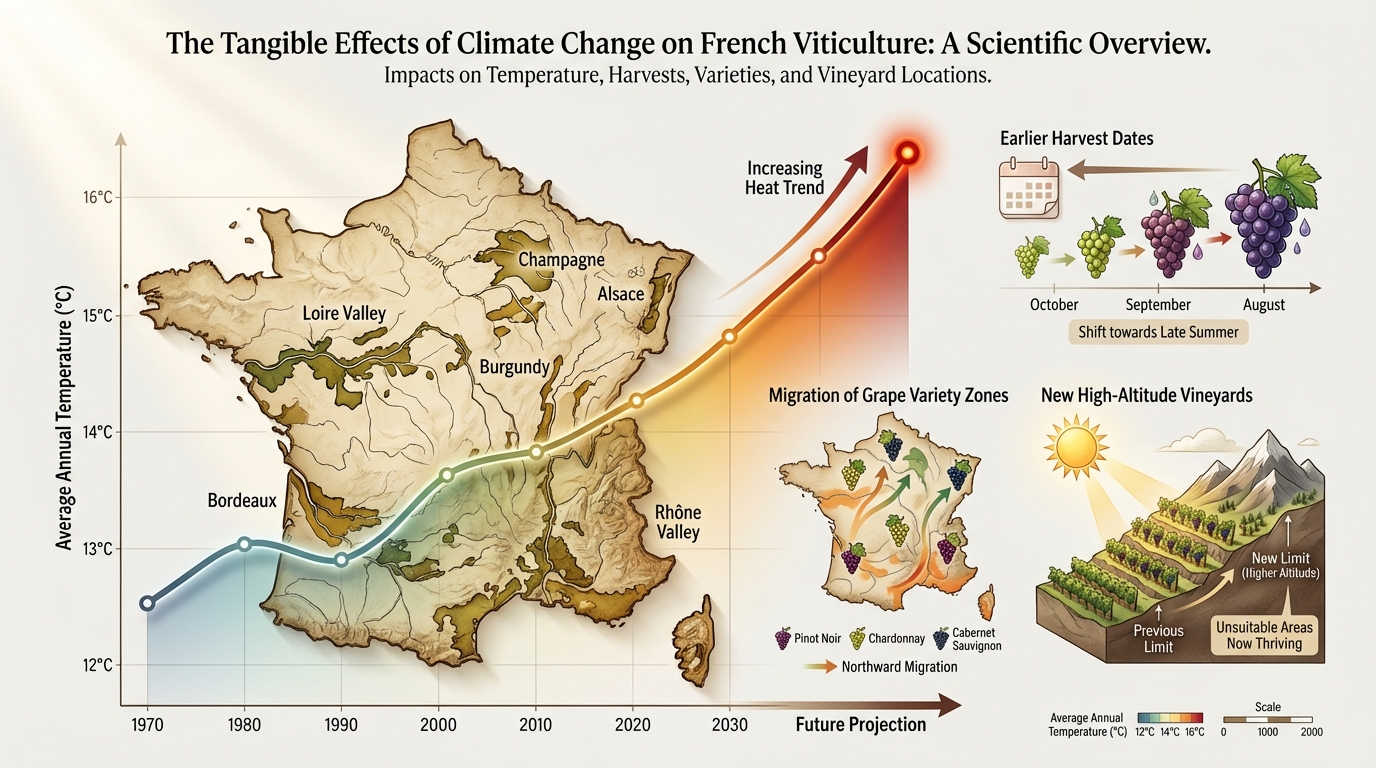
The transformation is not a projection — it is an observable, measurable reality that has been reshaping French viticulture for decades. Across every major French wine region, harvest dates have advanced by two to three weeks compared to the 1980s. In Burgundy, the average harvest date for Pinot Noir has shifted from mid-October in the 1970s to late September or even early September in recent vintages. Châteauneuf-du-Pape, once reliably picked in the first two weeks of October, now routinely begins harvest in the first week of September. The data is unambiguous: a comprehensive study published in Nature Climate Change analyzing 664 years of Burgundy harvest records found that harvests since 1988 have been significantly and consistently earlier than at any point in the historical record.
Temperature increases have been dramatic. France's average annual temperature has risen by approximately 1.7°C since 1900, with the rate of warming accelerating sharply since the 1980s. The viticultural consequences cascade through every aspect of grape growing. Higher temperatures during the growing season mean faster sugar accumulation, which translates directly into rising alcohol levels — average alcohol in Bordeaux reds has climbed from roughly 12% to 14% or higher over the past four decades. Simultaneously, acidity drops as malic acid is consumed more rapidly in warmer conditions, producing wines that can feel flabby and unbalanced without intervention.
The heat records tell their own story. The 2003 European heat wave killed an estimated 70,000 people and devastated vineyards across France, producing wines of extreme concentration but often lacking freshness and aging potential. The 2019 vintage saw temperatures exceed 46°C in parts of the Languedoc, literally cooking grapes on the vine — an event that would have been considered impossible a generation earlier. The 2022 vintage, the hottest year ever recorded in France at the time, combined extreme heat with severe drought that reduced national yields by an estimated 20% compared to the five-year average. Frost events, paradoxically, have also become more damaging: warmer early springs trigger premature budburst, leaving vines vulnerable to late frosts. The catastrophic April 2021 frost destroyed up to 30% of France's national crop, costing the industry an estimated two billion euros.
Drought is emerging as an equally critical challenge. Southern France has always been dry, but the combination of higher temperatures, reduced rainfall, and more intense evapotranspiration is pushing established varieties to their physiological limits. Water stress during veraison — the critical ripening period — produces smaller, thicker-skinned berries with higher tannin and sugar but lower juice volume. In extreme cases, vines simply shut down photosynthesis to survive, producing raisined, jammy fruit that no amount of winemaking skill can refine into elegant wine.
Region-by-Region Impact
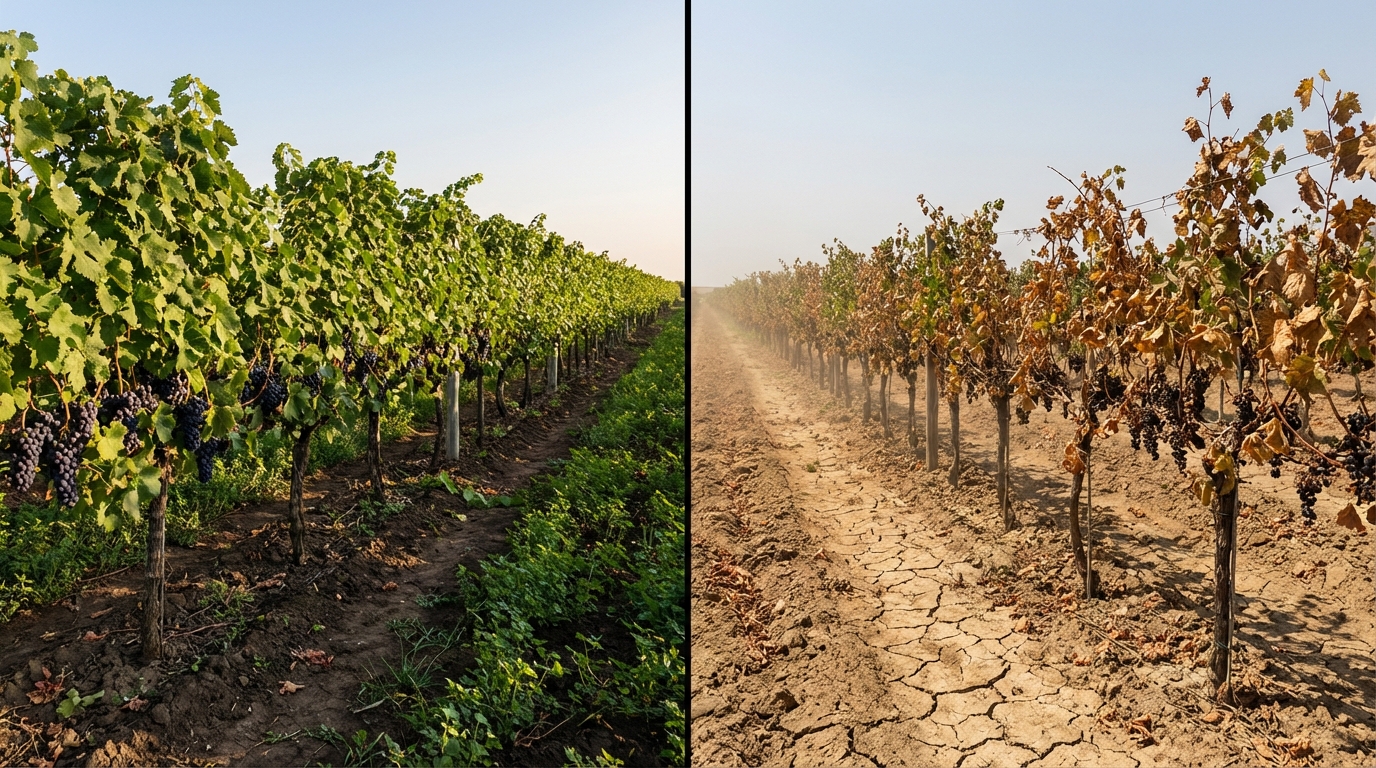
Bordeaux is experiencing a fundamental recalibration. The Right Bank — traditionally dominated by Merlot, an early-ripening variety that thrives in warm conditions — is now struggling with Merlot's tendency to over-ripen, losing acidity and gaining excessive alcohol. Conversely, the Left Bank's Cabernet Sauvignon, once considered borderline-ripe in cooler vintages, now achieves full phenolic maturity almost every year, producing deeply colored, structured wines with an ease that would have astonished earlier generations. In a landmark decision, the INAO authorized Bordeaux to plant seven new grape varieties in 2021 — including the Portuguese Touriga Nacional and the Iberian Marselan — specifically as climate-adaptation candidates. Meanwhile, some progressive estates are quietly reducing their Merlot plantings in favor of Cabernet Franc and Petit Verdot, varieties that maintain acidity better under heat.
Burgundy faces perhaps the most existential threat of any French region. Pinot Noir — the genetic foundation of the Côte d'Or — is a thin-skinned, early-ripening variety exquisitely sensitive to temperature. Harvest dates in Gevrey-Chambertin and Vosne-Romanée have advanced by nearly three weeks since 1988. Earlier harvests compress the growing season, reducing the slow, gradual accumulation of complexity that defines great Burgundy. Frost vulnerability has intensified: the warm March of 2021 triggered early budburst, and the subsequent April freeze destroyed an estimated 50% of the Côte de Beaune crop. Burgundy's response has been conservative — no new varieties have been authorized — but viticultural practices are evolving rapidly, with later pruning, higher vine training, and experimentation with organic and biodynamic methods to build soil resilience.
Champagne presents a more nuanced picture. Warmer temperatures have unequivocally improved base wine quality: grapes now achieve higher natural sugar levels, reducing the need for dosage (the sugar addition after secondary fermentation). Many prestige Champagne houses have lowered their dosage levels significantly over the past two decades, producing drier, more mineral-driven styles. The 2018, 2019, 2020, and 2022 vintages were all declared exceptional — a frequency of great vintages that would have been extraordinary in the late 20th century. However, Champagne's long-term concern is the erosion of its signature high acidity. If average temperatures continue to rise, Champagne may eventually struggle to produce wines with the nervous, racy freshness that defines the style.
The Southern Rhône and Languedoc are the front lines of climate stress. Grenache and Syrah — the dominant varieties of the southern Rhône — are drought-tolerant by historical standards, but even these hardy vines are reaching their limits in the hottest vintages. Average alcohol levels in Châteauneuf-du-Pape have crept to 15% or higher, creating regulatory tension with the appellation's maximum alcohol limit. Languedoc vineyards in the coastal plains, where temperatures routinely exceed 40°C during summer, face the stark possibility that viticulture may become economically unviable within decades without major adaptation.
The Loire Valley is one of climate change's relative beneficiaries — at least for now. Cabernet Franc, long considered a marginal variety in the Loire that struggled to ripen fully in cooler years, now achieves consistent phenolic maturity in appellations like Chinon, Bourgueil, and Saumur-Champigny. The green, herbal character that once dominated Loire reds has given way to riper, more fruit-driven profiles. Loire Chenin Blanc vineyards are producing wines of remarkable concentration, and sparkling Saumur and Crémant de Loire have benefited from improved base wine quality.
Alsace is witnessing a transformation of its aromatic identity. The traditionally cool-climate Rieslings and Gewurztraminers are developing riper, more tropical fruit profiles, with some producers noting that their wines increasingly resemble those of warmer regions. Late-harvest (Vendange Tardive) conditions that once occurred sporadically now arrive almost every year. The challenge for Alsace is preserving the taut, mineral precision that distinguishes its wines from those of warmer terroirs.
Adaptation Strategies in the Vineyard
French viticulture is responding to climate pressure with a suite of strategies that range from incremental adjustments to fundamental rethinking of how and where vines are grown.
Variety selection is the most consequential long-term lever. Beyond Bordeaux's seven new authorized varieties, research programs at the INRAE (France's national agricultural research institute) are evaluating dozens of heat- and drought-tolerant cultivars from southern Europe and the Mediterranean basin. Varieties like Assyrtiko (Greece), Agiorgitiko (Greece), and Nero d'Avola (Sicily) are being trialed in experimental plots across southern France. Within existing French varieties, Mourvèdre and Counoise — late-ripening varieties that maintain acidity in hot conditions — are gaining planting share at the expense of Grenache and Syrah in the southern Rhône.
Rootstock selection is evolving in parallel. Modern rootstock breeding programs prioritize drought tolerance and the ability to regulate vigor under water stress. Rootstocks like 110 Richter and 140 Ruggeri, which develop deep root systems capable of accessing subsoil moisture, are increasingly favored over more vigorous options that perform well only with adequate water.
Canopy management has become a critical climate-adaptation tool. In warmer regions, growers are maintaining larger leaf canopies to shade fruit clusters from direct sun exposure, reducing the risk of sunburn and slowing sugar accumulation. Some producers in the Languedoc and southern Rhône have shifted from traditional gobelet (bush vine) training — which exposes fruit to maximum sun — to trellised systems that allow better canopy control. Leaf removal on the south-facing side of the vine, once standard practice for promoting ripeness, is now avoided in many warm-climate vineyards to protect berries from heat stress.
Higher-altitude plantings represent a structural response to warming. In the Languedoc, vineyards are being established at 400–600 meters elevation in the foothills of the Massif Central and the Cévennes, where temperatures are 3–5°C cooler than on the coastal plains. The Terrasses du Larzac appellation, situated at elevation with significant diurnal temperature variation, has emerged as one of France's most exciting wine regions precisely because its altitude provides a natural buffer against warming.
Dry farming and cover cropping are gaining ground as water management strategies. Cover crops — planted between vine rows — compete with vines for surface moisture but improve soil structure, organic matter, and water-holding capacity over time. The short-term yield reduction is offset by long-term soil health benefits. Some biodynamic producers in the Rhône Valley report that their soils, enriched by decades of cover cropping and composting, retain moisture significantly better than conventionally farmed neighboring plots during drought years.
Winemaking Adaptations
In the cellar, winemakers are deploying an expanding toolkit to counteract the effects of warmer, drier vintages.
Earlier harvesting to preserve acidity is the simplest and most widespread response. Many producers now pick at lower sugar levels than they did a decade ago, accepting slightly lower potential alcohol in exchange for the bright, energizing acidity that warm-vintage wines often lack. The risk is picking before phenolic maturity — when tannins, color compounds, and flavor precursors have fully developed — which can produce wines with green, unripe tannins despite adequate sugar. Navigating this tension between sugar ripeness and phenolic ripeness has become the defining skill of modern French winemaking in warm regions.
Partial de-alcoholization — using techniques such as spinning cone column technology, reverse osmosis, or vacuum distillation to remove a fraction of the wine's alcohol — remains controversial but is increasingly accepted as a legitimate tool. French regulations now permit the reduction of alcohol by up to 2% by volume under controlled conditions. Several large Bordeaux and Languedoc producers routinely employ de-alcoholization in warm vintages, though few advertise the fact given lingering consumer prejudice against the practice.
Reduced oak regimes are spreading as winemakers recognize that heavy new oak, which adds sweetness, vanilla, and richness, amplifies the already generous fruit and alcohol of warm-vintage wines. The trend across France — from Burgundy to Bordeaux to the Rhône — is toward larger barrels (500-liter demi-muids or 600-liter formats), older barrels, and shorter aging periods. Concrete tanks and amphora (clay vessels), which offer gentle micro-oxygenation without adding flavor, have experienced a revival driven in part by climate adaptation: they produce fresher, more mineral-driven wines than new oak in warm vintages.
Cryo-extraction and cold settling techniques allow winemakers to manage must composition before fermentation, concentrating desirable compounds while controlling sugar levels. Acidification — the addition of tartaric acid to boost acidity — is now routine in warm southern French regions where it was once rare, though the best producers view it as a last resort rather than a standard practice.
New Opportunities
Climate change is not solely destructive. It is creating genuine new opportunities in regions and styles that were previously marginal or impossible.
English sparkling wine is the most dramatic example. The chalk soils of southern England are geologically identical to those of Champagne, and warming temperatures have made the region capable of ripening Chardonnay, Pinot Noir, and Pinot Meunier to levels adequate for high-quality sparkling wine. Major Champagne houses — including Taittinger (Domaine Evremond) and Pommery (Hattingley Valley partnership) — have invested in English vineyards, an implicit acknowledgment that the climate band suitable for Champagne-method sparkling wine is shifting northward. English plantings have increased from approximately 1,000 hectares in 2000 to over 4,000 hectares by 2024.
Within France, northern regions are producing red wines of a quality that was unthinkable three decades ago. Pinot Noir in Champagne — traditionally used only for sparkling wine — is now yielding still reds (marketed as Coteaux Champenois) of genuine interest. The Loire's Cabernet Franc reds have evolved from lean, green curiosities into serious, concentrated wines. Even Alsace is experimenting with still Pinot Noir of surprising depth and color.
Altitude and orientation are becoming the new frontiers of French terroir. North-facing slopes, once considered inferior because they received less sunlight, are now prized for their ability to moderate ripening speed. Vineyards at 500–700 meters in the Languedoc and Roussillon are producing wines with a freshness and precision that was previously the exclusive domain of more northern regions. The concept of "new terroirs" — sites that become viable for quality viticulture only because of warming — is reshaping how the French wine industry thinks about its geographic future.
Mediterranean varieties in northern zones offer exciting possibilities. Grenache, Mourvèdre, and Syrah — once confined to the southern third of France — are being trialed or planted in the central Loire, northern Languedoc, and even experimental plots in the southern outskirts of the Paris basin. If these trials succeed, they could fundamentally expand the diversity of French wine production.
The Regulatory Response
France's appellation system — managed by the INAO (Institut national de l'origine et de la qualité) — was designed to codify and protect traditional practices, not to facilitate rapid adaptation. The tension between regulatory conservatism and climate urgency is one of the central dramas of contemporary French wine.
Bordeaux's 2021 authorization of seven new grape varieties — Arinarnoa, Castets, Liliorila, and Marselan (red) and Alvarinho, Petit Manseng, and Liliorila (white) — was the most significant regulatory response to climate change in French wine history. These varieties are permitted as minor blending components (up to 5% of the blend initially, rising to 10%), not as standalone plantings, reflecting the cautious incrementalism of the appellation system. The trials will run for a decade before any permanent authorization decision.
The INAO has also launched broader variety experimentation programs (VIFA — Variétés d'Intérêt à Fin d'Adaptation) across multiple appellations. In the Rhône, trials of Agiorgitiko, Assyrtiko, and Xinomavro are underway. In Languedoc appellations, producers are testing Italian and Iberian varieties alongside French cultivars that were historically planted further south. These programs operate under strict conditions: experimental wines cannot carry the appellation name and are classified as Vin de France during the trial period.
The European Union has established a sustainability framework that increasingly links vineyard subsidies to climate adaptation measures. France's Haute Valeur Environnementale (HVE) certification — a three-tier environmental quality label — has become widespread, with over 30,000 farms certified by 2024. While HVE is broader than climate adaptation specifically, it incentivizes the water management, biodiversity, and soil health practices that build vineyard resilience. The EU's Common Agricultural Policy reform for 2023–2027 also includes provisions for restructuring vineyards toward more climate-adapted configurations.
What Consumers Should Know
For wine drinkers, climate change means navigating a landscape of shifting flavors, evolving regions, and new decision-making frameworks.
Flavor profiles are changing. The lean, austere, high-acid styles that defined many classic French wines are becoming rarer. Burgundy is riper and richer; Bordeaux is more consistently generous; Loire reds have lost their green edge. Whether this represents improvement or loss depends on your perspective — and on the specific wine and vintage. The stylistic range within any given appellation is widening as producers make different choices about when to pick, how to vinify, and whether to intervene to preserve traditional profiles.
Vintage consistency is increasing — paradoxically. While extreme weather events are more frequent, the overall warming trend means that truly difficult, underripe vintages have become rare in most French regions. Bordeaux has not produced a genuinely poor vintage since 2013. Burgundy's hit rate for excellent vintages has improved dramatically. For consumers, this means that vintage charts matter less than they used to — a 2021 Bordeaux may have been affected by frost, but the fruit that survived ripened beautifully.
Buying strategies should adapt accordingly. Consider exploring higher-altitude appellations like Terrasses du Larzac, Faugères, and the mountain wines of Savoie and Jura — these offer natural climate resilience and often exceptional value. Pay attention to producers who communicate their adaptation strategies — those mentioning organic farming, cover cropping, altitude, or north-facing exposures are likely to deliver more balanced wines in warm vintages. Look for wines from cooler vintages (like 2021 in many regions) when you want classic freshness and structure. And diversify beyond the most famous regions: the Loire, Alsace, and the Jura are producing some of France's most exciting wines precisely because their cooler climates still allow for the tension and acidity that define great wine.
Finally, consider the wines of the future with an open mind. The new varieties being planted in Bordeaux, the Greek and Italian cultivars being trialed in the Rhône, the English sparkling wines being made by Champagne houses — these are not threats to tradition. They are tradition adapting, as it always has, to the conditions of the moment. The greatest wines of 2050 may come from places, varieties, and styles that barely exist today. For curious wine lovers, that prospect is not alarming — it is thrilling.


