France: The World's Wine Reference
France is not merely a wine-producing country — it is the country against which all other wine-producing nations measure themselves. The vocabulary of wine, the classification systems, the grape varieties that dominate vineyards on every continent — nearly all trace their origins to French soil. Understanding French wine geography is therefore not an academic exercise but the essential foundation for understanding wine itself.
The numbers frame the scale. France is the world's second-largest wine producer (alternating with Italy for first place depending on the vintage), cultivating approximately 750,000 hectares of vines — an area roughly the size of the entire country of Cyprus. The national vineyard is organized into more than 360 Appellations d'Origine Contrôlée (AOCs), each defining a specific geographic area along with permitted grape varieties, viticultural practices, and winemaking methods. Annual production averages 45 to 50 million hectoliters, generating roughly €12 billion in export revenue and making wine France's second-largest agricultural export after cereals.
What makes France uniquely important to global wine taxonomy is the concept of terroir — the idea that specific combinations of soil, climate, altitude, and human tradition produce wines of irreplaceable character. Every major international grape variety — Cabernet Sauvignon, Merlot, Pinot Noir, Chardonnay, Sauvignon Blanc, Syrah — was either born in France or achieved its definitive expression there. The French classification system, particularly the AOC hierarchy, became the model for wine regulation in Italy (DOC/DOCG), Spain (DO/DOCa), Portugal (DOC), and across the European Union's Protected Designation of Origin framework.
France's 16 major wine regions span an extraordinary range of climates, soils, and elevations — from the chalky plains of Champagne in the north to the sun-baked schist of Corsica in the Mediterranean, from the Atlantic-influenced gravel banks of Bordeaux to the continental limestone slopes of Burgundy. This guide maps every one of them.
The Northern Regions
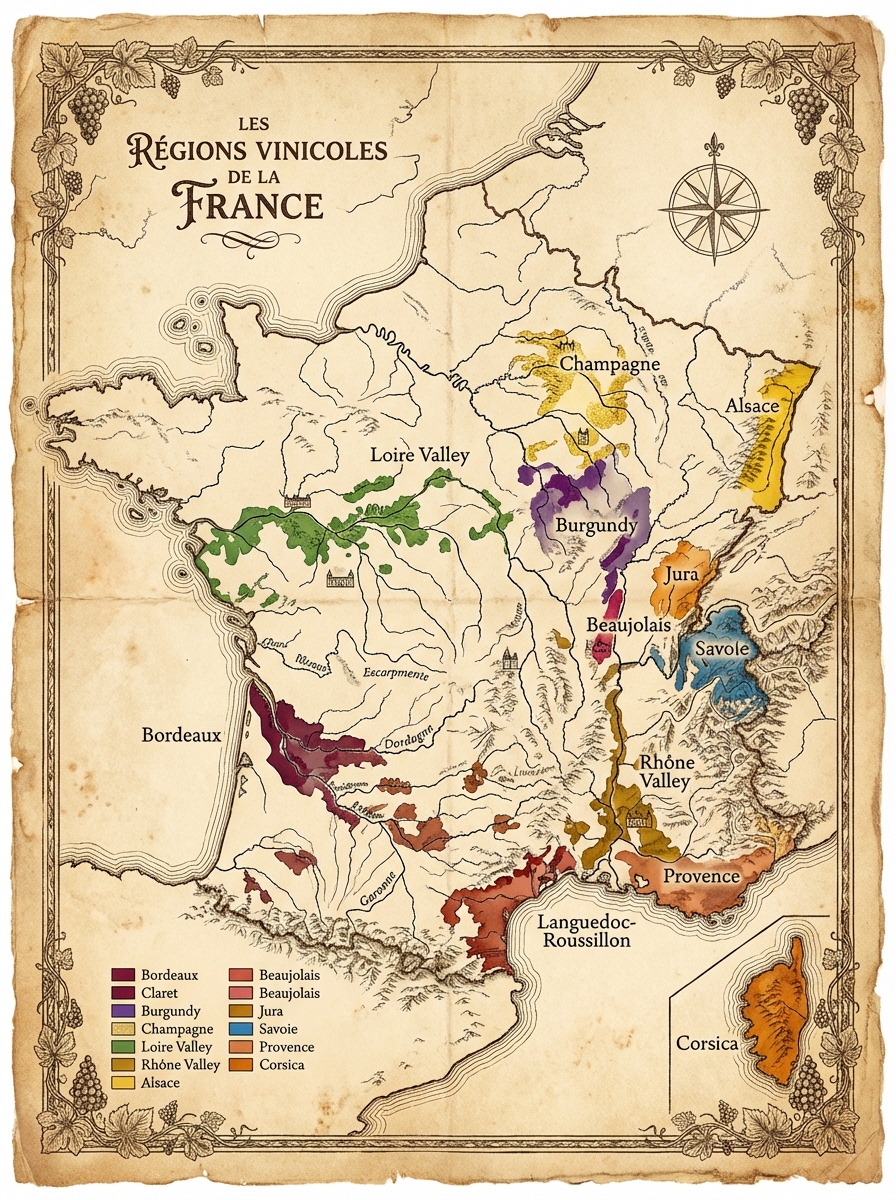
The northern tier of French viticulture produces some of the world's most celebrated and expensive wines, thriving in cool climates where grapes ripen slowly and develop intense aromatic complexity.
Champagne — the northernmost major wine region at roughly 49°N latitude — is defined by its chalky subsoil, cool continental climate, and the méthode traditionnelle that produces the world's most famous sparkling wine. Approximately 34,000 hectares are planted primarily to Pinot Noir, Chardonnay, and Pinot Meunier. The chalk acts as a thermal regulator, absorbing daytime heat and releasing it at night, while its porosity ensures excellent drainage. Annual production exceeds 300 million bottles, making Champagne both a luxury product and a vast industry.
Alsace sits in a narrow corridor between the Vosges Mountains and the Rhine, sheltered from Atlantic rainfall by the mountains and enjoying one of France's driest, sunniest climates despite its northerly position. The region's 15,600 hectares are planted predominantly to aromatic white varieties — Riesling, Gewurztraminer, Pinot Gris, and Muscat — across 51 Grand Cru vineyard sites. Alsace is unique in France for labeling wines by grape variety rather than appellation.
Burgundy is the spiritual home of Pinot Noir and Chardonnay, organized into a famously intricate hierarchy of regional, village, Premier Cru, and Grand Cru appellations across roughly 29,500 hectares. From Chablis in the north (Kimmeridgian limestone, razor-sharp Chardonnay) through the Côte d'Or (the golden slope of Gevrey-Chambertin, Vosne-Romanée, Meursault, Puligny-Montrachet) to the Mâconnais and Chalonnaise in the south, Burgundy remains the world's most granular expression of terroir-driven winemaking.
Beaujolais, though often grouped with Burgundy administratively, is a distinct region of 15,500 hectares devoted almost entirely to Gamay grown on granite soils. The 10 Crus of Beaujolais — Morgon, Fleurie, Moulin-à-Vent, Brouilly among them — produce serious, age-worthy reds that have undergone a dramatic quality renaissance.
Jura is a tiny (2,100 hectares) but fascinating region between Burgundy and Switzerland, famous for its oxidative Vin Jaune made from Savagnin, the unique Vin de Paille straw wine, and its indigenous red grape Trousseau. The Jura's limestone and marl soils and continental climate produce wines unlike anything else in France.
Savoie, nestled in the French Alps, covers approximately 2,200 hectares of steeply terraced vineyards producing crisp, mountain whites from Jacquère, Altesse (Roussette), and Bergeron (Roussanne), alongside light, aromatic reds from Mondeuse. These are quintessential alpine wines — fresh, mineral, and rarely seen outside the region.
The Loire Valley
The Loire Valley stretches over 1,000 kilometers from the volcanic Massif Central to the Atlantic Ocean, making it the longest wine river in France. With more than 70 appellations and roughly 70,000 hectares under vine, the Loire is France's third-largest wine region and its most stylistically diverse.
The valley divides into four sub-regions. The Pays Nantais at the Atlantic end produces Muscadet from Melon de Bourgogne — lean, saline whites ideal with oysters. Anjou-Saumur is the heartland of Chenin Blanc, producing everything from razor-dry Savennières to the luscious botrytized sweet wines of Quarts de Chaume and Bonnezeaux, plus France's best sparkling wine outside Champagne (Crémant de Loire). Touraine centers on the Cabernet Franc reds of Chinon and Bourgueil. The eastern Centre-Loire gives us Sancerre and Pouilly-Fumé, the global benchmarks for mineral-driven Sauvignon Blanc.
The Loire's enormous climatic range — oceanic in the west, continental in the east — means that a single vintage can produce wildly different results across the valley. This diversity is the Loire's greatest strength, offering wines for every palate and occasion at prices that remain remarkably accessible.
Bordeaux and the South-West
Bordeaux is France's largest fine-wine region and arguably the most famous wine name on Earth. Its 111,000 hectares of vineyards — divided by the Gironde estuary and Garonne and Dordogne rivers into the Left Bank, Right Bank, and Entre-Deux-Mers — produce predominantly red blends based on Cabernet Sauvignon (Left Bank) and Merlot (Right Bank), alongside dry and sweet whites.
The Left Bank encompasses the legendary communes of the Médoc — Margaux, Pauillac, Saint-Julien, Saint-Estèphe — where deep gravel soils and maritime influence produce structured, long-lived Cabernet Sauvignon-dominant wines. The Right Bank centers on Saint-Émilion and Pomerol, where clay and limestone soils favor Merlot-based wines of richness and generosity. Bordeaux's 1855 Classification, Cru Classé of Saint-Émilion, and the Cru Bourgeois system create a layered hierarchy that ranges from First Growth icons to everyday claret.
The South-West (Sud-Ouest) encompasses the diverse regions radiating outward from Bordeaux's shadow. Cahors produces dark, tannic reds from Malbec (locally called Côt) — this is the grape's ancestral home, long before Argentina made it famous. Madiran crafts powerful, age-worthy reds from Tannat, one of the most tannic grapes in the world. Jurançon in the Pyrenean foothills produces exquisite sweet and dry whites from Gros Manseng and Petit Manseng. Bergerac and Gaillac round out the region with approachable, Bordeaux-style blends at friendlier prices.
The Rhône Valley
The Rhône Valley is France's second-largest AOC region, stretching 200 kilometers from the granite slopes south of Lyon to the sun-drenched plains approaching the Mediterranean. It divides into two profoundly different halves.
The Northern Rhône is a narrow, steep-sided corridor where Syrah reigns supreme as the sole red grape. The great appellations — Côte-Rôtie (roasted slope), Hermitage, Cornas, and Saint-Joseph — produce some of France's most powerful, complex, and long-lived red wines from terraced vineyards of granite and schist. White wines from Viognier (Condrieu), Marsanne, and Roussanne add aromatic brilliance. The northern Rhône covers a mere 4,700 hectares but commands prices rivaling Burgundy.
The Southern Rhône is a broad, warm landscape of garrigue-covered hills and river terraces, producing primarily Grenache-based blends combined with Syrah, Mourvèdre, Cinsault, and others. Châteauneuf-du-Pape — permitting 13 grape varieties and covering 3,200 hectares of the famous galets roulés (large round stones) — is the flagship appellation. Gigondas, Vacqueyras, and Rasteau deliver comparable quality at more accessible prices, while the vast Côtes du Rhône and Côtes du Rhône-Villages appellations offer outstanding everyday value. The southern Rhône alone encompasses over 60,000 hectares.
Mediterranean France
The Mediterranean sweep of France's southern coast encompasses the country's most productive and fast-evolving wine regions.
Languedoc-Roussillon is France's largest wine region by volume, spanning roughly 230,000 hectares from the Spanish border to the outskirts of Nîmes. Once dismissed as a lake of cheap, anonymous bulk wine, the Languedoc has undergone a quality revolution rivaled only by the cooperative transformation of the southern Rhône. Appellations like Pic Saint-Loup, Terrasses du Larzac, Faugères, Minervois, Corbières, and Fitou now produce structured, terroir-driven reds from Grenache, Syrah, Mourvèdre, and old-vine Carignan at prices that make them the best value in French wine. Roussillon, in the shadow of the Pyrenees, adds powerful dry reds and the famous fortified sweet wines of Banyuls and Maury from Grenache Noir.
Provence covers approximately 27,000 hectares along the Mediterranean coast and into the hills of the Var and Bouches-du-Rhône departments. Provence is synonymous with rosé — the region produces roughly 40% of all French rosé, in a pale, dry, refreshing style that has conquered global markets. But serious reds from Bandol (based on Mourvèdre) and whites from Cassis and Palette demonstrate depth well beyond pink wine.
Corsica (Corse) brings island viticulture to the French wine map, with approximately 7,000 hectares of vineyards cultivating both international varieties and indigenous grapes like Nielluccio (related to Sangiovese), Sciaccarello, and Vermentino. The island's granite and schist soils, maritime climate, and altitude produce wines of distinctive character — aromatic, mineral, and often marked by the garrigue herbs of the maquis.
How to Navigate French Wine Labels
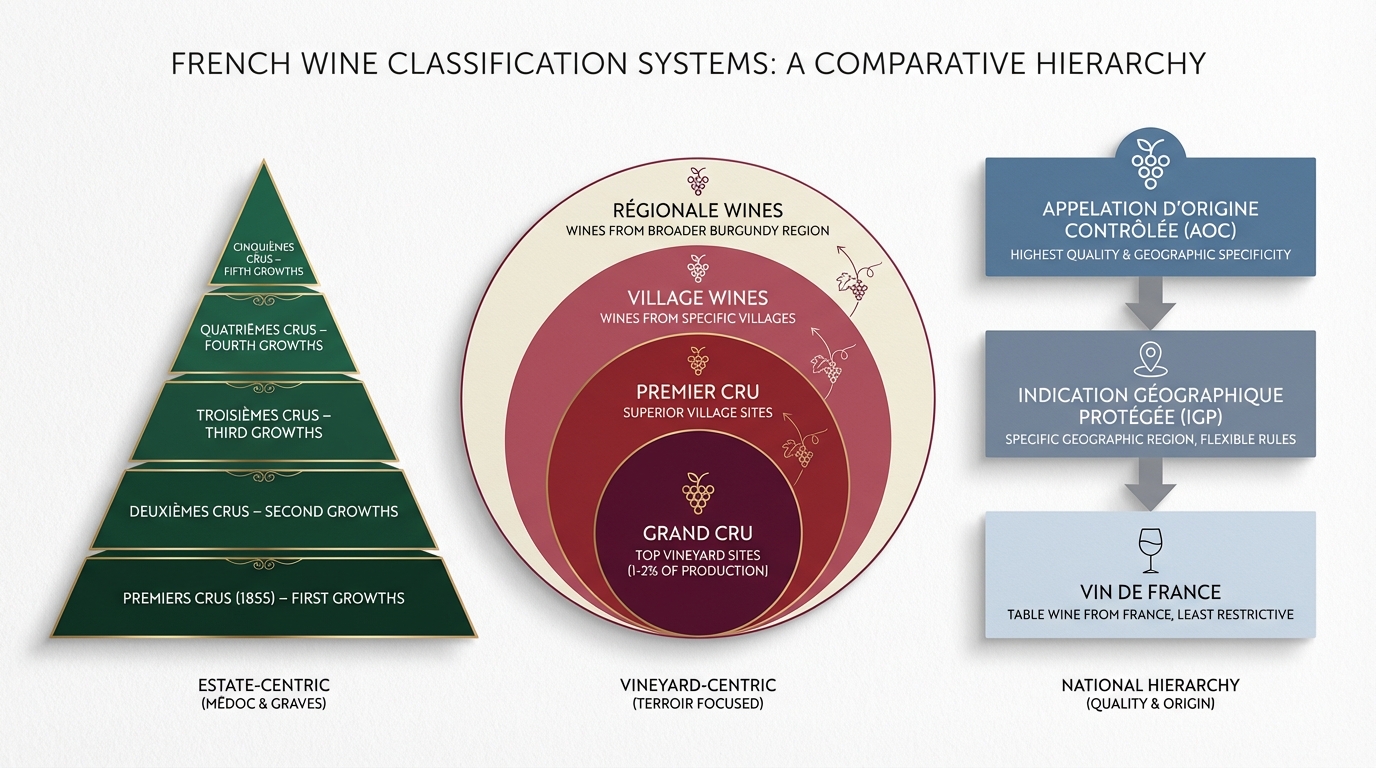
French wine labels can intimidate newcomers because they prioritize place over grape. Understanding the three-tier classification system unlocks the logic.
AOC/AOP (Appellation d'Origine Contrôlée/Protégée) is the highest tier, guaranteeing that the wine comes from a specific geographic area and was produced according to strict regulations governing grape varieties, yields, alcohol levels, and winemaking practices. Within AOC, a hierarchy exists: regional appellations (e.g., Bourgogne, Bordeaux) cover broad areas; sub-regional or communal appellations (e.g., Pauillac, Gevrey-Chambertin) narrow the origin; and Premier Cru and Grand Cru designate the finest individual vineyard sites, primarily in Burgundy, Alsace, and Champagne.
IGP (Indication Géographique Protégée), formerly Vin de Pays, is the middle tier. IGP wines must come from a specified region but face fewer restrictions on grape varieties and winemaking, allowing more innovation. Many excellent wines are classified as IGP — particularly in the Languedoc, where winemakers working with non-traditional varieties or blends choose IGP designation for creative freedom.
Vin de France is the entry-level designation, with no geographic restriction beyond the national boundary. Grapes can be sourced from anywhere in France. While Vin de France includes simple table wine, it also shelters some avant-garde natural wines and experimental cuvées from producers who deliberately reject the AOC system.
To read a French label effectively, start with the appellation name (the largest text, usually above the word "Appellation ... Contrôlée"). Then look for a producer or château name, a vintage year, and any quality tier (Grand Cru, Premier Cru, Cru Bourgeois, Cru Classé). In Alsace, the grape variety will also appear prominently. Back labels often reveal the bottler's identity, alcohol level, and whether the wine is estate-bottled (mis en bouteille au domaine/château) or blended by a négociant.
French Wine by the Numbers
France's viticultural landscape is staggering in its breadth. The table below summarizes all 16 major wine regions, their key grapes, signature wines, and approximate production volumes.
| Region | Key Grape | Signature Wine | Production (million hl/yr) |
|---|---|---|---|
| Champagne | Pinot Noir, Chardonnay | Champagne Brut | 2.5 |
| Alsace | Riesling | Alsace Grand Cru Riesling | 1.1 |
| Burgundy | Pinot Noir, Chardonnay | Gevrey-Chambertin, Meursault | 1.5 |
| Beaujolais | Gamay | Morgon, Fleurie | 0.8 |
| Jura | Savagnin | Vin Jaune | 0.1 |
| Savoie | Jacquère | Apremont | 0.1 |
| Loire Valley | Chenin Blanc, Sauvignon Blanc | Sancerre, Vouvray | 4.0 |
| Bordeaux | Cabernet Sauvignon, Merlot | Pauillac, Saint-Émilion | 5.5 |
| South-West | Malbec, Tannat | Cahors, Madiran | 1.8 |
| Northern Rhône | Syrah | Hermitage, Côte-Rôtie | 0.3 |
| Southern Rhône | Grenache | Châteauneuf-du-Pape | 3.2 |
| Languedoc | Grenache, Syrah, Carignan | Pic Saint-Loup, Minervois | 12.0 |
| Roussillon | Grenache Noir | Banyuls, Côtes du Roussillon | 2.0 |
| Provence | Grenache, Cinsault | Côtes de Provence Rosé | 1.4 |
| Corsica | Nielluccio, Vermentino | Patrimonio | 0.3 |
| Cognac & others | Ugni Blanc | Cognac (spirit) | 8.0 |
Among planted grape varieties, Merlot leads France with roughly 115,000 hectares, followed by Grenache (~90,000 ha), Ugni Blanc (~80,000 ha, primarily for Cognac distillation), Syrah (~65,000 ha), and Cabernet Sauvignon (~50,000 ha). For whites, Chardonnay (~50,000 ha) and Sauvignon Blanc (~30,000 ha) dominate.
France's top export destinations by value are the United States, the United Kingdom, Germany, Belgium, Japan, and China, with the EU as a whole absorbing roughly half of total exports. The export portfolio skews heavily toward premium and fine wine, with Champagne, Bordeaux, and Burgundy together accounting for the lion's share of export revenue despite representing a minority of total volume.
The breadth and depth of French wine — from a €5 Côtes du Rhône to a €5,000 Romanée-Conti, from Champagne's chalky cellars to Corsica's sun-baked granite slopes — is unmatched by any other country. Each of the 16 regions offers a distinct lens through which to understand how geography, climate, grape variety, and centuries of accumulated human knowledge combine to produce the world's most diverse and influential wine culture.


