Overview of French Wine Law
France did not invent wine, but it invented the legal framework that the rest of the winemaking world eventually borrowed. The idea that a wine's identity is inseparable from the place where it is grown — and that this relationship deserves legal protection — is a distinctly French contribution to global food culture. Every classification system discussed in this guide flows from that single conviction: terroir matters more than the winemaker.
The modern regulatory system traces its roots to the 1930s, when widespread fraud after the phylloxera crisis forced the government to act. Baron Pierre Le Roy de Boiseaumarié, a Châteauneuf-du-Pape producer, lobbied for legally defined wine regions with enforceable production rules. His efforts led to the creation of the Institut National de l'Origine et de la Qualité (INAO) in 1935, the body that still oversees all French wine appellations today.
What makes French classification uniquely complex is that it is not one system but several overlapping systems. The national AOC/AOP hierarchy governs all French wine. But within that framework, individual regions have developed their own internal rankings — the 1855 Classification in Bordeaux, the Premier Cru and Grand Cru vineyard hierarchy in Burgundy, the periodically revised Saint-Émilion classification, and the Grand Cru vineyard designations in Alsace. Each system uses different criteria, different terminology, and different revision procedures. Understanding them requires examining each on its own terms.
The AOC/AOP System
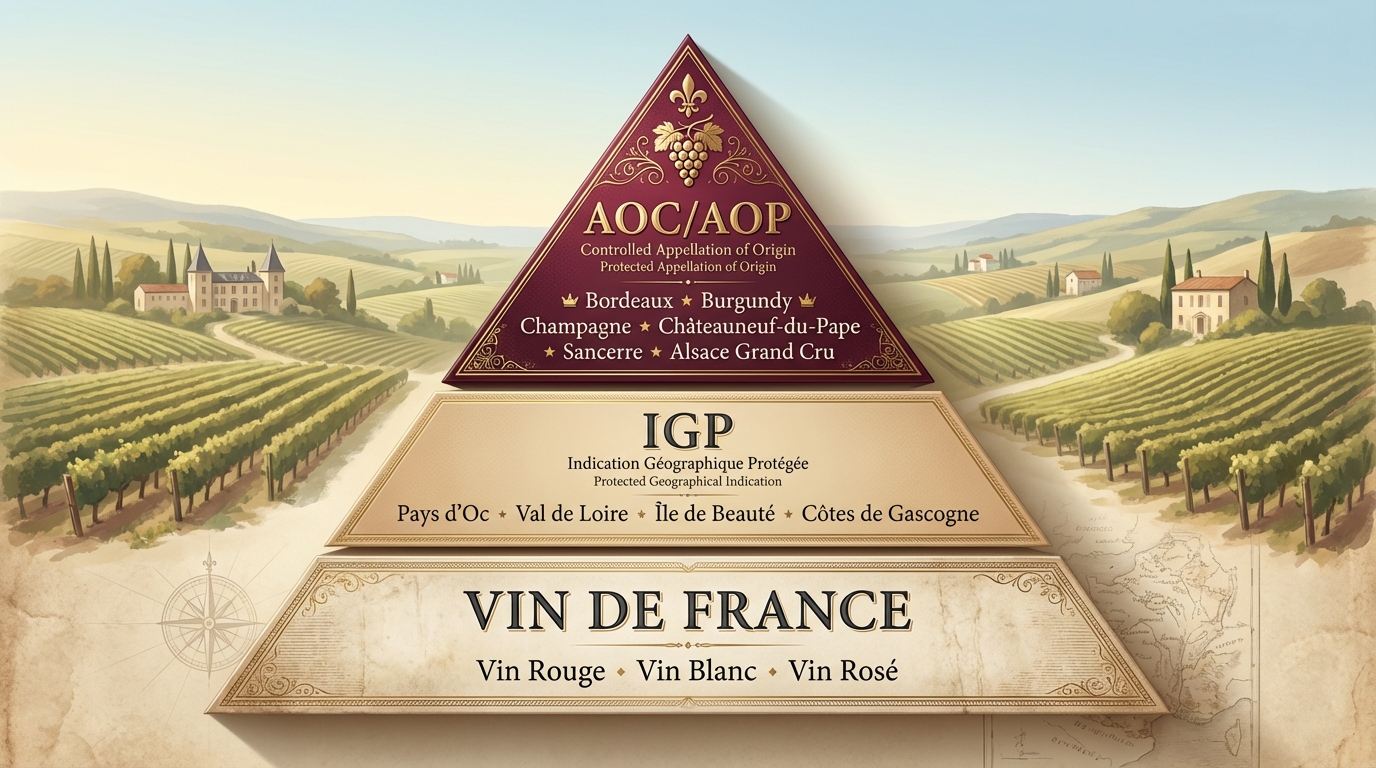
At the broadest level, every bottle of French wine falls into one of three quality tiers. This pyramid is the foundation on which all regional classifications are built.
Vin de France sits at the base. Formerly called Vin de Table, this category permits grapes from anywhere in France, blended freely across regions and vintages. Labels may state the grape variety and vintage but cannot name a specific region. This tier accounts for roughly 30% of French wine production and includes both bulk wine and a growing number of non-conformist bottles from producers who reject appellation rules.
IGP (Indication Géographique Protégée) occupies the middle tier, replacing the older Vin de Pays designation. IGP wines must come from a defined geographic area and meet basic production standards, but the rules are far more flexible than AOC requirements. There are 74 IGP zones in France. The best-known is IGP Pays d'Oc in the Languedoc. IGP wines may list grape varieties on the label — something historically restricted under AOC rules.
AOC (Appellation d'Origine Contrôlée) — now officially AOP (Appellation d'Origine Protégée) under EU harmonization — is the top tier. France currently recognizes 363 AOC appellations for wine, each governed by a cahier des charges (specification document) that defines permitted grape varieties, maximum yields, minimum alcohol levels, viticultural practices, aging requirements, and geographic boundaries down to the parcel level. Wines must pass a tasting panel before receiving AOC status.
Within AOC, smaller appellations generally indicate higher prestige. A wine labeled Bourgogne (regional AOC) follows broader rules than one labeled Gevrey-Chambertin (village AOC), which in turn is less specific than Gevrey-Chambertin Premier Cru Clos Saint-Jacques (single-vineyard AOC). The system rewards specificity: the narrower the origin claim, the stricter the rules and — in theory — the higher the quality.
The 1855 Bordeaux Classification
No wine ranking in history has proven as durable — or as controversial — as the Classification of 1855. Commissioned by Emperor Napoleon III for the Universal Exhibition in Paris, Bordeaux wine brokers ranked the region's top estates based on decades of market prices and trading records. The result was a five-tier hierarchy of 61 châteaux from the Médoc (plus one from Graves) and a separate ranking for sweet wines from Sauternes and Barsac.
The five tiers of the Médoc classification are:
| Tier | French Title | Number of Châteaux |
|---|---|---|
| First Growth | Premier Grand Cru Classé | 5 |
| Second Growth | Deuxième Grand Cru Classé | 14 |
| Third Growth | Troisième Grand Cru Classé | 14 |
| Fourth Growth | Quatrième Grand Cru Classé | 10 |
| Fifth Growth | Cinquième Grand Cru Classé | 18 |
The five First Growths — Château Lafite Rothschild, Château Latour, Château Margaux, Château Haut-Brion, and Château Mouton Rothschild — remain the most prestigious (and expensive) names in Bordeaux. The inclusion of Haut-Brion from Graves was an exception; the estate's reputation was simply too great to ignore despite its location outside the Médoc.
The classification has been amended exactly once in over 170 years. In 1973, Baron Philippe de Rothschild's relentless lobbying succeeded in elevating Château Mouton Rothschild from Second Growth to First Growth — the only promotion in the system's history. His famous motto changed from "First I cannot be, second I do not deign to be" to "First I am, second I was, Mouton does not change."
The Sauternes classification followed a similar tiered system, with Château d'Yquem standing alone as the sole Premier Cru Supérieur — a rank above all other classified sweet wine estates. Below it, 11 Premiers Crus and 15 Deuxièmes Crus completed the hierarchy.
Critics note that the 1855 ranking reflects mid-nineteenth-century market conditions. Some Fifth Growths now rival Second or even First Growths — Château Lynch-Bages and Château Pontet-Canet are frequently cited examples. Yet the classification endures because no stakeholder has incentive to reopen it: promotion for one château means demotion for another, and the financial consequences are enormous.
Burgundy Classification: The Reign of Terroir
Burgundy's classification system is the purest expression of the French terroir philosophy. Where Bordeaux ranks estates (châteaux), Burgundy ranks vineyards (climats). The land itself carries the classification, regardless of who owns or farms it. A parcel of Chambertin Grand Cru retains its status whether owned by a famous domaine or a cooperative — the dirt is what matters.
The four-tier hierarchy, from broadest to most specific:
Regional appellations (Bourgogne, Bourgogne Aligoté, Mâcon) cover wide areas and permit the broadest range of vineyard sources. These wines offer the least site-specificity but the most accessible price points.
Village appellations (Gevrey-Chambertin, Meursault, Pommard, Volnay) restrict production to vineyards within a single commune. There are 44 village appellations in Burgundy. Village-level wines represent the backbone of the region — expressive enough to show local character but affordable enough for regular enjoyment.
Premier Cru vineyards are individually named sites within a village that have demonstrated, over centuries of observation, a capacity for producing wines of recognizably superior character. There are approximately 640 Premier Cru vineyards (also called climats) across Burgundy, accounting for about 10% of total production. The vineyard name appears on the label alongside the village: Meursault Premier Cru Les Perrières, Nuits-Saint-Georges Premier Cru Les Vaucrains.
Grand Cru vineyards are the summit. Only 33 Grand Crus exist in Burgundy — 32 in the Côte d'Or and one in Chablis (which is itself subdivided into seven named climats). Grand Cru wines carry only the vineyard name on the label, without the village: a bottle says simply Musigny or Montrachet, never "Chambolle-Musigny Grand Cru Musigny." Grand Crus represent barely 1.5% of Burgundy's total production, which explains both their scarcity and their extraordinary prices.
The concept of the climat — a precisely delimited vineyard parcel defined by its unique combination of soil, slope, drainage, microclimate, and aspect — was recognized by UNESCO as a World Heritage Site in 2015. The climats of Burgundy represent the oldest and most detailed mapping of terroir anywhere in the world, with records stretching back to Cistercian monks in the twelfth century.
The Saint-Émilion Classification
Unlike the frozen-in-time 1855 Bordeaux Classification, the Saint-Émilion Classification was designed from its inception in 1955 to be revised approximately every ten years. This built-in mechanism for reassessment makes it the most dynamic — and most litigated — classification in France.
The system divides classified estates into two tiers: Premier Grand Cru Classé (subdivided into A and B ranks) and Grand Cru Classé. Below these, hundreds of estates may use the basic Saint-Émilion Grand Cru appellation, which is an AOC designation rather than a classification rank and should not be confused with the classified tiers above.
The most recent revision, published in 2022, elevated two estates — Château Figeac joining Château Pavie and Château Angélus — to the supreme Premier Grand Cru Classé A rank alongside the two historic holders, Château Ausone and Château Cheval Blanc. However, the 2022 revision was immediately engulfed in controversy: Ausone and Cheval Blanc had already withdrawn from the classification process before results were announced, objecting to new requirements including mandatory participation in group tastings and wine tourism obligations they considered beneath their stature. Several other prestigious estates followed suit, raising existential questions about whether a classification system retains meaning when its most famous members refuse to participate.
The revision process evaluates estates on multiple criteria: blind tasting results over a ten-year window, reputation and market pricing, terroir quality, and vineyard management practices. This broader assessment distinguishes it from the 1855 system, which relied solely on market price.
The Alsace Grand Cru System
Alsace stands apart from other French regions in two important ways: it labels wines by grape variety rather than by place name alone, and its Grand Cru system is tied to specific lieux-dits (named vineyard sites) rather than to estates or villages.
The Alsace Grand Cru appellation, established progressively between 1975 and 2007, now encompasses 51 individually delimited vineyard sites spread across the length of the Alsatian wine route. Each Grand Cru has its own defined boundaries, permitted grape varieties (traditionally restricted to the four "noble" varieties: Riesling, Gewurztraminer, Pinot Gris, and Muscat), maximum yields, and minimum ripeness levels.
The size and character of Alsace Grand Crus vary enormously. Schlossberg, the first to be recognized (in 1975), covers 80 hectares of granite soils, while some of the smallest Grand Crus span barely 3 hectares. Soil types range from granite to limestone to volcanic sandstone.
Some producers argue that 51 Grand Crus is too many — that certain sites were included for political rather than qualitative reasons. Others contend that the restriction to four noble varieties excludes excellent Pinot Noir and Sylvaner plantings on Grand Cru sites. Recent amendments have begun to allow exceptions: Zotzenberg Grand Cru permits Sylvaner, and several Grand Crus now allow Pinot Noir following the variety's quality improvements in Alsace over the past two decades.
Other French Classifications Worth Knowing
Several additional classification systems operate alongside the major frameworks described above.
Cru Bourgeois du Médoc classifies estates below the 1855 Classification. After legal battles and a complete annulment in 2007, the system was relaunched in 2020 with three tiers: Cru Bourgeois, Cru Bourgeois Supérieur, and Cru Bourgeois Exceptionnel. Unlike the 1855 classification, it is reassessed every five years, covering approximately 250 estates.
Cru Artisan is a smaller classification for family-run Médoc estates, typically with fewer than 5 hectares under vine.
Champagne's échelle des crus is a historical system that rated villages on a percentage scale from 80% to 100%. Villages scoring 100% earned Grand Cru status (17 villages), while those between 90% and 99% were designated Premier Cru (42 villages). Although the échelle was officially abolished as a pricing mechanism in 2010, the Grand Cru and Premier Cru village designations remain in active use on labels. Champagne's system is notable for classifying villages rather than individual vineyards — a significant simplification compared to Burgundy.
The Graves Classification of 1959 ranked 16 estates in the Graves region (now largely within Pessac-Léognan) without internal tiers — all hold the same rank of Cru Classé de Graves, covering both red and white wines.
How to Use Classifications When Buying Wine
Understanding French classifications is valuable, but applying them wisely requires nuance. Classifications indicate historical reputation and regulatory rigor, not a guaranteed quality experience in every vintage or at every price point.
A well-made Bourgogne Rouge from a talented grower in a great vintage can deliver more pleasure than a mediocre Grand Cru from a careless producer in a difficult year. Many unclassified Bordeaux estates — particularly in Lalande-de-Pomerol, Fronsac, and Côtes de Bourg — outperform classified growths at a fraction of the price.
Use classifications as a starting point, not a verdict. In Burgundy, knowing that a wine is Premier Cru tells you the vineyard has recognized potential — but the producer's skill and the vintage conditions determine whether that potential is realized. In Bordeaux, the 1855 ranking tells you the estate carried prestige 170 years ago — the current winemaking team determines whether it deserves that prestige today.
The most practical approach is to learn the classification hierarchy for context, then focus on producers, vintages, and trusted recommendations for purchasing decisions. A classification is a map, not a guarantee — and the most rewarding wines are often found in the spaces between the lines.


