History: Born from Crisis and Solidarity
The story of French wine cooperatives begins in devastation. In the final decades of the 19th century, the phylloxera epidemic obliterated roughly two-thirds of France's vineyards, destroying the livelihoods of hundreds of thousands of smallholder growers who had no means to replant on their own. When the vines were eventually replaced — grafted onto resistant American rootstocks — the recovery brought a new problem: massive overproduction and plummeting prices in the early 1900s. Southern France was hardest hit. In 1907, the Languedoc revolts saw hundreds of thousands of desperate vignerons marching through Montpellier and Narbonne, demanding government intervention as wine prices collapsed below the cost of production.
Out of this crisis came the cooperative movement. The first French wine cooperative, the Cave Coopérative de Maraussan, was founded in 1901 in the Hérault department, inspired by agricultural cooperative models already operating in Germany and Denmark. The principle was simple but revolutionary: individual growers — many farming plots of just two or three hectares — would pool their harvests into a shared winery, splitting the costs of pressing, fermentation, storage, and marketing. No single family could afford modern equipment alone, but together they could invest in concrete vats, trained winemakers, and bottling lines.
The movement spread rapidly through the Midi, the Rhône Valley, and Provence during the 1920s and 1930s, often supported by local mutual-aid societies rooted in the same republican values of liberté, égalité, fraternité that animated French rural politics. By the end of World War II, cooperatives were embedded in nearly every French wine region. The postwar decades saw further expansion driven by government incentives to modernize agriculture and increase production. By the 1970s, cooperatives accounted for roughly half of all French wine production — an extraordinary share that reflected both their economic efficiency and their social importance in maintaining the rural fabric of wine country.
How Cooperatives Work
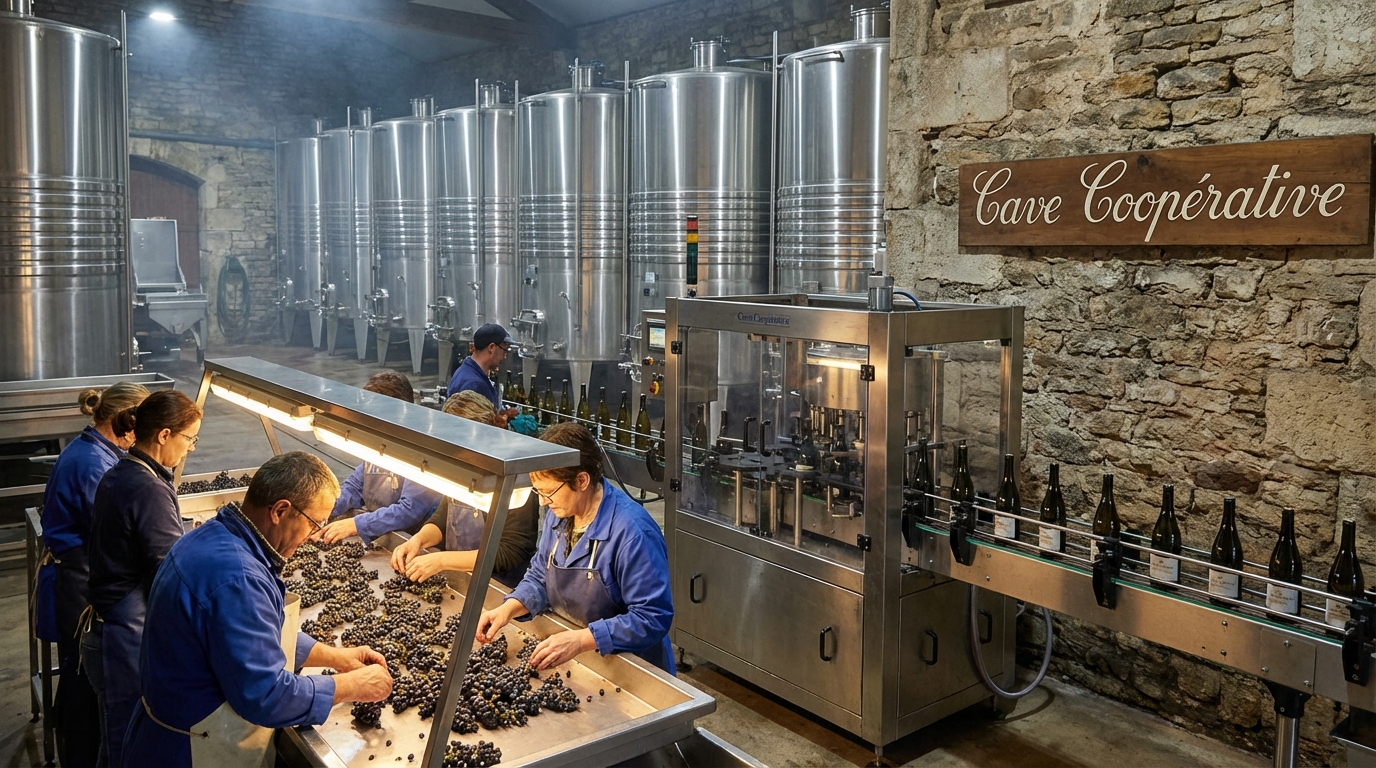
A French wine cooperative — cave coopérative — is a legally structured entity owned collectively by its member-growers. Each member farms their own vineyards independently but delivers their harvested grapes (or, in some cases, juice) to the cooperative's shared winemaking facility at vintage time. The cooperative employs professional winemakers and cellar staff who vinify, age, blend, bottle, and market the wines on behalf of all members.
Governance follows a democratic model: one member, one vote, regardless of the size of each member's vineyard holdings. A board of directors — elected from among the growers — sets strategic direction, approves budgets, and hires management. Major decisions such as investment in new equipment, changes to quality charters, or the introduction of new cuvées require votes at the annual general assembly.
Payment to members is typically calculated per kilogram of grapes delivered, with quality bonuses or penalties based on measurable criteria: sugar levels (potential alcohol), acidity, health of the fruit, and — increasingly — adherence to specific viticultural practices such as yield limits, organic farming, or manual harvesting. This payment structure is critical because it determines whether growers are incentivized to maximize quantity or quality. The most progressive cooperatives have restructured their payment grids to reward low yields, old vines, and parcel-specific harvesting — effectively paying two to three times more per kilo for premium fruit than for standard production.
Modern cooperatives range enormously in scale. Some, like Vignerons de Buzet in the Southwest, operate with around 200 members farming approximately 1,900 hectares. Others, like the giant Val d'Orbieu group in the Languedoc, aggregate production from thousands of growers across multiple appellations. At the other end of the spectrum, small cooperatives in Alsace or Savoie may have fewer than 50 members and produce just a few hundred thousand bottles annually.
The Quality Revolution
For much of the 20th century, French cooperatives earned a reputation — often deserved — as producers of cheap, anonymous bulk wine. The postwar emphasis on volume over quality, combined with a payment system that rewarded high yields, meant that cooperative wines were synonymous with the anonymous vin de table that filled French supermarket shelves and fuelled the export market's bottommost tiers. By the 1980s, this model was in crisis: consumption of basic table wine was declining steeply in France, European subsidies were distorting the market, and the New World was capturing export share with branded varietal wines that offered more flavor at similar prices.
The response, beginning in the late 1980s and accelerating through the 1990s and 2000s, was a wholesale transformation that ranks among the most significant quality revolutions in modern wine history. Leading cooperatives undertook radical restructuring: slashing yields, ripping out high-production grape varieties in favor of quality-oriented plantings, investing in temperature-controlled stainless steel fermentation, purchasing new oak barrels for aging premium cuvées, and — crucially — restructuring payment grids to penalize overproduction and reward excellence.
The appointment of university-trained oenologues as technical directors transformed winemaking practices. Cooperatives began implementing parcel-by-parcel vinification — keeping fruit from distinct terroirs separate through fermentation and aging rather than blending everything into homogeneous cuvées. Tasting committees were established to evaluate and classify wines internally. The most ambitious cooperatives created prestige ranges — single-vineyard or old-vine selections that could compete head-to-head with estate-bottled wines from private domaines.
The results have been dramatic. Today, cooperative wines regularly receive 90+ point scores from major critics, win gold medals at international competitions, and appear on the lists of serious wine merchants. The price-to-quality ratio of top cooperative wines is arguably the best in France.
Regional Stars: Where Cooperatives Shine
Languedoc-Roussillon remains the heartland of the cooperative movement. Cooperatives here produce roughly 70% of the region's total output. Standout operations include Les Vignerons du Mont Tauch in Fitou, Castelbarry (Cave de Montpeyroux) producing structured Terrasses du Larzac, and Foncalieu, one of the largest cooperative groups in France, managing wines across multiple Languedoc appellations. The Languedoc's cooperative revolution has been particularly transformative: vineyards that once produced anonymous bulk rosé now yield complex, terroir-driven reds from Grenache, Syrah, Mourvèdre, and Carignan that rival wines costing three or four times the price from more famous regions.
In the Rhône Valley, cooperatives play a dominant role in both the northern and southern sectors. The southern Rhône is especially cooperative-rich: the villages of Cairanne, Rasteau, Vacqueyras, and Beaumes-de-Venise all have cooperatives producing excellent wines at remarkable value. In the northern Rhône, Cave de Tain stands as proof that cooperatives can produce world-class wine — their Hermitage and Crozes-Hermitage bottlings are benchmarks for the appellations.
Alsace cooperatives, though fewer in number, include some of the region's most reliable producers. Cave de Ribeauvillé (founded in 1895, one of the oldest cooperatives in France), Cave de Turckheim, and Wolfberger (Cave Vinicole d'Eguisheim) produce consistently excellent Riesling, Gewurztraminer, and Crémant d'Alsace across a range of quality tiers, including Grand Cru bottlings.
In Bordeaux, cooperatives account for roughly 25% of production, particularly on the Right Bank and in satellite appellations like Castillon Côtes de Bordeaux, Blaye, and Entre-Deux-Mers. While Bordeaux cooperatives have historically been overshadowed by the prestige of classified châteaux, several — notably Tutiac and Producta Vignobles — are producing well-made, everyday Bordeaux at prices that make château-bottled equivalents look expensive.
Top Cooperatives to Know
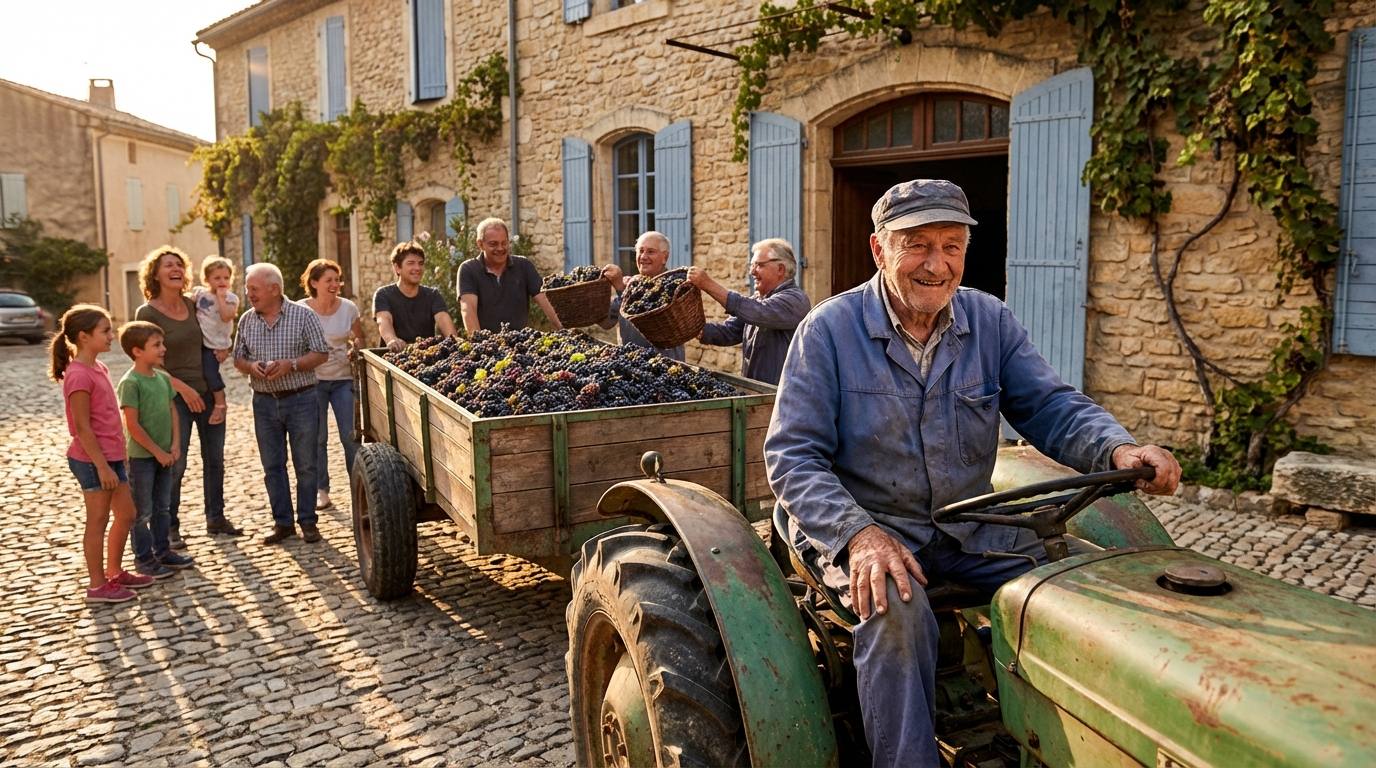
Cave de Tain (Tain-l'Hermitage, Northern Rhône) — Founded in 1933, this is arguably France's most prestigious cooperative. Its 187 members farm approximately 1,000 hectares spanning Hermitage, Crozes-Hermitage, Saint-Joseph, and Cornas. The top cuvées — particularly the Hermitage Gambert de Loche and the Crozes-Hermitage Les Hauts du Fief — are serious, age-worthy wines. Cave de Tain is also the single largest vineyard holder on the legendary Hermitage hill, owning or managing roughly 22 hectares of that precious 136-hectare appellation.
Plaimont Producteurs (Gers, Southwest France) — A union of three cooperatives in Gascony with over 800 grower-members farming 5,300 hectares, Plaimont is the guardian of rare indigenous grape varieties like Manseng Noir, Arrufiac, and Petit Courbu. Their top range, Château d'Aydie (Madiran), produces powerful, tannic reds from old-vine Tannat that age magnificently. The white Saint-Mont wines from Plaimont, blending Gros Manseng and Arrufiac, offer extraordinary aromatic complexity at under fifteen euros.
Cave de Ribeauvillé (Alsace) — Founded in 1895, this is the oldest cooperative in Alsace and one of the oldest in France. With roughly 200 members working 260 hectares including parcels in Grand Cru vineyards Altenberg de Bergheim, Gloeckelberg, Kirchberg de Ribeauvillé, and Osterberg, the cave produces structured, mineral-driven Rieslings and Gewurztraminers that compete with those from top private estates.
Les Vignerons de Buzet (Southwest France) — A pioneer in environmental sustainability, Buzet's cooperative achieved 100% organic or HVE3 certification across its entire membership — a remarkable feat for a cooperative of this scale. Their wines, predominantly Bordeaux-style blends of Merlot, Cabernet Sauvignon, and Cabernet Franc, offer outstanding value.
Vignerons de Caractère (Vacqueyras, Southern Rhône) — This cooperative produces a wide range of southern Rhône wines from Vacqueyras, Gigondas, Beaumes-de-Venise, and Côtes du Rhône-Villages. Their single-parcel Vacqueyras and Gigondas cuvées regularly earn high scores from critics and represent some of the finest value in the entire Rhône Valley.
Cooperative vs Domaine vs Négociant
Understanding the three pillars of French wine production helps navigate the market effectively.
A domaine (or château in Bordeaux) is an estate that grows its own grapes and makes its own wine from start to finish. The winemaker controls everything — viticulture, vinification, aging, and bottling. Domaine wines can achieve the highest expressions of individual terroir and winemaking vision, but they also carry higher overhead costs, which are reflected in the price. Quality varies enormously: a domaine label guarantees estate provenance, not excellence.
A négociant purchases grapes, juice, or finished wine from multiple growers, then blends, ages, and markets it under their own brand. Major Burgundy négociants like Louis Jadot or Joseph Drouhin operate this way, as do large Bordeaux houses. The négociant model allows access to fruit from multiple appellations and terroirs, enabling a wide portfolio. Quality depends entirely on the négociant's sourcing standards, winemaking skill, and willingness to invest.
A cooperative combines elements of both: growers maintain individual vineyard ownership and farming autonomy (like domaine growers), while pooling resources for shared winemaking and marketing (like a négociant structure). The key advantages are economies of scale — access to professional winemaking talent, modern equipment, and marketing reach that individual smallholders could never afford — and democratic governance that keeps the value chain in the hands of growers rather than intermediaries.
Choose a domaine when seeking singular terroir expression and are willing to pay the premium. Choose a négociant when you want reliable quality across a broad range or need access to prestigious appellations at multiple price points. Choose a cooperative when seeking the best value-to-quality ratio — the combination of professional winemaking, quality fruit from experienced growers, and low overhead that makes cooperative wines the smartest everyday purchase in French wine.
Buying Guide: Finding Great Cooperative Wines
The first step is label literacy. Look for "Cave Coopérative", "Cave des Vignerons", "Les Vignerons de", or "Producteurs Réunis" on the label — these phrases identify cooperative-produced wines. Many cooperatives also bottle wines under château or domaine-sounding brand names that can obscure their cooperative origins, so the back label (which must list the bottler) is always more informative than the front.
Quality indicators to prioritize: single-vineyard or lieu-dit selections (these receive parcel-specific vinification and are typically a cooperative's best work); old-vine (Vieilles Vignes) designations; specific terroir or cuvée names rather than generic appellation labels; and any mention of yield restrictions, manual harvesting, or organic/biodynamic certification.
For everyday value, southern French cooperatives offer the most compelling deals. A Côtes du Rhône Villages from a good cooperative (such as Vignerons de Caractère or Cave de Cairanne) delivers the same Grenache-Syrah-Mourvèdre blend as wines from more famous appellations at a fraction of the cost — typically six to ten euros retail. Languedoc cooperatives producing Minervois, Corbières, Faugères, or Pic Saint-Loup offer comparable value with distinctive regional character.
For premium cooperative wines, look to Cave de Tain for northern Rhône Syrah, Plaimont for Southwest France's indigenous varieties, and Cave de Ribeauvillé for Alsace Grand Cru whites. These bottlings — typically priced between fifteen and thirty-five euros — compete directly with estate wines costing two to three times as much.


