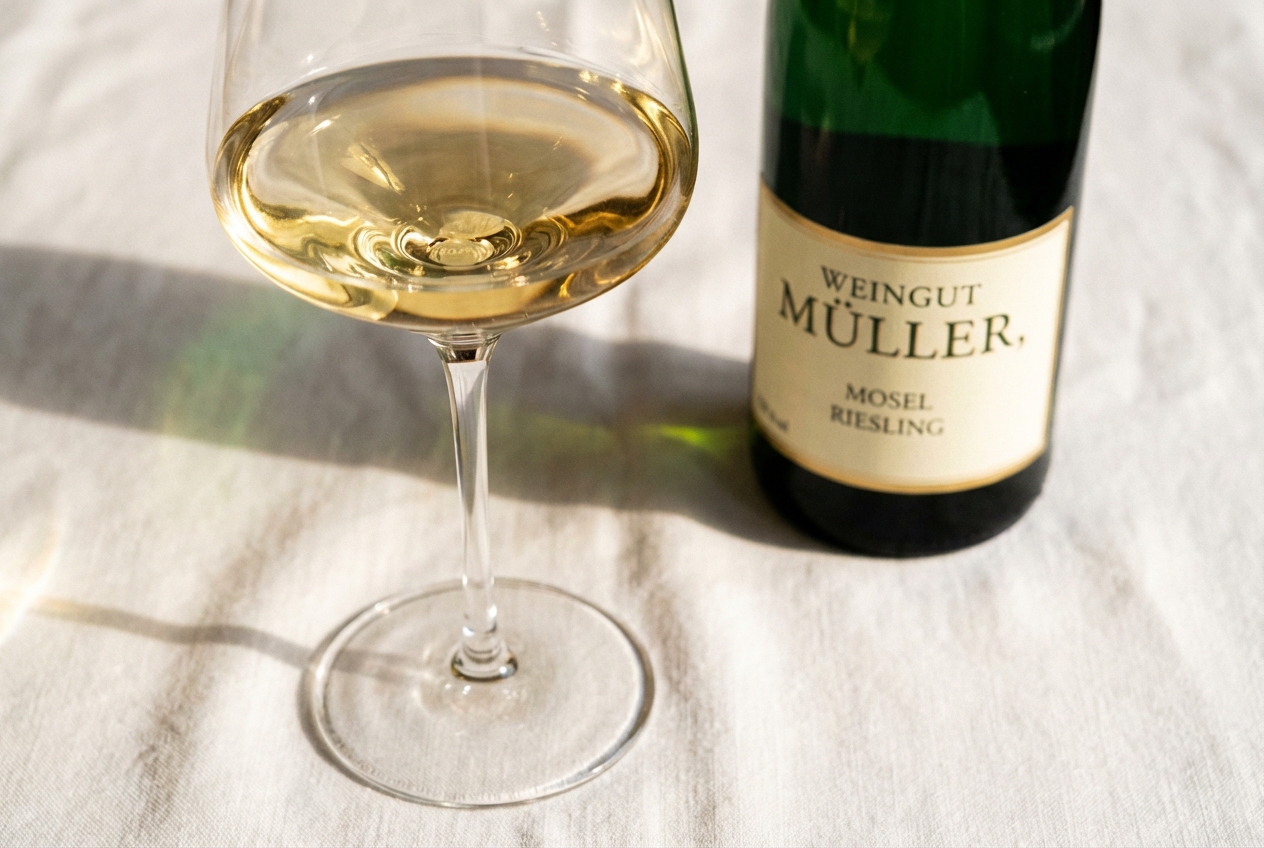
The Noble White Grape
Riesling is one of the world's truly great grape varieties — and Germany is its spiritual homeland. No other wine grape produces such an astonishing range of styles, from razor-sharp, bone-dry mineral wines to some of the sweetest, most concentrated nectars on earth. German Riesling combines crystalline purity, electric acidity, and extraordinary aging potential in a way no other white wine can match.
Understanding the Prädikat System
Germany's wine classification is based on the ripeness of grapes at harvest, a system called Prädikatswein. From lowest to highest ripeness:
- Kabinett — The lightest and most delicate style. Low alcohol (7-9%), often with a whisper of residual sweetness balanced by vibrant acidity. Perfect as an aperitif or with lighter dishes. These are arguably Riesling's most graceful expression.
- Spätlese — "Late harvest." Riper, more concentrated, but still elegant. Can be dry (trocken) or off-dry. Outstanding food wines, particularly with Asian cuisine.
- Auslese — "Select harvest." Made from specially selected bunches of very ripe grapes. Rich and concentrated, sometimes with noble rot (botrytis). Can age for decades.
- Beerenauslese (BA) — "Berry select harvest." Made from individually selected botrytized grapes. Intensely sweet with flavors of honey, apricot, and marmalade. Rare and expensive.
- Trockenbeerenauslese (TBA) — The pinnacle. Grapes are individually picked after shriveling almost to raisins on the vine due to botrytis. Syrupy, immortal wines with sugar levels exceeding 150 g/L. Among the most expensive wines in the world. A single bottle of Egon Müller TBA can sell for €10,000+.
- Eiswein — Made from grapes frozen naturally on the vine (harvested at -7°C or below). Intensely concentrated with searing acidity to balance the sweetness. Climate change is making Eiswein increasingly rare.
The Dry vs Sweet Debate
Historically, German Riesling was associated with sweetness. But today, over 60% of German Riesling is vinified dry (trocken). The top tier of dry German Riesling is classified as Grosses Gewächs (GG) — Grand Cru-level wines from classified vineyard sites. These are among the world's greatest dry white wines, rivaling top white Burgundy.
Key terms on German labels:
- Trocken — Dry
- Halbtrocken / Feinherb — Off-dry
- Fruchtsüss — Fruity-sweet (traditional style)
The Great Riesling Regions
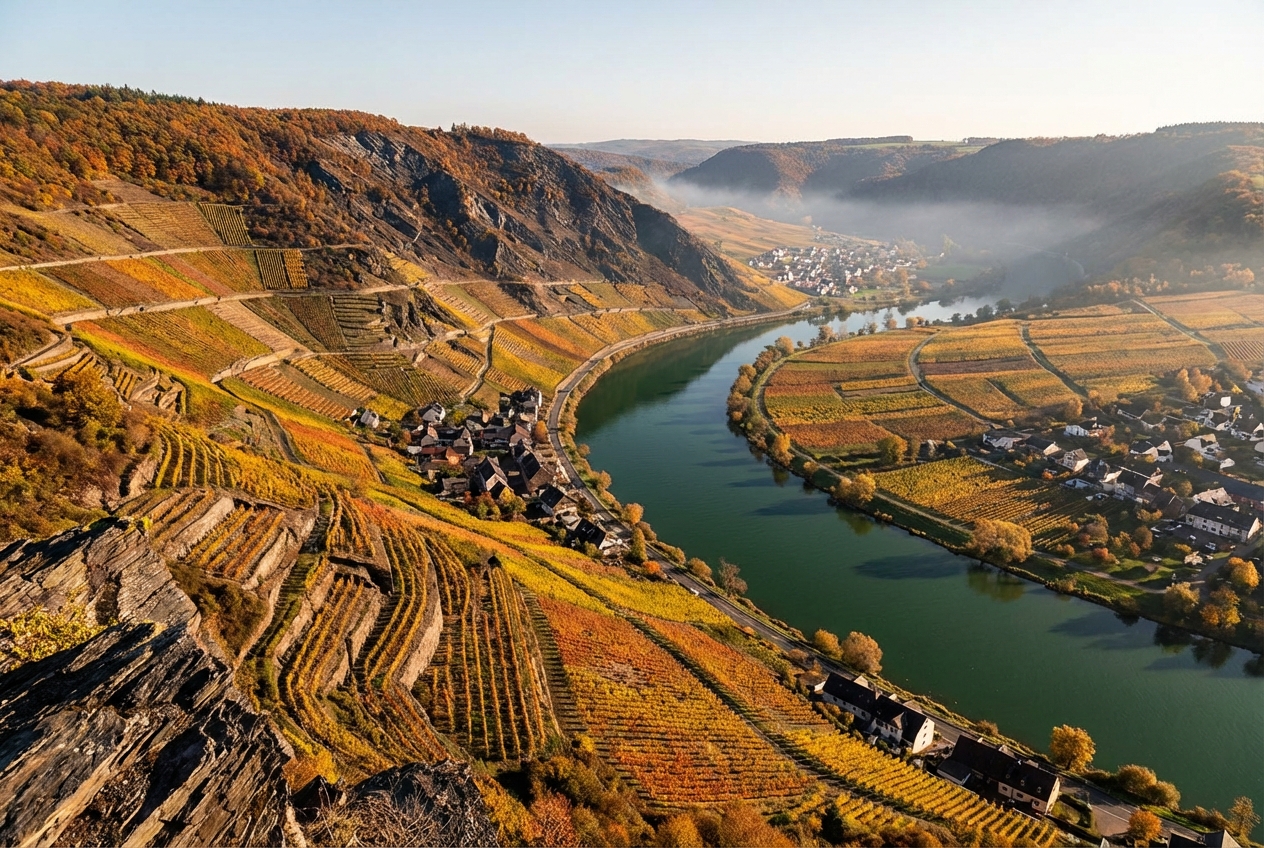
Mosel The Mosel (including its tributaries Saar and Ruwer) produces Riesling of ethereal delicacy. Steep slate hillsides along the winding river yield wines with electric acidity, low alcohol (often 7-8%), and haunting floral and citrus aromas. The best sites include Wehlener Sonnenuhr, Ürziger Würzgarten, Scharzhofberger, and Brauneberger Juffer-Sonnenuhr.
Top Mosel producers:
- Egon Müller — The Scharzhofberger vineyard produces the most expensive Rieslings on earth. His TBA is wine royalty.
- JJ Prüm — Wehlener Sonnenuhr Spätlese and Auslese are Mosel benchmarks. Wines need 10+ years to show their best.
- Fritz Haag — Brauneberger Juffer-Sonnenuhr in multiple Prädikat levels. Impeccable purity.
- Markus Molitor — Bold, concentrated wines with distinctive white labels (dry) and gold labels (fruity).
Rheingau Historically Germany's most prestigious region, the Rheingau produces fuller-bodied, more structured Rieslings than the Mosel. The Rhine turns east-west here, creating ideal south-facing slopes. Schloss Johannisberg, Schloss Vollrads, and the Steinberg vineyard are iconic historical sites.
Top Rheingau producers:
- Robert Weil — Kiedrich Gräfenberg is one of Germany's greatest vineyards
- Künstler — Dry Rieslings of power and precision
- Breuer — Rauenthaler Nonnenberg GG is a benchmark dry Riesling
Pfalz (Palatinate) Germany's warmest and sunniest major region, producing the fullest-bodied and most generous Rieslings. The best combine opulence with the signature German acidity.
Top Pfalz producers:
- Müller-Catoir — Haardter Bürgergarten and Herrenletten are stunning
- Bürklin-Wolf — Biodynamic estate with multiple GG bottlings
- Christmann — Another outstanding biodynamic producer
Nahe The Nahe combines the delicacy of the Mosel with the body of the Rheingau, producing perhaps Germany's most complete Rieslings. The volcanic and mineral diversity of its soils creates wines of extraordinary complexity.
Top Nahe producers:
- Dönnhoff — Helmut Dönnhoff's Hermannshöhle and Niederhäuser Dellchen are among Germany's greatest GGs
- Emrich-Schönleber — Monzinger Halenberg GG is exceptional
- Schäfer-Fröhlich — Pushing boundaries with powerful, complex dry wines
Aging Potential
German Riesling is one of the most age-worthy white wines in the world:
- Kabinett — 5-15 years
- Spätlese — 10-25 years
- Auslese — 15-40 years
- BA/TBA — 50-100+ years
- Grosses Gewächs — 10-30 years
Aged Riesling develops distinctive petrol or kerosene notes (from a compound called TDN), along with honeycomb, lanolin, dried apricot, and ginger. These wines are among the most complex and rewarding aged whites.
Food Pairing
Riesling's high acidity and range of sweetness levels make it perhaps the most food-friendly wine in existence:
- Dry Riesling (GG) — Roast chicken, pork schnitzel, river trout, white asparagus, sushi
- Kabinett — Thai cuisine, Vietnamese pho, Chinese dim sum, spicy Indian dishes
- Spätlese — Duck with orange sauce, foie gras, smoked salmon, Alsatian tarte flambée
- Auslese/BA/TBA — Blue cheese, fruit tarts, crème brûlée, tropical fruit desserts
“Riesling dünyanın en hafife alınan üzümüdür.”
— Stuart Pigott