The French Principle: What Grows Together Goes Together
The most reliable rule in French gastronomy is deceptively simple: what grows together goes together. Centuries before food science could explain why certain cheeses and wines harmonize, French farmers already knew the answer — they came from the same soil. A goat herder in the Loire Valley and the vintner tending Sauvignon Blanc vines on the opposite hillside shared the same limestone bedrock, the same microclimate, the same terroir. Their products evolved together over generations, shaping one another through centuries of local meals.
This principle is anchored in France's Appellation d'Origine Contrôlée (AOC) system, which protects both wine and cheese with legally defined geographic boundaries and production methods. France recognizes 46 AOP cheeses (the European equivalent of AOC) and over 360 wine appellations. Many of these geographic zones overlap directly — the same limestone soils that produce Sancerre also nurture the goats whose milk becomes Crottin de Chavignol. The same lush Normandy pastures that feed dairy cattle sit just kilometers from Calvados orchards and Muscadet vineyards.
Understanding regional pairings is not about memorizing rules — it is about understanding terroir as a shared vocabulary between cheese and wine. When both products express the same soil, climate, and agricultural tradition, harmony on the palate follows naturally. This guide walks through every major cheese-producing region of France, matching local fromages with their natural wine partners and explaining the sensory logic behind each pairing.
Normandy & Brittany: Creamy Meets Crisp
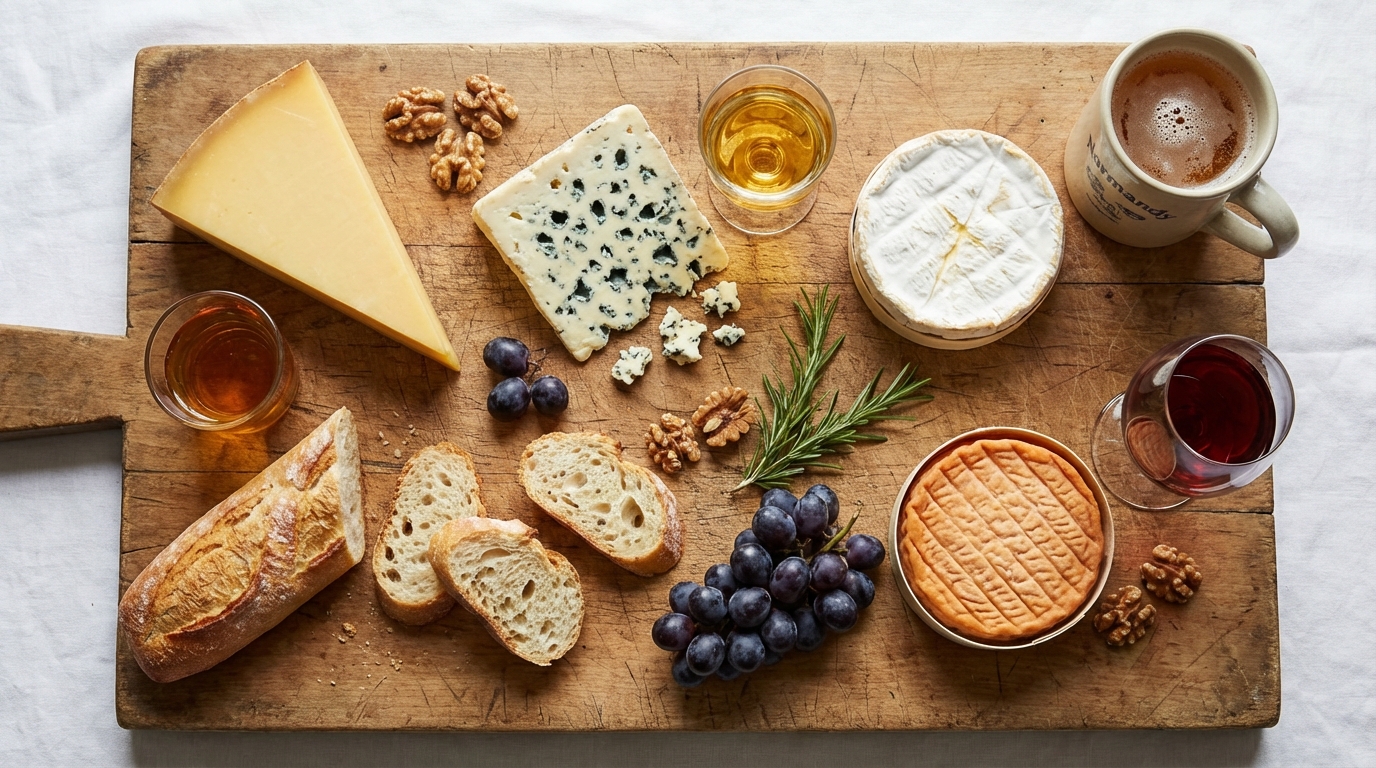
Normandy is France's dairy heartland, home to some of the world's most celebrated soft cheeses. Camembert de Normandie (AOP), with its bloomy white rind and unctuous, mushroomy paste, is the region's icon — but it shares the stage with Pont-l'Évêque, one of France's oldest cheeses dating to the 13th century, and Livarot, nicknamed "the Colonel" for the five bands of raffia encircling its pungent, washed-rind form. Nearby, Neufchâtel — shaped like a heart — offers a drier, crumblier texture with a pronounced tang.
Normandy is cider country, not wine country, and the classic local pairing is Camembert with Cidre Brut — the apple acidity cuts through the fat with precision. For wine pairings, reach across regional borders to Muscadet from the nearby Loire estuary. Its saline, lees-rich character (especially Muscadet Sèvre-et-Maine sur lie) mirrors the coastal terroir both products share. Champagne Brut is another magnificent partner — the persistent bubbles and high acidity cleanse the palate after each bite of rich, creamy cheese, while the toasty autolysis notes complement the earthy mushroom flavors of a ripe Camembert.
The sensory logic is straightforward: Normandy cheeses are high in fat and relatively mild in salt, demanding a beverage with sharp acidity or effervescence to refresh the palate. Heavy red wines overwhelm these delicate cheeses, while crisp whites and sparkling wines create balance.
Loire Valley: Goat Cheese & Sauvignon Blanc Magic
The Loire Valley is the undisputed kingdom of French chèvre (goat cheese). Crottin de Chavignol, Sainte-Maure-de-Touraine, Valençay, Selles-sur-Cher, and Pouligny-Saint-Pierre — five AOP goat cheeses, all produced within the same limestone corridor that yields France's most electric Sauvignon Blanc wines. This is no coincidence. The Kimmeridgian and Tuffeau limestone that gives Loire Sauvignon Blanc its mineral spine also feeds the pastures where goats graze, imparting a subtle chalky quality to both wine and cheese.
Sancerre and Crottin de Chavignol is perhaps the single most famous cheese-and-wine pairing in France — and deservedly so. The wine's razor-sharp acidity and citrus-herbaceous aromatics cut through the goat cheese's tangy creaminess, while shared mineral undertones create a seamless bridge between sip and bite. Vouvray — both dry (sec) and off-dry (demi-sec) — works beautifully with the denser, more aged goat cheeses like a mature Sainte-Maure, where the Chenin Blanc's honeyed richness softens the cheese's intensifying sharpness. For red wine lovers, Chinon (Cabernet Franc) with its earthy, medium-bodied profile pairs surprisingly well with lightly aged chèvre, particularly when served at cellar temperature.
Burgundy: Washed Rinds & Chardonnay
Burgundy produces some of France's most powerful cheeses alongside its most celebrated wines. Époisses de Bourgogne — washed in Marc de Bourgogne during its affinage — is legendarily pungent, with a sticky orange rind and a molten, intensely savory interior that Napoleon reportedly adored. Brillat-Savarin, a triple-cream cheese from the same region, offers the opposite experience — pure luxurious butterfat with a mild, cultured tang. Cîteaux, made by Cistercian monks at the Abbey of Cîteaux, is a pressed, semi-soft cheese with nutty, floral complexity.
The classic Burgundy pairing matches Époisses with Chablis — a combination that seems counterintuitive (pungent cheese with elegant white wine?) but works brilliantly. Chablis' steely acidity and Kimmeridgian mineral backbone cut through the cheese's richness, while the wine's restrained fruit lets the cheese's complex flavors take center stage. For richer white Burgundies — Meursault or Puligny-Montrachet — pair with Brillat-Savarin, where the shared opulence of buttery Chardonnay and triple-cream cheese creates a decadent harmony.
Red Burgundy and cheese is a more delicate matter. Pinot Noir from the Côte de Beaune — lighter, more fruit-driven villages like Savigny-lès-Beaune or Santenay — works with Cîteaux and other semi-firm Burgundian cheeses. Avoid pairing tannic red Burgundy with washed-rind cheeses like Époisses — the tannins react with the cheese's ammonia compounds, producing a metallic, unpleasant bitterness.
Bordeaux & South-West: Sweet Wine Meets Blue Cheese
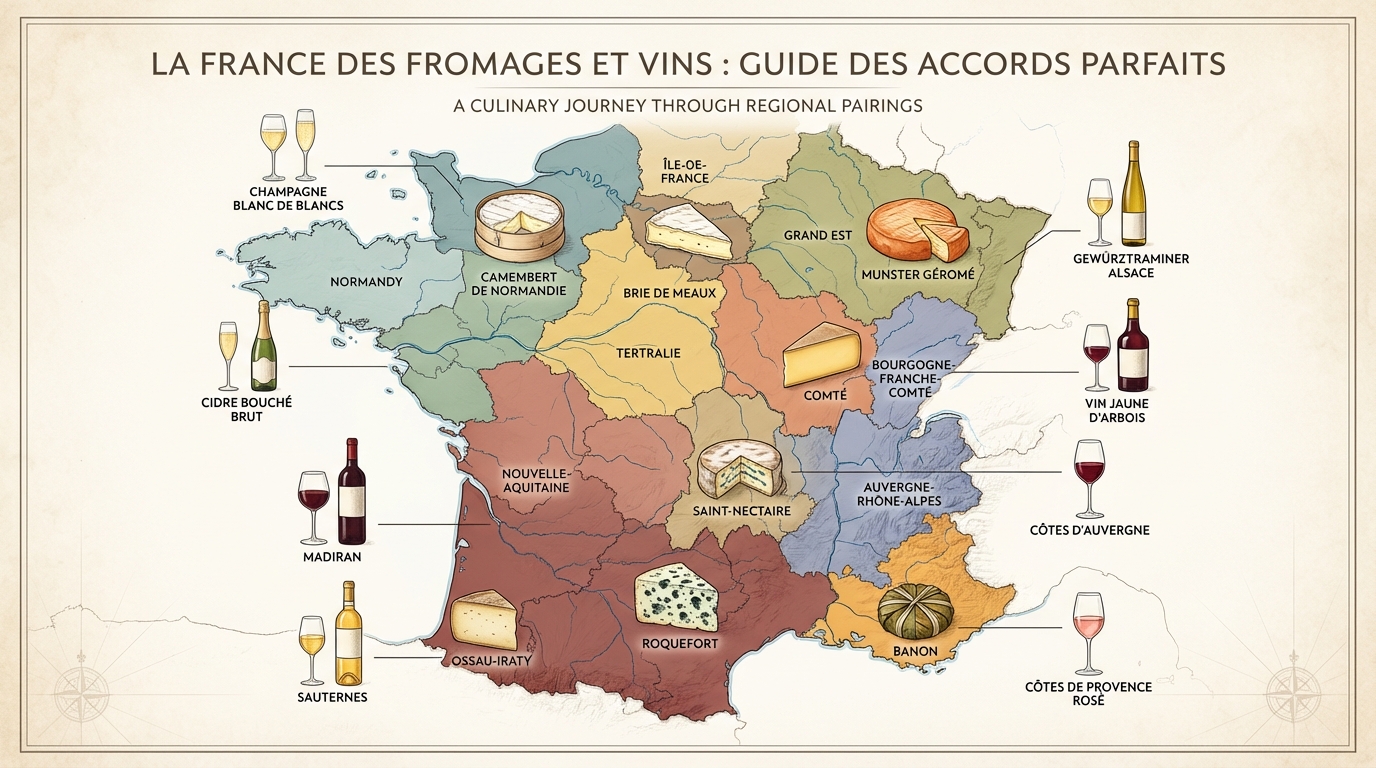
The southwest quadrant of France — from Bordeaux down through Béarn and the Pyrénées — produces cheeses of extraordinary diversity and some of the most dramatic wine pairings in the French repertoire. Roquefort (AOP), the king of blue cheeses, is aged in the natural limestone caves of Roquefort-sur-Soulzon in Aveyron. Ossau-Iraty (AOP), a firm sheep's milk cheese from the Basque Country and Béarn, has a nutty, caramel sweetness. Tomme des Pyrénées, with its distinctive black rind, offers mild, supple flavors that bridge the gap between mountain cheeses and lowland styles.
The revelation of this region is the pairing of blue cheese with sweet wine. Roquefort with Sauternes is considered by many French gastronomes to be the single greatest cheese-wine combination in existence. The logic is precise: Roquefort's intense saltiness and pungent blue mold require a wine with enough residual sugar to balance the salt, enough acidity to cut the fat, and enough aromatic complexity to stand alongside the cheese's powerful flavor. Sauternes — with its apricot, honey, and botrytis complexity — delivers on all three counts. Jurançon Moelleux (sweet Jurançon from Petit Manseng grapes) offers a similar sweet-salty magic with Ossau-Iraty, where the wine's tropical fruit and spice complement the cheese's nutty depth.
For red wine drinkers, Cahors (Malbec) with Tomme des Pyrénées demonstrates how robust, tannic reds work best with firm, aged cheeses rather than soft or blue styles. The tannins bind to the cheese's protein rather than its fat, creating a savory, structured combination.
Alps & Jura: Mountain Cheeses & Oxidative Wines
The French Alps and the Jura mountains produce cheeses defined by altitude, long winters, and the tradition of alpine cheesemaking — large-format pressed cheeses designed to sustain mountain communities through months of snow. Comté (AOP), France's most-produced AOP cheese at over 66,000 tonnes annually, is a marvel of complexity: depending on its age (from four months to over three years), it can express flavors ranging from fresh butter and hazelnuts to caramel, dried fruit, and roasted spice. Beaufort (AOP), often called "the Prince of Gruyères," is similarly complex, with a firmer texture and more pronounced fruity, floral notes. Reblochon (AOP), the essential ingredient of tartiflette, is softer and creamier — a washed-rind mountain cheese with a mild, nutty character. Abondance (AOP) bridges the gap between Reblochon and Beaufort with a semi-firm, elastic paste and earthy, slightly bitter finish.
The Jura wine region produces France's most singular wines, and the pairing of aged Comté with Vin Jaune is one of the country's great gastronomic monuments. Vin Jaune — made from Savagnin grapes aged under a veil of yeast (voile) for a minimum of six years and three months — develops intense walnut, curry, and dried mushroom flavors that mirror the same nutty, umami complexity found in well-aged Comté. Both products owe their character to the same Jurassic limestone soils and the same patient, transformative aging processes. Roussette de Savoie (from the Altesse grape) pairs beautifully with Reblochon — the wine's delicate floral and almond notes complement the cheese's mild creaminess without overwhelming it.
| Region | Cheese | Wine Pairing | Why It Works |
|---|---|---|---|
| Normandy | Camembert de Normandie | Champagne Brut / Cidre | Bubbles and acidity cut creamy fat |
| Loire | Crottin de Chavignol | Sancerre | Shared limestone terroir, tangy + mineral |
| Burgundy | Époisses | Chablis | Steely acidity tames pungent washed rind |
| Burgundy | Brillat-Savarin | Meursault | Buttery opulence meets triple cream |
| South-West | Roquefort | Sauternes | Sweetness balances salt and blue mold |
| South-West | Ossau-Iraty | Jurançon Moelleux | Tropical fruit + nutty sheep cheese |
| Jura | Comté (aged 18+ months) | Vin Jaune | Walnut and umami mirror each other |
| Alps | Reblochon | Roussette de Savoie | Floral wine + mild mountain cream |
| Alsace | Munster | Gewürztraminer | Aromatic intensity matches pungent rind |
| Provence | Banon | Provence Rosé | Herbal goat cheese + garrigue rosé |
Provence & Corsica: Sun, Herbs, and Island Character
The Mediterranean south brings a different cheese tradition — smaller-format goat and sheep cheeses shaped by dry summers, wild herbs, and ancient pastoral practices. Banon (AOP), from the hills of Haute-Provence, is a small goat cheese wrapped in chestnut leaves and tied with raffia, developing a soft, gooey interior with earthy, herbaceous flavors as it ages. In Corsica, Brocciu (AOP) — a fresh whey cheese made from sheep or goat milk — is the island's culinary soul, used in everything from omelets to cheesecakes when fresh, and developing piquant, complex flavors when aged as Brocciu Passu.
Provence rosé with Banon is a pairing of profound regional logic. The rosé's dry, herbal, garrigue-inflected character (thyme, rosemary, lavender) echoes the same wild herbs that flavor the goat's milk, while its fresh acidity and low tannin handle the cheese's creamy texture elegantly. In Corsica, Patrimonio reds (from the Nielluccio grape, Corsica's clone of Sangiovese) offer enough structure and savory depth to partner aged Brocciu, while Vermentino — whether from Patrimonio or the broader Vin de Corse appellation — brings citrus and saline minerality that complements fresh Brocciu perfectly.
Alsace: Munster & Gewürztraminer — The Iconic Pairing
No discussion of French cheese-and-wine pairing is complete without Munster (AOP) and Gewürztraminer — arguably the most iconic single pairing in the French repertoire. Munster, produced in the Vosges mountains that straddle Alsace and Lorraine, is a washed-rind cheese of formidable aroma — its orange rind emits a barnyard pungency that intimidates the uninitiated but conceals a paste of remarkable smoothness and savory depth.
Gewürztraminer, Alsace's most aromatically intense variety, meets Munster with equal force. The wine's explosive lychee, rose petal, ginger, and spice aromas are powerful enough to stand alongside the cheese's pungency — where most wines would be overpowered, Gewürztraminer thrives. The residual sugar commonly found in Alsace Gewürztraminer (even in wines labeled "dry," which may contain 10–15 g/L of residual sugar) provides a crucial sweetness that balances Munster's salt, while the wine's relatively low acidity prevents any acidic clash with the cheese's ammoniated rind.
The pairing also works with Alsace Pinot Gris, which offers a richer, more honeyed profile, and with Munster Géromé (the Lorraine variant), which tends to be slightly milder. A sprinkle of cumin seeds on the Munster — a traditional Alsatian accompaniment — adds another aromatic layer that further bridges cheese and wine.
Practical Tips: Building the Perfect French Cheese & Wine Board
Serving order matters. Arrange cheeses from mildest to strongest — typically fresh chèvre first, then pressed mountain cheeses, then soft-ripened varieties, and finally blue or washed-rind cheeses last. Pair wines in the same ascending order of intensity.
Temperature is critical. Remove cheeses from the refrigerator at least one hour before serving — cold cheese has muted flavor and unappetizing texture. Serve white wines at 10–12°C, reds at 14–16°C, and sparkling wines at 6–8°C.
Accompaniments enhance but should not compete. Offer crusty baguette (never flavored bread, which clashes with cheese), unsalted butter (a Normandy tradition for serving with Camembert), walnuts (natural partner for Comté and Roquefort), seasonal fresh fruit (grapes, figs, pears), and a small pot of honey (for drizzling on blue cheeses alongside Sauternes).
The rule of three or five. For a dinner party, select three cheeses (one goat, one pressed, one soft-ripened) with two wines, or five cheeses (spanning all families) with three wines. Resist the temptation to offer too many cheeses — quality over quantity ensures each cheese gets proper attention and each pairing can be savored.
When in doubt, go local. If you know the region a cheese comes from, start with a wine from the same area. This rule alone will produce successful pairings far more often than any attempt to construct "creative" cross-regional matches. The centuries of co-evolution between local cheeses and local wines have already done the hard work of finding harmony — trust the terroir.


