Why Pronunciation Matters
Few things undermine wine confidence faster than stumbling over a name on a wine list. You know what you want — that elegant Burgundy white, that bold Tuscan red — but the prospect of saying the name aloud in front of a sommelier, a dinner companion, or a wine shop clerk triggers a moment of hesitation that has nothing to do with your actual knowledge. The irony is that many deeply knowledgeable wine enthusiasts mispronounce terms they have read hundreds of times, simply because wine education happens overwhelmingly through text rather than conversation.
Correct pronunciation matters for several practical reasons. First, it is a matter of clear communication. When you ask for a "Croze-air-mee-tahj" at a restaurant, the sommelier knows exactly what you mean. When you ask for a "Crozz Hermitage" — rhyming with "cottage" — there may be a beat of confusion that slows service and creates unnecessary awkwardness. Second, wine names are almost always place names or grape names drawn from the languages of the countries that created them. Pronouncing them correctly is a small but genuine gesture of respect for the culture and tradition behind the wine. Third, and most practically, getting the sounds right builds a feedback loop of confidence: the more naturally a name rolls off your tongue, the more likely you are to order adventurously, explore unfamiliar regions, and expand your wine horizons.
The good news is that wine pronunciation follows consistent rules within each language. French, Italian, Spanish, German, and Portuguese each have phonetic systems that, once internalized, unlock the pronunciation of hundreds of terms. You do not need to learn five languages — you need to learn roughly a dozen phonetic rules per language, and suddenly the vast majority of wine names become intuitive. This guide provides phonetic spellings for over 100 essential wine terms organized by language, highlights the most common mistakes, and offers concrete strategies for building pronunciation fluency.
French Wine Terms
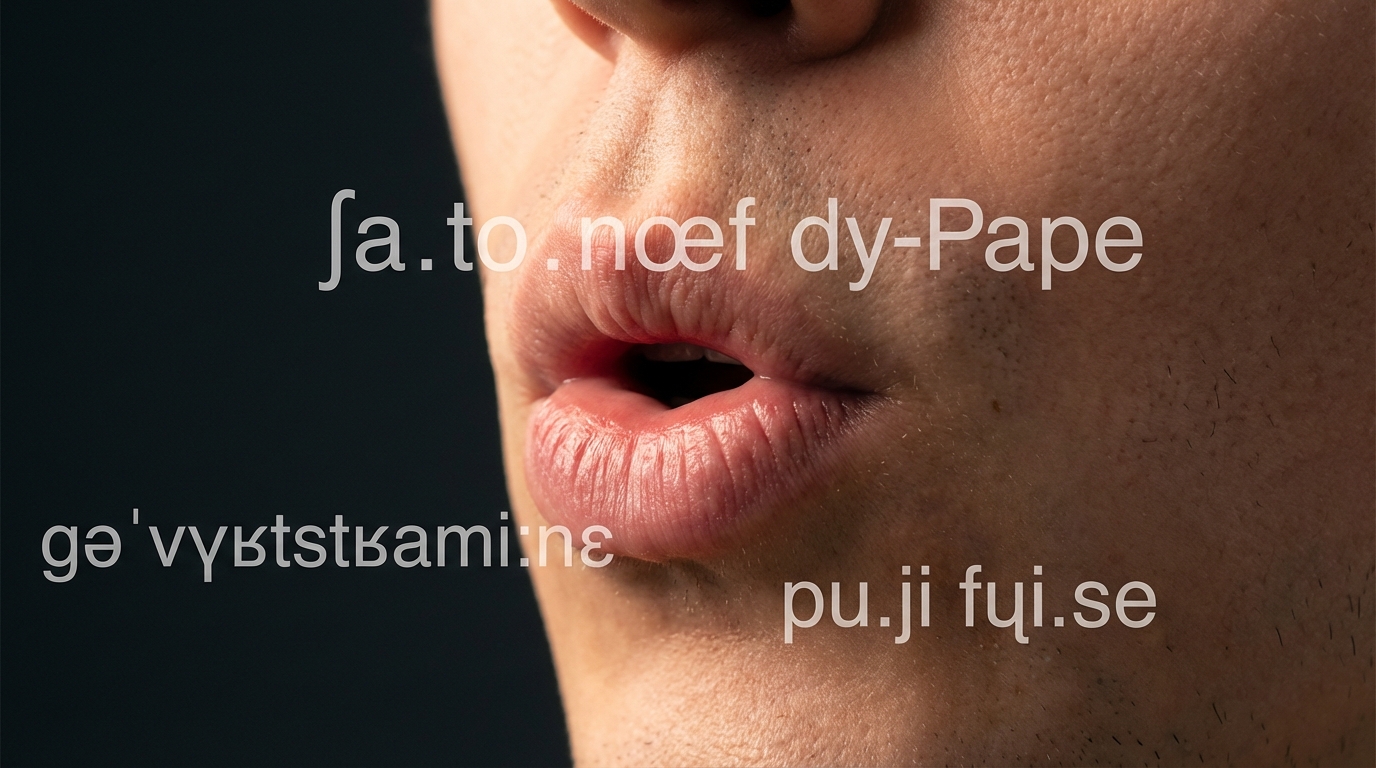
French dominates the global wine vocabulary. Mastering a few key rules unlocks most French wine terms: final consonants are usually silent (except C, R, F, L — think "CaReFuL"), the letter combination "eau" sounds like "oh," "ou" sounds like "oo," "oi" sounds like "wah," and nasal vowels (an, en, in, on) produce the distinctive French sounds where air flows through the nose rather than the mouth.
| Term | Phonetic | Meaning |
|---|---|---|
| Bordeaux | bor-DOH | Major wine region in southwest France |
| Bourgogne | boor-GON-yuh | Burgundy — historic wine region in eastern France |
| Châteauneuf-du-Pape | sha-toh-NUHF-doo-PAHP | "New Castle of the Pope" — prestige southern Rhône appellation |
| Côte-Rôtie | koht-roh-TEE | "Roasted Slope" — premier northern Rhône appellation |
| Gewürztraminer | guh-VURTS-trah-mee-ner | Aromatic white grape, prominent in Alsace |
| Pouilly-Fumé | pwee-yee-foo-MAY | Loire Valley Sauvignon Blanc appellation |
| Sancerre | sahn-SAIR | Loire Valley appellation known for Sauvignon Blanc |
| Sauternes | soh-TAIRN | Sweet wine appellation in Bordeaux |
| Viognier | vee-on-YAY | Aromatic white grape of the Rhône Valley |
| Chenin Blanc | sheh-NAN blahn | Versatile white grape, star of the Loire Valley |
| Crémant | kray-MAHN | French sparkling wine made outside Champagne |
| Cuvée | koo-VAY | A specific blend or batch of wine |
| Brut | BROOT | Dry style of sparkling wine |
| Demi-sec | deh-mee-SEK | "Half-dry" — off-dry sparkling wine style |
| Terroir | teh-RWAHR | The complete natural environment of a vineyard |
| Appellation | ah-peh-lah-SYOHN | Official designated wine region |
| Domaine | doh-MEHN | Wine estate, especially in Burgundy |
| Château | sha-TOH | Wine estate, especially in Bordeaux |
| Sommelier | suh-mel-YAY | Trained wine service professional |
| Pinot Noir | PEE-noh NWAHR | Classic red grape of Burgundy |
| Sauvignon Blanc | soh-vee-NYOHN BLAHN | Major white grape variety |
| Chablis | sha-BLEE | Northernmost Burgundy appellation, known for Chardonnay |
| Muscadet | moos-kah-DAY | Loire Valley white wine from Melon de Bourgogne |
| Vouvray | voo-VRAY | Loire Valley appellation for Chenin Blanc |
| Chinon | shee-NOHN | Loire Valley red wine appellation for Cabernet Franc |
| Cahors | kah-OR | Southwest France appellation known for Malbec |
| Beaujolais | boh-zhoh-LAY | Region south of Burgundy, home of Gamay |
| Alsace | al-SASS | Northeastern French wine region |
| Provence | proh-VAHNSS | Southeastern French region famous for rosé |
| Languedoc | lahn-guh-DOK | Vast southern French wine region |
| Montrachet | mohn-rah-SHAY | Legendary Burgundy white wine vineyard |
Italian Wine Terms
Italian pronunciation is far more phonetic than French — what you see is largely what you say. The key rules: "ch" before "e" or "i" sounds like "k" (Chianti = kee-AHN-tee), "gl" before "i" sounds like "ly" (as in "million"), double consonants are held slightly longer, and stress typically falls on the second-to-last syllable unless marked otherwise. The letter "e" is always pronounced (never silent as in French), and "gn" sounds like "ny" (as in "canyon").
| Term | Phonetic | Meaning |
|---|---|---|
| Chianti | kee-AHN-tee | Tuscan red wine from Sangiovese |
| Barolo | bah-ROH-loh | Prestigious Nebbiolo red from Piedmont |
| Brunello di Montalcino | broo-NEL-loh dee mon-tal-CHEE-noh | Premium Sangiovese from southern Tuscany |
| Amarone | ah-mah-ROH-neh | Rich dried-grape red from Veneto |
| Prosecco | proh-SEH-koh | Italian sparkling wine from Glera grapes |
| Pinot Grigio | PEE-noh GREE-joh | Italian name for Pinot Gris white grape |
| Nebbiolo | neh-bee-OH-loh | Noble red grape of Piedmont |
| Sangiovese | san-joh-VAY-zeh | Italy's most planted red grape |
| Montepulciano | mon-teh-pool-CHAH-noh | Red grape (also a Tuscan town) |
| Franciacorta | frahn-chah-KOR-tah | Premium Italian sparkling wine region |
| Valpolicella | val-poh-lee-CHEL-lah | Veneto red wine region |
| Lambrusco | lahm-BROO-skoh | Fizzy red wine from Emilia-Romagna |
| Grillo | GREE-loh | White grape from Sicily |
| Verdicchio | ver-DEEK-kee-oh | White grape from the Marche region |
Spanish & Portuguese Terms
Spanish pronunciation is highly regular: every letter is pronounced, "j" sounds like a throaty "h" (as in Rioja), "ñ" sounds like "ny," double "ll" sounds like "y," and stress follows predictable patterns. Portuguese adds nasal vowels (similar to French) and the "nh" combination that sounds like "ny."
| Term | Phonetic | Meaning |
|---|---|---|
| Rioja | ree-OH-hah | Spain's most famous red wine region |
| Tempranillo | tem-prah-NEE-yoh | Spain's premier red grape |
| Garnacha | gar-NAH-chah | Spanish name for Grenache |
| Albariño | al-bah-REE-nyoh | Aromatic white grape from Galicia |
| Cava | KAH-vah | Spanish traditional-method sparkling wine |
| Jerez (Sherry) | heh-RETH | Andalusian city and origin of Sherry |
| Ribera del Duero | ree-BEH-rah del DWEH-roh | Premium Spanish red wine region |
| Vinho Verde | VEE-nyoo VEHR-deh | Light Portuguese white wine |
| Touriga Nacional | too-REE-gah nah-see-oh-NAHL | Portugal's premier red grape |
| Douro | DOH-roo | Portuguese river valley and Port wine region |
German & Austrian Terms
German wine terms intimidate many English speakers, but the pronunciation is quite systematic. The umlaut "ü" sounds like "ew" (purse your lips as if whistling while saying "ee"), "ä" sounds like "eh," "ei" sounds like "eye," "ie" sounds like "ee," "ch" after a front vowel is a soft hissing sound (like the "h" in "huge"), and "w" sounds like "v."
| Term | Phonetic | Meaning |
|---|---|---|
| Riesling | REES-ling | Noble aromatic white grape |
| Spätlese | SHPAYT-lay-zuh | "Late harvest" — riper style of German wine |
| Auslese | OWS-lay-zuh | "Select harvest" — rich, often sweet wine |
| Gewürztraminer | guh-VURTS-trah-mee-ner | "Spiced" aromatic grape from Alsace/Germany |
| Grüner Veltliner | GROO-ner FELT-lee-ner | Austria's signature white grape |
| Eiswein | ICE-vine | Rare wine made from grapes frozen on the vine |
| Mosel | MOH-zel | German river valley renowned for Riesling |
| Rheingau | RINE-gow | Historic German Riesling region |
Common Mistakes to Avoid
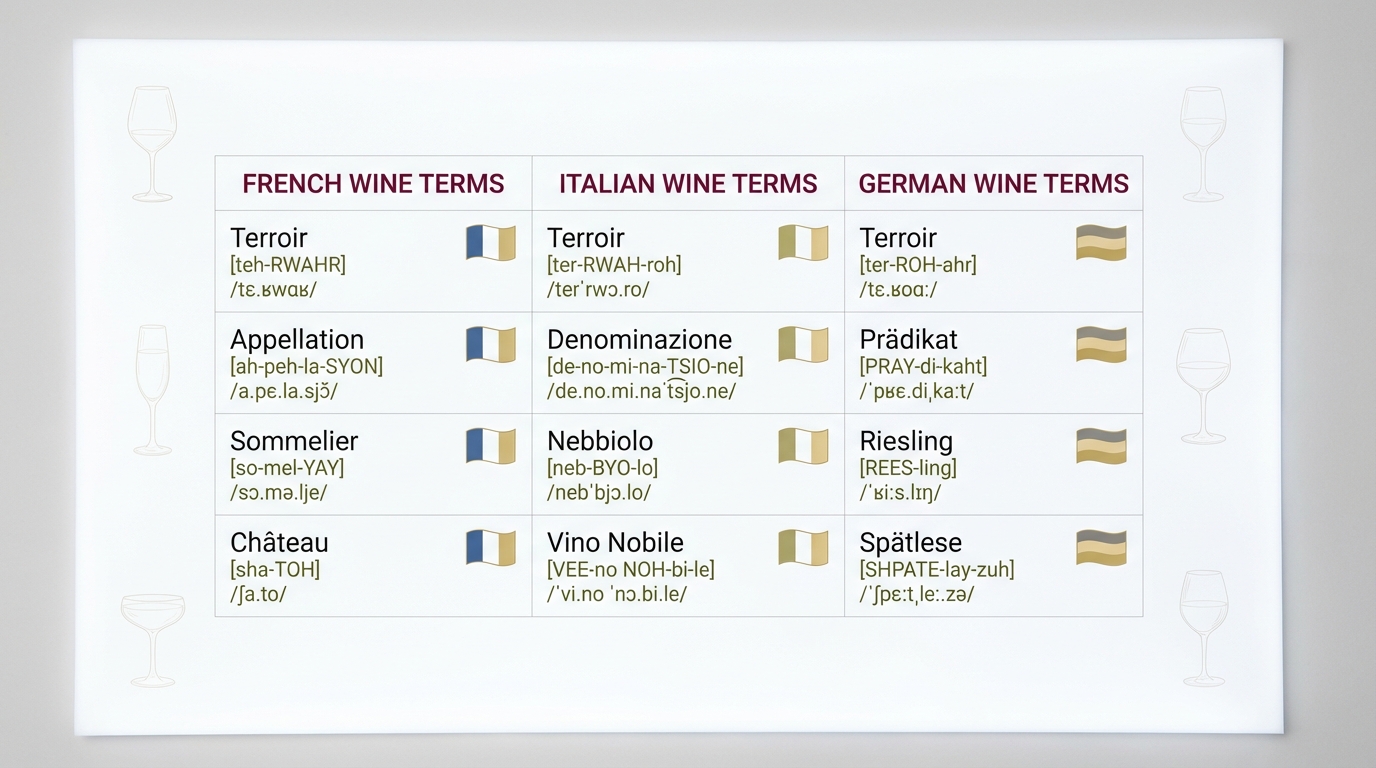
Even experienced wine drinkers fall into pronunciation traps. Here are the most frequently mangled terms and their corrections:
Bordeaux — It is "bor-DOH," not "bor-DOCKS." The final "x" is completely silent in French, as are most final consonants. The same rule applies to Châteaux (sha-TOH), not "sha-TOES."
Pinot Noir / Pinot Grigio — The "t" in Pinot is silent: "PEE-noh," not "PEE-not." This is one of the most common errors in English-speaking countries, where the instinct to pronounce every consonant overrides the French rule.
Gewürztraminer — This intimidating name breaks into manageable pieces: guh-VURTS-trah-mee-ner. The most common mistake is pronouncing the "w" as an English "w" rather than the German "v" sound, and stressing the wrong syllable.
Chianti — "Kee-AHN-tee," not "chee-AN-tee." In Italian, "ch" before "i" or "e" produces a hard "k" sound — the opposite of the English instinct.
Viognier — "Vee-on-YAY," not "VYE-og-nee-er." The "gn" in French produces a "ny" sound (like Spanish "ñ"), and the final "er" becomes "ay."
Tempranillo — "Tem-prah-NEE-yoh," not "tem-pruh-NIL-oh." The double "ll" in Spanish produces a "y" sound, and the stress falls on the penultimate syllable.
Brut — "BROOT," not "BRUT" (rhyming with "gut"). The French "u" sound has no direct English equivalent — round your lips as if to say "oo" while trying to say "ee."
Mosel — "MOH-zel," not "MOH-sell." German final consonants are voiced, and the "s" between vowels is pronounced as "z."
Sommelier — "Suh-mel-YAY," not "SAHM-uh-leer." The stress falls at the end, and the final "ier" produces the "yay" sound typical of French.
Tips for Mastering Wine Pronunciation
Listen to native speakers. The single most effective strategy is hearing the words spoken correctly. Wine podcasts, YouTube channels by French, Italian, and Spanish wine educators, and even pronunciation databases like Forvo provide authentic audio references. Listening once is informative; listening and repeating aloud five times builds muscle memory.
Learn rules, not individual words. Rather than memorizing the pronunciation of every wine term individually, invest time in learning the core phonetic rules of each language. For French: silent final consonants (except C, R, F, L), nasal vowels (an, en, in, on, un), and the key vowel combinations (eau = oh, ou = oo, oi = wah, ai = eh). For Italian: everything is pronounced, "ch" = k before e/i, "gn" = ny, double consonants are elongated. For Spanish: "j" = h, "ñ" = ny, "ll" = y, every vowel is pronounced. For German: "w" = v, "z" = ts, "ei" = eye, "ie" = ee, umlauts modify the base vowel.
Break long names into syllables. Châteauneuf-du-Pape becomes manageable as four pieces: sha-toh / nuhf / doo / pahp. Brunello di Montalcino is broo-NEL-loh / dee / mon-tal-CHEE-noh. Almost every intimidating wine name is simply a sequence of short, pronounceable syllables strung together.
Practice with a wine list. Next time you are at a restaurant or browsing an online wine shop, read the names aloud — quietly if you prefer — before ordering. This low-stakes rehearsal builds familiarity rapidly. Within a few weeks of regular practice, the terms that once felt foreign will feel natural.
Accept imperfection gracefully. No one expects a non-native speaker to produce flawless French nasals or a perfect German umlaut. What matters is that you are close enough to be understood and that you approach the language with good-faith effort rather than dismissive anglicization. A sommelier will always appreciate a genuine attempt at "Châteauneuf-du-Pape" — even if your accent is imperfect — over someone who refuses to try and just points at the list.


