Introduction: France's Alpine Wine Frontier
Savoie is France's most spectacularly situated wine region — a chain of vineyards draped across the western slopes of the Alps, scattered around the shores of great lakes, and threaded through narrow river valleys where limestone cliffs and glacial moraines create a viticultural landscape unlike anything else in the country. This is wine at altitude, wine shaped by mountains, and wine that until very recently was drunk almost exclusively by the people who made it.
For most of the 20th century, Savoie wines rarely traveled beyond the ski resorts and lakeside restaurants of the French Alps. Production was modest, yields were generous, and the wines — mostly light, refreshing whites — were consumed as seasonal refreshment: vin de soif to wash down fondue, raclette, and tartiflette during the winter ski season, or chilled apéritifs sipped on the terraces overlooking Lac du Bourget, Lac d'Annecy, or Lac Léman (Lake Geneva) in summer. Few critics paid attention, and fewer still considered Savoie capable of producing serious, age-worthy wine.
That perception has changed dramatically in the past two decades. A new generation of vignerons — many of them committed to organic, biodynamic, or low-intervention viticulture — has demonstrated that Savoie's unique combination of altitude, ancient soils, indigenous grape varieties, and extreme climatic conditions can produce wines of extraordinary character, precision, and complexity. The same attributes that once marginalized the region — small production, obscure grapes, challenging terrain — are now its greatest assets in a wine world hungry for authenticity and discovery.
Savoie's total vineyard area is approximately 2,100 hectares, making it one of France's smallest wine regions — roughly the size of a single large Bordeaux commune. Production is predominantly white (roughly 70%), with the balance split between reds and rosés. The wines are unified under the broad Vin de Savoie AOC (established 1973), but the appellation system is decentralized: 16 named crus are permitted to append their village or lieu-dit name to the label, creating a patchwork of micro-appellations that each express distinct terroir. Additional standalone AOCs include Roussette de Savoie, Seyssel, and Crépy.
The region's geography is defined by three great lakes and the mountain ranges that surround them. Lac Léman (Lake Geneva) dominates the north, where the Crépy and Ripaille vineyards overlook the water. Lac du Bourget, France's largest natural lake, moderates the climate for the crus of Jongieux, Marestel, and Monthoux on its western shore. Lac d'Annecy sits further south in a dramatic alpine setting. Between and around these lakes, the vineyards occupy south-facing slopes of glacial debris — moraines, scree, and alluvial terraces deposited during the retreat of the great alpine glaciers some 12,000 to 15,000 years ago. The resulting soils are an extraordinary jumble of limestone, schist, marl, molasse (compacted sandstone), and glacial till, often within the same vineyard.
Geography and Terroir: Shaped by Ice, Stone, and Altitude
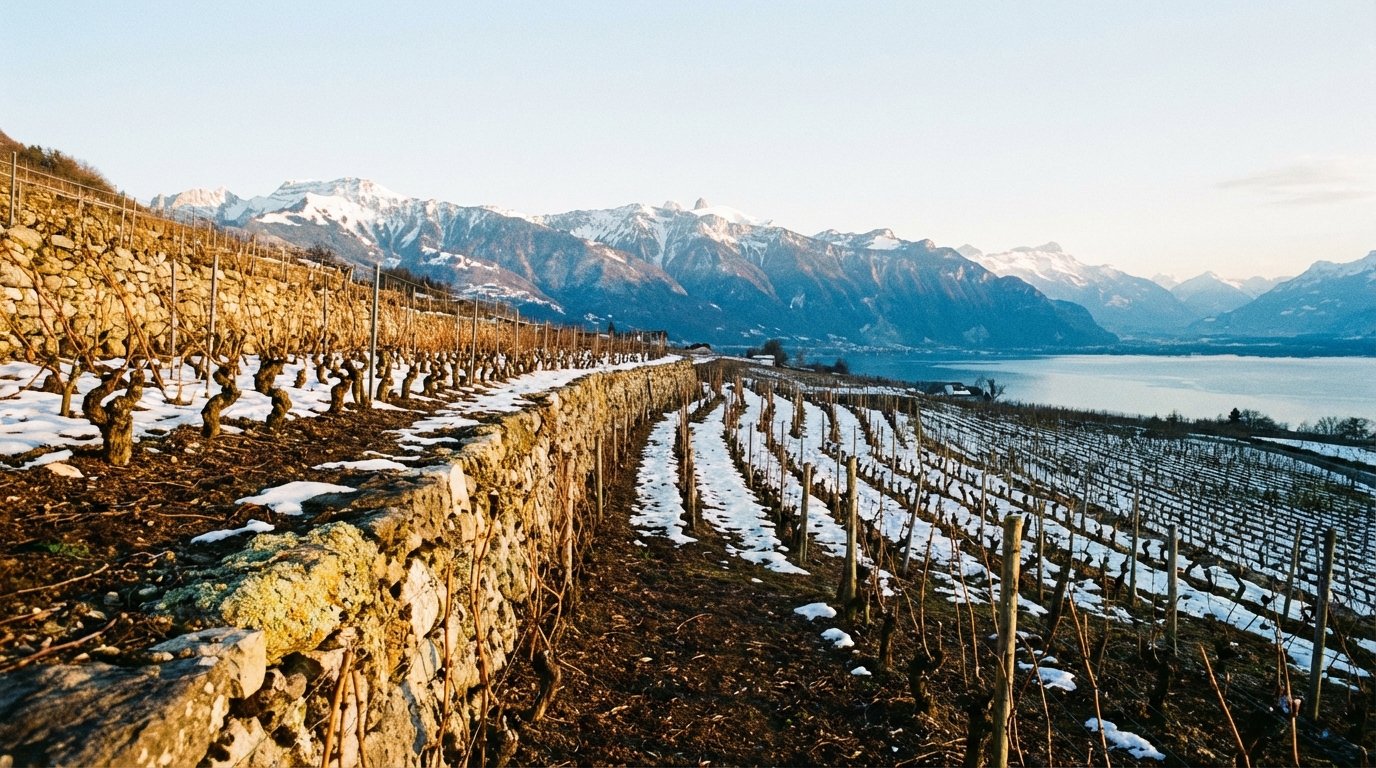
The terroir of Savoie is a direct legacy of the last Ice Age. When the massive glaciers that once filled the alpine valleys retreated, they left behind a chaotic landscape of moraines, erratic boulders, scree slopes, and lake basins carved deep into the bedrock. The vineyards that colonized this terrain occupy some of the most geologically varied and dramatically situated sites in France.
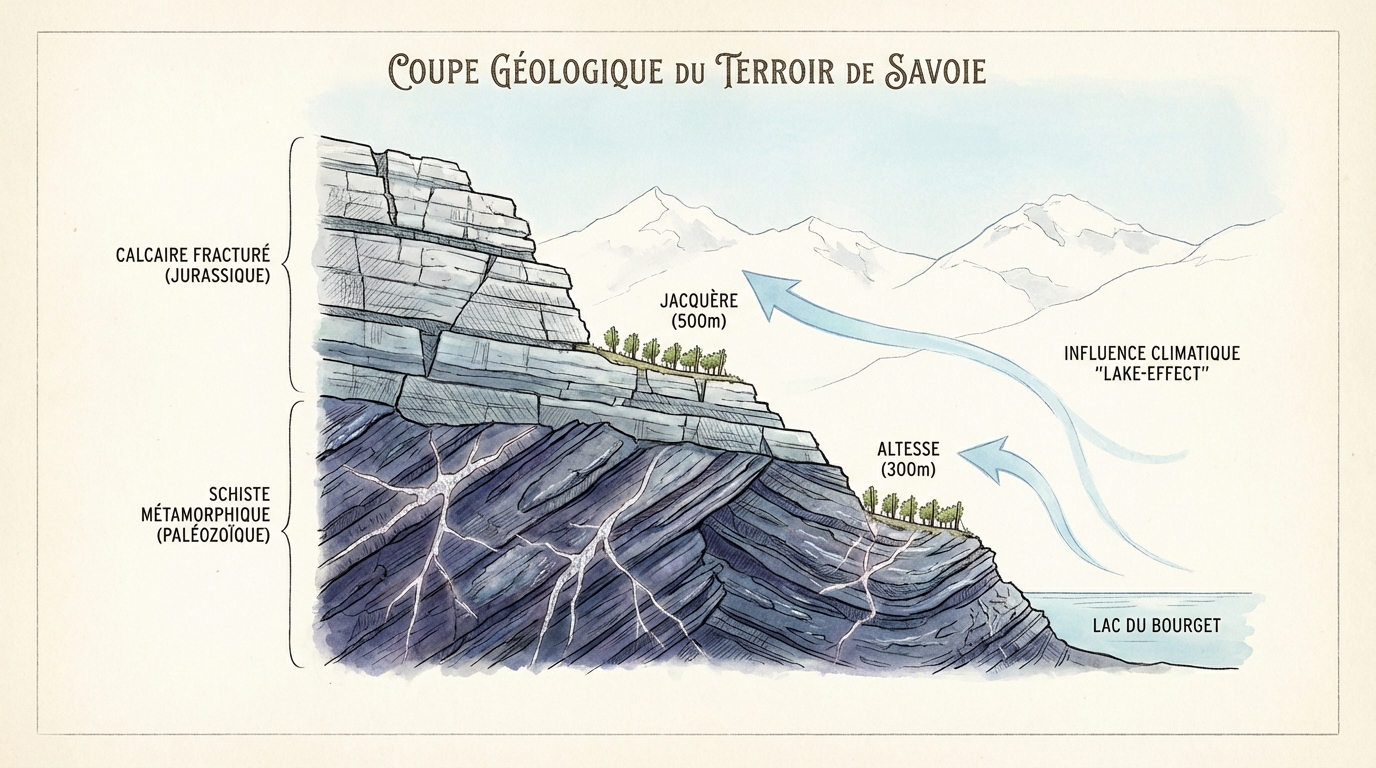
Altitude is a defining factor. Most Savoie vineyards sit between 250 and 500 meters above sea level, with a few exceptional parcels climbing above 600 meters. At these elevations, diurnal temperature variation is extreme — warm days driven by strong alpine sunshine give way to cool nights as mountain air descends through the valleys. This thermal amplitude is critical: it preserves acidity while allowing full phenolic ripeness, producing whites of remarkable freshness and tension even in warm vintages.
The mountain aspect matters enormously. South and southeast-facing slopes receive maximum sunlight, and many of the best crus are positioned to catch the morning sun while being shaded from the scorching afternoon heat by surrounding peaks. The lakes contribute a moderating influence, retaining summer warmth and releasing it gradually through autumn, extending the growing season and reducing frost risk in spring.
The soils tell the story of geological time compressed into a small space. The Apremont and Abymes crus, the largest and most famous in Savoie, are planted on a vast field of limestone rubble — the debris from a catastrophic landslide in 1248, when the face of Mont Granier collapsed in one of the largest recorded rockfalls in European history, burying several villages and creating a moonscape of broken limestone that proved ideal for viticulture. The exceptionally well-drained, stony soils force vines to root deeply and produce intensely mineral wines.
Further north, the crus along Lac du Bourget — Jongieux, Marestel, and Monthoux — sit on steep slopes of limestone and marl, with lake-moderated temperatures and an amphitheater-like exposure that concentrates warmth. The Chignin cru occupies south-facing slopes of clay-limestone below dramatic rock outcrops, while Arbin, the heartland of red Mondeuse, is planted on schist and anthracite-bearing soils that give the wines their distinctive mineral, almost smoky character.
The Combe de Savoie, the valley stretching southeast from Chambéry toward Albertville, is the region's viticultural spine — a long, narrow corridor where the vineyards line the lower slopes on either side, sheltered from the worst weather by surrounding mountains. This is where most of Savoie's named crus are concentrated, and where the interplay between soil, altitude, aspect, and microclimate creates the most compelling expressions of the region's indigenous grapes.
Key White Grapes: Jacquère, Altesse, and Roussanne
White wine accounts for roughly 70% of Savoie's production, and the region's identity is built on three principal white grape varieties, each occupying its own ecological niche and producing a distinctly different style.
Jacquère is the workhorse and dominant variety of Savoie, covering approximately 1,000 hectares — nearly half the total vineyard area. It is the grape behind the region's two most famous crus, Apremont and Abymes, and its character defines the default Savoie white: pale, light-bodied, crisply acidic, with delicate notes of white flowers, green apple, citrus zest, and a distinctive mineral, almost flinty finish. At its most basic, Jacquère produces pleasant but unremarkable vin de soif. In the hands of a quality-minded producer working with old vines and low yields, however, it is capable of surprising depth and complexity — wines with a saline, chalky texture, vibrant acidity, and a persistent mineral finish that reflects the broken limestone terroir of the Mont Granier landslide.
The key to great Jacquère is restraint. The variety is naturally productive, and overcropping produces thin, dilute wines. Producers who limit yields to 40 to 50 hectoliters per hectare (compared to the permitted 70 hl/ha) and harvest at optimal ripeness rather than maximum volume achieve wines of genuine interest. Domaine Louis Magnin, Domaine des Ardoisières, and Domaine Giachino are among those demonstrating that Jacquère, properly handled, deserves to be taken seriously.
Altesse (also called Roussette) is Savoie's most noble white grape, producing wines of substantially greater weight, complexity, and aging potential than Jacquère. The variety has its own appellation — Roussette de Savoie AOC — requiring 100% Altesse, which can be further specified by cru: Frangy, Marestel, Monterminod, and Monthoux. The origin of Altesse is debated: legend attributes its arrival in Savoie to a 15th-century princess who brought cuttings from Cyprus, though genetic analysis suggests a more prosaic Burgundian origin.
Altesse produces medium to full-bodied whites with a distinctive golden hue, aromas of dried fruits, hazelnuts, honey, and beeswax, and a round, textured palate with enough acidity to maintain freshness and structure. The finest Roussette de Savoie — particularly from the Marestel cru on the slopes above Lac du Bourget — can age beautifully for 8 to 15 years, developing a nutty, almost Burgundian complexity. This is Savoie's candidate for serious gastronomy, pairing beautifully with freshwater fish, poultry in cream sauce, and aged alpine cheeses.
Roussanne — the great white grape of the northern Rhône — finds one of its most distinctive expressions in Savoie under the local synonym Bergeron. The cru of Chignin-Bergeron is devoted exclusively to this variety, planted on south-facing clay-limestone slopes that achieve the warmth necessary to ripen this late-budding, heat-loving grape. Chignin-Bergeron is the most structured, richest, and most age-worthy dry white wine of Savoie — full-bodied, with aromas of apricot, white peach, herbs, and a distinctive waxy, honeyed texture that becomes increasingly complex with 5 to 10 years of bottle age.
Other white varieties include Chasselas (used in the Crépy AOC along Lac Léman, producing light, neutral wines similar to those across the border in Switzerland), Gringet (a rare local variety used in the Ayze cru for still and sparkling wines), and Molette (a component of Seyssel sparkling wine).
Key Red Grape: Mondeuse — The Soul of Savoie Reds
If Jacquère defines Savoie's white wines, Mondeuse (specifically Mondeuse Noire) is the soul of its reds — an indigenous variety of extraordinary character that has been compared to Syrah, linked genetically to Refosco in Italy's Friuli, and even suggested as a distant relative of the Jura's Trousseau. Recent DNA analysis has confirmed that Mondeuse is an ancient Alpine variety with a complex family tree, but its truest comparison may simply be to itself: there is nothing else quite like it.
At its best, Mondeuse produces medium to full-bodied reds of remarkable complexity: dark cherry and blackberry fruit, pronounced black pepper and violet aromatics, a distinctive smoky, mineral character (particularly from the schist soils of Arbin), firm but fine tannins, and vibrant acidity that makes it both food-friendly and age-worthy. The parallel with Syrah is often drawn — both share peppery spice and dark fruit — but Mondeuse has its own distinct personality: lighter in body, more lifted in acidity, and with a mountain freshness that Syrah rarely achieves.
The heartland of great Mondeuse is the cru of Arbin, in the Combe de Savoie southeast of Chambéry. Here, the vines grow on steep, south-facing slopes of schist and anthracite-bearing soils at altitudes of 300 to 450 meters. The combination of extreme sun exposure, well-drained mineral soils, and cool nighttime temperatures produces Mondeuse of remarkable concentration and structure — wines that can age for 10 to 20 years and develop savory, truffle-like complexity.
Saint-Jean-de-la-Porte is another key cru for Mondeuse, producing a slightly softer, more immediately approachable style on clay-limestone soils. Chignin also produces noteworthy Mondeuse alongside its famous Bergeron whites.
The revival of Mondeuse as a serious red wine is one of Savoie's most exciting developments. For much of the 20th century, it was typically made in a light, carbonic-maceration style designed for early drinking — the mountain equivalent of Beaujolais. Today, a growing number of producers are giving Mondeuse the respect it deserves: lower yields, longer macerations, judicious oak aging, and the conviction that this variety can produce world-class reds. Domaine Louis Magnin, whose Mondeuse Arbin from old vines on schist is considered the benchmark, Domaine des Ardoisières (Brice Omont), Domaine Giachino, and Domaine Dupasquier are all pushing the grape to new heights.
A related variety, Mondeuse Blanche, is the mother grape of Syrah (confirmed by DNA analysis) and still exists in tiny plantings in Savoie. It produces aromatic, herbal white wines of considerable interest, though quantities are minuscule.
Key Appellations and Crus
Savoie's appellation system is deceptively complex for such a small region. The umbrella Vin de Savoie AOC encompasses 16 named crus, each with its own terroir signature. Understanding the key crus is essential to navigating the region.
Apremont is the largest and most well-known cru, responsible for a significant proportion of all Savoie wine sold. It sits on the debris field of the 1248 Mont Granier landslide — broken limestone rubble that produces quintessential Jacquère: pale, crisp, mineral, with a slight spritz (many producers leave a trace of residual CO2 for freshness). This is the classic apéritif wine of Savoie and the standard accompaniment to fondue.
Abymes occupies the lower portion of the same landslide terrain as Apremont and produces a similar but generally lighter, more floral style of Jacquère. The two crus together account for the vast majority of Jacquère production.
Chignin is a versatile cru producing both whites (Jacquère and Bergeron/Roussanne) and reds (Mondeuse and Gamay). Chignin-Bergeron, as noted above, is exclusively Roussanne and produces the richest white wines of the region. The village sits at the foot of dramatic limestone cliffs, with vineyards on steep, well-exposed slopes.
Arbin is the spiritual home of Mondeuse and arguably the most terroir-expressive cru in Savoie. The schist and anthracite soils here produce Mondeuse of unmatched depth, mineral intensity, and aging potential. This is where the grape reaches its highest expression.
Crépy, on the southern shore of Lac Léman near the Swiss border, produces delicate, light whites from Chasselas — nearly indistinguishable from the Fendant wines of neighboring Valais. These are charming lake wines, best drunk young and cold as an apéritif.
Seyssel, the oldest AOC in Savoie (established 1942), straddles the Rhône as it exits Lac du Bourget. The appellation produces still Roussette (Altesse) and a traditional-method sparkling wine, Seyssel Mousseux, made from the rare Molette grape blended with Altesse. The sparkling wine was once famous — Varichon & Clerc supplied it to Parisian restaurants throughout the 20th century — and remains one of France's most charming, affordable sparklers.
Marestel and Jongieux, on the western shore of Lac du Bourget, produce some of the finest Roussette de Savoie from Altesse vines on steep limestone slopes moderated by the lake's thermal mass. Marestel in particular is considered the Grand Cru of Altesse.
Ayze, near Bonneville in the Arve Valley, is home to the rare Gringet grape, used for still and sparkling wines. The local tradition of pétillant (lightly sparkling) Gringet is unique to Savoie and has attracted the attention of the natural wine movement.
Winemaking: Fresh, Mineral, Low-Intervention
Savoie's winemaking philosophy has evolved from rustic functionality to a refined pursuit of purity and terroir expression. The dominant approach today — particularly among the quality-oriented independent producers — emphasizes minimal intervention: native yeast fermentations, limited or no sulfur additions, no new oak (or very judicious use of large, neutral casks), and bottling that preserves the wine's natural vivacity.
For whites, stainless steel remains the dominant vessel, protecting the delicate aromatics and crisp acidity that define Savoie's identity. Some producers experiment with large oak foudres, concrete eggs, or amphora, but the goal is always the same: to let the terroir speak without the distraction of winemaking artifice. Many Jacquère wines are bottled with a deliberate trace of dissolved CO2 — not enough to be truly sparkling, but sufficient to add a prickling freshness on the palate that enhances the wine's liveliness.
For Mondeuse and other reds, the trend has shifted from light, carbonic-maceration styles toward longer macerations with gentle extraction, producing wines with more color, structure, and complexity while maintaining the variety's characteristic freshness. A few producers use small oak barrels for their top Mondeuse cuvées, though the consensus favors restraint — Mondeuse's natural peppery, smoky character is best served by winemaking that amplifies rather than obscures it.
The natural wine movement has found a particularly receptive home in Savoie. The region's small scale, artisanal traditions, indigenous grape varieties, and challenging mountain terroir align perfectly with the natural wine ethos of minimal intervention and maximal terroir expression. Producers like Domaine des Ardoisières, Domaine Giachino, Domaine Belluard (the champion of Gringet in Ayze), and Les Vignes de Paradis have become darlings of the natural wine circuit, their bottles sought after by sommeliers and wine bars from Paris to New York to Tokyo.
This convergence of Savoie's traditional strengths with contemporary natural wine values has been transformative for the region's reputation. Wines that were once invisible outside the Alps now appear on some of the world's most celebrated restaurant lists, and young winemakers are arriving in Savoie specifically because its unique terroir and grapes offer what homogenized appellations cannot: genuine originality.
Food Pairing: Alpine Cuisine and Mountain Wines
The marriage between Savoie wines and Savoyard cuisine is one of the most perfect regional food-and-wine symbioses in France. The rich, warming, cheese-centric dishes of the mountains demand wines with the precision and acidity to cut through the fat, and Savoie delivers this with effortless grace.
Fondue — the region's most iconic dish — is the quintessential Jacquère pairing. The wine's high acidity, light body, and mineral crunch act as a palate cleanser against the molten Beaufort, Comté, and Emmental in the pot. The trace of CO2 in many Jacquère wines adds a further cleansing effect, preventing the cheese from becoming cloying. Apremont and Abymes are the traditional choices, and no fondue restaurant in the Alps would serve anything else.
Raclette — melted cheese scraped onto boiled potatoes, charcuterie, and cornichons — pairs beautifully with both Jacquère and Roussette de Savoie. The richer texture of Altesse can stand up to the intensity of the melted Raclette cheese, while Jacquère provides refreshing contrast.
Tartiflette — the gratinéed potato, bacon, onion, and Reblochon cheese casserole — is perhaps the most indulgent of all Savoyard dishes. Chignin-Bergeron, with its weight and waxy texture, is the ideal partner: the Roussanne's richness matches the dish's intensity, while its acidity prevents palate fatigue.
For Mondeuse, the classic pairings are mountain charcuterie — diots (Savoyard pork sausages, traditionally cooked in white wine), lonzo, and coppa — as well as braised or roast game, mushroom dishes, and robust mountain stews. The wine's peppery spice and firm structure complement the smoky, earthy flavors of cured and braised meats.
Savoie's great cheeses are natural partners for its wines: Beaufort (a massive, firm alpine cheese with nutty, slightly sweet flavor) with Roussette de Savoie or aged Chignin-Bergeron; Reblochon (a soft, washed-rind cheese) with Jacquère or young Mondeuse; Abondance (semi-firm, fruity) with Apremont; and Tome des Bauges (a rustic farmhouse cheese) with virtually any red or white from the region.
Freshwater fish from the region's lakes — féra (a whitefish from Lac Léman), omble chevalier (Arctic char from Lac du Bourget), and perch from Lac d'Annecy — are natural matches for Jacquère and Roussette. The delicate flesh of these lake fish demands wines that enhance rather than overpower, and Savoie whites provide exactly that.
Top Producers
The quality hierarchy in Savoie has crystallized considerably over the past decade. These producers represent the region's current pinnacle:
Domaine Louis Magnin (Arbin) — Michel and Béatrice Magnin farm biodynamically on the steep schist slopes of Arbin, producing what many consider the definitive Mondeuse: concentrated, mineral, peppery, with astonishing aging potential. Their Roussette de Savoie and Chignin-Bergeron are equally compelling. This is the estate that proved Savoie could produce world-class wine.
Domaine des Ardoisières (Cevins) — Brice Omont farms a remarkable site in the Combe de Savoie where schist (ardoise) soils at altitude produce wines of crystalline purity. His white "Quartz" (from Jacquère and Altesse), red "Amethyste" (Mondeuse, Persan, Gamay), and "Argile" bottlings are named for the minerals in his soils — a geological approach that yields genuinely distinctive wines.
Domaine Giachino (Chapareillan) — Frédéric Giachino practices natural winemaking with a precision that belies the "natural" label. His Jacquère from Apremont is a benchmark for the variety, while his Mondeuse and Persan bottlings demonstrate the potential of Savoie's red varieties in hands that combine conviction with craft.
Domaine Belluard (Ayze) — The late Dominique Belluard was the champion of Gringet, the rare indigenous variety of the Arve Valley. His biodynamic estate produces still and sparkling Gringet of remarkable purity and originality, alongside Mondeuse and Altesse. His son now continues the legacy with the same uncompromising approach.
André et Michel Quenard (Chignin) — This family estate is perhaps the most reliable producer across the full range of Savoie styles, from crisp Jacquère and aromatic Roussette to benchmark Chignin-Bergeron and structured Mondeuse. Their wines are widely available and consistently excellent, making them the ideal introduction to the region.
Domaine Dupasquier (Jongieux) — Noël Dupasquier was a pioneer of quality-focused viticulture on the slopes above Lac du Bourget. The estate's Roussette de Savoie Marestel and Mondeuse are benchmarks, and their rare Mondeuse Blanche bottling is one of the most unusual wines in France.
Other producers of note include Domaine Jean-Pierre et Jean-François Quenard, Domaine Philippe Grisard, Les Vignes de Paradis (Dominique Lucas), Domaine de l'Idylle, and Château de Ripaille (for Chasselas from the shores of Lac Léman).
Why Savoie Is Surging in Natural Wine Circles
Savoie's emergence as a darling of the natural wine movement is no accident — it is the logical convergence of everything that makes the region distinctive. Small-scale, artisanal production. Indigenous grape varieties with unique flavor profiles. Dramatic, high-altitude terroir that imprints itself on the wines. A tradition of minimal intervention that predates the natural wine movement by generations. And prices that allow adventurous drinkers to explore without financial barrier.
The natural wine community values originality above all, and Savoie delivers it in abundance. A glass of Mondeuse from Arbin tastes like nowhere else on earth. A Gringet from Ayze exists in a category of its own. Even Jacquère, the region's most basic variety, carries a mineral signature — the ghost of a medieval landslide — that you will not find in any Sauvignon Blanc or Pinot Grigio on the planet. In a wine world increasingly dominated by international varieties and homogenized styles, Savoie's stubborn individuality is its greatest commercial asset.
The movement has also attracted new talent to the region. Young winemakers who might once have sought land in the Languedoc or the Loire are instead heading to the Alps, drawn by affordable vineyard prices, pristine growing conditions, and the opportunity to work with grapes that have yet to be fully explored. This influx of energy and ambition is accelerating the quality trajectory that producers like Magnin, Belluard, and Omont initiated.
Climate change, paradoxically, is also working in Savoie's favor. As warming temperatures push traditional lowland regions toward overripeness and alcohol excess, the altitude and continental climate of the Alps provide a natural buffer. Savoie's vineyards, already positioned for maximum sun exposure, can absorb additional warmth without losing the acidity and freshness that define the style. What was once a marginal, cool-climate region is increasingly becoming an optimal one.
For the wine drinker, the practical takeaway is simple: Savoie has never been better, has never been more available beyond its borders, and has never been more relevant. These are wines of place, wines of personality, and wines of extraordinary value. The Alps have found their voice, and the wine world is listening.


