Sicily is the Mediterranean's largest island at 25,000 square kilometres. The diversity of terroir across the island is enormous: from the volcanic heights of Mount Etna at 3,300 metres to the flat, torrid southern plains where Nero d'Avola reaches its highest concentration.
Etna: The Volcano That Remade Sicilian Wine
No single place has done more to reshape global perceptions of Sicilian wine than Mount Etna -- the active volcano that dominates the northeastern corner of the island. Etna has become one of the most discussed wine regions in the world, drawing comparisons to Burgundy for its terroir complexity, Barolo for its tannin structure, and Pinot Noir for the transparency of its finest wines to site and vintage.
The Etna DOC, established in 2001, covers vineyards on the lower slopes of the volcano at elevations of 400-1,000 metres above sea level. The slopes are steep, access roads are rough, and the volcanic soil -- black basalt and grey pumice -- requires entirely different viticultural techniques from the sandy or clay soils of the Sicilian lowlands.
The Contrade System: Burgundy on a Volcano
Etna's winemakers have established a contrade (singular: contrada) classification system that functions much like Burgundy's Premier and Grand Cru designations. Each contrada corresponds to a specific lava flow from a particular historical eruption, and the age and composition of the basalt profoundly influences the character of wines grown there.
Key contrade on Etna's northern slope (Etna Nord -- generally considered the finest zone):
- Contrada Calderara Sottana: Elegant, floral, high-elevation expression
- Contrada Barbabecchi: Power and concentration, south-facing aspect
- Contrada Santo Spirito: Balance and minerality, benchmark Passopisaro site
- Contrada Feudo di Mezzo: Nerello of unusual delicacy and aromatic lift
The Alberello Bush Vine Tradition
Etna's vineyards are trained in the ancient alberello (bush vine) method -- free-standing, un-trellised vines pruned to a low gobelet form. This training system, used in Etna for centuries, forces vines into a naturally low yield and provides shade for the grape bunches during the intense Sicilian summer. Many of Etna's alberello vines are pre-phylloxera, surviving on their own rootstocks in the volcanic soil that phylloxera could not penetrate, and some are 80-150 years old.
Nerello Mascalese is the primary red grape of Etna, producing wines of haunting elegance -- pale ruby in colour, aromatic and fine-boned, with bright acidity and silky tannins that Burgundy lovers find immediately appealing. Nerello Cappuccio plays a blending role, adding colour and roundness to the more austere Mascalese.
Carricante is the prized white variety of Etna, producing wines of remarkable freshness and mineral drive from high-altitude vineyards on the eastern slope (Etna Est). At its best -- from producers like Benanti in the Milo area -- Carricante delivers citrus, green herb, and volcanic mineral notes that are like nothing else in Italian white wine.
Top Etna Producers
Benanti
The estate that first demonstrated Etna's world-class potential, Benanti began serious work in the 1990s when the rest of Sicily was still focused on bulk production. Their Rovittello Etna Rosso from the northern slope and their Pietra Marina Etna Bianco from Carricante remain benchmarks of the appellation and inspired a generation of smaller producers to follow.
Cornelissen
Frank Cornelissen (Belgian-born, Etna-adopted) is the most radical of the Etna winemakers -- making wines without sulphur additions, without temperature control, and with extended skin contact for both reds and whites in clay amphora. The wines are controversial (some bottles show oxidation or volatility) but the best are extraordinary expressions of Nerello terroir. His Magma is among the most sought-after Italian wines.
Passopisaro
Passopisaro (Andrea Franchetti, who also founded Trinoro in Tuscany) produces single-contrada Nerello Mascalese wines that are among the most Burgundian in style on Etna -- perfumed, elegant, and site-specific. The estate works exclusively with old-vine alberello plantings in the premium contrade of the north slope.
Terre Nere
Terre Nere (Marc de Grazia, an Italian-American wine merchant turned winemaker) produces the most extensive range of single-contrada Etna Rosso, demonstrating the terroir differences between parcels with clarity and consistency. De Grazia's background as an importer gives the wines immediate international credibility and distribution.
COS
COS (Giambattista Cilia and Cirino Strano) in Vittoria in southeastern Sicily is one of the founding estates of the Sicilian natural wine movement -- making wines from Nero d'Avola and Frappato in clay amphora since the 1980s. Their Pithos wines are named after the Greek word for amphora and are among the most important natural wines in Italy.
Sicily's transformation begins on a volcano but its most famous variety grows in the opposite landscape: the hot, flat plains of the southern coast.
Nero d'Avola: Sicily's Signature Red
Nero d'Avola takes its name from the town of Avola near Syracuse in southeastern Sicily. It is the island's most internationally recognised red grape -- a variety that combines the power of the sun-baked Sicilian south with enough acidity and tannin structure to produce wines of genuine interest beyond sheer volume.
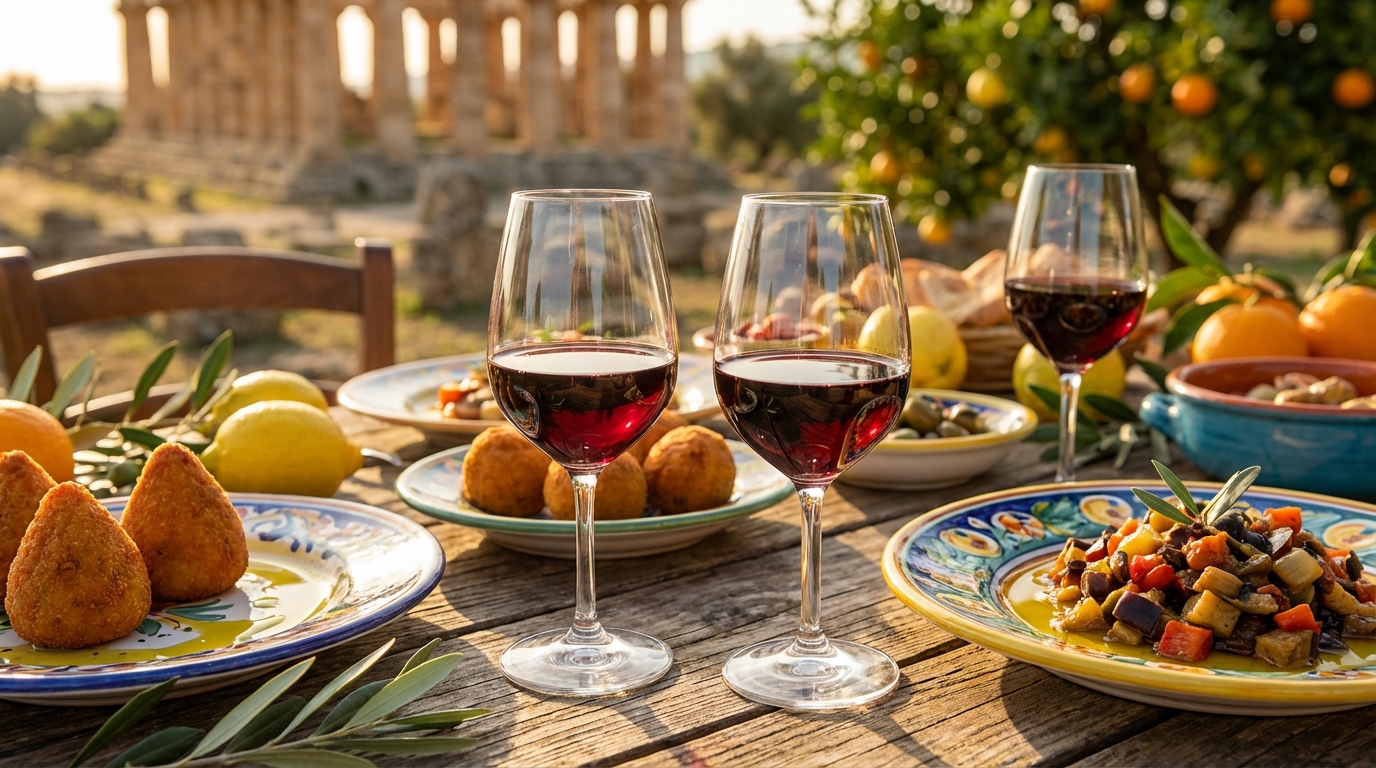
The classic Nero d'Avola profile:
- Dark cherry and blackcurrant fruit, rich and generous
- Chocolate, licorice, and tobacco secondary notes
- Firm but ripe tannins with good natural acidity
- Full body and generous alcohol (typically 13.5-15%)
- Excellent value at most price points
The finest Nero d'Avola comes from the Pachino DOC area at the very tip of southeastern Sicily, where ancient limestone soils and proximity to the sea create wines of greater complexity and mineral character than the flat plains further north. The Pachino designation is seldom seen on export labels but marks the most serious Nero d'Avola available.
Marsala: The Fortified Wine That Built an Empire
Marsala is Sicily's most historically significant wine style -- a fortified wine with origins in 1796, when English merchant John Woodhouse stopped in the western Sicilian port of Marsala during a storm. Woodhouse discovered the local wine, added grape spirit to preserve it for the voyage to England, and returned to establish the first commercial Marsala winery. The wine became enormously popular in Britain, and several British merchants (including the Whitaker and Ingham families) subsequently established major houses in Marsala.
Modern Marsala is produced from native Sicilian varieties (Grillo, Catarratto, Inzolia for white Marsala; Perricone, Calabrese/Nero d'Avola, Nerello Mascalese for Rubino/red styles) fortified with grape spirit to 17-22% alcohol. The main quality categories:
- Marsala Fino: Minimum 1 year ageing -- the simplest category, often used for cooking
- Marsala Superiore: Minimum 2 years -- more complex, can be excellent as an aperitif
- Marsala Superiore Riserva: Minimum 4 years
- Marsala Vergine/Soleras: Minimum 5 years (10 for Stravecchio), made without concentrated must -- the finest category, comparable to Amontillado Sherry in quality and character
The cooking wine stigma has unfairly damaged Marsala's reputation. A well-aged Marsala Vergine from producers like Marco De Bartoli or Florio is a genuinely great wine -- complex, nutty, and worthy of serious attention at the table.
The Islands: Pantelleria and the Aeolians
Pantelleria: Passito di Pantelleria
The island of Pantelleria, closer to Tunisia than to Sicily, produces one of Italy's most distinctive sweet wines from Zibibbo (Muscat of Alexandria). The island's volcanic soil, relentless winds, and North African climate create conditions where the traditional bush-vine alberello training (here called the Pantesco system, with vines trained almost flat to the ground to shelter from wind) produces tiny quantities of intensely concentrated fruit.
Passito di Pantelleria is made from Zibibbo grapes partially dried on the vine or on mats in the sun, concentrating sugar, aromatic compounds, and acidity. The result is one of the world's great dessert wines -- apricot, candied citrus, rose petal, and honey in intense harmony, with enough acidity to prevent cloying sweetness. The non-dolce (dry) version, often called Pantelleria Bianco or Moscato di Pantelleria Naturale, is also exceptional.
The Aeolian Islands: Malvasia delle Lipari
The volcanic Aeolian Islands north of Sicily produce Malvasia delle Lipari -- a luscious, amber-tinged passito from Malvasia grapes dried on bamboo racks in the island sun. The wines are intensely aromatic (orange blossom, apricot, honey) with a distinctive volcanic mineral note that distinguishes them from mainland Malvasia styles. Production is tiny and the wines are rarely seen outside specialist Italian wine merchants.
Sicilian White Wines
Sicily produces substantial quantities of white wine from native varieties that are increasingly recognised for their quality:
- Catarratto: The most widely planted variety on the island (white), producing wines of citrus and almond character. At its best -- from low-yielding old vines -- it achieves real depth; at its worst, it is neutral and thin
- Grillo: A naturally high-acid variety that excels as both still white wine (herbaceous, citrus) and as the best base for quality Marsala
- Carricante: The great white variety of Etna -- mineral, fresh, and complex at high altitude
- Inzolia (Ansonica): Aromatic and light-bodied, found across western Sicily and the Tuscan coast under the name Ansonica
IGT Sicily: Freedom to Experiment
The IGT (Indicazione Geografica Tipica) Sicilia designation has been crucial to the island's transformation. Unlike the restrictive DOC rules that govern Etna or Marsala wines, IGT Sicilia allows producers to use any grape varieties in any proportions -- enabling international varieties (Syrah, Cabernet, Chardonnay), experimental blends, and indigenous varieties not covered by other DOC rules.
This freedom has been essential for producers who want to experiment with Syrah from volcanic soils, blend Nero d'Avola with Cabernet Sauvignon, or make white wines from rare indigenous varieties without bureaucratic constraint. The best IGT Sicily wines are among the most exciting wines on the island.
Buying Guide
- Entry level (EUR 10-18): COS Frappato, Donnafugata Sul Vulcano Etna Rosso -- excellent value from serious producers
- Mid-range (EUR 20-40): Benanti Rovittello Etna Rosso, Terre Nere Etna Rosso -- site-specific excellence
- Premium (EUR 45-100): Cornelissen Munjebel, Passopisaro Porcaria -- single-contrada precision
- Icon (EUR 100+): Cornelissen Magma -- the most discussed Sicilian wine
Sicily has earned its place among the great wine islands of the world -- alongside Sardinia, Corsica, and the Canary Islands -- and its volcanic heart at Etna may yet prove to be among the greatest terroirs of Italy. The alberello vines, the ancient lava flows, the 1,000-metre altitude: all point toward a future as distinguished as its 8,000-year-old past.


