Introduction: France's Most Diverse and Underrated Wine Region
Sud-Ouest — South-West France — is one of the most sprawling, heterogeneous, and consistently undervalued wine regions on earth. Stretching from the eastern fringes of Bordeaux to the foothills of the Pyrenees, and from the Atlantic coast to the uplands of the Massif Central, the Sud-Ouest encompasses more than 50 distinct appellations and a dizzying array of indigenous grape varieties found virtually nowhere else. If Bordeaux is France's polished elder statesman, the Sud-Ouest is its wilder, more eccentric sibling — equally talented but far less concerned with appearances.
The region's diversity is its defining characteristic and, paradoxically, the primary reason it has struggled for international recognition. While Bordeaux built a global brand around two or three blends, the Sud-Ouest never consolidated. Instead, each pocket of this vast territory preserved its own grapes, its own traditions, and its own fierce local identity. Cahors champions Malbec — the grape's ancestral homeland, centuries before Argentina made it famous. Madiran tames the ferocious Tannat into wines of extraordinary power and longevity. Jurançon produces hauntingly beautiful sweet wines from Petit Manseng and Gros Manseng, grapes that exist almost exclusively here. Gaillac cultivates varieties like Mauzac, Len de l'El, and Duras that most wine professionals have never encountered. And in the Basque Country, tiny Irouléguy crafts mountain wines against improbable odds.
For the adventurous wine drinker, the Sud-Ouest represents one of the last great treasure hunts in French wine. Prices remain astonishingly low — often €8 to €15 for bottles of genuine complexity and character — and the quality revolution that began in the 1990s continues to accelerate. A new generation of winemakers, many of them returning from stints in Bordeaux, Burgundy, or the New World, is pushing the region forward while respecting the indigenous varieties that give it a voice unlike any other.
The geography alone hints at the region's complexity. The Garonne and Tarn rivers carve through limestone plateaus in the east, creating the dramatic causse terrain of Cahors. Further south, the Adour river system feeds the foothills around Madiran and Jurançon. The Pyrenees form the southern wall, their altitude and maritime influence shaping the vineyards of Irouléguy and Jurançon. In between, rolling hills of clay, gravel, sand, and ancient alluvium produce wines that defy generalization — which is precisely the point.
Cahors: Malbec's Birthplace and the "Black Wine"
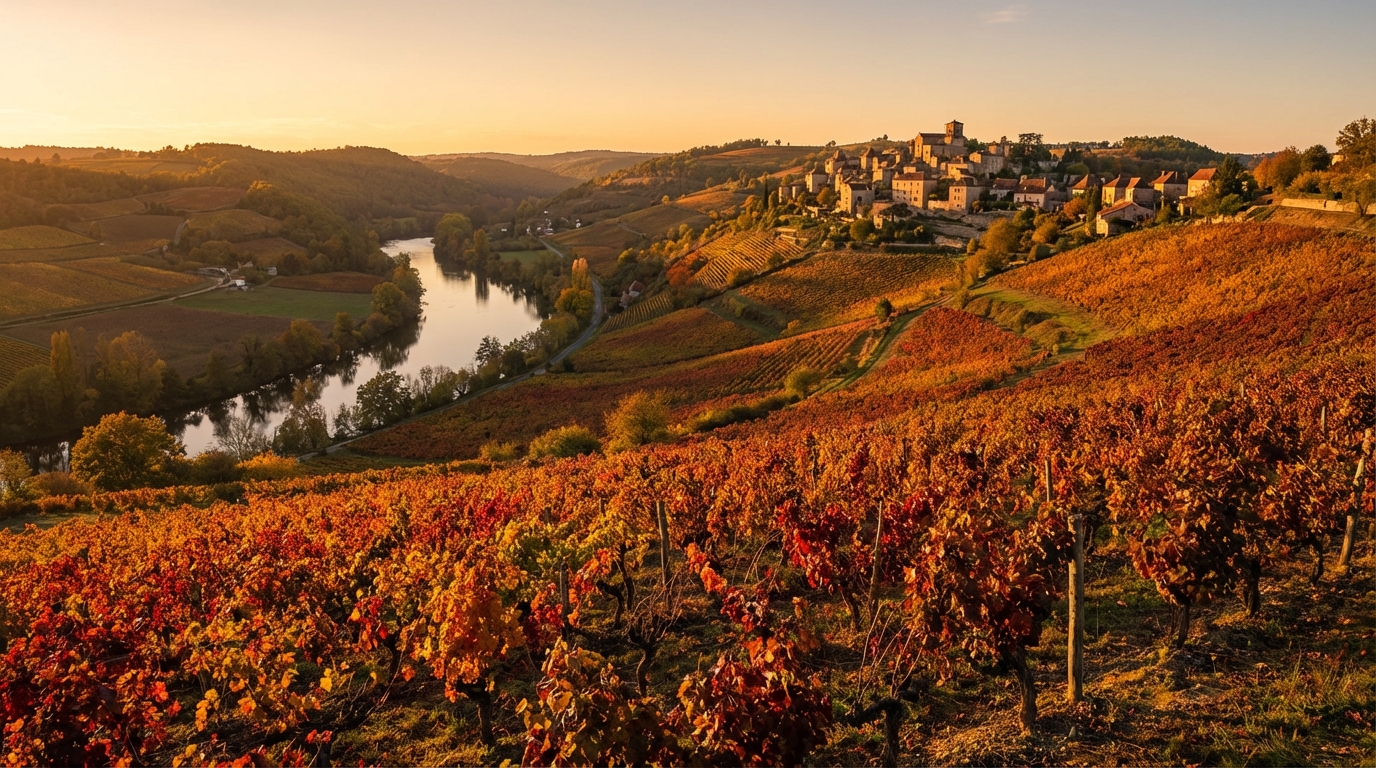
Cahors is the soul of the Sud-Ouest and one of France's oldest wine regions, with documented viticulture stretching back to Roman times. The appellation sits along a dramatic bend of the Lot River, about 120 kilometers east of Bordeaux, where steep limestone cliffs and iron-rich terrace soils create conditions that produce wines of remarkable depth and concentration. This is the birthplace of Malbec — known locally as Côt or Auxerrois — and the region's winemakers are justifiably proud that their grape conquered the world from Argentine soil long before most consumers realized it had French origins.
The historical reputation of Cahors rests on the legendary "Black Wine" (vin noir) — ink-dark, tannic, massively structured wines that were prized across medieval Europe. In the 13th and 14th centuries, Cahors wines rivaled Bordeaux in prestige, exported through the port of Bordeaux and drunk at the courts of popes, kings, and tsars. The Russian Orthodox Church designated Cahors as its sacramental wine, a tradition that persists to this day. However, the region's fortunes collapsed in the 19th century — first from the devastating phylloxera epidemic, then from catastrophic frosts in 1956 that destroyed most of the vineyard area.
Modern Cahors was rebuilt almost from scratch in the 1960s and 1970s, and the appellation received AOC status in 1971. The rules require a minimum of 70% Malbec in the blend, with Merlot and Tannat permitted as supporting varieties. In practice, many of the best producers work with 100% Malbec, believing the grape needs no dilution on its home terroir.
The appellation divides into three broad terroir zones. The Lot Valley floor (première terrasse) produces softer, earlier-drinking wines from gravelly, alluvial soils. The second terrace (deuxième terrasse) offers more structure from iron-rich clay. And the elevated causse — the limestone plateau above the valley — yields the most concentrated, age-worthy wines, with deep root systems reaching into fractured rock. The best Cahors from causse vineyards can age for 20 to 30 years, developing notes of truffle, tobacco, dark plum, and iron.
Key producers driving Cahors's modern renaissance include Château du Cèdre (Pascal and Jean-Marc Verhaeghe), whose single-vineyard cuvées rival top Bordeaux in complexity; Clos Triguedina (the Baldès family), pioneers of Cahors's quality revolution since the 1830s; Château Lagrezette, owned by Alain-Dominique Perrin, which brought investment and ambition to the appellation in the 1990s; and Domaine Cosse Maisonneuve, whose natural-wine approach produces hauntingly pure expressions of Malbec from old vines on the causse. The newer generation is represented by estates like Château Lamartine and Mas del Périé (Fabien Jouves), whose biodynamic cuvées have earned cult followings among sommeliers.
Despite this quality surge, Cahors remains criminally underpriced. A top-tier cuvée from the causse rarely exceeds €25 to €35, and excellent entry-level bottles can be found for €8 to €12 — a fraction of what comparable quality would cost from Bordeaux's classified growths.
Madiran: The Tannat Revolution
If Cahors is the Sud-Ouest's brooding poet, Madiran is its heavyweight boxer — a small appellation in the département of Gers and Hautes-Pyrénées that produces some of France's most powerful, tannic, and long-lived red wines from the formidable Tannat grape. The name says it all: Tannat delivers tannins of extraordinary density and grip, creating wines that in their youth can feel almost impenetrable, yet with age transform into something majestic.
Madiran's vineyard area covers approximately 1,300 hectares on rolling clay-limestone and siliceous hills in the piedmont zone of the western Pyrenees. The appellation requires a minimum of 60% Tannat in the blend, supplemented by Cabernet Franc (locally called Bouchy), Cabernet Sauvignon, and Fer Servadou (also known as Pinenc). The best examples use 80% to 100% Tannat, relying on modern techniques to manage the grape's immense tannin load rather than diluting it with softer varieties.
The transformation of Madiran from rustic oddity to serious fine wine is largely the story of one man: Alain Brumont. Beginning in the 1980s at his estates Château Montus and Château Bouscassé, Brumont championed low yields, new oak aging, and the revolutionary technique of micro-oxygenation — a process he helped develop specifically to tame Tannat's aggressive tannins. Micro-oxygenation involves introducing tiny, controlled amounts of oxygen into the wine during fermentation and aging, softening tannin chains without reducing their overall quantity. The technique has since been adopted worldwide, but it was born in the cellars of Madiran.
Today, Madiran offers two broad styles. The traditional approach produces wines of enormous structure, needing 10 to 15 years of cellaring to reach their peak — dark-fruited, meaty, earthy, with a tannic backbone that can support decades of aging. The modern style, pioneered by Brumont and adopted by producers like Domaine Labranche Laffont (Christine Dupuy) and Château d'Aydie (the Laplace family), delivers riper fruit, smoother tannins, and earlier accessibility without sacrificing power. Both styles are compelling, and both represent extraordinary value — €10 to €20 buys serious wine in Madiran.
The appellation also includes a white wine under the Pacherenc du Vic-Bilh AOC, made from the same Manseng varieties used in Jurançon. Dry versions are crisp and aromatic; sweet late-harvest versions, produced from grapes dried on the vine into winter (passerillage), can be exquisite.
Bergerac and Monbazillac: Bordeaux's Overlooked Neighbor
Bergerac sits directly east of Bordeaux along the Dordogne River, using the same grape varieties — Merlot, Cabernet Sauvignon, Cabernet Franc for reds; Sauvignon Blanc, Sémillon, Muscadelle for whites — in an essentially continuous viticultural landscape. The soils are similar, the climate near-identical, yet Bergerac wines sell for a fraction of Bordeaux prices. This is one of the wine world's most persistent anomalies: an invisible border creates a three-to-tenfold price difference for wines of comparable quality.
The appellation hierarchy includes Bergerac (basic red and white), Côtes de Bergerac (slightly higher standards), and several superior sub-zones. Pécharmant, on iron-rich gravelly clay north of the town of Bergerac, produces the region's best reds — structured, Merlot-dominant wines that genuinely rival Saint-Émilion's satellites. Rosette makes off-dry whites of delicacy and charm.
The crown jewel is Monbazillac, one of France's greatest sweet wine appellations and among its most underappreciated. Monbazillac sits on north-facing slopes above the Dordogne, where autumn mists from the river encourage Botrytis cinerea (noble rot) in conditions remarkably similar to Sauternes. The wines — predominantly Sémillon with Sauvignon Blanc and Muscadelle — offer luscious honey, apricot, and candied citrus flavors with balancing acidity. Top Monbazillac from estates like Château Tirecul La Gravière and Château Bélingard can rival mid-tier Sauternes, yet bottles rarely exceed €15 to €25 — an astonishing bargain for botrytized wine.
Jurançon: Mountain Poetry in a Glass
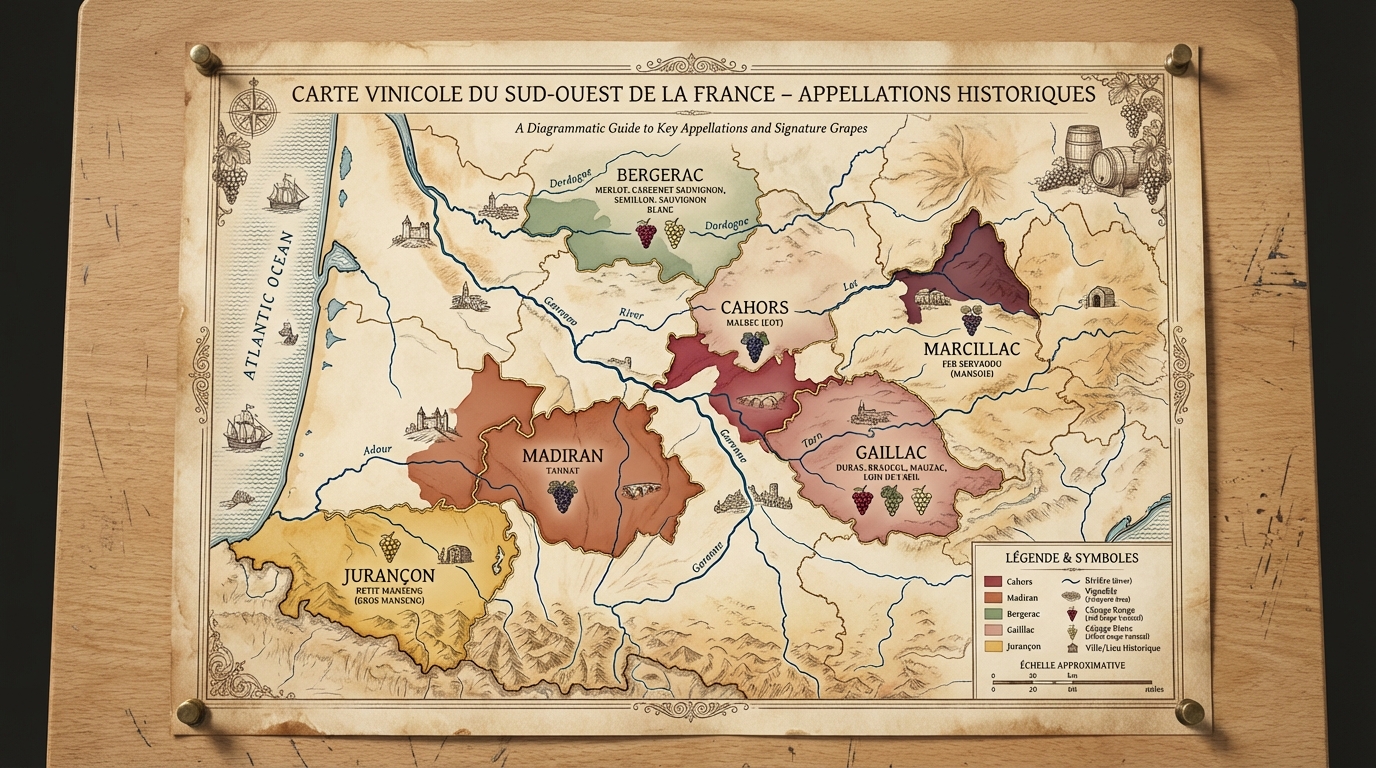
Jurançon occupies a privileged amphitheater of south-facing slopes in the foothills of the western Pyrenees, just south of the city of Pau in Béarn. The appellation is divided into two distinct categories: Jurançon sec (dry) and Jurançon (sweet), both made from the indigenous Petit Manseng and Gros Manseng grapes, sometimes supplemented by Courbu and Camaralet.
The landscape is stunning — steeply terraced vineyards at altitudes of 300 to 400 meters overlook the snow-capped Pyrenees to the south. The aspect ensures maximum sun exposure, while the altitude and proximity to the mountains provide cool nights that preserve acidity. This combination of warmth and freshness is the secret to Jurançon's unique character.
Gros Manseng forms the backbone of Jurançon sec, producing dry whites of remarkable aromatic intensity — grapefruit, passion fruit, white peach — with a saline, mineral finish that reflects the clay-and-pebble soils. These are among the most food-versatile whites in France, pairing brilliantly with seafood, poultry, and the region's distinctive Béarnaise cuisine.
Petit Manseng is the star of sweet Jurançon. Unlike most sweet wines, Jurançon's sweetness comes not from botrytis but from passerillage — the grapes are left on the vine late into autumn and sometimes into early winter, slowly desiccating and concentrating their sugars while the berry's thick skin protects against rot. The resulting wines are intensely sweet yet vibrant, with flavors of candied pineapple, quince, cinnamon, honey, and a distinctive smoky spice note. The natural acidity of Petit Manseng keeps even the richest examples fresh and dynamic. Great sweet Jurançon can age for 20 to 40 years.
The appellation's most celebrated producers include Domaine Cauhapé (Henri Ramonteu), whose Quintessence cuvée is among the finest sweet wines in France; Clos Uroulat (Charles Hours), a champion of traditional methods and biodynamic viticulture; Clos Lapeyre (Jean-Bernard Larrieu), producing both pristine dry whites and opulent sweet wines; and Domaine Bru-Baché, whose late-harvest cuvées achieve extraordinary concentration.
Legend holds that Henri IV of France, born in Pau in 1553, had his lips moistened with Jurançon wine at his baptism — a tradition called the baptême béarnais that is still practiced in the region today. Whether or not the story is literally true, it speaks to Jurançon's deep roots in Pyrenean culture.
Gaillac: One of France's Oldest Wine Regions
Gaillac claims to be one of the oldest wine-producing regions in France, with archaeological evidence suggesting organized viticulture as early as the 1st century BC — predating even the Roman expansion into Gaul. Situated along the Tarn River northeast of Toulouse, Gaillac encompasses approximately 3,600 hectares and produces an extraordinary range of styles: still reds, dry whites, sparkling wines, and sweet wines, all from a roster of indigenous varieties that reads like a botanical catalogue.
The indigenous white grape Mauzac is Gaillac's signature, producing both still wines with distinctive apple-skin and pear aromas and traditional-method sparkling wines called Gaillac Mousseux or Méthode Gaillacoise (the local version of méthode ancestrale, in which the wine finishes its primary fermentation in the bottle, capturing natural CO2). Gaillac's sparkling tradition predates Champagne by at least a century — the monks of the Abbaye Saint-Michel de Gaillac were producing effervescent wines as early as the 10th century, long before Dom Pérignon was born.
Len de l'El (literally "far from sight," referring to the grape's long peduncle that holds the clusters away from the vine) produces aromatic, full-bodied whites. Ondenc, once nearly extinct, has been revived by a handful of producers and contributes floral complexity to white blends. For reds, Duras (unrelated to the Bordeaux appellation) and Braucol (the local name for Fer Servadou) are the indigenous stars, producing wines of surprising depth — peppery, herbal, dark-fruited, with a distinctive regional character.
Modern Gaillac also incorporates international varieties — Syrah, Merlot, Cabernet Sauvignon, and Sauvignon Blanc are all permitted — but the most exciting wines come from producers who champion the indigenous grapes. Domaine Plageoles (the Plageoles family) has been the region's standard-bearer for decades, preserving rare varieties and producing a portfolio that ranges from bone-dry Mauzac to skin-contact whites to stunning oxidative vin de voile (veil wines, aged under a film of yeast similar to Jura's vin jaune).
Other notable producers include Domaine Causse Marines (Patrice Lescarret), a pioneer of natural winemaking in the Sud-Ouest whose cuvées have cult status among sommeliers; Château de Mayragues, practicing biodynamic viticulture at altitude; and Domaine Rotier, which produces benchmark examples of both the dry and sweet styles at accessible prices. Sweet Gaillac, made from Muscadelle, Len de l'El, and late-harvested Mauzac, deserves far more attention than it receives — these are wines of genuine complexity at €8 to €15 a bottle.
Irouléguy: Basque Country Mountain Wines
Irouléguy is one of France's most dramatic and improbable appellations — a tiny AOC of approximately 230 hectares wedged into the western Pyrenees in the French Basque Country (Pays Basque), near the Spanish border. The vineyards cling to terrifyingly steep terraced hillsides at altitudes of 200 to 400 meters, where mechanization is often impossible and all work must be done by hand, sometimes with the aid of mules. The landscape is breathtaking: emerald-green mountains, whitewashed Basque farmhouses, and vineyards that look more like they belong in the Douro Valley than in France.
The appellation produces reds, rosés, and whites. Reds and rosés are based on Tannat (here called Bordelesa Beltza) and Cabernet Franc (Axeria), often blended with small amounts of Cabernet Sauvignon. Whites use Petit Manseng, Gros Manseng, and Petit Courbu. The reds are the appellation's calling card — medium-bodied, peppery, herbal, with a distinctive mountain freshness that distinguishes them from the heavier Tannat-based wines of Madiran. The rosés are among the finest in the Sud-Ouest.
The Cave d'Irouléguy cooperative produces the majority of the appellation's wine and has played a crucial role in keeping the region viable. Among private estates, Domaine Arretxea (Michel and Thérèse Riouspeyrous) stands out for biodynamic viticulture on vertigo-inducing slopes, producing whites and reds of remarkable purity and precision. Domaine Ilarria (Peio Espil) crafts powerful, terroir-driven reds from centenarian vines. These are wines with a strong sense of place — you taste the mountains, the schist, and the Atlantic influence in every glass.
Other Notable Appellations
The Sud-Ouest's mosaic extends well beyond its headline appellations. Fronton, north of Toulouse, is home to the unique Négrette grape, producing perfumed, violet-scented reds that are unlike anything else in France — served in virtually every bistrot in Toulouse. Buzet, between Bordeaux and Toulouse, makes Bordeaux-style blends at a fraction of the price. Côtes du Marmandais and Côtes de Duras offer reliable everyday reds and whites from both Bordeaux varieties and indigenous grapes. Marcillac, in the rugged Aveyron département, produces spicy, mineral reds from Fer Servadou (known locally as Mansois) grown on red iron-rich soils — small-production wines with fierce local character.
Côtes de Saint-Mont, elevated from VDQS to AOC status in 2011, produces both red and white wines from the same varieties as Madiran and Pacherenc, at even more accessible prices. The cooperative Producteurs Plaimont is the primary force here, farming over 1,300 hectares and investing heavily in preserving ancient vine material — their vineyard includes parcels of pre-phylloxera Tannat vines on their own rootstocks, among the oldest in France.
Key Producers and Value Picks
The Sud-Ouest rewards exploration. For buyers seeking specific recommendations across the region:
Best value reds: Château du Cèdre "Le Cèdre" (Cahors, €12–15), Domaine Labranche Laffont (Madiran, €10–14), Château d'Aydie "Odé d'Aydie" (Madiran, €9–12), Domaine Rotier "Les Gravels" (Gaillac, €8–10), Château Montauriol "Mons Auréolus" (Fronton, €8–12).
Splurge-worthy bottles: Château Montus "Prestige" (Madiran, €25–40), Clos Triguedina "Probus" (Cahors, €25–35), Domaine Cauhapé "Quintessence" (Jurançon sweet, €30–45), Domaine Arretxea cuvée Hegoxuri (Irouléguy white, €18–25).
Natural wine picks: Domaine Causse Marines "Les Greilles" (Gaillac, €12–15), Mas del Périé "Les Laquets" (Cahors, €14–18), Domaine Plageoles "Mauzac Nature" (Gaillac, €10–14).
Sweet wine treasures: Château Tirecul La Gravière (Monbazillac, €15–25), Clos Uroulat "Jurançon" (Jurançon sweet, €18–25), Domaine Bru-Baché "Quintessence" (Jurançon sweet, €25–40).
Food Pairing: The Table of the Sud-Ouest
The cuisine of South-West France is among the richest and most soul-satisfying in the country, and the local wines have evolved over centuries to complement it. This is the homeland of duck confit, cassoulet, foie gras, magret de canard (pan-seared duck breast), garbure (a hearty cabbage and meat soup), and piperade (Basque pepper and egg stew).
Cahors and cassoulet is one of France's great regional pairings — the wine's dark fruit, firm tannins, and earthy depth perfectly counterbalance the richness of white beans, Toulouse sausage, duck confit, and pork belly slow-cooked in a clay cassole. The tannins cut through the fat, while the wine's iron-tinged minerality echoes the earthiness of the beans.
Madiran stands up to the fattiest, richest dishes — it is the quintessential partner for foie gras (particularly pan-seared), magret de canard cooked rare, and slow-braised meats. The tannin structure provides essential counterpoint to the unctuousness of the food.
Jurançon sec pairs beautifully with grilled trout, poule au pot (Henri IV's famous boiled chicken), and young Ossau-Iraty cheese (the great Basque sheep's milk cheese). Sweet Jurançon is the classic partner for foie gras — the combination of the wine's sweetness, acidity, and spice with the creamy, savory richness of the liver is legendary. It also excels alongside Roquefort and fruit-based desserts.
Irouléguy rosé with Bayonne ham, piment d'Espelette-spiced dishes, and grilled lamb is a taste of the Basque Country that no restaurant in Biarritz would be without. The reds pair with braised lamb shoulder and axoa (minced veal with Espelette pepper).
Gaillac reds complement rustic dishes — sausages, stews, and grilled meats — while Gaillac Mousseux sparkling is a charming apéritif that costs a fraction of Crémant d'Alsace or Champagne.
Why the Sud-Ouest Matters Now
The Sud-Ouest is experiencing a quiet renaissance that mirrors broader trends in the wine world. The growing interest in indigenous grape varieties, natural winemaking, and value-driven discoveries has turned a spotlight on this region like never before. Sommeliers in Paris, London, New York, and Tokyo are discovering that Sud-Ouest wines offer precisely what their adventurous clients want: authentic character, genuine terroir expression, and prices that allow for exploration without financial risk.
Climate change is also reshaping the equation. As temperatures rise across southern France, the altitude and continental influence of many Sud-Ouest vineyards provide a natural buffer, maintaining the freshness and acidity that warmer regions are struggling to preserve. Cahors's high-altitude causse vineyards, Jurançon's Pyrenean slopes, and Gaillac's elevated terraces are increasingly well-positioned for the viticultural challenges of the coming decades.
For the wine lover willing to venture beyond the familiar appellations of Bordeaux, Burgundy, and the Rhône, the Sud-Ouest offers a lifetime of discovery. Each appellation is its own world, each indigenous grape variety a unique voice, and each bottle an invitation to explore one of France's most fascinating — and most generous — wine regions. The revolution is well underway; the only question is how long it will take the rest of the world to notice.


