Corsica: France's Most Distinctive Wine Island
Corsica — known as the Île de Beauté (Island of Beauty) — is France's most geographically isolated and culturally distinct wine region. Rising dramatically from the Mediterranean Sea roughly 170 kilometers southeast of the French Riviera and only 80 kilometers west of the Tuscan coast, Corsica occupies a unique position at the crossroads of French and Italian winemaking traditions. The island's wines are unlike anything produced on the French mainland, built from grape varieties that trace their origins to Genoa, Sardinia, and Tuscany, yet shaped by a terroir that exists nowhere else.
The island covers approximately 8,680 square kilometers, making it the fourth-largest island in the Mediterranean after Sicily, Sardinia, and Cyprus. Its vineyard area has fluctuated dramatically over the centuries — from a peak of roughly 30,000 hectares in the late 19th century to a low point of barely 7,000 hectares in the 1970s following a devastating phylloxera crisis and decades of rural depopulation. Today, Corsica cultivates approximately 5,800 hectares of vine, producing around 350,000 hectoliters of wine annually. While these numbers are modest by French standards, the quality trajectory over the past two decades has been extraordinary.
What makes Corsican wine genuinely distinctive is the convergence of three factors: indigenous grape varieties that are largely unknown on the French mainland, extreme geological diversity compressed into a small island landmass, and a Mediterranean climate modulated by altitude, sea breezes, and the towering granite mountains that form the island's spine. The result is a collection of wines that taste simultaneously ancient and modern — rooted in centuries of viticultural tradition yet rediscovered and reimagined by a new generation of ambitious, often biodynamic, winemakers.
History: From Genoa to France
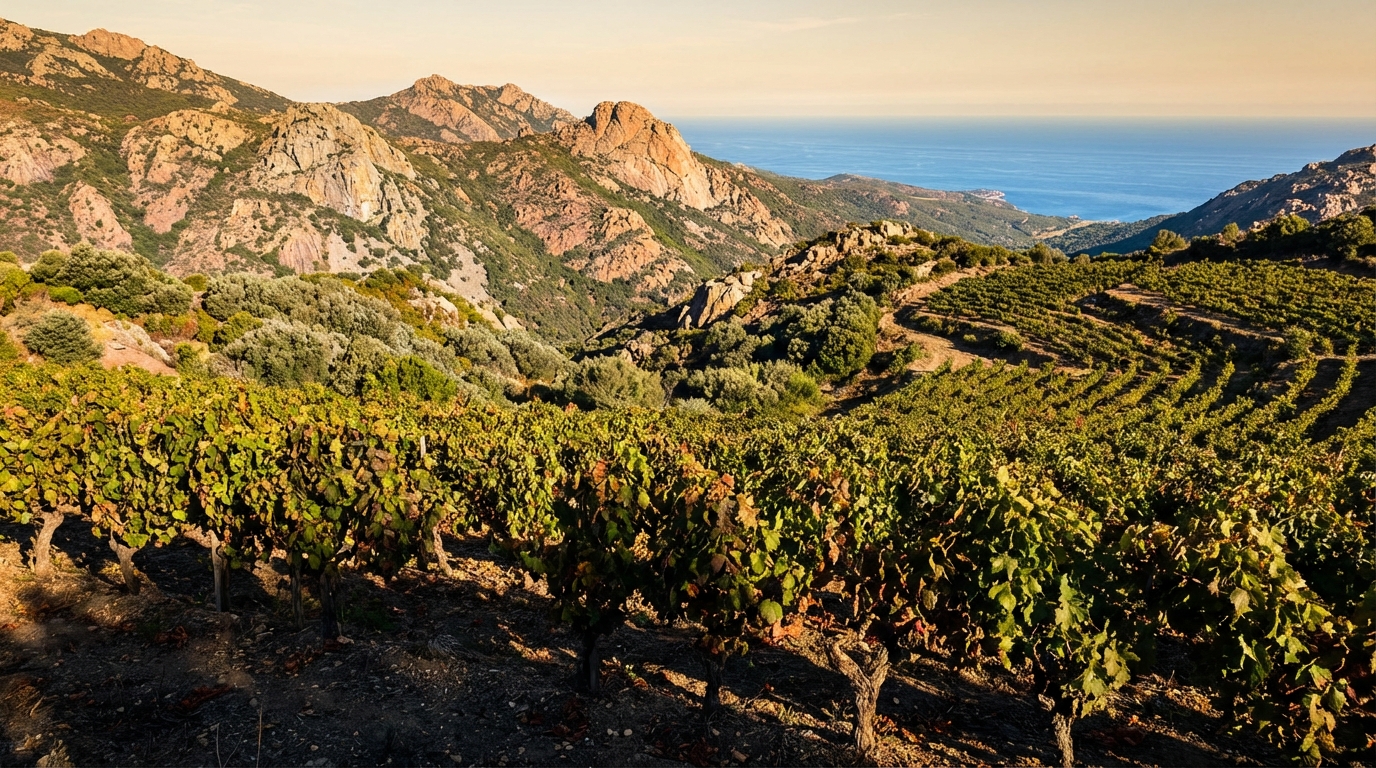
Corsica's winemaking history stretches back at least 2,500 years to the arrival of the Phocaean Greeks, who established the colony of Alalia (modern Aléria) on the island's eastern coast around 565 BC. The Greeks brought viticulture to Corsica, and the tradition was maintained and expanded under Roman rule. Pliny the Elder mentioned Corsican wines in his Natural History, noting their rustic character — a diplomatic assessment that reflected the wild, mountainous terrain's resistance to systematic cultivation.
The island's wine culture was profoundly shaped by six centuries of Genoese rule (1284–1768). Under the Republic of Genoa, Corsica became an important wine-producing territory, with Italian grape varieties — particularly Sangiovese (known locally as Nielluccio), Mammolo (Sciaccarellu), and Vermentino (Vermentinu) — forming the backbone of the vineyard landscape. Genoese merchants traded Corsican wine throughout the western Mediterranean, and the island's winemaking vocabulary, techniques, and viticultural calendar remained fundamentally Italian in character.
France acquired Corsica from Genoa through the Treaty of Versailles in 1768 — just one year before the birth of the island's most famous son, Napoleon Bonaparte, in Ajaccio. French administration brought new regulations and commercial structures, but the Italian grape varieties and winemaking traditions endured. The 19th century saw Corsican vineyards expand significantly, particularly on the fertile eastern coastal plains, where high-volume production of unremarkable table wine became the dominant model.
The twin catastrophes of phylloxera in the late 19th century and the world wars of the 20th century devastated Corsican viticulture. Vineyards were abandoned as young men left for the mainland, and the postwar years saw the eastern plains replanted with high-yielding varieties by pieds-noirs — French settlers returning from North Africa — who produced industrial quantities of cheap wine that did nothing for the island's reputation.
The modern renaissance began in the 1960s and 1970s, when a handful of visionary producers recognized that Corsica's indigenous varieties and hillside terroirs were capable of producing wines of genuine distinction. The creation of the Patrimonio AOC in 1968 — Corsica's first controlled appellation — marked a turning point. Over the following decades, appellation rules were tightened, yields reduced, and the focus shifted decisively from quantity to quality. Today, Corsica is widely regarded as one of the most exciting and dynamic wine regions in the entire Mediterranean basin.
Geography, Geology, and Climate
Corsica is sometimes described as "a mountain in the sea," and the characterization is apt. The island's highest peak, Monte Cinto, reaches 2,706 meters — extraordinarily high for an island of this size. This dramatic topography creates an astonishing range of microclimates and soil types within a compact area.
Granite dominates the western two-thirds of the island, forming the ancient crystalline massif that defines Corsica's dramatic western coastline. The granite soils are typically sandy and well-drained, with low fertility that naturally restricts vine vigor and concentrates flavors. The appellations of Ajaccio, Calvi, and parts of Sartène and Figari are planted primarily on granitic terrain, producing wines with notable aromatic finesse, mineral precision, and relatively delicate structure.
The eastern third of the island is geologically distinct, built from schist, clay, limestone, and alluvial deposits. The Patrimonio appellation, located on the northern tip of the island, sits on a foundation of limestone and clay overlaid with schist — a soil profile that produces Corsica's most structured, age-worthy wines. The eastern plains around Aléria consist of deep alluvial soils, historically used for high-volume production but increasingly home to quality-focused estates.
Cap Corse, the dramatic finger of land extending northward from the island, has its own unique geology: steep schist hillsides dropping directly into the sea, with vineyards planted in near-impossible conditions on narrow terraces. These extreme sites produce the legendary Muscat du Cap Corse — one of France's most distinctive sweet wines.
The climate is classically Mediterranean: hot, dry summers with temperatures regularly exceeding 30°C, mild winters rarely dipping below freezing at vineyard altitude, and annual rainfall of 600 to 900 millimeters concentrated heavily in autumn and winter. The critical moderating factor is altitude — vineyards planted at 200 to 400 meters experience significantly cooler nighttime temperatures than those at sea level, preserving acidity and aromatic complexity in the grapes.
Key Red Grape Varieties
Nielluccio: Corsica's Noble Red
Nielluccio is Corsica's most important red grape variety, genetically identical to Sangiovese — the grape behind Chianti, Brunello di Montalcino, and Vino Nobile di Montepulciano. DNA profiling has confirmed the relationship beyond doubt, yet Nielluccio on Corsican soil produces a wine with a distinctly different personality from its Tuscan counterpart.
The variety thrives particularly on the limestone and clay soils of Patrimonio, where it produces deeply colored, structured wines with firm tannins, bright cherry and redcurrant fruit, herbaceous garrigue notes, and a distinctive mineral backbone. Young Nielluccio can be austere and tightly wound — it demands patience, rewarding 5 to 10 years of cellaring in the best examples. With age, it develops complex secondary aromas of leather, dried herbs, and spice that evoke both the Italian mainland and the Corsican maquis simultaneously.
Nielluccio accounts for approximately 35% of Corsica's red and rosé plantings and is the dominant variety in the Patrimonio appellation, where it must constitute at least 90% of the blend for red wines. It also features prominently in the Vin de Corse appellations, where it is typically blended with Sciaccarellu, Grenache, and other varieties.
Sciaccarellu: The Elegant Alternative
Sciaccarellu (pronounced roughly "sha-ka-REL-loo") is Corsica's second signature red grape, though it could not be more different from Nielluccio in style. Genetically related to Mammolo — a minor Tuscan variety sometimes used in traditional Chianti blends — Sciaccarellu produces lighter-bodied, aromatic wines with a captivating peppery, herbal character that seems to capture the essence of the maquis shrubland.
The variety is most closely associated with the Ajaccio appellation on Corsica's western coast, where it grows on warm granite hillsides. Sciaccarellu wines are typically pale ruby to garnet in color, with aromas of red berries, black pepper, fresh herbs, smoke, and a distinctive almond-like finish. The tannins are fine and supple, the body medium at most, and the overall impression is one of elegance and perfume rather than power.
Sciaccarellu is often compared to Pinot Noir for its aromatic delicacy and lighter structure — a comparison that, while imperfect, captures the variety's seductive charm. It drinks beautifully young but can develop intriguing complexity over 3 to 7 years in bottle. The grape is also an excellent base for rosé, producing pale, aromatic wines with real structure and interest.
Key White Grape Varieties
Vermentinu: The Mediterranean Flagship
Vermentinu — the Corsican name for Vermentino, a variety widely planted across Sardinia, Liguria, Provence, and Languedoc — is the island's dominant white grape, accounting for roughly 75% of white wine production. It has been present on Corsica for centuries, likely arriving with the Genoese, and has adapted superbly to the island's warm, dry Mediterranean conditions.
Corsican Vermentinu produces wines of notable richness and texture: ripe stone fruit (white peach, apricot), citrus blossom, almond, and a distinctive waxy, almost oily mouthfeel that distinguishes it from the leaner, more austere Vermentino of Sardinia or the lighter versions of Provence. In Patrimonio, where Vermentinu must constitute 100% of white wines, the limestone soils add a pronounced mineral tension that prevents the wine from tipping into heaviness.
The best examples of Corsican Vermentinu — from producers like Domaine Antoine Arena and Clos Canarelli — are genuinely world-class Mediterranean whites, combining the generosity of a warm-climate variety with surprising complexity and food versatility. They serve magnificently with grilled fish, seafood, and the island's aromatic cuisine.
Biancu Gentile: The Rediscovered Treasure
Biancu Gentile is a rare indigenous Corsican white variety that came perilously close to extinction in the mid-20th century. By the 1990s, only a handful of hectares remained, primarily around the Ajaccio appellation. Thanks to the dedication of producers like Domaine Comte Abbatucci, who identified and propagated old vines from their family estates, Biancu Gentile has been rescued and is now experiencing a modest but significant revival.
The wine it produces is distinctive: low in alcohol relative to other Mediterranean whites (typically 12–13%), with delicate floral aromas, citrus and green apple notes, a saline minerality, and an almost ethereal lightness. It offers a refreshing counterpoint to the richer Vermentinu and demonstrates that Corsica's viticultural heritage includes far more than its two or three best-known varieties. Other rare indigenous whites include Genovese and Coda di Volpe, both being gradually rehabilitated by the island's more adventurous producers.
The Appellations of Corsica
Patrimonio AOC
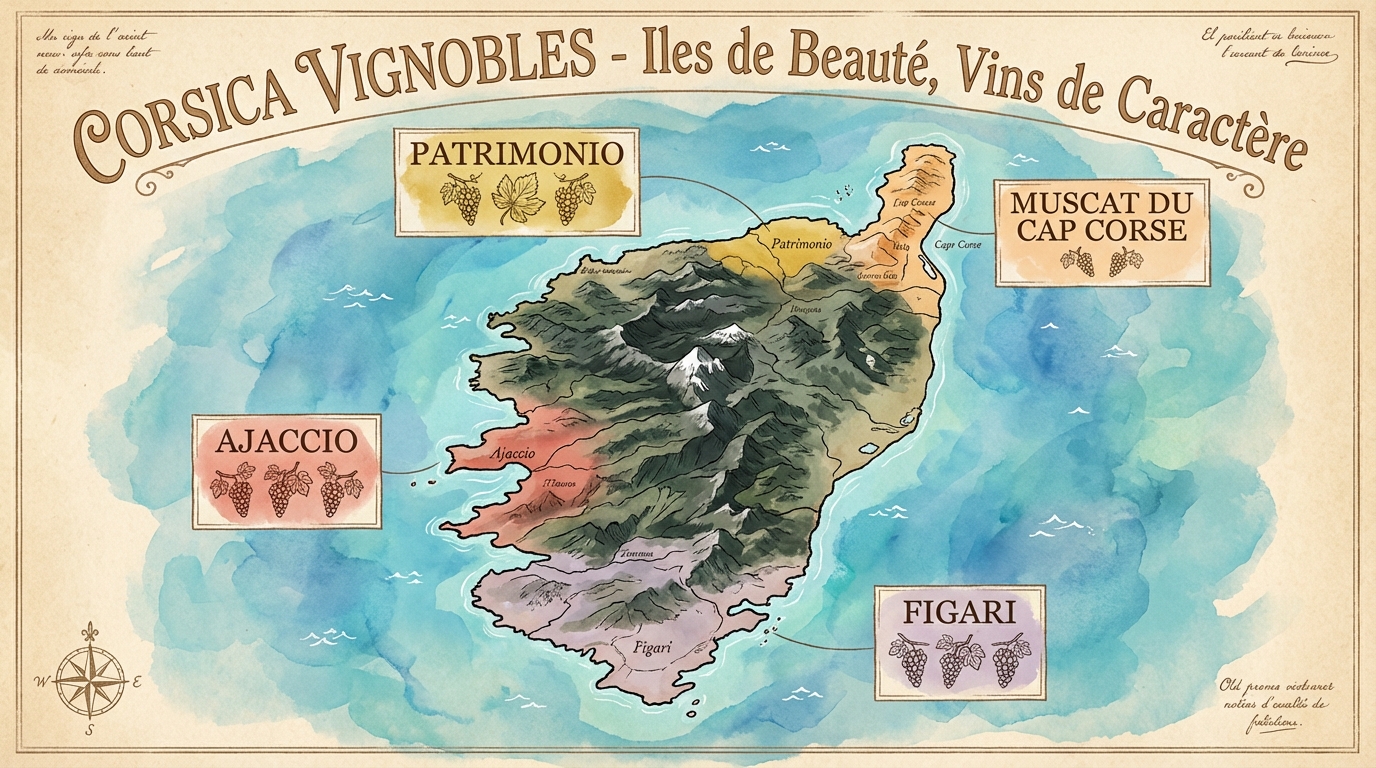
Patrimonio, established in 1968 as Corsica's first AOC, is unquestionably the island's flagship appellation. Located on the northern end of Corsica around the Golfe de Saint-Florent, Patrimonio encompasses approximately 460 hectares of vineyard planted primarily on limestone and clay slopes — a geological anomaly on an island dominated by granite.
The limestone soils are the key to Patrimonio's character: they produce red wines of remarkable structure, depth, and aging potential from Nielluccio, and white wines of crystalline mineral tension from Vermentinu. Patrimonio reds must contain at least 90% Nielluccio, and the best examples — from producers like Arena, Leccia, and Gentile — can evolve for 15 to 20 years in cellar.
Patrimonio also produces outstanding Muscat — not the famous vin doux naturel of Cap Corse, but dry-fermented Muscat à Petits Grains of startling aromatic intensity.
Ajaccio AOC
Ajaccio, the appellation surrounding Corsica's capital city on the western coast, is the homeland of Sciaccarellu. The vineyards are planted on granite hillsides at elevations of 200 to 400 meters, benefiting from sea breezes and the altitude-driven temperature differential that preserves freshness.
Red Ajaccio wines must contain at least 40% Sciaccarellu, though the finest examples are predominantly or entirely Sciaccarellu, complemented by small additions of Nielluccio and Grenache. The appellation's rosés, also Sciaccarellu-based, are among the most characterful in France — far more complex than typical Provence rosé, with real structure and aromatic depth. White Ajaccio is Vermentinu-based, produced in smaller quantities but often excellent.
Vin de Corse AOC and Its Sub-Zones
The Vin de Corse appellation covers the rest of the island's quality wine production, with five sub-zones that may append their name to the label:
Vin de Corse Calvi, on the northwestern coast, produces generous, sun-drenched wines from granite soils. The reds blend Nielluccio with Sciaccarellu and Grenache, and the rosés are particularly successful. Vin de Corse Porto-Vecchio, in the island's southeast, benefits from cooling maritime influence and granitic soils that produce elegant, perfumed wines. Vin de Corse Figari, from Corsica's southernmost tip near Bonifacio, is one of the island's most windswept vineyard areas, where constant exposure to the Libeccio and Gregale winds produces concentrated, mineral wines of real intensity. Vin de Corse Sartène, between Ajaccio and Figari, grows outstanding Sciaccarellu-dominant reds on granite slopes overlooking the sea. Vin de Corse Cap Corse covers the dramatic northern peninsula, where steep schist terraces produce tiny quantities of remarkable white and rosé wine alongside the celebrated Muscat.
Muscat du Cap Corse AOC
Muscat du Cap Corse is Corsica's most distinctive and historically significant sweet wine — a vin doux naturel (VDN) made from Muscat à Petits Grains grown on the steep, schist-dominated terraces of the Cap Corse peninsula. The appellation was granted AOC status in 1993, though the tradition of making Muscat on Cap Corse stretches back centuries.
The production method involves partially fermenting the grape must and then arresting fermentation by adding grape spirit (mutage), preserving natural sweetness while raising the alcohol to approximately 15% to 17%. The resulting wine is golden, intensely aromatic — orange blossom, candied citrus, honey, apricot, exotic spice — with a luscious sweetness balanced by the saline, mineral character imparted by the schist soils and maritime influence.
Muscat du Cap Corse is produced in tiny quantities — fewer than 2,000 hectoliters in most years — and remains one of France's best-kept oenological secrets. Producers like Clos Nicrosi, Domaine Pieretti, and Domaine Antoine Arena craft versions that rank among the finest Muscats produced anywhere in the Mediterranean.
Leading Producers
Domaine Antoine Arena
Antoine Arena is widely regarded as the patriarch of modern Corsican wine. Based in Patrimonio, Arena has spent four decades demonstrating that the appellation's limestone terroir is capable of producing wines that rival the finest expressions of the greater Mediterranean. His Vermentinu "Grotte di Sole" — fermented and aged in large oak casks — is a landmark Corsican white, combining richness, mineral tension, and extraordinary complexity. The Nielluccio reds are equally celebrated, and his Muscat du Cap Corse is considered a reference for the appellation.
Arena was an early champion of organic and natural winemaking on Corsica, and his sons now continue the family tradition with the same uncompromising approach to quality.
Clos Canarelli
Yves Canarelli has been a transformative figure in Corsican wine since establishing his domaine in the Figari sub-zone in 1993. Working with both mainstream Corsican varieties (Nielluccio, Sciaccarellu, Vermentinu) and rare indigenous grapes — including the white Biancu Gentile and the red Carcaghjolu Neru — Canarelli has produced a body of work that has earned critical acclaim far beyond the island.
His white wines are particularly celebrated: the Clos Canarelli Blanc (Vermentinu) and the single-variety Biancu Gentile bottling are both widely considered among the finest white wines of the Mediterranean. Canarelli farms organically on granite soils near the sea, and his wines combine a sense of wild, untamed terroir with meticulous winemaking precision.
Domaine Comte Abbatucci
Jean-Charles Abbatucci represents the most radical and visionary edge of Corsican winemaking. Working from his family's historic estate in the Ajaccio appellation — a property that has been in the Abbatucci family since the 16th century — he has dedicated himself to rescuing Corsica's rarest indigenous grape varieties. His vineyard contains over 20 different varieties, many of which were on the verge of extinction: Biancu Gentile, Rossola Bianca, Riminese, Carcaghjolu Neru, Morescola, and more.
Abbatucci farms biodynamically and makes wines with minimal intervention — no added sulfur in many cuvées, native yeast fermentation, and extended maceration. The results are polarizing but frequently magnificent: wines of extraordinary purity, complexity, and sense of place that have no equivalent anywhere in France. His Cuvée Collection wines, made from individual rare varieties, are among the most fascinating bottles produced on the island.
Domaine Leccia
Annette Leccia produces elegant, classically structured wines in the heart of Patrimonio. After separating from the larger family estate (now run as Domaine Leccia by her brother), she established her own domaine, E Croce, focusing on organic viticulture and restrained winemaking. Her Nielluccio reds are models of the variety: structured, aromatic, built for aging, with a seductive combination of fruit purity and mineral austerity. The Vermentinu whites are equally accomplished.
Other notable producers include Domaine Gentile (Patrimonio), Domaine de Torraccia (Porto-Vecchio), Clos Columbu (Calvi), Clos Teddi (Patrimonio), Clos d'Alzeto (the highest vineyard on the island, at 500 meters), and Domaine Maestracci (Calvi).
Food Pairing: The Corsican Table
Corsican cuisine is as distinctive as its wines — a robust, aromatic cooking tradition built around wild game, mountain herbs, free-range pork, sheep's milk cheese, and the bounty of the Mediterranean Sea. The island's wines have evolved alongside this cuisine for centuries, and the pairings are natural and profound.
Wild boar (sanglier) is the quintessential Corsican dish — braised slowly with myrtle, juniper, and bay leaves from the maquis. A structured, tannic Nielluccio from Patrimonio is the classic match, its firm tannins cutting through the rich, gamey meat while the herbal aromatics echo the maquis herbs in the sauce.
Brocciu — Corsica's signature fresh sheep's or goat's milk cheese (similar to ricotta but with far more character) — appears in everything from savory tarts and omelettes to pastries and cannelloni. Young, fresh Brocciu pairs beautifully with Vermentinu, whose richness and slight bitterness complement the cheese's creamy, tangy character. Aged Corsican cheeses like Calinzana and Venachese demand the aromatic intensity of Sciaccarellu or a robust Nielluccio.
Corsican charcuterie — including lonzu (cured pork loin), coppa, prisuttu (air-dried ham), and figatellu (pork liver sausage) — is among the finest in France, produced from free-range pigs that feed on chestnuts in the island's forests. These intensely flavored meats find an ideal partner in a structured rosé or a light, peppery Sciaccarellu red, served slightly cool.
Grilled fish and seafood — sea bass, red mullet, langoustines, mussels — call for Vermentinu or the rare Biancu Gentile, whose saline minerality mirrors the marine character of the food. And Muscat du Cap Corse is a transcendent match for the island's chestnut-flour desserts, particularly fiadone (a brocciu cheesecake scented with lemon) and canistrelli (dry biscuits flavored with anise or citrus).
The Natural Wine Movement on Corsica
Corsica has emerged as one of the most fertile grounds for natural winemaking in all of France — a development that reflects both the island's fiercely independent cultural spirit and the practical realities of its viticultural environment.
The island's warm, dry Mediterranean climate naturally limits disease pressure, reducing the need for chemical treatments. The traditional Corsican varieties — Nielluccio, Sciaccarellu, Vermentinu — are well-adapted to these conditions after centuries of cultivation, showing greater resilience to drought and heat than many international varieties. And the island's relative isolation from mainstream French wine commerce has allowed its producers to experiment with alternative approaches free from the commercial pressure to conform.
The movement's roots lie with pioneers like Antoine Arena and Jean-Charles Abbatucci, who began farming organically and reducing winemaking intervention in the 1990s, well before natural wine became a fashionable category. Today, a significant proportion of Corsica's most acclaimed producers work organically, biodynamically, or with minimal intervention: Clos Canarelli, Domaine Vaccelli, Domaine U Stiliccionu, Clos Fornelli, and others have embraced low-sulfur or zero-sulfur winemaking with impressive results.
The natural wine movement has also accelerated the rediscovery of rare indigenous varieties. Producers seeking to make wines that express the deepest character of Corsican terroir have turned to nearly forgotten grapes — Biancu Gentile, Carcaghjolu Neru, Rossola Bianca, Riminese, Genovese — that were abandoned during the 20th-century shift toward volume production. These ancient varieties, often cultivated from ungrafted vines on their own rootstocks, bring a dimension of historical authenticity that resonates powerfully with the natural wine ethos.
The result is that Corsica now occupies a unique position in the French wine landscape: an island where cutting-edge natural winemaking and ancient viticultural tradition are not in tension but are effectively the same project — a collective effort to recover and express what is most genuinely and distinctively Corsican about the island's wines.
Visiting Corsica's Wine Country
Corsica offers an extraordinary wine-tourism experience for visitors willing to explore beyond the island's famous beaches and hiking trails. The Patrimonio appellation is the most accessible starting point, with numerous producers offering tastings within a short drive of Saint-Florent and Bastia. The landscape is breathtaking — vineyards draped across limestone slopes above the turquoise waters of the Golfe de Saint-Florent, with the maquis-covered mountains rising steeply behind.
The Ajaccio corridor provides a different character: granite hillsides above Napoleon's birthplace, with producers like Clos d'Alzeto offering tastings at vertiginous altitude. The southern appellations of Figari, Sartène, and Porto-Vecchio reward the more adventurous traveler, with wild, sparsely populated landscapes and tiny family producers who welcome visitors with genuine warmth.
Cap Corse is the most dramatic wine-touring experience on the island: a narrow, winding road traces the peninsula's coastline, passing through tiny villages where Muscat vineyards cling to near-vertical schist slopes above the sea. Allow a full day for the drive, stopping at Clos Nicrosi, Domaine Pieretti, and the cooperative at Rogliano for tastings.
The best time to visit is May to June or September to October, when the weather is warm but not oppressive, the tourist crowds are manageable, and — in autumn — the harvest atmosphere adds an extra dimension to the experience. Most producers are happy to receive visitors without appointment during these periods, though calling ahead is always courteous, particularly for smaller estates.


