One of the World's Great Wines, Chronically Undervalued
Sherry is among the most extraordinary, complex, and diverse wines produced anywhere on earth — and it is almost certainly the most undervalued. For the price of an average bottle of entry-level Burgundy or Napa Cabernet, you can acquire a Sherry that has been aging in solera for 20, 30, or even 50 years, crafted with a level of artisanal skill and biological complexity that has no parallel in the wine world. Yet Sherry suffers from a perception problem that has persisted for decades: association with cheap, cloying cream sherries that dominated export markets in the mid-20th century, an image that bears virtually no resemblance to the dry, sophisticated, profoundly savory wines that define the category at its best.
The truth is that a bone-dry Fino from Jerez or a sea-salt-inflected Manzanilla from Sanlúcar de Barrameda is one of the great gastronomic wines of the world — as refreshing as good Champagne, as complex as aged Burgundy, and more versatile at the table than almost any wine you can name. An aged Amontillado or a venerable Palo Cortado achieves a depth and intensity of flavor that rivals the finest spirits. And a great Pedro Ximénez, dark as molasses and impossibly sweet, is dessert in a glass. No other wine region on earth produces this breadth of style from a single appellation.
Understanding Sherry requires abandoning many assumptions that apply to other wines. Sherry is not defined by vintage. It is not defined by a single grape-to-glass process. It is defined by biological and oxidative aging — processes that transform a simple, neutral white wine into something utterly unique — and by the solera system, a fractional blending method that creates continuity across decades. These two elements — flor yeast and solera — are the twin pillars on which all Sherry stands.
The Marco de Jerez: A Triangle of Genius
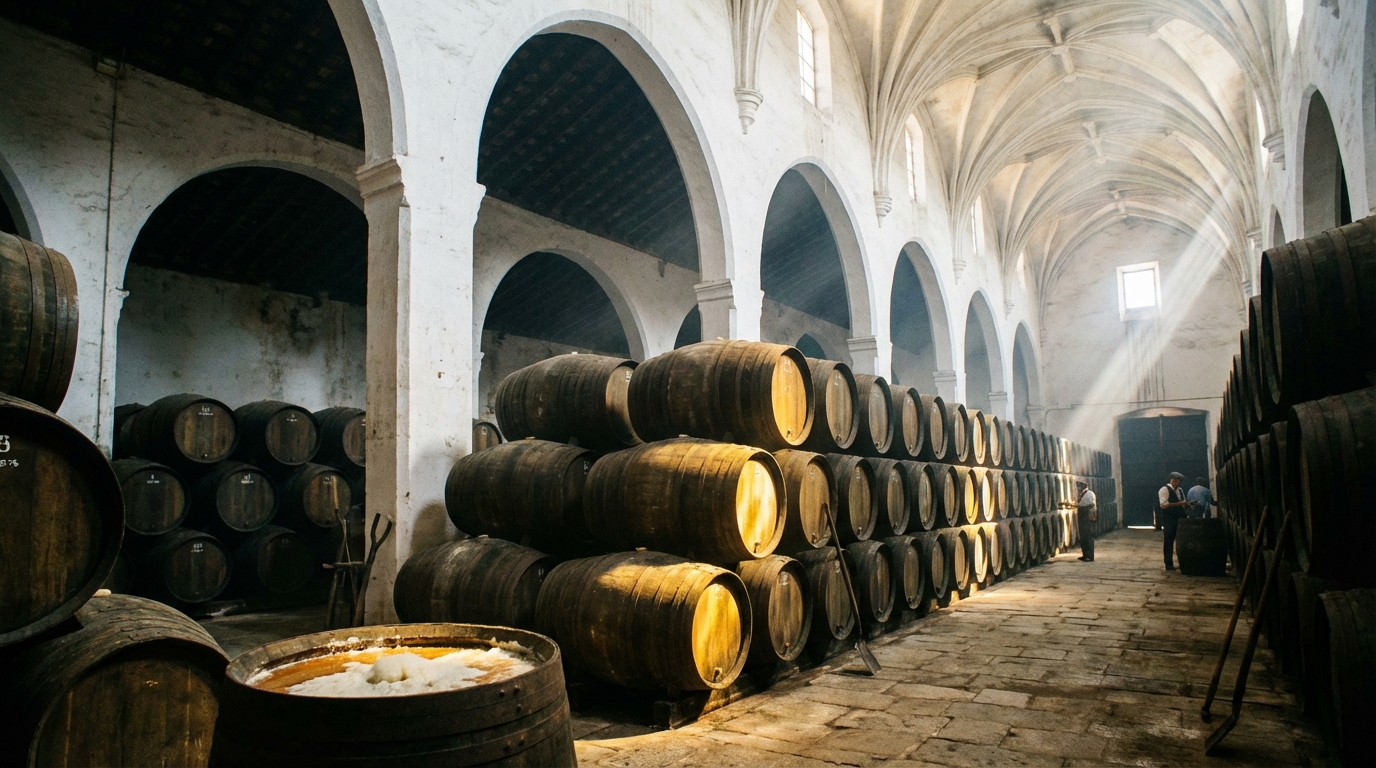
All authentic Sherry comes from the Marco de Jerez — the Sherry Triangle — a delimited zone in the province of Cádiz in southwestern Andalucía, Spain. Three towns define the triangle: Jerez de la Frontera, the historic capital of the Sherry trade and home to the largest bodegas; Sanlúcar de Barrameda, a coastal town at the mouth of the Guadalquivir River, where the unique microclimate produces Manzanilla; and El Puerto de Santa María, a port town that historically served as the shipping point for Sherry exported to Britain and the Americas.
The climate is Mediterranean in the truest sense: hot, dry summers with temperatures regularly exceeding 35°C, mild winters, and an average of 290 days of sunshine per year. Rainfall is concentrated in the autumn and winter months, with annual totals averaging roughly 600 millimeters. The Poniente (westerly wind from the Atlantic) and the Levante (hot, dry easterly wind from the interior) are defining climatic features. The Poniente brings cooling moisture and high humidity — critical for the survival of flor yeast — while the Levante accelerates evaporation and concentration during the drying months.
The vineyards of the Marco de Jerez are spread across gently rolling hills at elevations of 30 to 140 meters. The finest sites occupy the highest ground, where the soils achieve their most characteristic expression.
Albariza: The White Gold of Sherry
The quality of Sherry is inextricably linked to albariza — the brilliant white, chalky soil that covers the best vineyard sites in the Marco de Jerez. Albariza is a sedimentary marl composed of chalk, clay, silica, and the fossilized remains of marine organisms deposited when the region lay beneath an ancient sea. Its white surface reflects sunlight back onto the vines (reducing heat stress on the grapes), and its remarkable capacity to absorb and retain winter rainfall provides a natural irrigation reservoir that sustains the vines through the long, rainless summers.
During the wet season, albariza absorbs moisture like a sponge, swelling to form a sealed surface that minimizes evaporation. As the soil dries, it forms a hard, cracked crust that locks in subsurface moisture. A well-managed albariza vineyard can retain enough water to sustain Palomino Fino vines through four to five months without rain — an essential adaptation in a region where summer rainfall is effectively zero.
The two other soil types found in the Marco — barros (dark, clay-rich) and arenas (sandy) — produce higher yields of lower quality. The DO regulations allow grapes from all three soil types, but the finest Sherries — and virtually all wines from quality-focused bodegas — come from albariza vineyards classified as Jerez Superior, the top tier of vineyard land.
The Grapes of Sherry
Palomino Fino dominates Sherry production, accounting for approximately 99% of planted vineyard area in the Marco de Jerez. It is a remarkably neutral grape — low in acidity, moderate in sugar, virtually devoid of aromatic character — which makes it the perfect blank canvas for the transformative processes of biological and oxidative aging. Palomino's neutrality is a feature, not a flaw: it allows the flor yeast and the solera system to express themselves without interference from varietal aromatics.
Pedro Ximénez (PX) is grown in much smaller quantities and is used almost exclusively for the intensely sweet wines that bear its name. The grapes are sun-dried on esparto grass mats — a process called asoleo — for 7 to 21 days after harvest, concentrating sugars to extreme levels before fermentation. The resulting must is so rich that fermentation arrests naturally, leaving enormous residual sugar. PX is also used to sweeten blended styles such as Cream Sherry.
Moscatel (Muscat of Alexandria) is the third permitted variety, grown in sandy coastal vineyards. It produces aromatic sweet wines that are rarer and less celebrated than PX but can be exceptionally complex, with orange blossom, jasmine, and candied citrus notes. Like PX, Moscatel grapes undergo asoleo before pressing.
The Miracle of Flor: Biological Aging
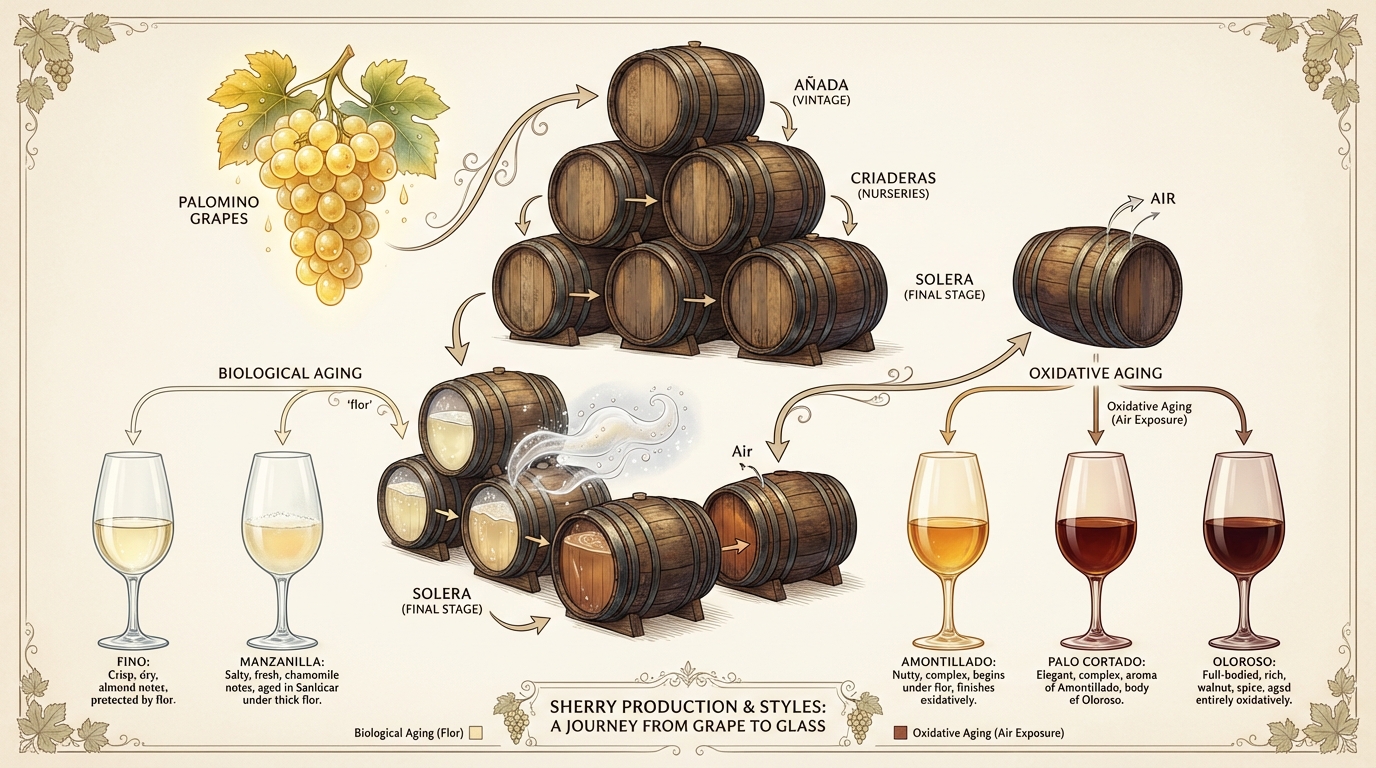
The most remarkable aspect of Sherry production is biological aging under flor — a process that occurs nowhere else in the wine world with the same consistency and complexity. Flor is a film of Saccharomyces yeast — primarily four strains of Saccharomyces cerevisiae (beticus, montuliensis, cheresiensis, and rouxii) — that forms spontaneously on the surface of young Sherry wines in partially filled barrels.
After fermentation, the young base wine (called mosto) is fortified with grape spirit. Wines destined for biological aging are fortified to 15% to 15.5% alcohol — the precise range at which flor yeast can thrive. The wine is then placed into butts (botas) — 600-liter American oak barrels — filled to approximately five-sixths capacity, leaving a large surface area of wine exposed to air. Within weeks, a creamy-white film of yeast begins to form on the surface, creating a living velum (veil) that completely seals the wine from contact with oxygen.
This velum of flor is a biological miracle. The yeast cells consume glycerol and residual sugar in the wine, producing acetaldehyde — the compound responsible for the distinctive sharp, tangy, green-apple-and-almond character of biologically aged Sherry. The flor also metabolizes ethanol and certain acids, fundamentally altering the wine's chemical composition. The result is a wine that is bone-dry, pungent, and utterly unlike any other fermented beverage.
Flor is a living organism, and its health depends on precise environmental conditions. It thrives in temperatures between 15°C and 20°C and requires consistent humidity above 60%. During the hot Jerez summers, flor thins or dies back; during the cool, humid winters, it thickens and becomes more active. In Sanlúcar de Barrameda, the coastal location and Atlantic influence maintain higher average humidity and cooler temperatures than inland Jerez, allowing flor to survive year-round in thicker, more consistent layers. This microclimate difference is the fundamental reason why Manzanilla tastes different from Fino — the same grape, the same process, but a different expression of flor activity.
The Solera System: Time in a Bottle
The solera is the fractional blending system that gives Sherry its continuity, complexity, and agelessness. Understanding solera is essential to understanding why Sherry does not carry vintage dates and why a single glass can contain wine that is decades old.
A solera consists of a series of barrel groups called criaderas (literally "nurseries"), arranged in tiers. The oldest tier — the solera proper — sits at the bottom. Above it are successive criaderas numbered from the first (oldest after the solera) upward. When wine is withdrawn for bottling, it is drawn from the solera — the oldest tier. The solera is then refreshed with wine from the first criadera, which is refreshed from the second criadera, and so on, with the youngest criadera receiving the newest wine.
At each stage, only a fraction of the wine is withdrawn — typically one-third or less of the barrel's contents. This means that the solera always retains a significant proportion of its oldest wine. A solera established in 1900 will still contain traces of that original wine today, blended with every subsequent addition over 125 years. The system creates a perpetual blend that maintains remarkable consistency from year to year while accumulating extraordinary complexity over time.
The number of criaderas varies by style and bodega. A Fino solera might have 7 to 10 stages, with wine passing through the system over 3 to 8 years. An Oloroso solera might have 4 to 6 stages but with much slower turnover, as oxidatively aged wines evolve more gradually. Extraordinary aged Sherries — the VOS and VORS categories — may come from soleras with minimal refreshment, allowing the average age to climb to 20, 30, or even 50 years.
The genius of the solera is that it achieves two seemingly contradictory goals simultaneously: it maintains consistency (each bottling tastes recognizably like the last) while allowing evolution (the blend grows incrementally more complex with each passing year). No other aging system in the wine world achieves this balance.
Sherry Styles: A Complete Taxonomy
Fino
Fino is the purest expression of biological aging: pale gold to straw-colored, bone-dry, and intensely aromatic. The nose offers green almonds, bread dough, chamomile, dried herbs, and a distinctive saline tang. On the palate, Fino is light-bodied but concentrated, with piercing acidity and a long, bitter-almond finish. The alcohol level, typically 15% to 15.5%, is barely perceptible thanks to the wine's intensity and dryness.
Fino is Jerez's house wine — drunk copiously in bars throughout the city, poured from half-bottles kept in ice buckets. The best examples include González Byass Tio Pepe, the world's best-selling Fino and a consistently excellent wine; Valdespino Inocente, a single-vineyard Fino from the Macharnudo pago fermented in barrel (an increasingly rare practice); Lustau Jarana; and the extraordinary single-cask bottlings from Equipo Navazos.
Manzanilla
Manzanilla is, technically, Fino produced and aged exclusively in Sanlúcar de Barrameda. The cooler, more humid coastal climate allows flor to flourish year-round in thicker, more consistent layers, producing wines of exceptional delicacy and a distinctive saline, iodine-inflected character that Sherry lovers describe as the taste of the sea breeze. The name derives from manzanilla — chamomile — evoking the floral, herbal aromatics that distinguish these wines.
Manzanilla is the lightest and most ethereal of all Sherry styles — almost impossibly fresh, with a briny, minerally quality that makes it one of the world's great aperitif wines. Key producers include Barbadillo (whose Solear brand is the best-known Manzanilla), Hidalgo La Gitana (an iconic label), Herederos de Argüeso, and the transcendent single-cask Manzanillas from Equipo Navazos and Callejuela.
Manzanilla Pasada is an extended-aged variant — typically 7 to 12 years in solera — where the flor has begun to thin, allowing light oxidative influence. These wines bridge the gap between Manzanilla and Amontillado, offering the fresh salinity of youth with added nutty depth.
Amontillado
Amontillado is one of wine's most complex styles — a wine that has undergone both biological and oxidative aging in sequence. An Amontillado begins life as a Fino or Manzanilla, aging under flor for several years. At some point — either naturally (as the flor dies due to rising alcohol or depleted nutrients) or by deliberate intervention (the winemaker fortifies the wine above 16%, killing the flor) — the wine transitions to oxidative aging. The barrel is then allowed to develop without the protective yeast film, and the wine begins to concentrate through evaporation and take on the rich, nutty character of oxidative development.
The result is a wine of extraordinary duality: the sharp, tangy, almond-driven character of its biological phase combined with the walnut, hazelnut, toffee, dried herb, and tobacco notes of its oxidative phase. Amber to dark amber in color, Amontillado is medium-bodied, bone-dry, and remarkably complex. Great Amontillados — such as Valdespino Coliseo, González Byass Del Duque, or Bodegas Tradición's VORS Amontillado — rank among the most extraordinary wines produced anywhere.
The name references the town of Montilla in Córdoba province, where a similar style of wine was historically produced from Pedro Ximénez grapes. Edgar Allan Poe's famous short story "The Cask of Amontillado" (1846) helped cement the word in the English-speaking imagination, though the wine Fortunato sought was quite different from what modern producers create.
Oloroso
Oloroso — meaning "fragrant" or "scented" — is the fully oxidative counterpart to Fino's biological purity. After fermentation, wines destined to become Oloroso are fortified to 17% or higher, a level at which flor yeast cannot survive. The wine ages in partially filled butts with direct exposure to oxygen, concentrating through evaporation (the "angel's share" in Jerez can reach 3% to 5% per year) and developing deep amber to mahogany color, rich body, and intense nutty, spicy aromatics.
Dry Oloroso is a revelation for those who have only encountered sweetened commercial versions. The nose offers walnuts, hazelnuts, toffee, dried figs, leather, polished wood, and baking spices. On the palate, dry Oloroso is full-bodied, glycerous, and enveloping, with a warmth that comes from both alcohol (typically 18% to 22%) and concentration rather than sweetness. The finish is extraordinarily long — great Oloroso can persist for a minute or more after swallowing.
Exceptional dry Olorosos include Valdespino Don Gonzalo, González Byass Matusalem (which, confusingly, is actually sweetened despite being labeled Oloroso), Lustau Emperatriz Eugenia, and Bodegas Tradición VORS Oloroso. The age of the solera in these wines can be staggering — the Tradición VORS has an average age exceeding 30 years.
Palo Cortado
Palo Cortado is Sherry's most enigmatic style — a wine that defies neat categorization. Historically, Palo Cortado occurred spontaneously: a wine destined for biological aging as Fino would unexpectedly lose its flor, transitioning to oxidative aging without deliberate intervention. The result was a wine with the aromatic finesse and delicacy of an Amontillado but the body, richness, and palate weight of an Oloroso — a paradoxical combination that fascinated connoisseurs.
The name refers to a marking system used in bodegas: a palo (vertical stroke) indicated a wine classified as a potential Fino, while a cortado (horizontal stroke cutting across the palo) indicated that the wine had deviated from the expected path. Today, most Palo Cortados are created deliberately rather than by accident — the winemaker selects barrels with particular characteristics, fortifies them to halt flor development, and ages them oxidatively. Purists debate whether deliberately made Palo Cortados are true to the style, but the best examples are extraordinary regardless of their origin.
Key Palo Cortados include Valdespino Cardenal (from one of the oldest soleras in Jerez), Lustau Peninsula, González Byass Apóstoles (a VORS-age blend), Bodegas Tradición VORS Palo Cortado, and the rare single-cask releases from Equipo Navazos.
Pedro Ximénez
Pedro Ximénez (PX) is the polar opposite of Fino — an intensely sweet, viscous, nearly black wine made from sun-dried grapes. After harvest, PX grapes are spread on esparto grass mats and dried in the fierce Andalusian sun for 7 to 21 days, a process called asoleo that concentrates sugars to levels of 400 to 500 grams per liter or more. The raisined grapes are pressed and the thick must undergoes minimal fermentation — often reaching only 2% to 4% alcohol naturally — before being fortified to approximately 15% and entering the solera system.
Young PX is dark brown, syrupy, and overwhelmingly sweet, with flavors of raisins, figs, dates, molasses, coffee, dark chocolate, and Christmas pudding. With extended solera aging, PX develops additional complexity — caramel, burnt sugar, bitter orange, licorice — while retaining its signature unctuous sweetness. The greatest old PX wines achieve a balance between sweetness and the concentrating, slightly bitter effects of oxidation that elevates them beyond simple dessert wines.
Bodegas Tradición PX, González Byass Noé VORS, El Maestro Sierra PX, and Alvear PX de Añada (from Montilla-Moriles, technically not Sherry but stylistically identical) are benchmark examples.
Cream Sherry
Cream Sherry is a blended style — typically an Oloroso base sweetened with PX or concentrated grape must — that became enormously popular in Britain and the Commonwealth countries in the 19th and 20th centuries. The most famous example, Harvey's Bristol Cream, sold tens of millions of bottles annually at its peak and largely defined the international image of Sherry — for better and worse.
At its best, Cream Sherry is a legitimately complex and satisfying wine — rich, smooth, gently sweet, with nutty Oloroso depth balanced by PX's raisiny sweetness. Lustau East India Solera, aged using a system that mimics the heat and movement of long sea voyages, is an outstanding example. But cheap, industrially produced Cream Sherries — thin, cloying, and one-dimensional — did enormous damage to the category's reputation and contributed significantly to Sherry's image crisis.
VOS and VORS: The Treasures of Time
The Consejo Regulador (regulatory body) of the Jerez DO introduced two age-certification categories to identify the region's oldest and most extraordinary wines.
VOS (Vinum Optimum Signatum, or Very Old Sherry) certifies that the average age of the wine in the solera is at least 20 years. VORS (Vinum Optimum Rare Signatum, or Very Old Rare Sherry) certifies an average age of at least 30 years. Both categories require independent verification through carbon-14 dating and chemical analysis — a rigorous authentication process that gives consumers confidence in the age claims.
VOS and VORS wines represent the absolute pinnacle of the Sherry world. They are produced in tiny quantities, bottled in small formats (typically 375ml or 500ml), and priced accordingly — though even VORS wines rarely exceed the cost of a good Champagne or entry-level Burgundy Grand Cru, making them perhaps the greatest value proposition in fine wine.
Bodegas Tradición specializes almost exclusively in VOS and VORS wines and is widely regarded as the benchmark. González Byass offers an exceptional VORS range under its prestige labels (Del Duque Amontillado, Matusalem Oloroso, Noé PX, Apóstoles Palo Cortado). Valdespino, El Maestro Sierra, and Lustau also produce outstanding age-certified bottlings.
Key Producers of the Marco de Jerez
González Byass, founded in 1835, is the largest and most recognizable Sherry house, producing the globally ubiquitous Tio Pepe Fino. But the house's quality extends far beyond its flagship: the prestige range — Del Duque, Matusalem, Noé, Apóstoles — represents some of the finest aged Sherry available, and the Tio Pepe En Rama (a minimally filtered, seasonal release) has become a cult bottling among Sherry enthusiasts.
Valdespino is one of the oldest bodegas in Jerez, with records dating to 1264. The house is famous for Inocente, a single-vineyard Fino from the Macharnudo pago that is still fermented in barrel — an increasingly rare practice. The Coliseo Amontillado, Don Gonzalo Oloroso, and Cardenal Palo Cortado are reference wines for their respective styles.
Bodegas Tradición, founded in 1998 but working with purchased soleras of extraordinary age, has rapidly established itself as the quality benchmark for aged Sherry. The house produces exclusively VOS and VORS wines — Amontillado, Oloroso, Palo Cortado, and PX — of staggering depth and complexity.
Equipo Navazos is not a bodega but a bottling project founded by Jesús Barquín (a university professor and Sherry scholar) and Eduardo Ojeda (former winemaker of Valdespino). They identify exceptional individual casks in bodegas throughout the Marco de Jerez and bottle them unblended and unfiltered under the La Bota label. Each release is numbered and unique. These single-cask bottlings have revolutionized Sherry appreciation, demonstrating the extraordinary individuality that lurks within solera systems.
Lustau is a large, quality-focused house whose Almacenista range — single-solera wines sourced from small, independent aging houses — helped spark the Sherry revival of the 2000s and 2010s. The Papirusa Manzanilla, Jarana Fino, and age-dated VORS wines are consistently excellent.
Barbadillo, based in Sanlúcar, is the dominant producer of Manzanilla. The Solear Manzanilla is a market standard, while the Pastora Manzanilla Pasada and the Relicario Oloroso offer deeper, more complex expressions.
Hidalgo-La Gitana produces the iconic La Gitana Manzanilla — one of the best-selling and most consistently high-quality Manzanillas — along with the exceptional Pastrana Manzanilla Pasada and a range of aged Sherries of serious quality.
Other important houses include Fernando de Castilla (exceptional Antique range), Emilio Hidalgo (the El Tresillo Amontillado is a hidden gem), Williams & Humbert (Dos Cortados Palo Cortado), El Maestro Sierra (traditional, artisanal production), and Sánchez Romate (Cardenal Cisneros PX).
Food Pairing: Sherry at the Table
Sherry is arguably the most versatile food wine in the world — a claim that sounds hyperbolic until you experience the range of pairings it enables.
Fino and Manzanilla are the supreme aperitif wines, but they are also extraordinary at the table. Their cutting acidity and saline character make them perfect with jamón ibérico — the combination of fino and a plate of hand-carved Iberian ham is one of gastronomy's most perfect experiences. Green olives, Marcona almonds, boquerones (white anchovies in vinegar), gambas al ajillo (garlic shrimp), and fried fish (pescaíto frito) are all classic Andalusian pairings. Fino also excels with sushi, oysters, and raw shellfish — contexts where most red wines fail completely.
Amontillado bridges the gap between light and rich food. Its combination of tangy acidity and nutty depth makes it superb with hard aged cheeses (especially Manchego curado), roasted chicken, mushroom-based dishes, and consommés. Medium-dry Amontillados pair beautifully with Asian cuisine — particularly Thai and Vietnamese dishes where sweet, sour, salty, and umami intersect.
Oloroso (dry) pairs with the richest and most savory dishes: slow-braised meats, game birds, aged Manchego, stews, and anything with deep umami character. A dry Oloroso with oxtail stew (rabo de toro) is a transcendent Andalusian experience. The wine's glycerol richness and nutty concentration can also stand up to strong blue cheeses like Cabrales.
Palo Cortado is the sommelier's secret weapon — its combination of aromatic finesse and palate weight makes it adaptable to an extraordinary range of foods. Try it with duck confit, wild mushroom risotto, roasted root vegetables, or aged Comté cheese.
Pedro Ximénez demands sweet or intensely flavored partners: vanilla ice cream (the classic bar pairing — PX drizzled over a scoop of vanilla), dark chocolate desserts, blue cheese (especially Roquefort or Stilton), and fruit-based pastries. The wine's viscous sweetness and coffee-raisin intensity create a decadent conclusion to any meal.
How to Serve and Store Sherry
Proper service and storage are critical for Sherry enjoyment — more so than for almost any other wine, because the styles have dramatically different requirements.
Fino and Manzanilla must be refrigerated at all times — both before and after opening. Serve at 6°C to 8°C (43°F to 46°F) in small, tulip-shaped glasses (or traditional catavinos). Buy from retailers who store them cold and check the bottling date if available — Fino that has been sitting on a warm shelf for two years bears little resemblance to a fresh example. Once opened, consume within 5 to 7 days for Manzanilla and 7 to 14 days for Fino. The En Rama releases (minimally filtered, seasonal bottlings) are even more perishable.
Amontillado and Palo Cortado are more resilient once opened thanks to their higher alcohol and oxidative character. Serve at 12°C to 14°C (54°F to 57°F) — slightly cool but not refrigerator-cold. Once opened, they can maintain quality for 2 to 4 weeks in the refrigerator.
Oloroso is the most stable style — its fully oxidative character means it has already undergone the changes that ruin more delicate wines. Serve at 14°C to 16°C (57°F to 61°F). Once opened, Oloroso can last 4 to 8 weeks refrigerated without significant quality loss.
Pedro Ximénez, with its extreme sugar content and high alcohol, is virtually indestructible once bottled. Serve at 12°C to 14°C or slightly cooler. An opened bottle stored in the refrigerator can remain enjoyable for months.
Glassware matters more than most people realize. The traditional catavino — a small, tulip-shaped copita — concentrates aromatics beautifully and encourages small sips. A standard white wine glass works well for Fino and Manzanilla, while a slightly larger glass suits Amontillado and Oloroso. Avoid large Burgundy bowls, which can dissipate the complex aromatics of aged Sherries.
The Sherry Renaissance
After decades of declining sales and image problems, Sherry has experienced a genuine renaissance since the late 2000s. A new generation of producers, importers, and sommeliers has championed the quality and diversity of the region's wines, driving renewed interest among wine professionals and adventurous consumers.
Key drivers of the revival include the En Rama movement — annual releases of minimally filtered, intensely fresh Finos and Manzanillas that showcase the wines at their most vibrant — and the single-cask bottlings of Equipo Navazos, which demonstrated that Sherry could be as compelling and individual as the finest single-malt Scotch. The rise of tapas culture internationally has also helped, creating natural contexts for Sherry consumption outside Spain.
Despite this progress, Sherry remains profoundly undervalued relative to its quality. A VORS Palo Cortado with 30 years of average age — one of the most complex and laborious wines to produce — can be purchased for €40 to €80. A comparable aged spirit or a Burgundy of similar complexity would cost five to ten times as much. For the curious wine lover willing to explore beyond familiar categories, Sherry represents one of the last great bargains in the world of fine wine — and one of its most rewarding discoveries.


