Beyond Organic: Into the Cosmic Vineyard
Walk into any serious wine shop today and you will encounter the word "biodynamic" with increasing frequency. It appears on labels from Burgundy to Barossa, from Alsace to Argentina. Yet few wine terms provoke such polarized reactions. To its advocates, biodynamic farming represents the highest form of ecological viticulture — a holistic system that produces wines of extraordinary vitality and terroir expression. To its critics, it is pseudoscientific nonsense dressed up in mystical language, no more effective than conventional organic farming and considerably more eccentric.
The truth, as with most things in wine, resists simple categorization. But understanding biodynamics is essential for anyone who wants to engage meaningfully with contemporary wine culture, because some of the world's greatest wines are now made this way.
“Biodynamics is not a recipe. It is a way of thinking that reconnects the farmer to the living forces of the earth.”
— Nicolas Joly, Domaine de la Coulée de Serrant
Rudolf Steiner and the Origins of Biodynamics
Biodynamic agriculture predates the organic movement by several decades. It originated in a series of eight lectures delivered by the Austrian philosopher and esotericist Rudolf Steiner in June 1924, at the Koberwitz estate in Silesia (now Kobierzyce, Poland). Steiner was not a farmer. He was the founder of anthroposophy, a spiritual philosophy that sought to bridge the material and spiritual worlds through disciplined observation and practice.
Steiner's agricultural lectures were delivered at the request of farmers who had observed declining soil health, seed vitality, and animal well-being following the introduction of synthetic fertilizers in the late nineteenth century. His response was radical and, to many, bewildering: a system of farming that treated the farm as a self-contained, living organism, influenced not only by earthly forces but by cosmic rhythms — the movements of the moon, planets, and stars.
Steiner died in 1925, just one year after delivering these lectures. He never developed his agricultural ideas into a complete system. That work was carried forward by his followers, most notably Ehrenfried Pfeiffer, who established practical biodynamic methods in the decades that followed.
The Core Principles
Biodynamic viticulture rests on several interconnected principles:
1. The farm as organism
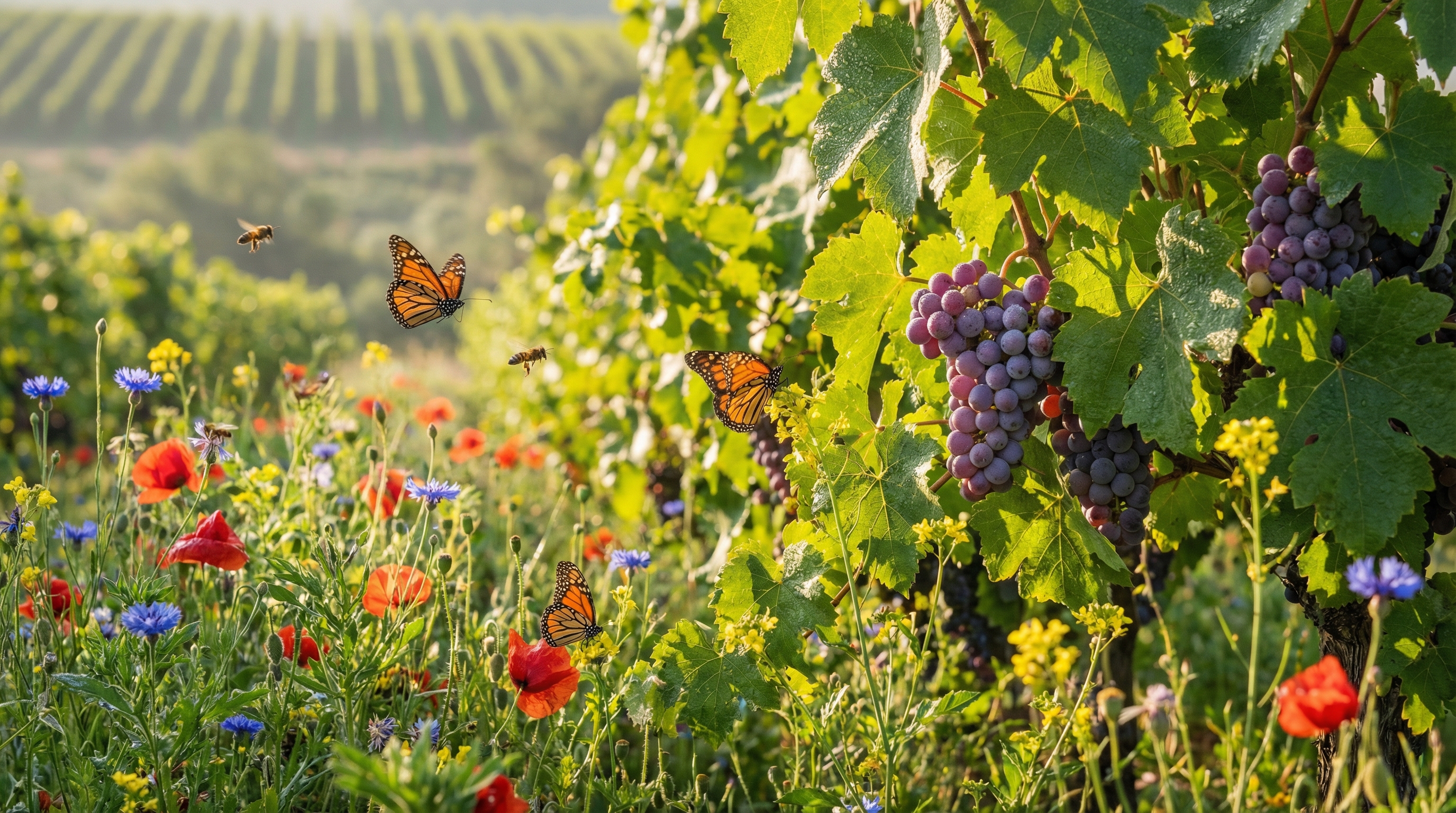
A biodynamic farm aspires to be a closed, self-sustaining system. Inputs from outside are minimized. The vineyard is not viewed in isolation but as part of a larger ecological whole that includes forests, meadows, wetlands, animals, and the people who work the land. Diversity is paramount — monoculture is the enemy.
2. The nine biodynamic preparations
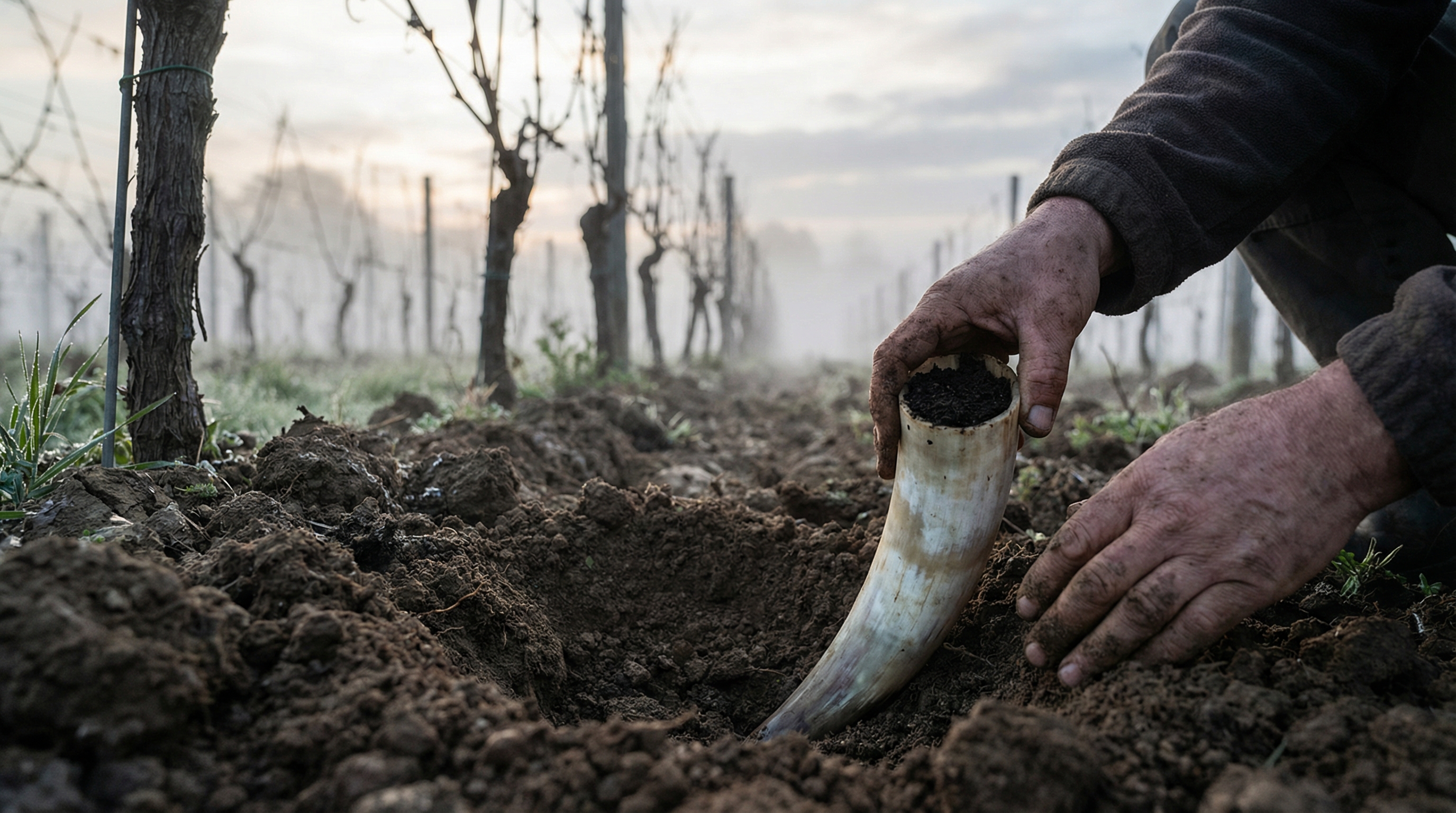
This is where biodynamics departs most dramatically from conventional and organic farming. Steiner prescribed nine specific preparations, numbered 500 through 508, each intended to enhance soil vitality, stimulate microbial life, or strengthen plant resilience:
| Preparation | Composition | Application |
|---|---|---|
| 500 | Cow manure fermented in a cow horn buried over winter | Sprayed on soil to stimulate root growth and humus formation |
| 501 | Ground quartz (silica) packed in a cow horn buried over summer | Sprayed on foliage to enhance photosynthesis and light metabolism |
| 502 | Yarrow flowers fermented in a stag bladder | Added to compost to regulate potassium and sulfur processes |
| 503 | Chamomile blossoms fermented in cow intestine | Added to compost to stabilize nitrogen and stimulate plant health |
| 504 | Stinging nettle, buried in soil for one year | Added to compost to enhance soil sensitivity and nutrition |
| 505 | Oak bark fermented in a cow skull | Added to compost to provide calcium and combat plant diseases |
| 506 | Dandelion flowers fermented in cow mesentery | Added to compost to stimulate the relationship between silica and potassium |
| 507 | Valerian flower extract | Sprayed on compost to stimulate phosphorus activity |
| 508 | Horsetail tea (Equisetum arvense) | Sprayed on vines to combat fungal diseases |
The preparations are used in extraordinarily dilute quantities — preparation 500, for example, is stirred in water for exactly one hour (alternating clockwise and counterclockwise to create a vortex) and then sprayed over the vineyard at a rate of roughly 60-90 grams per hectare. Critics point out that this degree of dilution is essentially homeopathic, and that no plausible biochemical mechanism exists for its efficacy.
3. The biodynamic calendar
Biodynamic practitioners follow a planting and farming calendar based on the position of the moon and planets relative to the twelve constellations of the zodiac. The calendar divides days into four types:
- Root days (Earth signs: Taurus, Virgo, Capricorn) — Favorable for root crops and soil work
- Fruit days (Fire signs: Aries, Leo, Sagittarius) — Ideal for harvesting grapes and fruit
- Flower days (Air signs: Gemini, Libra, Aquarius) — Best for aromatic plants; tasting days for wine
- Leaf days (Water signs: Cancer, Scorpio, Pisces) — Favorable for leaf vegetables; poor tasting days for wine
The calendar was elaborated by Maria Thun, a German researcher who spent fifty years studying the relationship between cosmic rhythms and plant growth. Her annual "Biodynamic Sowing and Planting Calendar" remains the standard reference used by biodynamic farmers worldwide.
Some wine professionals claim that wines genuinely taste different on fruit days versus root or leaf days. Controlled studies have produced mixed results, though a 2012 study published in the Journal of Wine Research found that trained tasters rated wines slightly higher on fruit days, albeit with marginal statistical significance.
4. Cosmic and terrestrial forces
Steiner distinguished between two fundamental forces: cosmic forces that stream down from the sky (light, warmth, the influence of distant planets) and terrestrial forces that rise from the earth (gravity, minerals, moisture). A healthy vine, in the biodynamic view, exists in a dynamic balance between these two forces. The preparations and calendar practices are designed to harmonize this balance.
Certification: The Demeter Standard
Demeter International is the primary certification body for biodynamic agriculture worldwide. Demeter certification requires:
- Full organic compliance (no synthetic chemicals, pesticides, herbicides, or fertilizers)
- Use of all nine biodynamic preparations
- Adherence to the biodynamic calendar for key activities
- At least 10% of farm area dedicated to biodiversity (hedgerows, forests, wetlands)
- Minimum three-year conversion period from conventional farming
- Annual inspection by certified auditors
Demeter standards are significantly more rigorous than organic certification. A wine can be labeled "biodynamic" without Demeter certification, but Demeter is the most widely recognized and trusted mark. In France, Biodyvin is another respected certification organization, with a membership that includes many of the country's most prestigious domaines.
The Science Question: Does It Actually Work?
This is the crux of the controversy. The scientific evidence for biodynamics is, frankly, mixed and limited.
What the evidence supports:
- Biodynamic farms consistently show higher soil biodiversity, greater earthworm populations, and richer microbial communities than conventional farms. A landmark 21-year study by the Research Institute of Organic Agriculture (FiBL) in Switzerland found that biodynamic plots had 40% higher mycorrhizal root colonization than conventional plots.
- Biodynamic vineyards often demonstrate deeper root systems, which many agronomists associate with more complex terroir expression.
- The emphasis on compost and soil health aligns perfectly with contemporary soil science. Biodynamic farmers were building soil microbiome health decades before the term "microbiome" entered mainstream agriculture.
What the evidence does not support:
- There is no peer-reviewed scientific evidence that the specific biodynamic preparations work through any mechanism beyond their role as compost inoculants. The quantities used are too small for measurable biochemical effects.
- The cosmic calendar lacks a plausible physical mechanism. While the moon unquestionably influences tides and certain biological rhythms, the influence of distant planets and zodiac constellations on plant growth remains unsupported by physics or biology.
- Comparative studies between biodynamic and organic farming (which shares the same chemical restrictions but omits the preparations and calendar) generally show little or no measurable difference in grape or wine quality.
“I do not need a double-blind study to tell me what I observe in my vineyards every year. The vines are healthier, the soil is alive, the wines are more expressive. That is all the evidence I need.”
— Nicolas Joly, Coulée de Serrant
The Wine World Divided
The roster of biodynamic wine producers reads like a who's who of the world's finest estates:
Burgundy — Domaine de la Romanée-Conti (since 2008), Domaine Leroy, Domaine Leflaive, Domaine Comte Armand, Domaine d'Auvenay. That the most prestigious domaine in the world practices biodynamics is perhaps the strongest endorsement the movement could ask for.
Loire Valley — Nicolas Joly's Coulée de Serrant is biodynamics' most vocal ambassador. Huet in Vouvray has been biodynamic since 1990 and produces some of the Loire's most profound Chenin Blanc.
Alsace — Domaine Zind-Humbrecht, Marcel Deiss, and Domaine Weinbach are all certified biodynamic, producing wines of staggering complexity from Riesling, Gewurztraminer, and Pinot Gris.
Bordeaux — Pontet-Canet became the first classified Bordeaux growth to achieve Demeter certification and has seen dramatic quality improvements. Château Palmer is another high-profile convert.
Rhône — M. Chapoutier has been fully biodynamic since 1991 across all of its extensive holdings. Domaine Zind-Humbrecht's Olivier Humbrecht MW credits biodynamics with transforming his understanding of terroir.
New World — Felton Road in Central Otago, New Zealand; Benziger in Sonoma, California; Cullen in Margaret River, Australia; Emiliana in Chile — biodynamics has gone global.
Biodynamic Versus Organic Versus Natural: Untangling the Terms
These three terms are frequently confused. Here is a clear distinction:
| Attribute | Organic | Biodynamic | Natural |
|---|---|---|---|
| Synthetic chemicals | Prohibited | Prohibited | Prohibited |
| Biodynamic preparations | Not required | Required | Not required |
| Cosmic calendar | Not followed | Followed | Not followed |
| Sulfite additions | Limited | Limited | Minimal or zero |
| Commercial yeasts | Permitted | Usually avoided | Prohibited |
| Certification body | Various (EU Organic, USDA Organic) | Demeter, Biodyvin | No formal standard |
| Fining/filtration | Permitted | Permitted | Usually avoided |
| Philosophy | Environmental protection | Holistic, spiritual ecology | Minimal intervention |
An important distinction: all biodynamic wine is organic, but not all organic wine is biodynamic. Natural wine overlaps with both but has its own additional restrictions (particularly around sulfites and winemaking interventions) and lacks a universally agreed definition or certification body.
How to Taste the Difference
Can you actually taste the difference between biodynamic and conventional wine? Many sommeliers and critics claim you can. The descriptors most commonly associated with biodynamic wines include:
- Vibrancy — A sense of energy, life, and pulsation that conventional wines may lack
- Precision — Clearer, more focused expression of terroir and grape variety
- Texture — Greater depth and complexity on the palate, particularly mid-palate weight
- Finish — Longer, more mineral-driven finishes
- Drinkability — A lightness and digestibility that makes the wine feel more "alive"
These are, of course, subjective assessments, and blind studies have not consistently demonstrated that tasters can reliably distinguish biodynamic from non-biodynamic wines. But the subjective experience of many professionals is worth noting.
Common Criticisms and Honest Responses
"It is just expensive organic farming." Perhaps. But the philosophical framework and the extreme attentiveness it demands produce extraordinary results. If the rituals and calendar force farmers to observe their vines more carefully, that alone has value.
"The preparations are homeopathic nonsense." The dilutions are indeed extreme, and no biochemical mechanism has been identified. However, the preparations may function as highly effective compost activators, and their role in forcing regular, close observation of the vineyard should not be dismissed.
"You cannot farm this way at scale." This is partially true. Biodynamic farming is labor-intensive and requires a deep personal connection to the land. It is difficult to implement on vast industrial estates. But domains like Chapoutier (with hundreds of hectares) prove it is possible at meaningful scale.
"It is a marketing gimmick." While some producers may use biodynamic claims for marketing, the Demeter certification process is rigorous and expensive. Few producers would undergo the conversion process solely for marketing value.
“People ask me if biodynamics is scientific. I say: is cooking scientific? Is music scientific? Some of the most important things in life cannot be reduced to a controlled experiment.”
— Lalou Bize-Leroy, Domaine Leroy
The Future of Biodynamic Wine
Biodynamic viticulture is growing rapidly. Demeter reports that certified biodynamic vineyard area has tripled globally since 2005. Climate change is accelerating adoption, as farmers seek resilient, ecologically robust approaches to an increasingly unpredictable environment. Young winemakers, in particular, are drawn to biodynamics as part of a broader rejection of industrial agriculture and a desire to reconnect with the rhythms of the natural world.
Whether you embrace the cosmic philosophy or dismiss it as mysticism, the results in the glass are difficult to argue with. The world's greatest wines are increasingly biodynamic. That alone makes this movement worth understanding — and its wines very much worth drinking.
Recommended Biodynamic Wines to Explore
For those curious to begin their biodynamic journey, here are approachable starting points at various price ranges:
- Entry ($15-$25): Emiliana Coyam (Chile), Montinore Estate Pinot Noir (Oregon), Benziger Family Winery Tribute (Sonoma)
- Mid-range ($30-$60): Domaine Huet Le Haut-Lieu Vouvray (Loire), Felton Road Pinot Noir (Central Otago), Pontet-Canet (Bordeaux)
- Premium ($60-$150): Domaine Zind-Humbrecht Rangen de Thann (Alsace), Domaine Leflaive Puligny-Montrachet (Burgundy), Cullen Diana Madeline (Margaret River)
- Icon ($200+): Coulée de Serrant (Loire), Domaine Leroy (Burgundy), DRC (Burgundy)
The best way to understand biodynamic wine is, as always, to open a bottle and pay attention.


