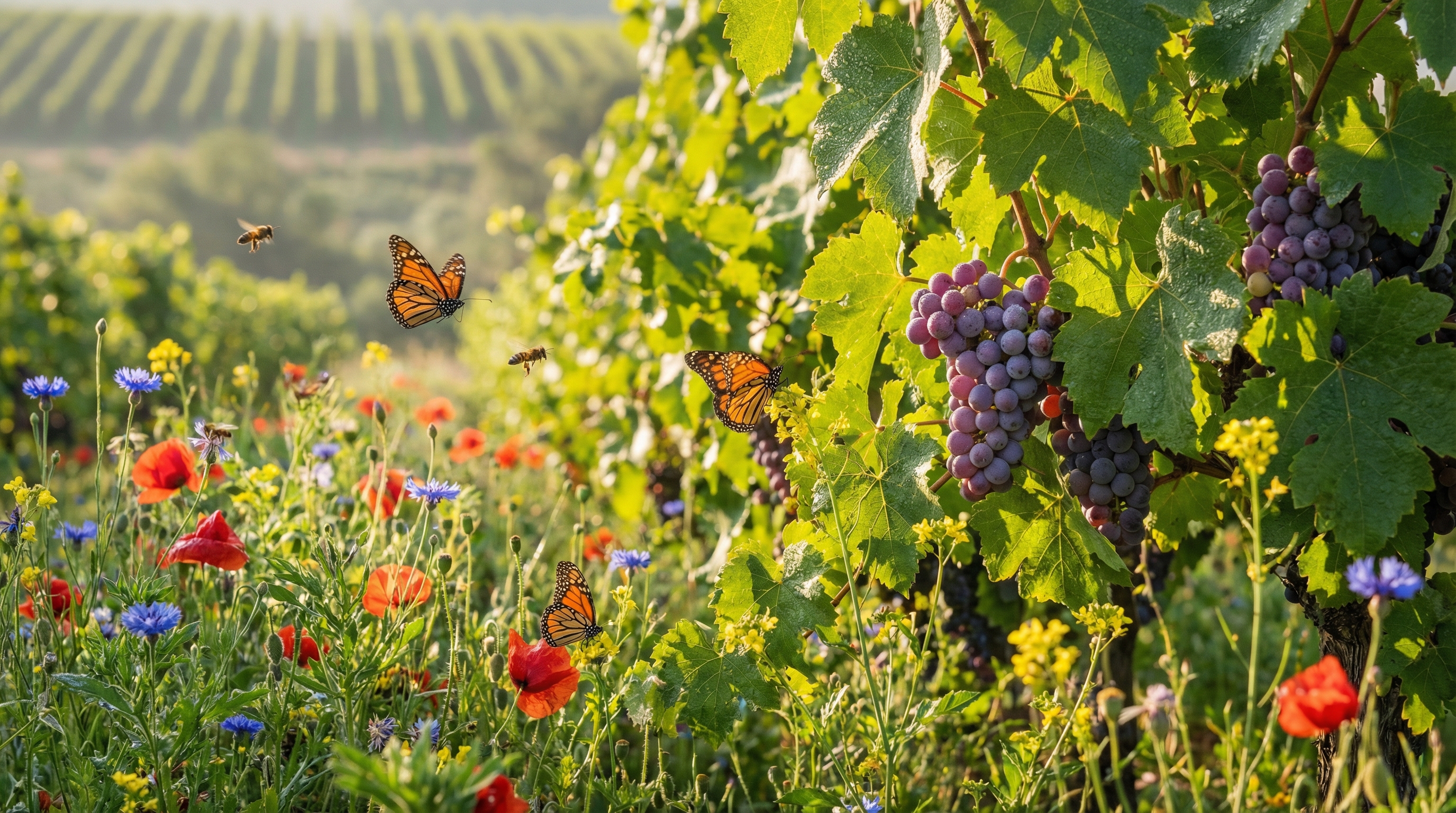
Beyond Organic: A Holistic Philosophy
Biodynamic viticulture is the most radical, controversial, and — to many — the most effective approach to farming vineyards. It goes far beyond organic agriculture, treating the vineyard as a self-sustaining living organism connected to cosmic rhythms. Some of the world's greatest wines — from Domaine Leroy's Burgundy to Zind-Humbrecht's Alsace to Nikolaihof's Wachau — are farmed biodynamically. Yet the philosophy behind the practice remains deeply polarizing.
The Origins: Rudolf Steiner
Biodynamic agriculture traces to a single event: a series of eight lectures delivered in June 1924 by Rudolf Steiner (1861-1925), the Austrian philosopher, esotericist, and founder of anthroposophy. Farmers had approached Steiner with concerns about declining soil fertility and crop quality following the introduction of chemical fertilizers. His response was a holistic agricultural system that incorporated spiritual science, astronomy, and homeopathic principles.
Steiner himself was not a farmer — he was a philosopher. His lectures were conceptual and sometimes cryptically esoteric. But the practical applications, developed by his followers over the following decades, have proven remarkably effective. Today, biodynamic agriculture is the fastest-growing certification in viticulture.
Core Principles
1. The Farm as a Living Organism The vineyard is not a factory but a self-sustaining ecosystem. Everything — soil, plants, insects, animals, and the humans who tend them — is interconnected. The goal is to create a closed loop where the farm generates its own fertility.
2. The Biodynamic Preparations (500-508) These are the most distinctive — and most controversial — elements:
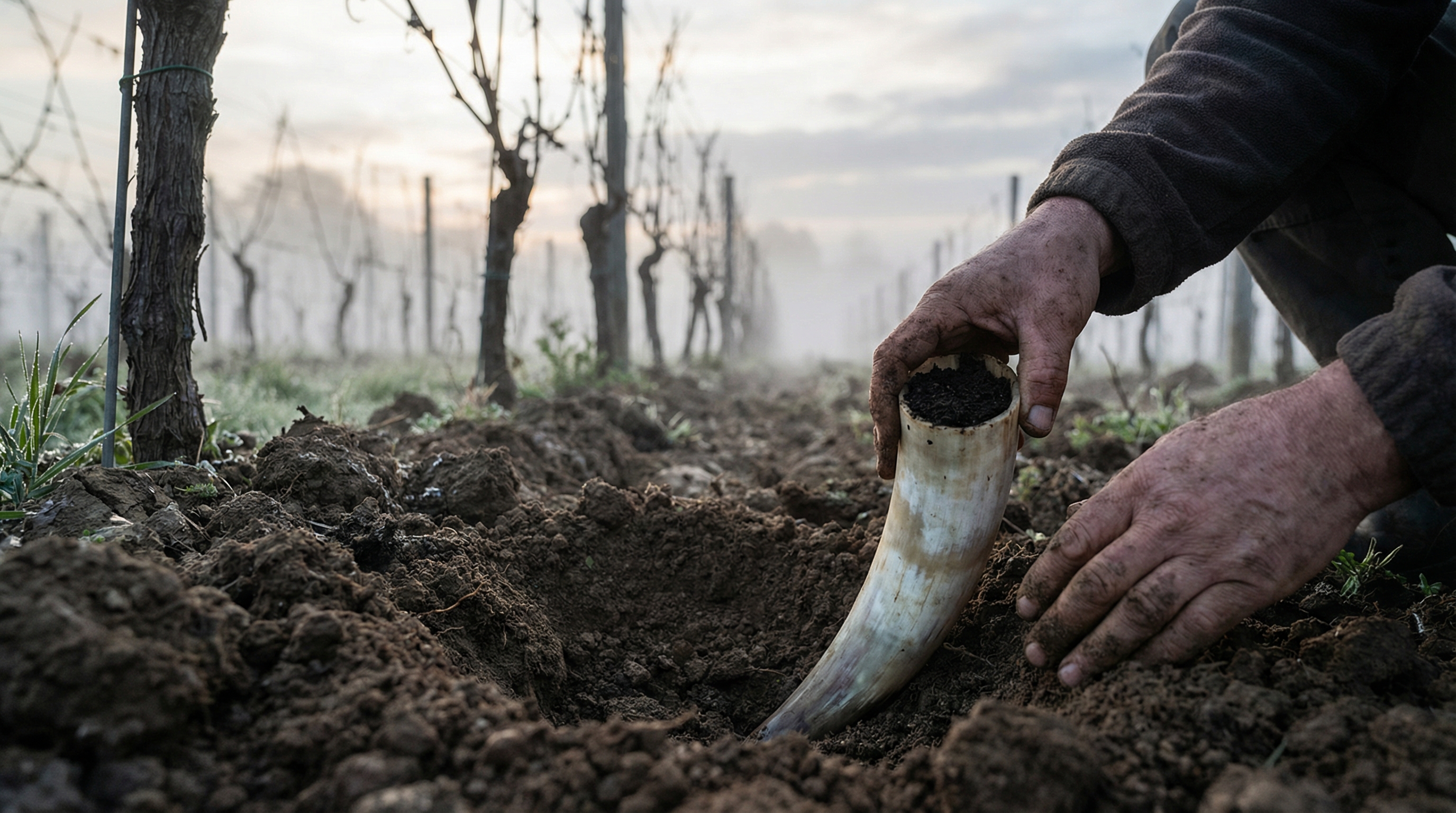
- Preparation 500 (Horn Manure) — Cow manure is packed into a cow horn and buried over winter. In spring, it is dug up and the transformed material is diluted in water, stirred dynamically (alternating clockwise and counterclockwise to create a vortex) for one hour, then sprayed on the soil. It is believed to stimulate root growth and soil microbiological activity.
- Preparation 501 (Horn Silica) — Ground quartz crystal packed in a cow horn, buried over summer. Applied to foliage in minute doses to enhance light metabolism and photosynthesis.
- Preparations 502-507 — Six compost preparations made from yarrow, chamomile, stinging nettle, oak bark, dandelion, and valerian. Each is processed in a specific animal organ (deer bladder, cow intestine, skull) and added to compost to enhance decomposition.
- Preparation 508 — Horsetail (Equisetum arvense) tea, sprayed to prevent fungal diseases.
3. The Biodynamic Calendar Based on the work of Maria Thun, the calendar divides days into four types based on the moon's position relative to the zodiac constellations:
- Fruit days — Best for harvesting wine grapes
- Root days — Best for pruning and working the soil
- Leaf days — Best for watering
- Flower days — Best for leaving the vineyard alone (and, some believe, for tasting wine)
The Skeptics vs the Believers
Skeptics argue:
- The preparations are homeopathic and have no plausible mechanism of action
- The cosmic calendar has no scientific basis
- Any benefits attributed to biodynamics could be explained by the heightened attention and care that biodynamic farmers give their vines
- The spiritual/esoteric framework is pseudoscience
Believers counter:
- Scientific studies have shown measurably different soil microbiology in biodynamic vineyards vs conventional ones
- The proof is in the glass — a disproportionate number of the world's greatest wines are biodynamic
- Even if the mechanism is not fully understood, the results are undeniable
- The holistic approach encourages biodiversity, soil health, and sustainable farming practices that demonstrably benefit wine quality
The truth may lie in the middle: regardless of whether cosmic forces influence vine growth, the practices of biodynamic farming — composting, cover cropping, minimal chemical intervention, attentive observation, and deep respect for the land — clearly produce healthier vineyards and more expressive wines.
Certification: Demeter
Demeter is the international certification body for biodynamic agriculture, established in 1928 (making it the oldest ecological certification in the world). Demeter certification requires:
- Full organic compliance (no synthetic chemicals)
- Use of all biodynamic preparations
- Following the biodynamic calendar for key operations
- A minimum conversion period of 3 years
- Regular inspections
Some producers practice biodynamics without seeking Demeter certification, either due to cost, philosophical reasons, or wanting flexibility.
The World's Greatest Biodynamic Wine Producers
Domaine Leroy / Domaine d'Auvenay (Burgundy, France) Lalou Bize-Leroy converted her estates to biodynamics in 1988 and produces what many consider the purest, most terroir-expressive wines in Burgundy. Her yields are vanishingly low (often under 20 hl/ha), and her wines command astronomical prices.
Domaine Zind-Humbrecht (Alsace, France) Olivier Humbrecht MW was one of the first Alsatian producers to adopt biodynamics (certified since 1998). His Rieslings, Gewürztraminers, and Pinot Gris from Grand Cru vineyards like Rangen, Brand, and Hengst are among the greatest white wines in the world.
Nikolaihof (Wachau, Austria) The oldest wine estate in Austria (founded in 985 AD) has been biodynamic since 1971 — one of the earliest adopters in the wine world. Christine and Nikolaus Saahs produce Riesling and Grüner Veltliner of extraordinary purity and aging potential.
Felton Road (Central Otago, New Zealand) Blair Walter's biodynamic estate in Bannockburn produces some of the Southern Hemisphere's finest Pinot Noir and Chardonnay, with an intensity and purity that many attribute to the farming philosophy.
Domaine de la Romanée-Conti (Burgundy, France) The world's most famous wine estate has been fully biodynamic since 2007, though they do not seek certification. Co-director Aubert de Villaine has long been a proponent.
Bonterra / Fetzer (Mendocino, California) One of the largest biodynamic operations in the world, demonstrating that the approach can work at scale, not just on boutique estates.
Other notable biodynamic producers:
- Chapoutier (Rhône, France) — M. Chapoutier's Hermitage and Côte-Rôtie wines
- Cullen (Margaret River, Australia) — Vanya Cullen's Diana Madeline is a benchmark
- Alvaro Palacios (Priorat, Spain) — L'Ermita and Finca Dofí
- Benziger (Sonoma, California) — Demeter-certified family estate
- Querciabella (Tuscany, Italy) — Batàr and Camartina
“Toprağı dinlemek.”
— Nicolas Joly