A Country Shaped by Extremes
Chile is the most geographically improbable wine country on earth. Stretching 4,300 kilometers from the Atacama Desert in the north to Patagonian glaciers in the south, yet averaging only 177 kilometers wide, it is a slender ribbon of land compressed between two colossal natural barriers: the Andes mountains to the east and the Pacific Ocean to the west. To the north lies the driest desert on the planet. To the south, Antarctica beckons. This extraordinary natural isolation has given Chile something no other wine country possesses — a viticultural clean room, sealed off from the pests and diseases that have devastated vineyards elsewhere throughout history.
Most significantly, the phylloxera louse that destroyed nearly every vineyard in Europe, North America, and eventually most of the winemaking world during the 19th and 20th centuries never reached Chile. Chilean vines grow on their own rootstock — ungrafted, as nature intended — a living connection to winemaking's ancient past that exists virtually nowhere else. This biological miracle, combined with a Mediterranean climate modulated by cold ocean currents and mountain air drainage, has created a viticultural paradise that the modern wine world is only now beginning to fully appreciate.
“Chile is not just a wine country. It is a geological gift to viticulture — a place where the earth itself conspired to create perfect conditions for the vine.”
— Eduardo Chadwick, President of Viña Errázuriz
A Brief History of Chilean Wine
Wine has been part of Chilean life since the Spanish conquistadors arrived in the 16th century, bringing Mission grapes (known locally as País) to supply sacramental wine. For centuries, these rustic plantings sufficed. But the real transformation began in the 1850s, when wealthy Chilean landowners — inspired by visits to Bordeaux — imported cuttings of Cabernet Sauvignon, Merlot, Carmenère, and other French varieties. Don Silvestre Ochagavía is widely credited with initiating this movement in 1851, hiring French winemaker Joseph Bertrand to oversee plantings at his estate.
The timing proved fortuitous. Just as phylloxera began its march across Europe, these French varieties had already taken root in Chile's protected valleys. While Bordeaux was being replanted on American rootstock, Chile's original French vines flourished undisturbed.
The modern era began in the 1980s, when Chilean winemakers like Miguel Torres (the Catalan pioneer who established himself in Curicó) and Eduardo Chadwick of Errázuriz began demonstrating that Chile could produce world-class wines, not just inexpensive bulk exports. The pivotal moment came in 2004, when Chadwick organized the "Berlin Tasting" — a blind tasting where his Viñedo Chadwick and Seña wines were ranked above Lafite Rothschild and other First Growth Bordeaux by a panel of European wine journalists. Chile's reputation was transformed overnight.
Understanding Chile's Wine Geography
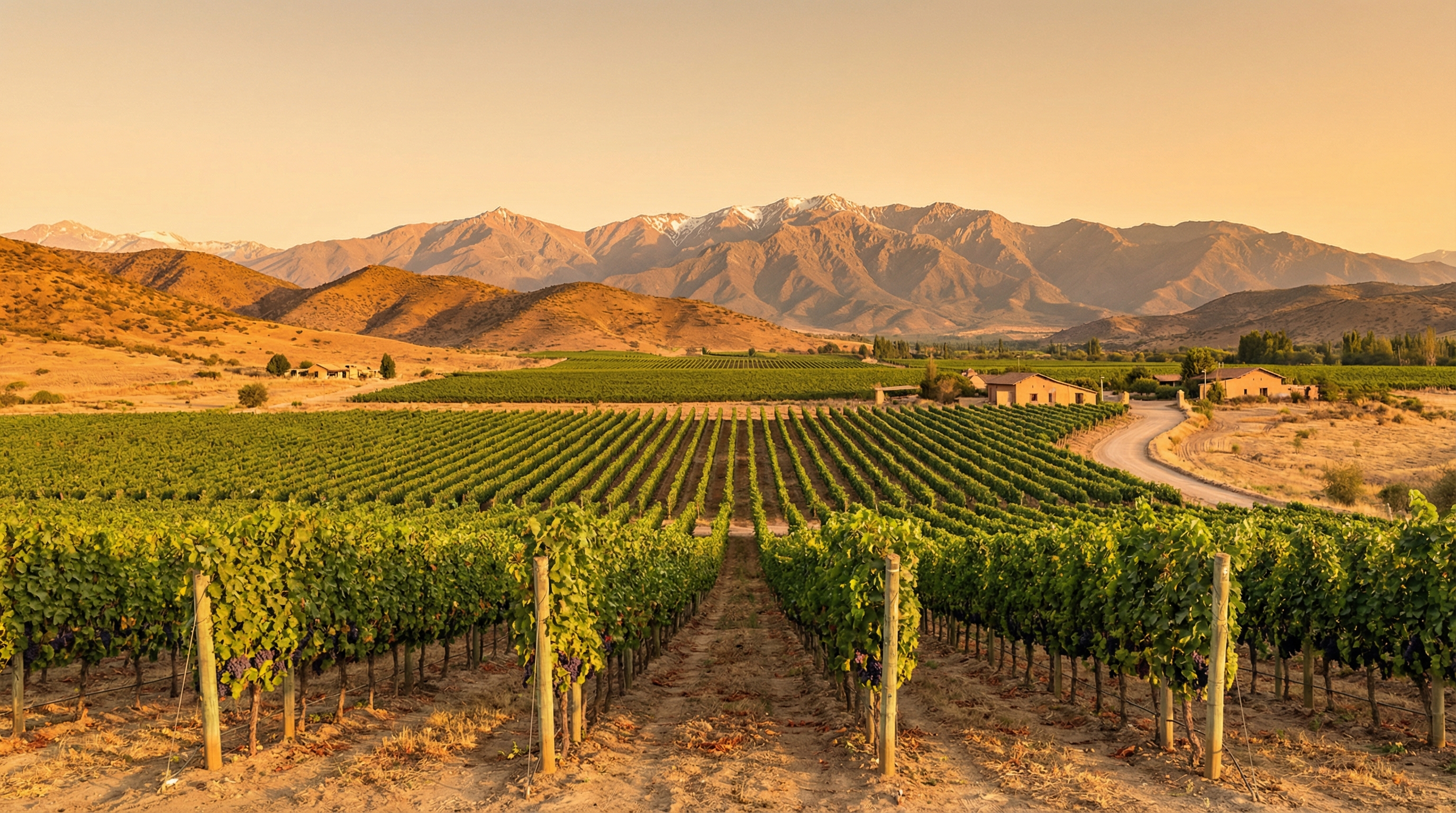
Chile's wine regions are organized by a system of intersecting axes that reflect the country's unique topography. The traditional north-south division by latitude (regions and valleys) has been complemented by an increasingly important east-west distinction recognizing the dramatic influence of altitude and maritime proximity.
The East-West Axis: Costa, Entre Cordilleras, Andes
In 2011, Chile introduced a groundbreaking appellation sub-classification that divides valleys into three transversal zones:
- Costa — Vineyards near the Pacific coast, directly influenced by the cold Humboldt Current and coastal fog. These sites produce the most vibrant, mineral, high-acid wines. Average temperatures can be 5-8°C cooler than inland sites in the same valley.
- Entre Cordilleras — The central, flat valley floor between the coastal range and the Andes foothills. This is where most of Chile's large-volume, fruit-forward wines originate. Warmer, with more consistent sunshine and fertile alluvial soils.
- Andes — Vineyards planted at altitude on the Andean foothills and slopes, benefiting from wide diurnal temperature shifts (sometimes 20°C between day and night), intense UV radiation, and rocky, mineral-rich soils. These sites produce wines of remarkable concentration and freshness.
This east-west classification was revolutionary because it acknowledged what winemakers already knew: a Syrah from the coastal Elqui Valley and a Syrah from the Andean foothills of Cachapoal share almost nothing in character despite being at similar latitudes.
Major Wine Valleys
| Valley | Key Grapes | Character | Notable Producers |
|---|---|---|---|
| Elqui | Syrah, Sauvignon Blanc | Desert viticulture at altitude; piercing acidity, mineral intensity | Viña Falernia, Centro |
| Limarí | Chardonnay, Syrah, Pinot Noir | Limestone soils, coastal fog; Burgundian elegance | Tabalí, De Martino |
| Aconcagua | Cabernet Sauvignon, Syrah | Warm interior with cool coastal sites; powerful reds | Errázuriz, Seña |
| Casablanca | Sauvignon Blanc, Chardonnay, Pinot Noir | Cool maritime climate; crisp whites, elegant Pinot | Kingston Family, Loma Larga |
| San Antonio / Leyda | Sauvignon Blanc, Pinot Noir, Syrah | Extreme coastal cool; electric acidity, maritime salinity | Amayna, Garcés Silva, Casa Marín |
| Maipo | Cabernet Sauvignon, Carmenère | Chile's Bordeaux; structured, age-worthy reds | Concha y Toro (Don Melchor), Almaviva, Cousiño-Macul |
| Rapel (Cachapoal / Colchagua) | Carmenère, Cabernet Sauvignon, Syrah | Warm, generous; Chile's red wine heartland | Montes, Lapostolle, Casa Silva |
| Curicó | Sauvignon Blanc, Cabernet Sauvignon | Chile's viticultural crossroads; reliable, value-driven | Miguel Torres Chile, San Pedro |
| Maule | País, Carignan, Cinsault | Chile's oldest vines; rustic charm, ancient dry-farmed bush vines | Gillmore, Bouchon, VIGNO producers |
| Itata | Muscat, País, Cinsault | Southern pioneer region; wild, textured wines from centenarian vines | Pandolfi Price, Leonardo Erazo |
| Bío-Bío / Malleco | Pinot Noir, Chardonnay, Riesling | Chile's deep south; cool, wet, high-acid wines | Cono Sur, William Fèvre |
Maipo Valley: The Historic Heartland
The Maipo Valley, surrounding Santiago, is Chile's most prestigious red wine region and the closest analogue to Bordeaux. The Alto Maipo (upper Maipo), where vineyards climb the Andean foothills to elevations above 800 meters, is the source of Chile's most celebrated Cabernet Sauvignons. The stony, alluvial soils and dramatic day-night temperature swings produce wines of extraordinary depth and structure.
Don Melchor, the flagship Cabernet from Concha y Toro's Puente Alto vineyard, has been one of South America's most consistent fine wines for over three decades. Almaviva, the joint venture between Baron Philippe de Rothschild and Concha y Toro, produces a Bordeaux-style blend that regularly earns scores above 95 points from international critics.
Colchagua: The Generous Heart
If Maipo is Chile's Bordeaux, Colchagua is its Napa Valley — a place of generous warmth, bold wines, and ambitious estates. The valley stretches from the Andes to the coast, and the best producers exploit this diversity brilliantly. Montes's Folly vineyard, planted on impossibly steep slopes in the Apalta sub-region, produces some of Chile's most concentrated Syrah. Lapostolle's Clos Apalta, a gravity-flow winery designed by architect Roberto Benavente, is built directly into the hillside.
The coastal end of Colchagua, around the town of Marchigüe and toward Paredones, is one of Chile's most exciting frontiers. Cool-climate Syrah and Pinot Noir from these Pacific-influenced sites show a completely different character from the warm inland wines — peppery, floral, and vibrant rather than lush and fruity.
The Carmenère Story
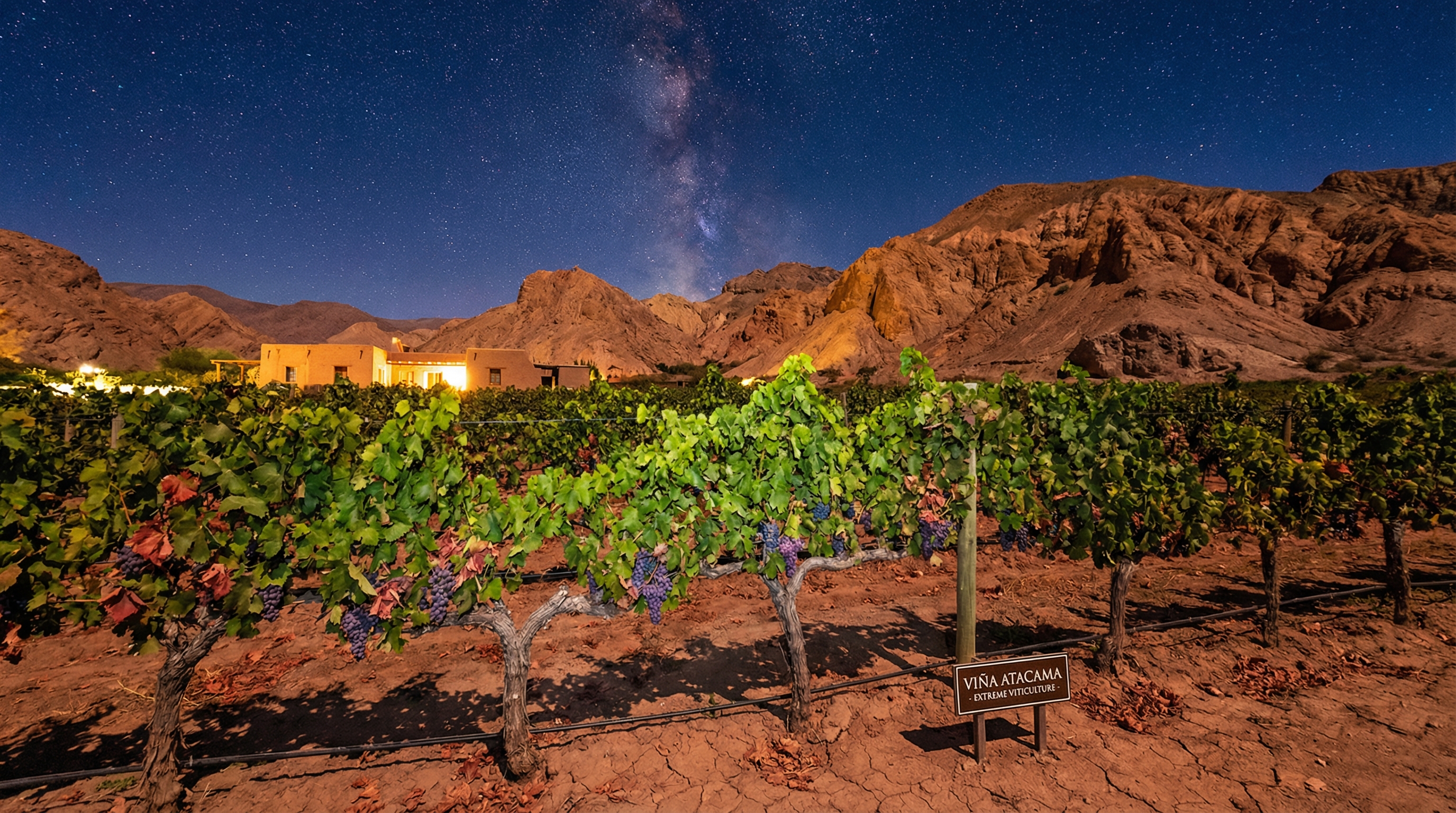
No grape is more intrinsically linked to Chile's identity than Carmenère. This variety was once widely planted in Bordeaux, where it was part of the traditional blend alongside Cabernet Sauvignon, Merlot, Cabernet Franc, Malbec, and Petit Verdot. But Carmenère was notoriously difficult in Bordeaux — late-ripening, prone to coulure (flower drop), and susceptible to rot in the damp maritime climate. After phylloxera devastated Bordeaux's vineyards, Carmenère was largely abandoned during replanting. By the late 20th century, it had virtually disappeared from France.
Meanwhile, in Chile, Carmenère had been quietly thriving — misidentified as Merlot. For over a century, Chilean "Merlot" vineyards contained a significant proportion of Carmenère, and nobody realized it. The truth was revealed in 1994, when French ampelographer Jean-Michel Boursiquot visited Chile and identified what everyone assumed was Merlot as the lost Bordeaux variety.
“When we discovered that what we had been calling Merlot was actually Carmenère, it was both shocking and thrilling. Chile had been unknowingly preserving a piece of Bordeaux history.”
— Eduardo Chadwick
The revelation was transformative. Chile officially recognized Carmenère as a distinct variety in 1998, and winemakers began to study how to grow and vinify it properly, rather than treating it as an underperforming Merlot. The results have been remarkable.
At its best, Carmenère produces deeply colored, richly textured wines with flavors of red and black fruit, green pepper (when picked early), roasted coffee, dark chocolate, and a distinctive smoky, spicy character. It thrives in Chile's warm inland valleys, where it can achieve full phenolic ripeness — something it rarely managed in Bordeaux. The Rapel Valley (both Cachapoal and Colchagua) and the warmer sites of Maipo produce the most impressive examples.
The Southern Renaissance: País, Carignan, and Ancient Vines
Perhaps the most exciting chapter in Chile's modern wine story is the rediscovery of its oldest vineyards. In the southern valleys of Maule, Itata, and Bío-Bío, ancient bush vines of País (Mission), Carignan, Cinsault, and Muscat of Alexandria have been growing — many of them dry-farmed and ungrafted — for well over a century. Some individual vines are estimated to be over 200 years old.
For generations, these vineyards were overlooked, their grapes sold cheaply for bulk wine or the production of pipeño, a rustic, unfiltered wine sold in rural communities. But a new generation of winemakers has recognized these ancient vines as a national treasure.
The VIGNO consortium, founded in 2009, is dedicated to old-vine Carignan from the Maule Valley. Members commit to using only dry-farmed, bush-trained vines at least 30 years old (most are far older), with limited yields. The resulting wines — aromatic, silky, and hauntingly complex — have redefined what Chilean wine can be. They speak not of international ambition but of local identity, history, and the resilience of vines that have survived earthquakes, neglect, and the relentless march of industrial agriculture.
Producers like Gillmore, Bouchon's Mingre label, and the visionary Roberto Henríquez are creating wines from these ancient vineyards that rival the most soulful bottles of southern France. A well-made old-vine País or Cinsault from Itata, fermented in ancient rauli (southern beech) vats, is one of the most singular and moving wine experiences available anywhere in the world.
“These old vines are Chile's true patrimony. They represent a viticultural heritage that predates the Bordeaux varieties by centuries. Our job is not to modernize them but to honor them.”
— Pedro Parra, terroir consultant and geologist
Chile's Key Producers: A Guide
Concha y Toro — Chile's largest and most globally recognized producer. While the entry-level wines are ubiquitous, the premium range is extraordinary. Don Melchor Cabernet Sauvignon from Puente Alto is one of South America's greatest wines, and Terrunyo Carmenère sets the benchmark for the variety.
Errázuriz / Seña / Viñedo Chadwick — Eduardo Chadwick's portfolio spans accessible daily wines to two of Chile's most lauded icons. Seña, a biodynamic blend from the Aconcagua Valley, combines Bordeaux power with Chilean freshness. Viñedo Chadwick, a single-vineyard Cabernet from Maipo, is Chile's answer to a First Growth.
Montes — Aurelio Montes Sr. has been one of Chile's most tireless quality ambassadors. The Alpha M and Folly (Syrah) bottlings from Apalta are consistently outstanding, and the newer Outer Limits range explores cool-climate frontiers.
De Martino — Under the direction of Marcelo Retamal, De Martino has become Chile's most intellectually ambitious winery. Their single-vineyard old-vine wines — Vigno Carignan, Old Vine País, and the Alto de Piedras Cabernet — represent the cutting edge of Chilean terroir expression.
Garage Wine Co. — Derek Yerxa and Alvaro Espinoza's micro-production project sources fruit from ancient vineyards across the south, creating small-batch wines of astonishing individuality. Each lot is numbered and labeled with the grower's name.
Casa Marín — María Luz Marín was a pioneer of extreme coastal viticulture. Her San Antonio Valley winery, just 4 kilometers from the Pacific, produces some of Chile's most bracingly fresh Sauvignon Blanc, Riesling, and Syrah.
The Climate Challenge and Sustainable Future
Chile's wine industry faces a serious reckoning with climate change. The country has experienced a prolonged megadrought since 2010, with rainfall in the central valleys declining by as much as 30% compared to historical averages. Water rights are a contentious political issue, and vineyards that once relied on rainfall alone now increasingly require irrigation.
Rising temperatures are pushing viticulture further south and toward the coast and higher altitudes. Regions like Malleco, at 38° south latitude, and the extreme coastal sites of Leyda and San Antonio represent the new frontier. Some producers are experimenting with drought-resistant heritage varieties and organic farming methods that improve soil water retention.
On the sustainability front, Chile has been a leader. The Wines of Chile sustainability code, established in 2011, now covers over 75% of national wine exports. Many top producers — including Emiliana, the world's largest organic and biodynamic winery — have embraced regenerative agriculture, cover cropping, and biodiversity corridors between vineyards.
Visiting Chile Wine Country
For the wine traveler, Chile offers an experience unlike any other. The combination of spectacular Andean scenery, warm hospitality, outstanding cuisine, and genuinely affordable world-class wine makes it one of the most rewarding wine destinations on earth.
The Colchagua Valley is the most developed for tourism, with excellent hotels, restaurants, and a wine train (the Tren del Vino) that runs from San Fernando to Santa Cruz. The Colchagua Valley Wine Route offers organized tours and tastings.
For a more adventurous experience, head south to the Maule and Itata valleys, where you can visit ancient vineyards, taste pipeño from the barrel, and experience a side of Chile that few tourists ever see. The Casablanca and San Antonio valleys are easy day trips from Santiago and offer some of the country's best white wines and seafood.
Practical Tips
- Best time to visit: March through May (harvest season). The weather is warm and dry, vineyards are at their most active, and many wineries host harvest festivals.
- Getting around: Renting a car is recommended outside Santiago. Roads are well-maintained and scenic.
- Don't miss: A traditional Chilean asado (barbecue) paired with Carmenère. It is one of the great food-and-wine combinations of the world.
- Book ahead: Many premium wineries require advance reservations for tours and tastings. Contact them at least a week before your visit.
The Road Ahead
Chile stands at a fascinating crossroads. Having proved it can compete with the world's best at the premium level, the country is now engaged in a deeper, more introspective exploration of identity. The rediscovery of ancient vines, the push into extreme coastal and Andean sites, and the growing commitment to sustainability and terroir expression suggest that Chile's most interesting wines may still lie ahead.
For wine lovers, this is an extraordinarily exciting time to explore Chilean wine. Whether you are drawn to the polished power of a great Alto Maipo Cabernet, the silky complexity of a Peumo Carmenère, the electric freshness of a Leyda Sauvignon Blanc, or the haunting soul of an old-vine País from Itata, Chile offers a depth and diversity of wine experience that rivals any country on earth — and at price points that remain remarkably accessible.


