Why Understanding Wine Faults Matters
Every wine drinker has experienced the moment: you open a bottle you have been looking forward to, pour a glass, bring it to your nose, and something is unmistakably wrong. The aroma is flat, pungent, or simply absent where it should be vibrant. Understanding wine faults transforms that vague sense of disappointment into precise, actionable knowledge — the ability to name the problem, understand its cause, and decide whether the wine is truly flawed or simply expressing a style you do not prefer.
The distinction between a fault and a stylistic choice is one of wine's great gray areas. A faint barnyard character from Brettanomyces might be considered a charming hallmark of traditional Southern Rhone winemaking by one taster and an unacceptable defect by another. Slight volatile acidity can lift a wine's aromatics at low levels but becomes nail-polish remover at high concentrations. Throughout this guide, we will identify the chemical causes and sensory signatures of the most common faults, note the thresholds at which they cross from acceptable to problematic, and clarify the cases where a "fault" is actually an intentional winemaking decision. Knowing these boundaries makes you a more confident taster, a more informed buyer, and a more effective communicator when a bottle genuinely needs to go back.
Studies suggest that somewhere between one in fifteen and one in twenty bottles of wine suffers from at least one detectable fault, though the rate has declined significantly over the past two decades thanks to improved winemaking technology and quality control. Among these, cork taint and oxidation remain the most prevalent. The cost to the industry is considerable — estimated at over $10 billion annually in spoiled wine, returns, and brand damage. For the individual consumer, the cost is simpler: a ruined dinner, a wasted purchase, or worse, the mistaken belief that you simply don't like a particular producer or region.
Cork Taint (TCA)

Cork taint is the single most notorious wine fault, caused primarily by 2,4,6-trichloroanisole (TCA), a chemical compound produced when naturally occurring fungi in cork bark come into contact with chlorinated phenolic compounds. The human nose is extraordinarily sensitive to TCA — most people can detect it at concentrations as low as 2 to 4 parts per trillion, making it one of the most potent aroma compounds known to sensory science.
The signature of cork taint is unmistakable once you learn to recognize it: damp cardboard, wet newspaper, musty basement, or moldy cellar. At very low concentrations, TCA may not produce an obvious off-aroma but instead strips the wine of its fruit character, leaving it muted and flat — a phenomenon sometimes called a "scalped" wine. This subtle form of cork taint is arguably more insidious than the obvious musty version because many drinkers assume the wine is simply boring rather than faulted.
Estimates of cork taint prevalence vary, but most industry analyses place the rate between 3% and 5% of all bottles sealed with natural cork. That figure has improved from the roughly 7–8% rates reported in the 1990s, thanks to advances in cork processing — including individual cork screening using gas chromatography and the development of treated corks like DIAM (which uses supercritical CO2 extraction to remove TCA precursors). The most definitive solution, however, is the screwcap (Stelvin closure), which eliminates TCA risk entirely. Australia and New Zealand have embraced screwcaps for the majority of their production, while traditional European regions have been slower to adopt the technology, partly due to consumer perception that screwcaps signal lower quality — a prejudice that is gradually eroding.
There is no way to salvage a corked bottle. TCA is chemically stable and will not dissipate with decanting or aeration. If you detect cork taint, the wine should be returned or replaced.
Oxidation
Oxidation occurs when wine is exposed to excessive oxygen, triggering a cascade of chemical reactions that fundamentally alter its color, aroma, and flavor. In white wines, oxidation produces a shift from pale gold to deep amber or brown, accompanied by aromas of bruised apple, stale nuts, and toffee. In red wines, the bright ruby or garnet hue fades to brick-orange or tawny brown, and fresh fruit gives way to flat, dried-out, and sometimes sherried characters.
The chemistry of oxidation centers on acetaldehyde, the primary oxidation product of ethanol. At elevated levels, acetaldehyde produces the distinctive bruised-apple aroma and a harsh, bitter finish. Phenolic compounds — particularly anthocyanins in red wines and catechins in whites — also undergo oxidative polymerization, causing the color changes that are often the first visual clue.
Oxidation is caused by faulty closures that allow too much air exchange, improper storage (particularly bottles stored upright for extended periods, drying out the cork), excessive headspace in the bottle, or winemaking errors such as inadequate sulfur dioxide (SO2) addition during production. Wines with lower sulfite levels — including many natural wines — are inherently more susceptible to oxidative faults.
However, oxidation is not always a fault. Sherry, Vin Jaune from the Jura, and certain traditional styles of white Rioja are deliberately oxidized during aging. The flor yeast that protects Fino and Manzanilla Sherry creates a controlled oxidative environment that produces the nutty, saline complexity prized in those wines. The key distinction is intent: oxidation as a winemaking choice, managed and consistent, is a style; oxidation from neglect or poor storage is a fault.
Volatile Acidity (VA)
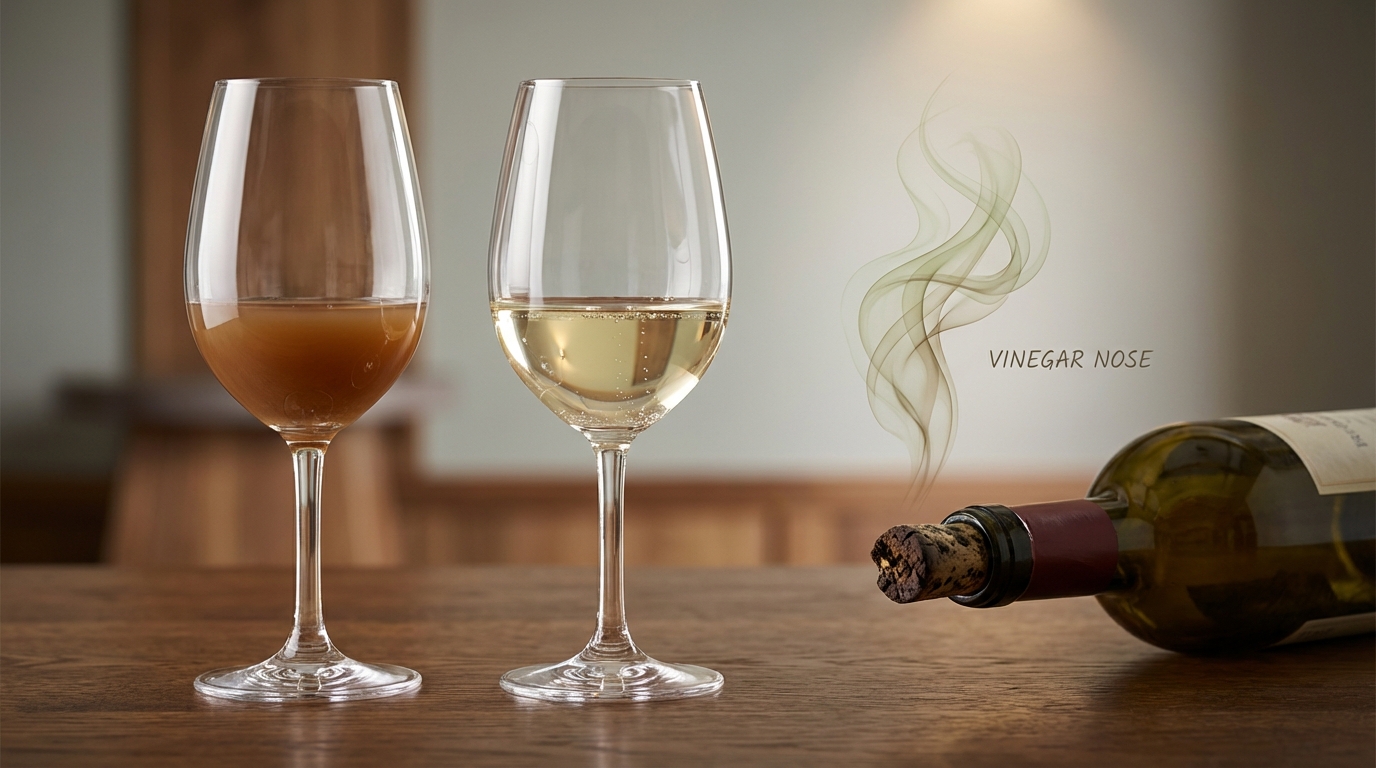
Volatile acidity refers to the presence of steam-distillable acids in wine, predominantly acetic acid (the acid in vinegar) and its ester ethyl acetate (nail polish remover). Every wine contains some volatile acidity — it is a natural byproduct of fermentation. The issue arises when VA exceeds the threshold at which it becomes objectionable, generally around 0.7 to 0.8 g/L of acetic acid for white wines and 1.0 to 1.2 g/L for reds, though perception thresholds vary significantly among individuals.
At low levels, VA can actually enhance a wine's aromatic complexity, adding a subtle lift and sweetness to the bouquet. Many of the world's most celebrated wines carry measurable VA that falls just below the perception threshold. The great wines of Barolo, for instance, often show higher VA than their French counterparts, and this contributes to their distinctive aromatic intensity. At high levels, however, the wine smells and tastes unmistakably of vinegar, with a sharp, biting acidity that overwhelms the fruit.
VA is produced by acetic acid bacteria (Acetobacter), which convert ethanol into acetic acid in the presence of oxygen. Winemaking conditions that promote VA include warm fermentation temperatures, stuck fermentations (where yeast activity stalls, leaving residual sugar for bacteria to consume), unsanitary equipment, and excessive oxygen exposure during aging. Wines with high pH (low acidity) are particularly vulnerable because the lower acid environment favors bacterial activity.
Once VA has developed beyond acceptable levels, there is no practical way to remove it from finished wine. Prevention through meticulous hygiene, temperature control, and appropriate SO2 management remains the only defense.
Reduction
Reduction is, in chemical terms, the opposite of oxidation — a wine fault caused by insufficient oxygen exposure, resulting in the formation of volatile sulfur compounds. The most common culprit is hydrogen sulfide (H2S), which smells of rotten eggs or struck matches. If left unaddressed during winemaking, H2S can react with other wine components to form mercaptans (thiols) and disulfides, which produce more complex and unpleasant aromas: rubber, burnt garlic, cooked cabbage, or sewage.
Reduction occurs most frequently in wines fermented or aged in reductive conditions — sealed stainless steel tanks without oxygen exposure, or under heavy-handed additions of sulfur dioxide. Certain grape varieties are genetically predisposed to producing higher levels of sulfur compounds during fermentation; Syrah/Shiraz, Mourvedre, and Chenin Blanc are particularly notorious. Nutrient-deficient musts — specifically those low in yeast-assimilable nitrogen (YAN) — also promote H2S production as stressed yeast metabolize sulfur-containing amino acids.
The critical distinction with reduction is that mild cases are often fixable. Simple H2S reduction can frequently be resolved by vigorous decanting or even by dropping a clean copper coin into the glass — copper reacts with sulfur compounds to form odorless copper sulfide. Swirling the glass aggressively for 30 seconds may be enough to dissipate light reductive notes. However, if the sulfur compounds have progressed to mercaptans or disulfides, no amount of aeration will eliminate the fault, and the wine is irreversibly damaged.
Many winemakers deliberately employ a degree of reductive winemaking to preserve primary fruit character and freshness. Wines made in this style may show a brief reductive note on opening that blows off within minutes of decanting. This is a stylistic choice, not a fault — patience and a decanter are all that is required.
Brettanomyces (Brett)
Brettanomyces (commonly abbreviated to Brett) is a genus of wild yeast that can colonize winery equipment, barrel surfaces, and finished wine, producing a suite of aromatic compounds — most notably 4-ethylphenol (4-EP) and 4-ethylguaiacol (4-EG). The sensory signatures of Brett are among the most divisive in the wine world: barnyard, band-aid, sweaty saddle, medicinal plaster, smoked meat, and — in its most extreme expression — horse stable.
Brett thrives in environments with residual sugar, low SO2 levels, warm cellar temperatures, and older barrels that are difficult to sterilize thoroughly. The yeast is remarkably tenacious: it can survive in dormant form for years in the wood of barrels and re-emerge when conditions become favorable. Complete eradication from a winery once Brett has taken hold is extremely difficult and expensive, often requiring the replacement of all wooden cooperage.
What makes Brett controversial is that at low to moderate levels, many experienced tasters and winemakers consider it a positive contributor to complexity. Traditional wines from the Southern Rhone Valley (particularly Chateauneuf-du-Pape), Burgundy (certain producers), and Bordeaux's Right Bank have historically shown Brett character that fans describe as earthy, leathery, and savory. Some iconic estates have built their reputation in part on a house style that includes recognizable Brett notes. At high levels, however, the fruit character is completely overwhelmed by medicinal, fecal, or pungent animal aromas, and virtually no one defends the result.
The line between "characterful Brett" and "faulty Brett" is subjective and culturally influenced. New World producers and critics tend to have lower tolerance for Brett, while certain Old World traditions accept or even celebrate it. Modern winemaking has significantly reduced Brett incidence through better hygiene, stricter SO2 protocols, and filtration before bottling.
Heat Damage (Cooked Wine)
Heat damage occurs when wine is exposed to temperatures above approximately 30°C (86°F) for extended periods, or to extreme temperature spikes during shipping or storage. The result is a wine that tastes cooked, stewed, or baked — the fresh fruit character is replaced by jammy, prune-like, or caramelized flavors, and the wine often develops a flat, lifeless quality on the palate. The term maderized is sometimes used (a reference to Madeira, which is intentionally heated during production).
The most obvious physical sign of heat damage is a pushed cork — the cork is partially forced out of the bottle neck due to thermal expansion of the wine. Sticky residue around the capsule or visible leakage are related indicators. However, wine can suffer significant heat damage without any visible physical signs, particularly if the exposure was prolonged but at temperatures just above the safe threshold.
Heat accelerates every chemical reaction in wine, including oxidation, polymerization, and the Maillard reaction between sugars and amino acids (the same reaction that browns bread and caramelizes onions). These changes are irreversible. A heat-damaged wine cannot be restored by cooling it back down — the chemical alterations are permanent. For this reason, proper storage at a consistent 12–15°C (54–59°F) with minimal temperature fluctuation is essential for any wine intended for aging.
Heat damage is overwhelmingly a storage and shipping problem rather than a winemaking fault. Wine left in a hot car trunk, stored in an uninsulated garage, or shipped via ground transport during summer months is at serious risk. Retailers and consumers share responsibility for the cold chain, and reputable shippers use insulated packaging or temperature-controlled logistics for wine transit.
How to Handle Faulted Wine
Knowing how to identify a wine fault is only half the equation — knowing how to respond gracefully and effectively completes the picture.
In a restaurant, you are fully within your rights to send back a bottle that is corked, oxidized, or otherwise faulted. The ritual of tasting wine before it is poured for the table exists precisely for this purpose. Smell the wine first; if you detect cork taint, mustiness, or any of the signatures described above, explain the issue calmly to your server or sommelier. A professional establishment will replace the bottle without argument. Importantly, this courtesy applies only to faults, not to wines you simply do not enjoy — disliking a wine's style is not grounds for return.
At a wine shop, most reputable retailers accept returns of faulted bottles, especially corked wines. Bring the bottle back with the receipt, ideally with some wine remaining so the retailer can verify the fault. Many shops will offer an immediate replacement or store credit. Establishing a good relationship with a knowledgeable wine merchant makes these situations easier for both parties.
When buying online, policies vary significantly. Some retailers offer unconditional satisfaction guarantees; others accept returns only for verifiable faults. Check the return policy before purchasing, particularly for expensive bottles. If a wine arrives showing signs of heat damage (pushed cork, leakage), document the condition with photographs immediately and contact the retailer before opening.
A useful personal practice is to keep a brief tasting note when you encounter a fault — what you smelled, what you think the cause was, the producer, vintage, and closure type. Over time, this builds your sensory library and sharpens your ability to distinguish between genuine faults and wines that are simply unfamiliar or outside your preferred style. The goal is not to become hypercritical but to become accurate — to enjoy great wine more deeply precisely because you understand what can go wrong.


