A Wine Nation Reborn
South Africa's wine story is one of the most dramatic transformation narratives in the modern wine world. For decades during the apartheid era, the country was isolated from international markets by trade sanctions and boycotts. Its wine industry, dominated by massive cooperatives producing cheap bulk wine for a captive domestic market and the distillery, had little incentive or opportunity to pursue quality. When apartheid ended in 1994 and South Africa rejoined the global community, its wine industry was technologically backward, its vineyards were planted with inferior clonal material, and its winemakers had limited exposure to international benchmarks.
What has happened since then — in barely three decades — is extraordinary. South Africa has reinvented itself as one of the world's most dynamic, diverse, and exciting wine-producing countries. Its best wines now compete confidently with those of Bordeaux, Burgundy, and the Rhône Valley. Its winemakers are among the most creative and ambitious on the planet. And its unique combination of Old World elegance and New World fruit intensity, shaped by a maritime climate unlike any other major wine region, gives South African wine a distinctive identity that the global market is beginning to recognize and reward.
“South Africa's advantage is that we have nothing to lose and everything to prove. That freedom is what drives our innovation.”
— Andrea Mullineux, Mullineux & Leeu Family Wines
A Brief History: From Jan van Riebeeck to Democracy
Winemaking in South Africa dates to 1659, when Jan van Riebeeck, the Dutch colonial administrator, recorded the first wine pressed from Cape grapes. The industry developed under Dutch and later British colonial rule, with the sweet wines of Constantia achieving legendary status in eighteenth-century Europe — Napoleon reportedly requested Constantia wine on his deathbed on St. Helena.
But the twentieth century was unkind to South African wine. The KWV (Koöperatieve Wijnbouwers Vereniging van Zuid-Afrika), established in 1918, became a powerful regulatory body that controlled production quotas, set minimum prices, and effectively discouraged innovation and quality in favor of volume. Farmers were paid by the ton, not for quality. The result was a culture of overproduction, with massive yields of mediocre grapes destined for distillation or bulk export.
The end of apartheid in 1994 opened South Africa to the world, but the transformation was not instantaneous. Virus-infected vineyards had to be replanted with clean material. Winemakers had to travel, taste, and learn. New regions had to be explored. Old assumptions had to be challenged.
The turning point came in the early 2000s, when a wave of pioneering producers — many working with old vines, unirrigated vineyards, and traditional winemaking methods — began producing wines that stunned international critics. Today, South Africa is home to roughly 560 wineries, producing approximately 1 billion liters of wine annually from around 91,000 hectares of vineyards.
The Cape Winelands: Geography and Climate
South Africa's wine regions cluster around the Western Cape, within roughly 200 kilometers of Cape Town. The key geographical influence is the meeting of the cold Benguela Current (flowing north from Antarctica along the Atlantic coast) and the warmer Agulhas Current (flowing down the Indian Ocean coast). This creates a maritime-influenced Mediterranean climate with warm, dry summers and cool, wet winters.
The defining characteristic of Cape wine is its ability to combine ripe fruit with freshness and structure — a balance that many New World regions struggle to achieve. The cool ocean breezes, known locally as the "Cape Doctor," moderate temperatures and preserve acidity, giving the wines a distinctly European character despite their sunny provenance.
Key Regions
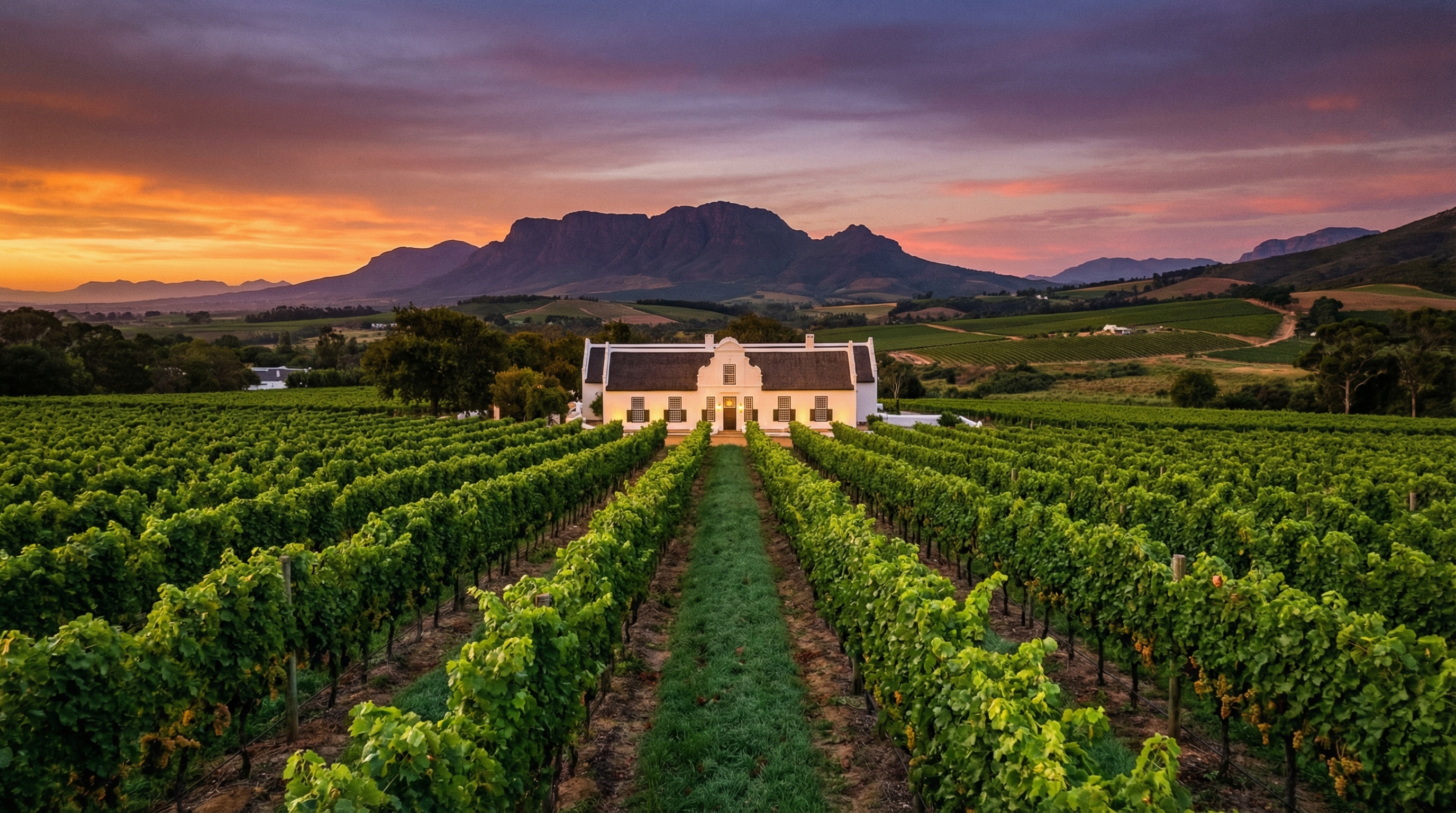
Stellenbosch is the historic heart of South African wine, a university town surrounded by mountains and some of the country's oldest and most prestigious estates. Established in 1679, it is the second-oldest European settlement in South Africa and has been the center of wine culture ever since.
The region is exceptionally diverse, with soils ranging from weathered granite on the mountain slopes to deep alluvial deposits on the valley floor. This diversity produces a wide range of styles:
- Helderberg — The southeastern corner, cooled by False Bay breezes, producing some of the Cape's most refined Cabernet Sauvignon and Bordeaux blends.
- Simonsberg — The northern slopes, warmer and more sheltered, producing richer, more powerful reds.
- Bottelary Hills — Famous for old-vine Chenin Blanc and increasingly for Cabernet Franc.
- Banghoek — A high-altitude valley producing concentrated, mineral-driven wines.
Leading Stellenbosch producers include Kanonkop (the benchmark for Pinotage), Rustenberg, Thelema, Tokara, De Toren, and Waterford.
Swartland
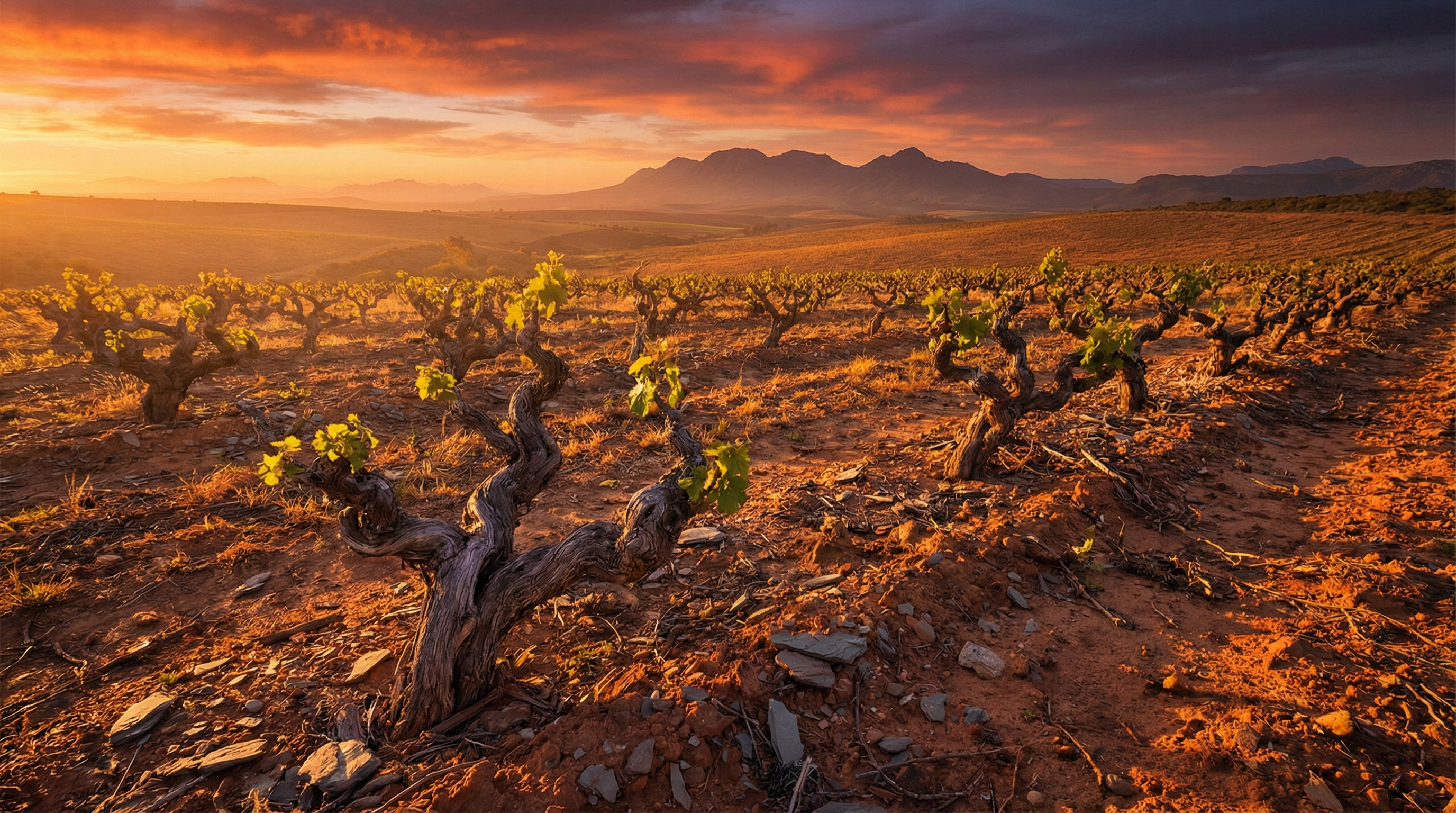
If Stellenbosch represents South African wine's establishment, Swartland is its revolution. This vast, rugged region northwest of Cape Town was historically wheat-farming country, with viticulture considered an afterthought. The old bush vines of Chenin Blanc, Cinsault, and Grenache that had been planted decades earlier were largely ignored, their grapes sold to cooperatives for bulk wine or distillation.
That changed dramatically in the mid-2000s, when a group of young winemakers — the self-styled "Swartland Revolution" — recognized that these old, unirrigated, dry-farmed bush vines, some over 50 years old, were producing grapes of exceptional concentration and character. Eben Sadie, Andrea and Chris Mullineux, David Sadie, Adi Badenhorst, and others began making wines that combined raw power with surprising elegance and complexity.
The Swartland style tends toward savory, textured, garrigue-inflected wines — Mediterranean in spirit but distinctly South African in execution. The best Swartland Chenin Blancs, in particular, are among the most exciting white wines being made anywhere in the world.
- Eben Sadie (Sadie Family Wines) — The godfather of the Swartland Revolution. His Columella (red blend) and Palladius (white blend) are South Africa's most critically acclaimed wines. His Ouwingerdreeks ("Old Vine Series") single-vineyard wines are masterpieces of site-specific expression.
- Mullineux & Leeu Family Wines — Andrea and Chris Mullineux produce wines of extraordinary precision and purity. Their Schist and Iron Syrahs are among the finest expressions of the grape outside the northern Rhône.
- A.A. Badenhorst Family Wines — Adi Badenhorst makes joyful, generous wines from old Swartland bush vines. His Secateurs range is one of South Africa's greatest values.
“The old vines of the Swartland are South Africa's greatest vinous treasure. They survived because nobody thought they were worth pulling out. Now we realize they are priceless.”
— Andrea Mullineux
Franschhoek
The "French Corner" was established by Huguenot refugees fleeing religious persecution in France in the late seventeenth century. It remains one of South Africa's most beautiful wine regions, a narrow valley surrounded by towering mountains, lined with Cape Dutch homesteads and some of the country's finest restaurants.
Franschhoek has traditionally been known for Semillon (South Africa's oldest planted variety) and Méthode Cap Classique sparkling wine. Notable producers include Boekenhoutskloof (whose Syrah is iconic), Chamonix, and La Motte.
Constantia
South Africa's oldest wine region, nestled on the southern slopes of Table Mountain within the Cape Town city limits. Constantia's cool, maritime-influenced climate produces exceptional Sauvignon Blanc and the historic sweet wine, Vin de Constance, from Klein Constantia — a recreation of the legendary eighteenth-century dessert wine.
Elgin and Walker Bay (Hemel-en-Aarde)
These cool-climate regions south and southeast of Cape Town are proving ideal for Pinot Noir, Chardonnay, and Syrah. The Hemel-en-Aarde Valley, in particular, has established itself as South Africa's premier Pinot Noir address. Hamilton Russell Vineyards, Bouchard Finlayson, and Creation Wines lead the way.
The Grape Varieties
Chenin Blanc: South Africa's White Wine Soul
Chenin Blanc, locally known as "Steen," is South Africa's most planted grape variety and its most exciting white wine story. South Africa has more Chenin Blanc planted than any country on earth — roughly 17,000 hectares, compared to around 10,000 in the Loire Valley (France), Chenin's homeland.
For decades, most South African Chenin was destined for bulk wine and brandy production. The transformation began when producers recognized that old, unirrigated bush vines — particularly in the Swartland, Stellenbosch's Bottelary Hills, and Paarl — were capable of producing profoundly complex, terroir-expressive wines rivaling the finest Vouvray or Savennières.
The Old Vine Project (OVP), launched in 2016, is a crucial initiative dedicated to identifying, certifying, and protecting South Africa's heritage vineyards. Wines from certified old vines (35 years or older) carry the OVP seal, signaling to consumers that they are drinking something special.
Pinotage: The Controversial Local Hero
Pinotage is South Africa's signature red grape — a cross between Pinot Noir and Cinsault (then called Hermitage in South Africa), created by Professor Abraham Izak Perold at Stellenbosch University in 1925. It is found virtually nowhere else in the world.
Pinotage divides opinion sharply. Poorly made versions can exhibit rubbery, acetone-like aromas that have given the variety a bad reputation. But in the hands of skilled producers — Kanonkop, Beyerskloof, Simonsig, and Rijks — Pinotage produces deeply colored, richly fruity wines with unique smoky, dark chocolate, and mulberry character. The best examples age impressively.
Syrah/Shiraz
South African Syrah is rapidly establishing itself as world-class. The cooler sites of Swartland, Stellenbosch, and Hemel-en-Aarde produce wines closer in style to northern Rhône Syrah — peppery, floral, and elegant — rather than the rich, opulent style of Australian Shiraz. Boekenhoutskloof, Sadie, Mullineux, and Porseleinberg are leading producers.
Cabernet Sauvignon and Bordeaux Blends
Stellenbosch remains the heartland for these varieties, producing structured, elegant wines that show remarkable affinity with the Cape's granite and shale soils. The Stellenbosch Cabernet Collective is working to establish the region's international reputation for Cabernet. Top producers include Kanonkop, Rustenberg, Meerlust, Warwick, and De Toren.
South African Wine: Key Producers at a Glance
| Producer | Region | Signature Wines | Style |
|---|---|---|---|
| Sadie Family Wines | Swartland | Columella, Palladius, Ouwingerdreeks | Complex, terroir-driven, old vine |
| Mullineux | Swartland | Schist Syrah, Iron Syrah, Old Vines White | Precise, mineral, elegant |
| Kanonkop | Stellenbosch | Paul Sauer, Black Label Pinotage | Classic, structured, age-worthy |
| Hamilton Russell | Hemel-en-Aarde | Pinot Noir, Chardonnay | Burgundian elegance, cool-climate |
| Alheit Vineyards | Various | Cartology, Magnetic North | Radical terroir whites from old vines |
| Boekenhoutskloof | Franschhoek/Swartland | Syrah, Porseleinberg, Chocolate Block | Powerful, characterful |
| David & Nadia | Swartland | Chenin Blanc, Pinotage, Grenache | Restrained, pure, mineral |
| Klein Constantia | Constantia | Vin de Constance, Sauvignon Blanc | Historic, elegant, cool-climate |
| Crystallum | Hemel-en-Aarde | Peter Max Pinot Noir, Clay Shales Chardonnay | Delicate, Burgundian |
| Restless River | Hemel-en-Aarde | Cabernet Sauvignon, Chardonnay | Understated, intellectual, terroir-focused |
Social Transformation and Equity
Any honest discussion of South African wine must address the industry's painful history of racial inequality. Under apartheid, Black and Coloured workers were systematically excluded from ownership and management. The notorious "dop system" — paying farm laborers partially in wine — perpetuated alcoholism and poverty for generations.
Post-apartheid transformation has been painfully slow. Black ownership of vineyards and wineries remains disproportionately low. But meaningful progress is being made:
- Thokozani — A worker-empowerment initiative at Diemersfontein that gives workers equity in the business.
- Solms-Delta — A pioneer in land reform, sharing ownership and profits with workers and their communities.
- Tesselaarsdal Wines — Berene Sauls, one of South Africa's few Black female winemakers, produces acclaimed Pinot Noir from Hemel-en-Aarde.
- The Pinotage Youth Development Academy — Training young people from disadvantaged backgrounds for careers in the wine industry.
The WOSA (Wines of South Africa) organization is working to promote both the quality of South African wine and the social transformation of the industry. Sustainable certification through the Integrity & Sustainability (IPW) seal is now standard, covering environmental and social practices.
The Cape Winemakers Guild
The Cape Winemakers Guild (CWG), established in 1982, is an invitation-only association of South Africa's most talented winemakers. Membership is by peer nomination and rigorous blind tasting of the nominee's wines over several years. The annual CWG Auction, held each October, is South Africa's most prestigious wine event, offering small-batch, auction-exclusive wines that represent the pinnacle of Cape winemaking.
CWG membership reads like a directory of South African wine excellence: Andrea Mullineux, Eben Sadie, Chris Alheit, Peter-Allan Finlayson (Crystallum), Samantha O'Keefe (Lismore), and many more. The auction wines often represent the most experimental, site-specific, and ambitious wines these producers make.
South African Wine and Food
South African cuisine — the "Rainbow Cuisine" that blends Dutch, Malay, Indian, indigenous African, and French Huguenot influences — is one of the most diverse and delicious in the world. The wines match this diversity beautifully:
- Braai (South African barbecue) with Stellenbosch Cabernet or Pinotage
- Bobotie (Cape Malay curried mince) with off-dry Chenin Blanc
- Biltong (dried cured meat) with Swartland Syrah
- Snoek (smoked fish) with Constantia Sauvignon Blanc
- Malva pudding with Klein Constantia Vin de Constance
“Our wines, like our country, are a blend of cultures, traditions, and terroirs. That complexity is our greatest strength.”
— Andrea Mullineux
Looking Ahead
South African wine faces significant challenges: climate change is intensifying drought conditions in an already water-stressed region, electricity supply remains unreliable, and social transformation requires sustained commitment. But the quality trajectory is unmistakable and accelerating.
The old narrative — cheap, cheerful wine from a troubled country — is dead. South Africa is producing world-class Syrah, Chenin Blanc, Cabernet Sauvignon, Pinot Noir, and Bordeaux blends that compete at the highest levels. Its old vines are a priceless national asset. Its young winemakers are bold, talented, and globally connected. And its wines offer, in many cases, the best value in the fine wine world.
For the adventurous wine lover willing to look beyond the established European and New World paradigms, South Africa is one of the most rewarding discoveries waiting to be made.


