350 Years of Winemaking at the Cape
South Africa's wine story stretches back to February 2, 1659, when Jan van Riebeeck — the first governor of the Dutch Cape Colony — wrote in his diary: "Today, praise be to God, wine was pressed for the first time from Cape grapes." Over three and a half centuries later, South Africa has emerged as one of the world's most dynamic and diverse wine-producing nations, with a new generation of winemakers creating wines of global stature.
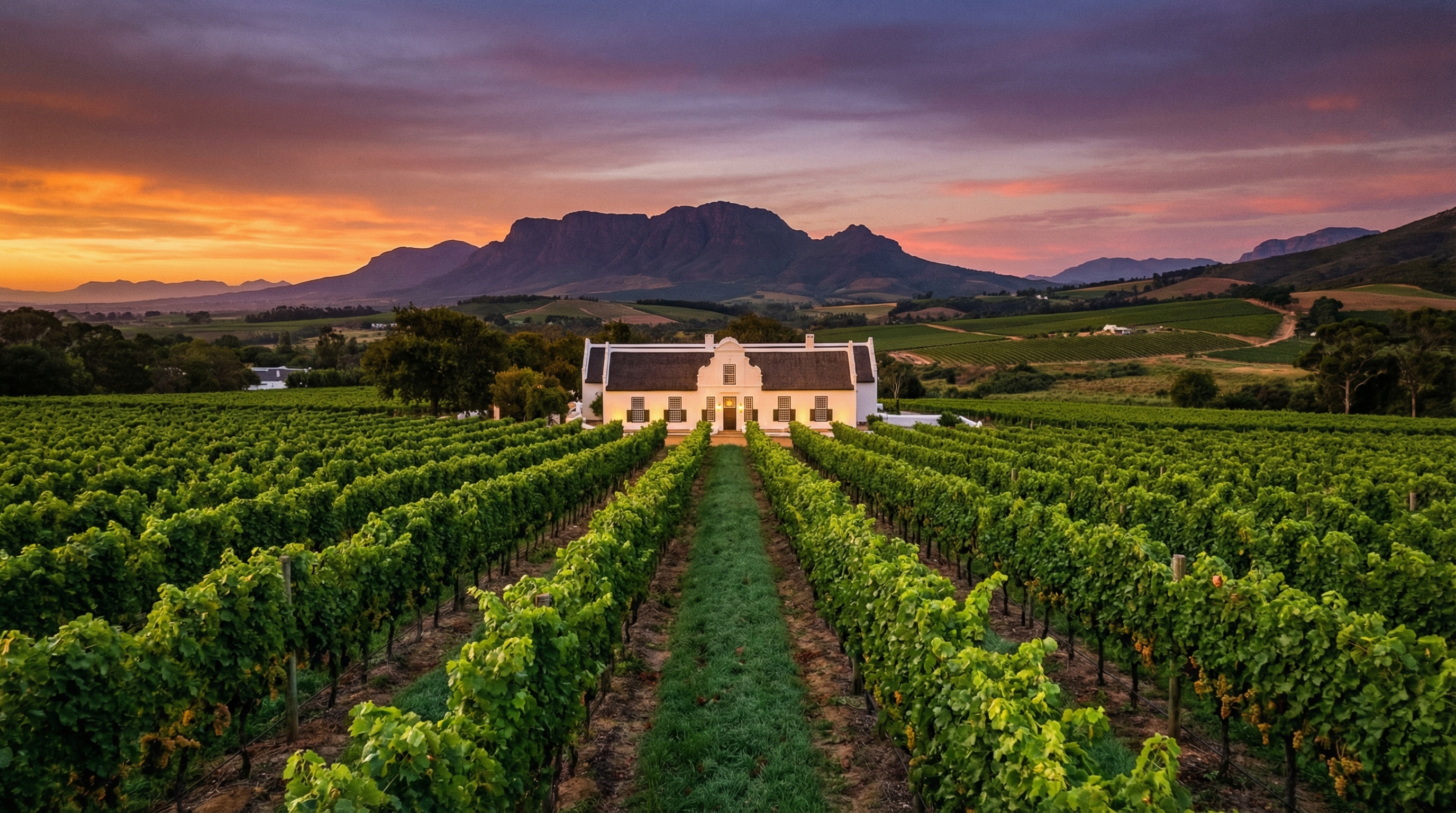
The Cape winelands occupy a spectacular landscape where mountains meet the sea, where the cold Benguela Current from Antarctica moderates the warmth of the African sun, and where some of the world's oldest geological formations provide an extraordinary diversity of soils. It is a winemaker's paradise — and an increasingly popular tourist destination.
The Key Regions
Stellenbosch The historic heart of South African wine, established in 1679 and home to the country's leading wine university. Stellenbosch's diverse terroirs — from warm valley floors to cool mountain slopes — produce outstanding Cabernet Sauvignon, Bordeaux blends, and increasingly impressive Syrah and Chenin Blanc.
Flagship producers:
- Kanonkop — The Paul Sauer (a Bordeaux blend) is South Africa's most iconic red wine. Their Pinotage is also a benchmark for the variety.
- Meerlust — The Rubicon (Cabernet-Merlot-Cabernet Franc blend) is one of the Cape's most historic wines, first produced in 1980.
- Thelema Mountain Vineyards — Gyles Webb produces excellent Cabernet and Chardonnay from mountain vineyards
- Rustenberg — One of South Africa's oldest farms (1682), producing outstanding Peter Barlow Cabernet and John X Merriman blend
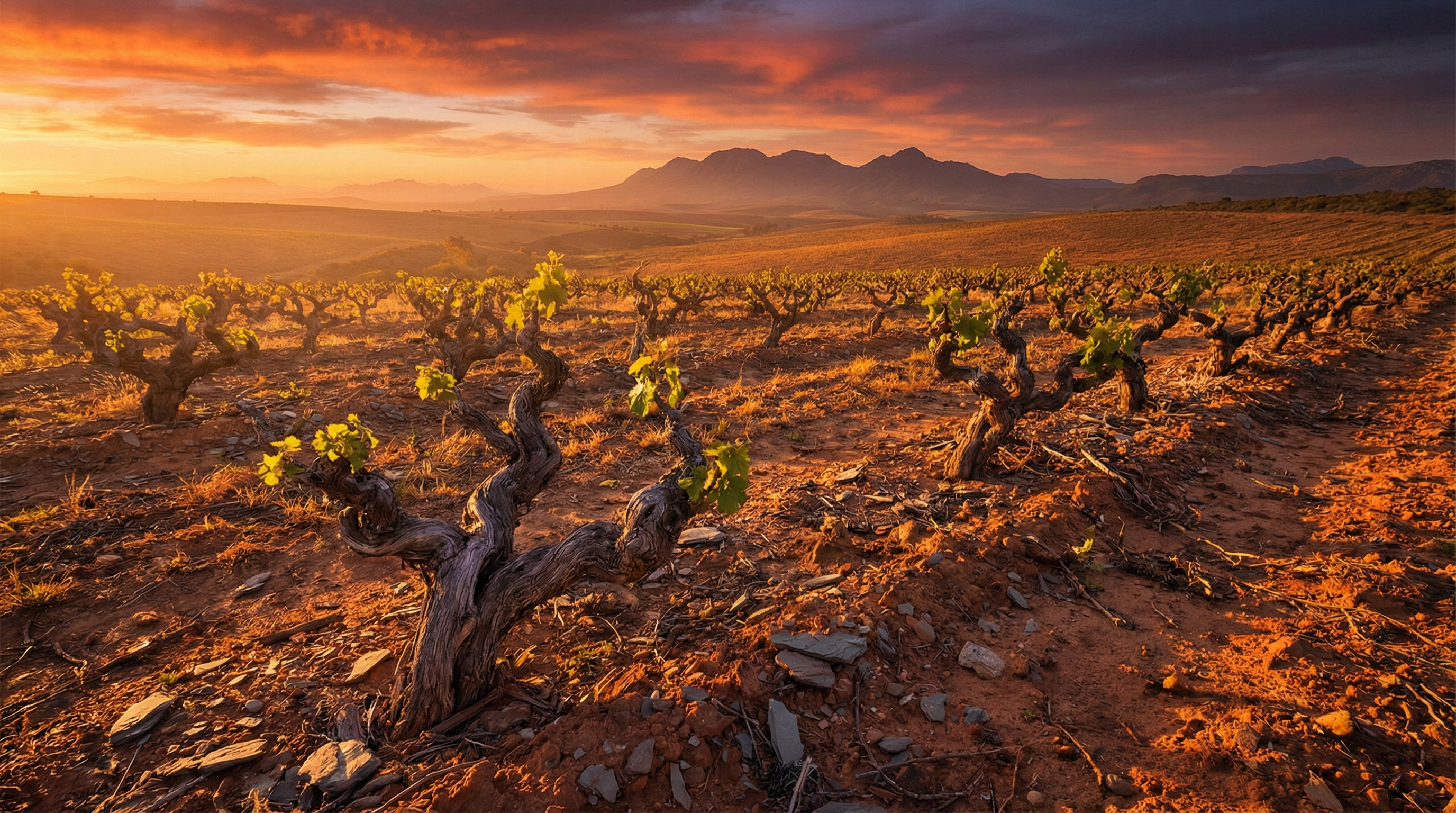
Swartland The epicenter of South Africa's wine revolution. Until the early 2000s, Swartland was considered too hot and arid for quality wine. Then a group of young, visionary winemakers — who called themselves the Swartland Revolution — proved everyone wrong. Old-vine bushvine Chenin Blanc, Grenache, Syrah, and Mourvèdre from dry-farmed, unirrigated vineyards produce wines of extraordinary character.
Flagship producers:
- Mullineux Family Wines — Chris and Andrea Mullineux produce what many consider South Africa's greatest wines. Their Old Vine White (Chenin Blanc), Schist Syrah, and Granite Syrah are world-class. Named Winery of the Year by Tim Atkin MW multiple times.
- Sadie Family Wines — Eben Sadie's Columella (a Syrah-Mourvèdre blend) and Palladius (a white blend led by Chenin Blanc) are among Africa's most celebrated wines. His Ouwingerdreeks single-vineyard series is a masterclass in terroir.
- AA Badenhorst — Adi Badenhorst's wild, characterful wines from old Swartland vineyards. The Family Red Blend and White Blend are superb.
- David & Nadia — Young producers making wines of purity and precision from old Swartland vines
Hemel-en-Aarde Valley A cool, maritime valley near the coastal town of Hermanus — approximately 120 km southeast of Cape Town. The name means "Heaven and Earth" in Afrikaans, and the wines live up to it. Cool ocean breezes and clay-rich soils produce South Africa's finest Pinot Noir and Chardonnay, rivaling the best of Burgundy in elegance and complexity.
Flagship producers:
- Hamilton Russell Vineyards — The pioneer of cool-climate winemaking in South Africa. Their Pinot Noir and Chardonnay have been benchmarks since the 1970s.
- Bouchard Finlayson — Founded by Hamilton Russell's former winemaker, Peter Finlayson. Galpin Peak Pinot Noir is outstanding.
- Creation Wines — Innovative, terroir-driven wines with an exceptional restaurant and tasting experience.
- Ataraxia — Kevin Grant produces some of the Hemel-en-Aarde's most refined Chardonnay and Pinot Noir
Constantia Cape Town's oldest wine region (planted in 1685) and home to one of wine history's great legends: Vin de Constance, a sweet Muscat wine from Klein Constantia that was prized by Napoleon (who ordered it regularly during his exile on St. Helena), Frederick the Great, and Jane Austen (who mentioned it in Sense and Sensibility). Today, Constantia produces elegant Sauvignon Blanc and the revived Vin de Constance alongside modern wines.
Franschhoek The "French Corner" — settled by Huguenot refugees in the 1680s — is perhaps South Africa's most picturesque wine valley and its culinary capital. The concentration of world-class restaurants (La Colombe, La Petite Colombe, Le Quartier Français) rivals any wine region globally.
Elgin A high-altitude, apple-growing region that has become a source of exceptional cool-climate Chardonnay, Sauvignon Blanc, and Pinot Noir. Paul Cluver and Richard Kershaw MW are leading the charge.
Signature Grapes
Chenin Blanc — South Africa's most planted grape, locally called Steen. The country has more old-vine Chenin Blanc (50+ years) than anywhere else on earth, including the Loire Valley. Styles range from fresh and crisp to richly textured and oak-aged. The best rival top Vouvray and Savennières.
Pinotage — South Africa's unique crossing of Pinot Noir and Cinsault, created in 1925 by Professor Abraham Perold at Stellenbosch University. Divisive but capable of excellence — at its best, Pinotage produces deeply colored wines with plum, chocolate, smoky, and bramble character. Kanonkop, Beyerskloof, and Rijks are top producers.
Syrah/Shiraz — Increasingly South Africa's most exciting red grape. Swartland and Stellenbosch produce Syrah ranging from peppery, Northern Rhône-like elegance to richer, warmer expressions.
Wine Route Tourism
South Africa's wine routes are among the most visitor-friendly in the world:
- The Stellenbosch Wine Route — One of the world's oldest, with over 150 member wineries
- Franschhoek Wine Tram — A hop-on, hop-off tram and bus system connecting wineries — no driving required
- Hermanus and Hemel-en-Aarde — Combine whale watching (June-November) with wine tasting
- Route 62 — An inland road through Robertson, Worcester, and Montagu with excellent value wines
The Value Proposition
South African wine offers extraordinary value on the global stage. The combination of low production costs, a favorable exchange rate (for international buyers), and high quality means that R200-400 (roughly €10-20) buys wine that competes with €30-50 bottles from established European regions. Even South Africa's most prestigious wines — Sadie Columella, Mullineux Schist, Hamilton Russell Pinot Noir — rarely exceed €40-60, a fraction of what comparable quality costs in Burgundy or the Northern Rhône.
“Dünyanın keşfetmekte olduğu şaraplar.”
— Tim Atkin